Arthur Hayes: If Bitcoin ETFs are too successful, they will destroy Bitcoin
TechFlow Selected TechFlow Selected
Arthur Hayes: If Bitcoin ETFs are too successful, they will destroy Bitcoin
The best time to buy Bitcoin and start your crypto journey was yesterday. The next best time is now.
 Navigating Web3 tides with focused insights
Author: Arthur Hayes
Translation: GaryMa, Wu Shuo Blockchain
Note: This is a translated version of the original article, with some content abridged and summarized during translation.
Every investment theme has an optimal expression (a specific way of being manifested or executed). When we consider the ongoing devaluation of fiat currency, what is the best way to profit from the collapse of the corrupt fiat financial system? What is the optimal expression of this trade?
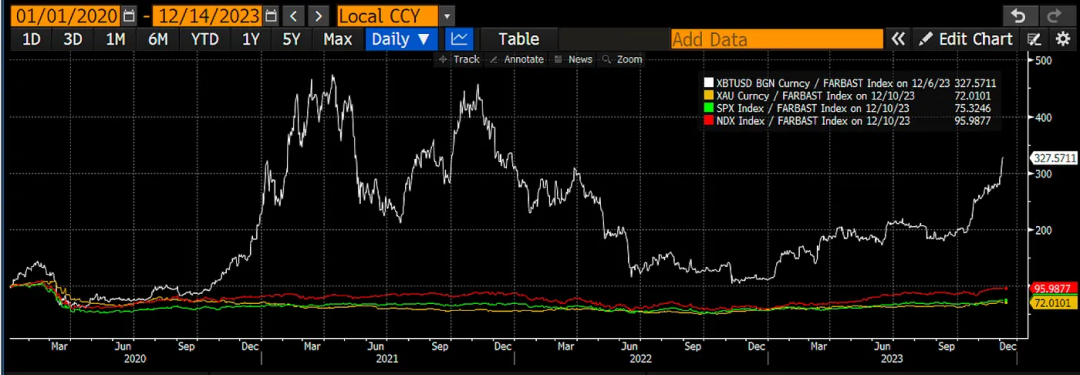
This is one of my favorite charts, clearly showing that Bitcoin—or more broadly, cryptocurrencies—is the optimal expression of the fiat devaluation trade. I've deflated the values of Bitcoin (white), gold (yellow), the S&P 500 index (green), and the Nasdaq 100 index (red) using the Federal Reserve's balance sheet as the benchmark, indexing their performance from January 1, 2020 (starting at 100). Bitcoin rose 228%, far outperforming all other high-risk assets.
If you set the starting point for these assets at 2010—the year Bitcoin began trading on exchanges—the results become even more favorable for Bitcoin.
At a fundamental level, why is this so? Cryptocurrencies represent a movement to separate money and finance from the state. Using computers, the internet, and most importantly cryptographic proof, we the people have created the strongest form of money ever—Bitcoin; we have built an entirely new decentralized financial system (DeFi) supported by public blockchain networks like Ethereum. This new crypto-based financial system relies on mathematics and grassroots support from disillusioned individuals, not on state-backed violence and its banking apparatus. Capital, as transformed energy, is seeking a safe haven away from devaluation—it is seeping into the crypto space. But compared to the total value of all fiat financial assets, the market cap of crypto remains negligible. That’s why even a small fraction of capital fleeing the collapse of the fiat financial system can generate such massive returns in such a short time.
Not all cryptocurrencies, tokens, and investment themes within the crypto space are equal. At year-end, I want to discuss some of the crypto traps being peddled by well-meaning enthusiasts and fools alike. As always, my goal is to offer a different perspective to make you, the reader, think. By answering these questions, you may be able to make more informed investment decisions.
Fed Pivot
2-Year U.S. Treasury Yield
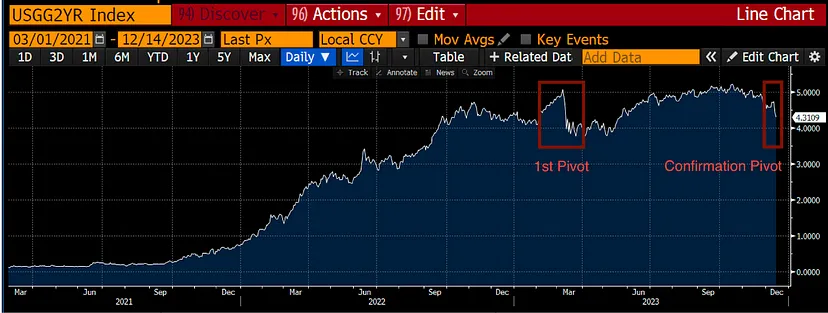
The first and largest pivot in Q1 2023 was the Federal Reserve and Treasury Department teaming up through the Bank Term Funding Program (BTFP) to swiftly implement a bailout plan worth approximately $4 trillion for the U.S. banking system and Treasury markets. Powell’s recent comments merely confirm looser U.S. monetary policy.
What changed in two weeks? ... Politics.
What is the worst thing for a politician? Not getting re-elected.
For a U.S. Democratic Party member, what’s second worst? Trump’s re-election, along with a wave of Republican congressmen and senators.
Using these two guiding principles, the political motivations behind the Fed’s actions from 2021 to today become very clear.
As post-pandemic inflation raged, Biden sat Powell down and instructed him to control inflation. As you can see from the chart above, by March 2023, the 2-year U.S. Treasury yield had surged from nearly 0% to 5%. This was driven by the fastest rate-hiking campaign by the Fed since Paul Volcker’s tenure in the 1980s.
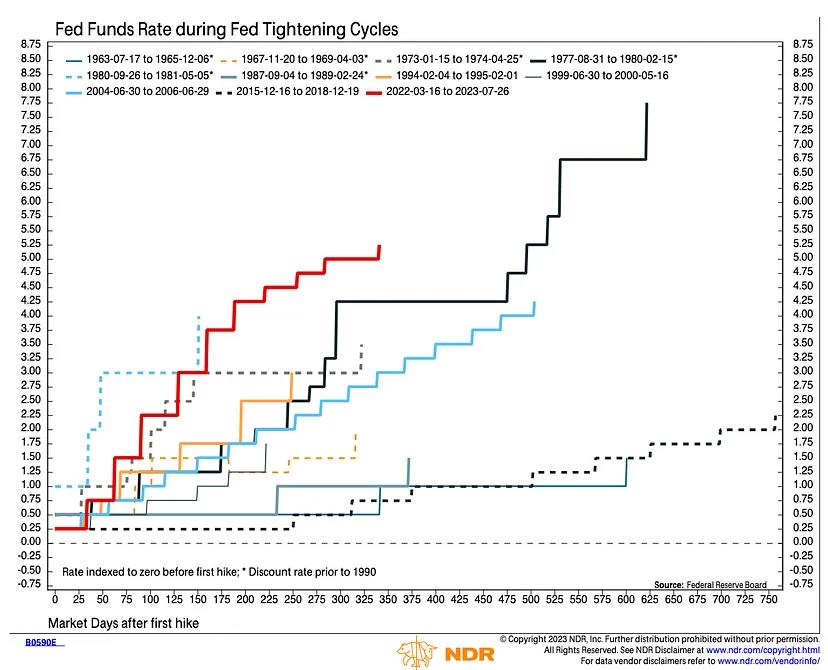
Massive money printing to placate the masses led to the highest inflation in over 40 years. A few months of Fed tightening were insufficient to kill this monster before the crucial November 2022 U.S. midterm elections. Subsequently, the Biden administration decided to draw down the U.S. Strategic Petroleum Reserve, flooding the oil market to lower gasoline prices on election day. This was a very “strategic” use of a scarce resource… to keep party members in office—and it worked.
Regardless of which clown runs America, the reasons for imperial decline were set in stone decades ago by past policies. In 2023, the Biden administration, working with Yellen, pushed hard to increase fiscal spending and shift borrowing toward the short end of the U.S. Treasury yield curve. The result: a booming U.S. economy, with real GDP growth reaching 5.2% in Q3 2023 and an estimated 2.6% in Q4—very impressive numbers for the world’s largest economy. Yet even this cannot quell voter dissatisfaction with Biden and his happy band of Democratic bureaucrats. Due to Biden’s poor performance, the most feared man in America, former President Trump, would defeat Biden if an election were held today.
Trump must be stopped, and Biden knows how to get it done.
To further stimulate the economy and please all financial asset holders—even if it risks more inflation later—Powell had to cooperate by loosening financial conditions. The hope is that the aforementioned inflation will arrive only after the November 2024 election. That’s why Powell has been vague about maintaining this "tight" financial stance at the Fed. It doesn’t matter. According to widely accepted economic theories like the Taylor Rule, flexible average inflation targeting, and core CPI exceeding the Fed’s 2% target, current financial conditions aren’t tight enough. As the Wall Street Journal pointed out, less than two weeks ago, Powell had a completely different view on the possibility of rate cuts.
Here’s probably how it went down:
Yellen called Powell into her office and told him how it is. Powell followed orders… signaling the possibility of rate cuts. Now financial assets will rise until the U.S. falls into recession or inflation surges back meaningfully. Given the federal government’s determination to spend as much as possible to sustain GDP growth, I don’t foresee a recession in the 2024 election year. It’s unclear whether food and fuel price inflation will meaningfully resurface before November 2024, triggering protests and instability. But let’s not worry too much about the future. Right now, the Fed, the U.S. Treasury, and the leadership of America are all shouting at you: buy, buy, buy. Don’t do anything stupid; get ready and participate in the optimal expression of this trade—cryptocurrency.
Other major countries or economic blocs, such as Japan and the EU, will go along, allowing the dollar to depreciate against the yen and euro. As the dollar weakens, everyone benefits—except those without enough financial assets to offset inflation’s impact.
Now that you understand the macro case for being bullish on crypto, let me help you avoid some potential value traps.
Permissioned DeFi
This is currently one of the most meaningless crypto themes. Anyone who actually thinks about the meaning of these words should realize that these projects are doomed to fail.
These projects are designed for institutional investors who face various regulations, often prohibiting them from trading on real DeFi platforms. That’s unfortunate because real DeFi free markets have abundant retail activity, which institutions can’t access. Markets filled with retail traders are the best kind—they give “smart” institutional capital the opportunity to profit from “dumb” retail investors, thanks to faster computers and emotionless execution. That’s how traditional financial markets operate, where exchanges create special order types and latency rules that give large high-frequency trading firms significant advantages. Michael Lewis wrote an excellent book on this topic called *Flash Boys*.
The truth is, there won’t be enough retail participation in permissioned DeFi because retail doesn’t need to trade with institutions. It’s the institutions that need access to retail flow. The entire appeal of DeFi to global retail crypto traders lies in its market structure, which differs from traditional financial equities and derivatives markets. Once the hype fades, these permissioned DeFi markets will simply become circles where HFT firms wait on the bid and ask, trying to catch each other crossing the spread. When sufficient directional retail volume fails to materialize to justify capital deployment on these protocols, institutional players will pack up and leave. The result? A ghost town—empty, inactive, and devoid of interest, with neither retail nor institutional participants.
Venture capital firms—essentially well-paid puppets—are jumping onto this bandwagon. They’ll continue burning capital, just as they did from 2014 to 2017 when investing in “blockchain, not Bitcoin.” Most of them missed or abandoned early investments in Uniswap, dYdX, Compound, Aave, and others. Instead of analyzing why they missed these foundational primitives, they’ve chosen to dive into something superficially similar and sounding sexy. As an investor, who wouldn’t want a trading platform that brings institutional investors with their massive capital base together with DeFi—a supposedly revolutionary way of organizing financial markets?
As usual, there will be those quick to act, selling snake oil to desperate VCs eager to invest in crypto but unwilling to engage with the current ecosystem. I bear no ill will toward founders pushing this nonsense; I respect their ability to extract funds from accredited investors whose IQs are questionable. But for you, dear reader, don’t become exit liquidity for these garbage projects when they launch governance tokens. You can use the project if you wish, but apply critical thinking and avoid becoming a victim of what will inevitably become a recurring cash grab disguised as governance token distribution.
RWA
RWA (Real World Assets) is an evolution of the security token theme from the last bull cycle. In short, RWA projects aim to place assets like real estate, tradable debt securities, and stocks into special purpose vehicles (SPVs), then fractionalize ownership via tokenization, making them accessible to ordinary people who otherwise couldn’t afford to buy an entire house or enter certain asset markets.
I firmly believe that any cryptocurrency token dependent on national law will not succeed at scale. Decentralized public blockchains are expensive precisely because they don’t require the existence of a state. Why pay a premium for decentralization when centralized alternatives already exist, are cheap, and highly liquid? The most direct example is fractionalized real estate.
The current problem is that due to asset inflation—directly caused and intended by central bank policy—many millennials and Zoomers can’t afford to buy homes. Owning a portion of a house and entering the real estate market would be a noble goal, but several issues remain.
First, young people trying to leave home or start families don’t want a fraction of a house located in cyberspace. They want a real building with four walls and a roof that they can actually live in. Buying a token representing the financial performance of an unoccupied property does nothing to solve this problem.
Second, every real estate asset is unique. This lack of standardization suppresses the development of truly liquid markets. For instance, once you buy a token representing 1/10 of a house, how do you find someone willing to buy it at a fair price when you want to sell? The buyer needs to understand the location, local real estate regulations, taxes, and ultimately must genuinely want that specific property. This will never approach the liquidity of owning a fraction of standardized stocks or bonds. Like such investments, entry is easy—but exit is hard… if you can exit at all.
Finally, and most importantly, you can already gain fractional ownership of real estate by purchasing large, liquid Real Estate Investment Trusts (REITs). Such securities are offered across traditional financial stock markets worldwide. They’re managed by large, reputable firms with experience longer than most target market participants have been alive. I see no reason why you’d need to perform all these blockchain tricks and issue tokens.
Feel free to buy these low-liquidity RWA tokens if you choose. But worse yet is investing in the governance tokens of the RWA issuance platforms themselves.
Debt Ownership Tokens
Another popular form of RWA involves creating tokens that represent income-generating debt ownership. The most popular projects offer their token holders yields from U.S. Treasury bills (T-bills). The idea is that Tether is great because it allows people without access to affordable U.S. dollar banking channels to send USD-pegged tokens 24/7 over public blockchains like Ethereum and Tron. But Tether doesn’t pay yield; Tether holders don’t capture the full yield from the dollar investments held in T-bills within its reserves. So what if there were a USD-pegged stablecoin that also paid this T-bill yield?
This is a great development, and I fully support increased competition that passes more of these stablecoins’ net interest margins (NIM) to holders. Holding and using these tokens isn’t bad in itself, but investing in the project’s governance token is foolish—because it’s merely a bet on the path of U.S. interest rates.
If U.S. rates stay meaningfully above zero, the project should be profitable and pass profits to governance token holders. If U.S. rates fall back close to zero, the project will lose money—having to pay developers, legal, and compliance costs without sufficient interest income to share. So as an investor, why would you pay a multiple of the project’s NIM to hold its governance token?
Instead, short a liquid exchange-traded fund (ETF) that holds T-bills. You can express the same rate bet—profiting when rates rise—without paying a premium to a group of crypto insiders. If you want real leverage, apply high leverage directly.
In short, leave the “real” world governed by national laws to traditional financial intermediaries. They can deliver a more consistent and cheaper investment product for the same theme. True DeFi projects should rely solely on well-written code, not on laws that must be interpreted and enforced by error-prone humans.
Bitcoin ETF
Fundamentally, if ETFs managed by traditional financial institutions become too successful, they could completely destroy Bitcoin.
Every other monetary asset used in human civilization exists due to natural laws. Gold is gold not because we say so, but because of atomic arrangements. The interactions between these atoms are governed by universal laws. Fiat money is nonsense printed on paper, yet still a physical object. Paper remains paper regardless of whether you believe it has monetary value. If you dig a hole, bury gold and a pile of paper, and return 100 years later, both will still exist. Bitcoin is entirely different.
Bitcoin is the first monetary asset in human history that only exists through continuous maintenance. After the Bitcoin block subsidy reaches zero around 2140, miners will earn rewards solely from transaction fees. This means miners only receive Bitcoin income while the network is actively used. Essentially, Bitcoin has value only if it flows. But if no two entities ever transact Bitcoin again, miners won’t earn enough to pay for the energy needed to secure the network. They will shut down their machines. Without miners, the network dies, and Bitcoin disappears.
BlackRock, the world’s largest traditional financial asset manager, is playing the asset accumulation game. They absorb assets, store them in metaphorical vaults, issue tradable securities, and charge management fees for their “hard work.” They don’t use the assets they hold on behalf of clients—and this poses a problem for Bitcoin, if we take an extreme view of a possible future.
Imagine a future where the largest Western and Chinese asset managers own all Bitcoin. This happens organically because people confuse financial assets with stores of value. Due to confusion and laziness, people buy Bitcoin ETF derivatives instead of buying and HODLing Bitcoin in self-custodied wallets. Now, only a few companies hold all Bitcoin, with no actual use for the Bitcoin blockchain. These tokens never move again. The end result? Miners shut down their machines, unable to afford the energy required to run them. Goodbye, Bitcoin!
When considering survival amid ongoing fiat currency devaluation, you must pick a side. Either you’re trading financial assets to earn more fiat, or you’re trying to preserve value in terms of energy while using a financial system beyond state control. In the former case, trade ETFs freely—that’s what they’re for. In the latter, you must buy Bitcoin and withdraw it from centralized exchanges into your own self-custodied wallet.
U.S. Election Year
Since the idea of the “nation-state” infected our collective consciousness hundreds of years ago, 2024 will see the most national elections ever. Any politician seeking re-election must deliver benefits to the people. To wealthy asset holders: provide loose financial conditions by encouraging central banks to print money. To the poor: give subsidies to cover rising food and energy costs—direct consequences of policies favoring asset-rich elites. To the middle class: give them “democracy,” tell them to pay taxes, bend over, and happily vote. With this in mind, it makes no sense for any re-election-seeking politician to stop the fiat devaluation party. Voters benefiting from inflation and monetary handouts will outnumber those suffering. Thus, every “democratic” nation globally will ramp up money printing in 2024.
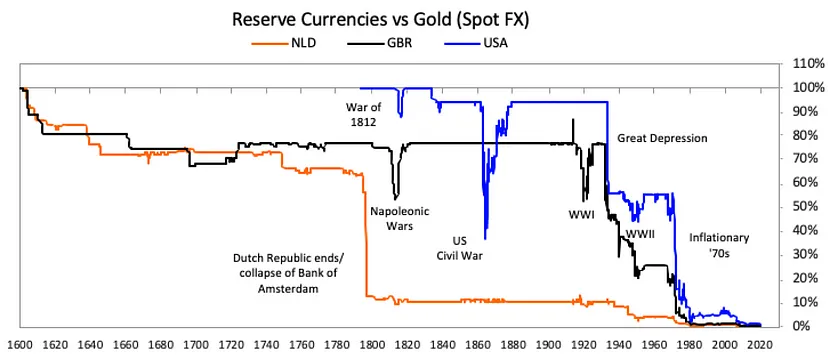
If you think today’s moment in history is special, look at the chart above showing the gold value of various global reserve fiat currencies over time. Fiat currencies always trend toward zero. No political system can resist the temptation to print.
The best time to buy Bitcoin and begin your crypto journey was yesterday. The second-best time is now.
Join TechFlow official community to stay tuned
Telegram:https://t.me/TechFlowDaily
X (Twitter):https://x.com/TechFlowPost
X (Twitter) EN:https://x.com/BlockFlow_News
 Arthur Hayes