









24 meetings, 6 major amendments: BlackRock and peers racing toward Bitcoin ETF
TechFlow Selected TechFlow Selected
24 meetings, 6 major amendments: BlackRock and peers racing toward Bitcoin ETF
To improve the approval chances, BlackRock is accelerating revisions to its application, making six key updates, including agreeing to a cash redemption mechanism in an effort to alleviate the SEC's concerns over market risk and potential price manipulation.
 Navigating Web3 tides with focused insights
By: Weilin
Numerous applicants have been vying for years with the U.S. Securities and Exchange Commission (SEC) over spot Bitcoin ETF applications, yet the SEC has never approved one. This time, the SEC's deadline to respond to multiple applicants falls between January 5 and January 10, 2024—within the next 20 days.
To date, 13 issuers have submitted spot Bitcoin ETF applications to the SEC, including Grayscale, BlackRock, Fidelity, VanEck, ARK, 21Shares, and Bitwise.
A spot Bitcoin ETF is a fund product designed to track the price movements of Bitcoin and allow investors to trade it through traditional securities markets.
Analysts point out that once approved, a spot Bitcoin ETF would allow investors to gain exposure to cryptocurrencies by purchasing shares, without needing digital wallets or exchange accounts, attracting a large number of traditional investors, and will be "a significant positive catalyst for the cryptocurrency market."
To increase the chances of approval, BlackRock is actively revising its application documents and has recently made six key amendments in response to SEC and Nasdaq requirements, including agreeing to a cash redemption model, aiming to alleviate SEC concerns regarding market risks and price manipulation.
Another positive signal comes from the SEC’s own shifting stance.
In an interview with CNBC on December 14, SEC Chair Gary Gensler stated that the commission would "reassess" its position and adopt "a more cautious and favorable approach toward Bitcoin ETFs."
BlackRock Agrees to 'Cash Redemption'
To date, the SEC has held approximately 24 meetings with applicants for spot Bitcoin ETFs. The final decision deadline for approval or rejection is January 5–10 next year. Wall Street analysts predict that, in the interest of market fairness, the SEC may approve multiple ETFs simultaneously.
On December 19 local time, the SEC, Nasdaq, and BlackRock met again to discuss amendments to the Bitcoin ETF application under Nasdaq Rule 5711(d). This marks the second meeting among the three parties within a month.
Rule 5711(d) contains strict regulatory provisions targeting commodity-based trust shares listed and traded on Nasdaq. It covers both initial and ongoing listing requirements, including supervision and compliance measures, aimed at safeguarding market integrity and preventing fraudulent activities in crypto trading.
The day before, on December 18, BlackRock resubmitted its application for the spot Bitcoin ETF product "iShares Bitcoin Trust," incorporating six significant revisions to meet broader regulatory demands from the SEC.
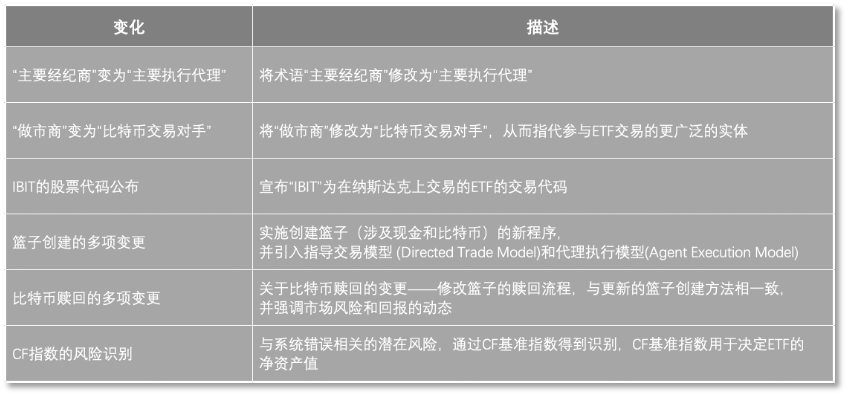 BlackRock makes six modifications to iShares Bitcoin Trust
Among the changes, Coinbase’s role shifted from "prime broker" to "primary execution agent." As the primary execution agent, Coinbase will now handle buy and sell orders on behalf of the ETF, rather than providing prime brokerage services as previously defined. Much of the language in this section remains consistent with the prior filing.
Meanwhile, BlackRock has restructured roles and compliance responsibilities within its ETF product, replacing the term "market maker" with "Bitcoin counterparty," indicating a broader range of entities involved in Bitcoin transactions and a more proactive approach to trade execution.
During a November meeting, BlackRock also agreed to adopt a "joint surveillance agreement" to mitigate market manipulation risks associated with crypto trading—a major concern for the SEC. At that meeting, BlackRock also presented a detailed PowerPoint outlining both "in-kind redemption" and "cash redemption" models.
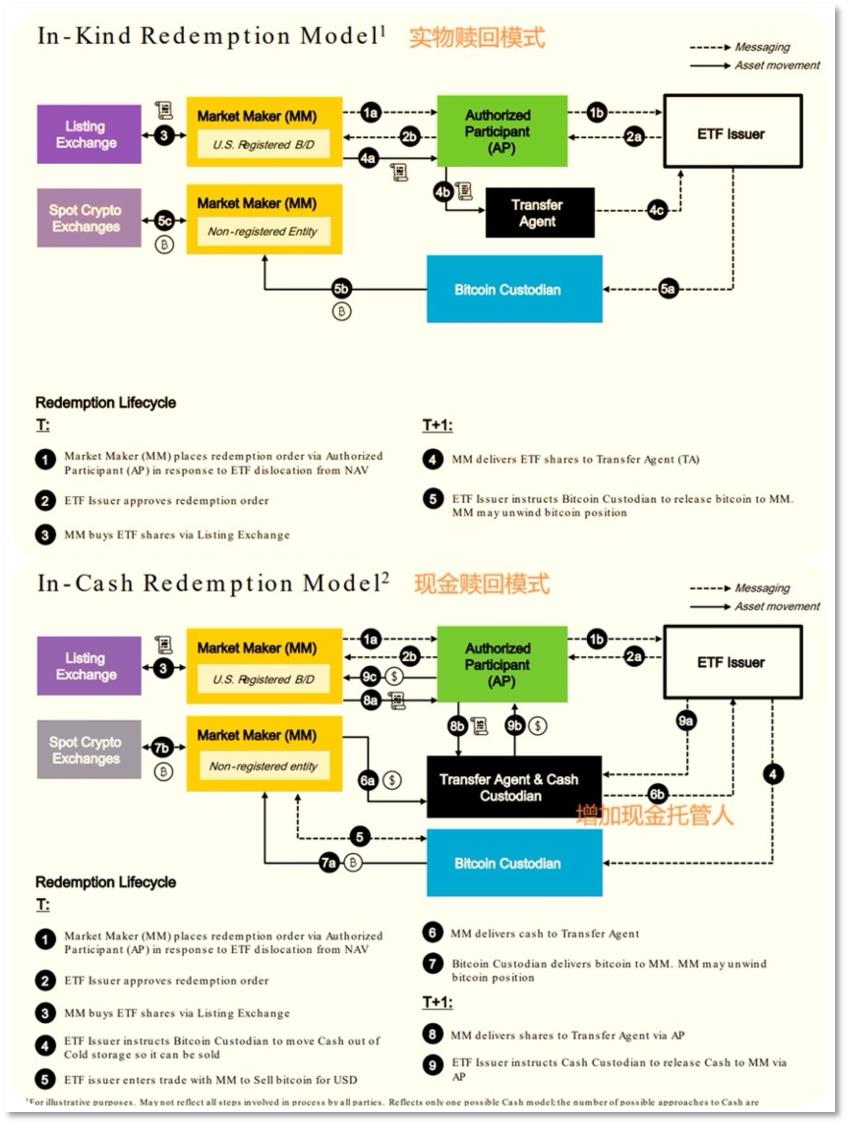 Cash redemption is the model preferred by the SEC
The key difference between these two models lies in whether shares of the ETF are backed by actual Bitcoin or U.S. dollars during creation and redemption processes.
Under the "in-kind" model, ETF shares are directly linked to Bitcoin’s market price, and the issuer does not need to account for price fluctuations during settlement. In contrast, the "cash redemption" model introduces a "cash custodian," effectively creating a separation between U.S. stock markets and Bitcoin markets using fiat currency—an arrangement favored by the SEC.
For the SEC, a cash-based model could make the spot Bitcoin market easier to regulate and facilitate its integration into the traditional financial system. With cash settlements, every transaction by market makers becomes traceable and subject to tax oversight.
According to Fox Business, BlackRock has made SEC approval of its spot Bitcoin ETF a top corporate priority. CEO Larry Fink described Bitcoin as "an international asset" and "a store of value" comparable to gold’s long-term status.
SEC to 'Re-examine' 8–12 Applications
Besides BlackRock, several other spot Bitcoin ETF applicants are intensifying discussions with the SEC for a final push.
Hashdex held another meeting with the SEC this week; WisdomTree has submitted its fourth amended prospectus (S-1 form) for its spot Bitcoin ETF; and ARK 21Shares’ spot Bitcoin ETF (ARKB) has been added to the website of the Depository Trust & Clearing Corporation (DTCC).
In a recent CNBC interview on December 14, SEC Chair Gary Gensler said the commission would reassess its stance on Bitcoin ETFs: "As you may know, we’ve rejected some of these applications in the past, but the D.C. Circuit Court has weighed in, so we’re re-examining the issue in light of those judicial rulings."
Gensler added, "There are about eight to twelve applications," and emphasized, "I’m the chair of the commission—I can’t prejudge any outcome. So this process is ongoing."
The court ruling Gensler referred to stems from the legal battle between the SEC and Grayscale.
In 2021, Grayscale applied to convert its GBTC trust into an ETF, but the SEC rejected it, citing concerns over "market manipulation." Grayscale then filed a lawsuit, arguing that the SEC’s decision violated the U.S. Administrative Procedure Act, especially since the SEC had already approved Bitcoin futures ETFs, which pose no fundamental difference in risk compared to Grayscale’s product.
On August 29 this year, the U.S. Court of Appeals for the District of Columbia ruled in favor of Grayscale, ordering the SEC to reevaluate the application. The SEC chose not to appeal the decision, which many in finance interpret as "increasing the likelihood of ETF approvals."
Since then, the SEC’s opposition to spot Bitcoin ETF applications appears to have softened.
Gensler told CNBC: "This recognition suggests a potential shift in the SEC’s attitude—one that may make it more willing to approve such applications. Acknowledging legal precedent and continuing to review numerous filings indicates the SEC is taking a more cautious yet favorable approach toward Bitcoin ETFs."
The SEC chair’s latest comments immediately energized crypto industry participants, who expressed strong optimism that approval of a spot Bitcoin ETF would have a positive impact across the entire cryptocurrency market.
Michael Saylor, Executive Chairman of MicroStrategy, argued that the significance of upcoming spot Bitcoin ETFs should not be underestimated: "This could be the biggest development on Wall Street in 30 years."
Fundstrat, an investment research firm, predicts that once a spot Bitcoin ETF is approved, Bitcoin’s price could surge more than fivefold from current levels—exceeding $150,000 and potentially reaching $180,000.
The reason institutions are so optimistic is largely because the approval of a spot Bitcoin ETF could bring substantial new capital inflows into the market.
"We expect over $2.4 billion to flow into newly approved U.S. spot Bitcoin ETFs in the first quarter of 2024, supporting higher Bitcoin prices," said Matthew Sigel, VanEck’s Head of Digital Asset Research. "Despite the possibility of significant volatility, Bitcoin is unlikely to fall below $30,000 in Q1 2024."
On December 21, CryptoQuant analysts stated in a report that anticipated demand from multiple U.S. spot ETFs, the upcoming Bitcoin halving, and a broader equity market rally amid expected rate cuts could drive Bitcoin to as high as $160,000, with a bull market likely beginning in 2024.
With persistent efforts from applicants like BlackRock, the prospect of successfully overcoming regulatory hurdles appears increasingly promising.
Join TechFlow official community to stay tuned
Telegram:https://t.me/TechFlowDaily
X (Twitter):https://x.com/TechFlowPost
X (Twitter) EN:https://x.com/BlockFlow_News









