Interpreting Binance Launchpool's New Model: A Transformation of Token Economics
TechFlow Selected TechFlow Selected
Interpreting Binance Launchpool's New Model: A Transformation of Token Economics
We often encounter situations where a project's holder count remains flat for a year, the circulating market cap stays unchanged, yet the token price halves. Under Fair Mode, this might never happen again.
 Navigating Web3 tides with focused insights
Author: Riyue Xiaochu
Editor's note: On December 19, Binance launched the 41st project on its new token launchpool model, Fair Mode. Fair Mode is a new initiative introduced by Binance Launchpool. Under this model, the initial circulating supply of issued tokens will significantly increase, aiming to protect the community and retail investors while maximizing user benefits. Additionally, a portion of allocations will be permanently locked out of circulation to further reduce inflationary pressure. In response, crypto KOL Riyue Xiaochu shared an analysis on X, which BlockBeats has compiled below:
Many may not have noticed that Binance’s new launchpool features a "Fair Mode," whose significance lies not in the specific project but in the transformation of the token economic system.
As the industry leader, Binance is sending an important signal with Fair Mode—using its influence to guide projects toward long-term sustainable development through innovative tokenomics, potentially nurturing great companies and creating hundredfold or even thousandfold opportunities.
I've always believed that beyond blockchain's innovations in decentralization and immutability, token economics represents the second powerful tool. There's a saying: "How you slice the pie determines how big the pie can grow." A good distribution scheme must incentivize all stakeholders, align their interests, and drive the project toward greatness. Tokens hold advantages over traditional equity, which is why previous innovations in token distribution—such as ICOs in 2017, DeFi yield farming in 2020, and inscription minting in 2023—have triggered massive industry shifts and created enormous opportunities.
Currently, the market widely criticizes the institutional model. With large amounts of U.S. institutional capital entering the space, project valuations are driven extremely high before exchange listings, leaving little room for growth in secondary markets. More critically, once project teams receive substantial funding, they often lose motivation to continue building effectively.
Binance’s Fair Mode represents an innovative experiment in new token economics. At first glance, it seems familiar—featuring team, institutional investors, development funds, airdrops, and launchpool allocations.
Indeed, these elements remain, but what sets Fair Mode apart is the token allocation ratio—an aspect that is not just important, but critical. For example, imagine starting a business with two friends. After a year of hard work, performance is strong—but if your stake is only 5%, would you still be motivated to push hard next year? However, if you held 30%, you’d likely be determined to achieve even greater success. As shown, different allocation ratios lead to completely different attitudes.
So, what makes Fair Mode different? Let me break it down.
1. Long-Term Development Fund
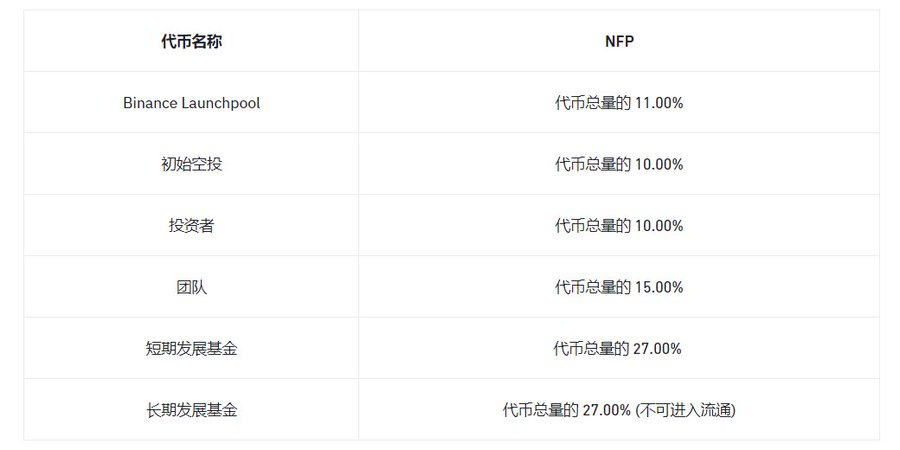
This time, Fair Mode introduces a Long-Term Development Fund accounting for 27%. These tokens allocated to the fund cannot be spent or sold and will never enter circulation. After vesting, they can participate in the ecosystem through staking to share rewards and benefits generated by the project, but they carry no governance rights. The staking rewards earned can support the project’s long-term operations and sustainable growth.
The Long-Term Development Fund is a major innovation never seen before in other projects. Its key features are: 1) these tokens will never circulate, and 2) they can only be used for staking to earn revenue shares, supporting long-term operations. This means: 1) the actual circulating supply is only 73%, and 2) it incentivizes the team to focus on increasing project revenues.
2. High Proportion of Fair Distribution, Increased Community Influence
Of the initial 25% circulating supply, 21% is fairly distributed to retail users—including 11% via Binance Launchpool and 10% through airdrops. By comparison, most projects have around 15% initial circulation, with fair distribution limited to under 5%; the rest of the circulating supply typically consists of marketing and liquidity tokens controlled by the team. In Fair Mode, however, community holdings reach 21%, while the team holds only 15%. This gives the community greater voting power in future DAO decisions and stronger incentive to collaborate with the team in building the project.
Additionally, the Binance Launchpool allocation has been significantly increased—from about 5% in past projects like Hook and Edu—to 11% this time. This not only enhances user benefits from Binance but also improves fairness in token distribution.
3. Increased Initial Circulation Means Higher FDV and Reduced Future Unlocks
At the same circulating market cap, a higher initial circulation implies a lower fully diluted valuation (FDV), resulting in far fewer future unlocks. NFPrompt’s initial circulation is 25%. Excluding the Long-Term Development Fund (which never enters circulation), another 43% of tokens will eventually become available—less than double the current supply over six years. In contrast, most projects start with around 10% initial circulation, with 90% remaining to unlock—meaning nine times more supply could flood the market over the next six years (possibly within 3–5 years).
It's common to see situations where a project holder waits one year, the circulating market cap remains unchanged, yet the price halves—simply because the circulating supply doubled during that period. With Fair Mode, such scenarios will no longer occur.
Nowadays, many projects follow a playbook: control most of the circulating supply, set a high initial listing price, then gradually offload onto secondary market retail investors. But under Fair Mode, with 25% initial circulation—only 4% controlled by the team and 21% fairly distributed—large portions of tokens are already in public hands. The team cannot manipulate the market to achieve inflated listing prices; thus, the initial price is naturally lower, allowing much greater room for future price appreciation.
4. Significantly Lower Team + Investor Allocation Reduces Downward Pressure and Supports Long-Term Growth
In this Fair Mode project NFPrompt, the combined team and investor allocation is only 25%, compared to Cyber at 47.2%, Arkham at 40.5%, ARB at 44%, and OP at 44%. Therefore, compared to typical projects, Fair Mode drastically reduces the proportion allocated to teams and institutional investors.
To clarify, although the team and institutional share is reduced, the unlock schedule remains conservative: 1-year lock-up followed by a 5-year linear release—no shorter than other projects. Teams shouldn't hold too many tokens; otherwise, even if the price rises with effort, early selling could crash it, undermining incentives to build sustainably.
While many advocate for 100% fair-launch inscriptions, I personally believe they suit only a minority of projects. Most need structured models like Fair Mode—where well-designed token distribution incentivizes all parties and lays a solid foundation for long-term price growth.
1) Increased initial circulation leads to lower FDV and significantly reduced future token unlocks over the coming years.
2) Greatly reduced allocations to institutions and teams, combined with long-term locking, incentivize genuine development rather than enabling teams to dump large quantities of zero-cost tokens immediately upon price increases.
3) A significant portion of tokens is fairly distributed to the community and relevant participants from day one. This strengthens community influence, encourages collaborative building, and prevents teams from manipulating supply for high initial pricing—leaving ample room for secondary market growth.
The first Fair Mode project is NFPrompt. While opinions on it vary, as an interesting experiment in a new token economic system, it deserves attention. More importantly, Binance—as the industry leader—is sending a powerful signal through Fair Mode: leveraging its influence to steer projects onto a path of long-term, healthy development, potentially giving rise to some truly great companies.
Join TechFlow official community to stay tuned
Telegram:https://t.me/TechFlowDaily
X (Twitter):https://x.com/TechFlowPost
X (Twitter) EN:https://x.com/BlockFlow_News
 @riyuexiaochu