Circle's New IPO Push and the Battle for Stablecoins: Why Are TUSD and FDUSD Rising?
TechFlow Selected TechFlow Selected
Circle's New IPO Push and the Battle for Stablecoins: Why Are TUSD and FDUSD Rising?
The repeated setbacks suffered by leading stablecoins have created an opportunity for new players to break through.
 Navigating Web3 tides with focused insights
Author: flowie, ChainCatcher
Recently, Bloomberg reported that Circle, the issuer of the stablecoin USDC, is planning to restart its IPO in early 2024. Compared to its previous tumultuous attempts at going public, this renewed effort may face even greater challenges. The market cap of USDC has nearly halved, dropping from $45 billion at the beginning of the year to around $24 billion.
As USDC's market share shrinks significantly, the entire stablecoin landscape is being reshaped in 2023. On one hand, regulatory crackdowns and de-pegging incidents have severely impacted major stablecoins like BUSD and USDC, creating opportunities for new entrants. On the other hand, interest-bearing stablecoins leveraging LSD and RWA, along with the entry of Web2 giants such as PayPal, are bringing fresh possibilities to the stablecoin market.
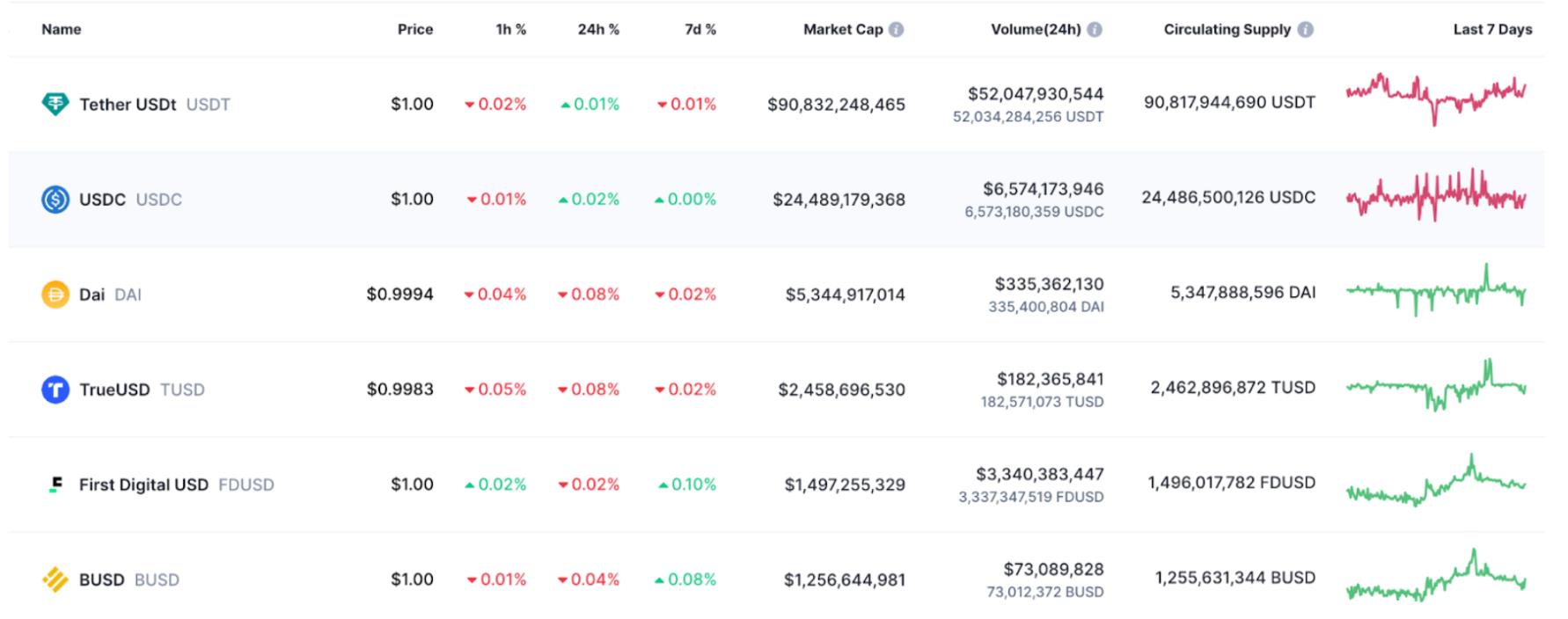
The rankings of the top five stablecoins by market cap have undergone significant changes. After BUSD stepped back and USDC suffered a de-pegging crisis, apart from DAI securing the third-largest stablecoin position, the low-profile veteran TUSD and the newcomer FDUSD have emerged strongly, currently ranking fourth and fifth by market cap respectively.
While interest-bearing stablecoins and those launched by Web2 giants still hold relatively small market shares and require longer-term validation, TUSD and FDUSD—each already reaching multi-billion dollar valuations with rapid growth—have gained initial market recognition.
I. A New Chapter in the Stablecoin Battle: Market Structure, Regulation, Yield-Bearing Models, and Web2 Giants Amid Circle’s IPO Push
Circle is no stranger to IPO aspirations. As early as July 2021, Circle planned to go public on the NYSE via a SPAC merger with a blank-check company. At that time, USDC was experiencing rapid market share growth, and Circle’s valuation reached $9 billion.
Despite this momentum, after 18 months of efforts, the IPO was ultimately "temporarily shelved." In December 2022, Circle announced it had suspended the process due to the SEC not approving its filing as "effective."
A year later, Circle’s circumstances have changed dramatically. According to Defillama data, the total market cap of stablecoins now stands at $129 billion, having declined since mid-May 2022 and only recently showing slight recovery amid broader crypto market rebound.
Amid ongoing challenges across the broader stablecoin market, 2023 has seen dramatic shifts—from black swan events including Silicon Valley Bank collapse and regulatory actions, to the rise of yield-bearing stablecoins powered by LSD and RWA, and the strong entry of Web2 giants like PayPal.
1. Shifting Leadership: TUSD and FDUSD Emerge Strongly
Most leading stablecoins have been affected to varying degrees, resulting in notable changes in market cap rankings compared to the start of the year.
Looking back, regulatory pressure hit BUSD first in February. The New York Department of Financial Services (NYDFS) announced an investigation into Paxos, BUSD’s issuer, followed shortly by the U.S. Securities and Exchange Commission (SEC) suing Paxos over issues related to BUSD. Binance had no choice but to gradually phase out BUSD. Most of BUSD’s major trading pairs have since been delisted from Binance, and recently, Binance also removed BUSD from its margin and futures platforms.
BUSD’s market cap plunged from $16 billion in February to around $1.2 billion—a 92% drop—losing its position as the third-largest stablecoin to DAI. It now ranks sixth.
After BUSD’s retreat, USDC faced severe setbacks. In March, the bank run on Silicon Valley Bank—a custodian of USDC reserves—triggered a redemption surge and de-pegging event for USDC. Once questions arose about USDC’s safety, large holders including Binance, MakerDAO, and Frax Finance sold off their USDC holdings and reduced reliance on it. In August, reports emerged that Binance had dumped large amounts of USDC to acquire BTC and ETH as reserve assets. Subsequently, MakerDAO and Frax Finance replaced much of their USDC reserves with lower-risk, interest-bearing U.S. Treasuries.
Although USDC remains the second-largest stablecoin by market cap, its value has dropped from $45 billion at the start of the year to approximately $24 billion—nearly halved—and hit a two-year low. Compared to its aggressive expansion just one or two years ago, Circle’s push for IPO now appears more desperate. Since the de-pegging incident, Circle has attempted to counter declining USDC market cap and rising competition through initiatives such as expanding into emerging markets and forming partnerships—but results seem limited. Enhanced transparency and credibility through a public listing might be one of Circle’s last major moves to revive USDC.
The impact wasn't limited to USDC alone; DAI, which relied heavily on USDC as collateral, also experienced significant volatility, dropping from a $5.6 billion market cap at the start of the year to $4.4 billion. Only after replacing much of its USDC reserves with U.S. Treasuries did DAI recover to its current level of $5.35 billion.
Thus, among the former top four stablecoins, only USDT increased its market cap—from $66 billion to $90 billion. BUSD, USDC, and DAI all saw declines. This created substantial room for growth for other players. With DAI taking over BUSD’s former third-place spot, fast-growing TUSD now ranks fourth, while FDUSD holds fifth place.
TUSD’s market cap surged from around $750 million at the beginning of the year to $2.5 billion today, peaking near $3.8 billion in October—an increase exceeding 400%. Meanwhile, FDUSD, launched in June this year, has already reached a $1.5 billion market cap, demonstrating remarkable speed of ascent.
2. The Rise of Yield-Bearing Stablecoins
Beyond shifting market shares among top stablecoins, 2023 also witnessed the emergence of yield-bearing stablecoins as a new narrative. Established DeFi blue-chips like DAI, Curve, and Aave, along with newer protocols such as Lybra Finance and OpenEden, are leveraging income-generating assets like LSD and RWA to develop their own yield-bearing stablecoins. For example, Lybra Finance, a protocol allowing users to mint yield-bearing stablecoins using LST assets as collateral, saw a 40x surge within just over a month of launch.
Additionally, Curve launched its crvUSD stablecoin in May 2023, enabling users to mint crvUSD using various LSD assets (e.g., rETH, wstETH, WBTC) as collateral. The protocol now holds over $100 million in collateral. Aave introduced GHO, an over-collateralized stablecoin backed by tokens within the Aave v3 protocol. Since launching in July, its TVL has shown clear upward momentum.
3. Web2 Payment Giants Shake Up the Market
The entry of Web2 payment giant PayPal has stirred the stablecoin market. Its issued stablecoin PYUSD has surpassed 200 million in circulation. Though its current market share remains small, with access to 400 million users, PYUSD holds significant implications for mass Web3 adoption, potentially drawing vast numbers of users into the cryptocurrency ecosystem. Many crypto KOLs speculate PayPal’s move will encourage further entries from other Web2 payment leaders.
4. Regulatory Frameworks Gradually Take Shape
Regulatory frameworks for stablecoins are becoming clearer in key jurisdictions such as the U.S., Singapore, Hong Kong, and the UK. In June, Hong Kong’s Financial Secretary’s Office stated plans to introduce a stablecoin regulatory framework by the end of 2024. In July, the U.S. House Committee on Financial Services passed the draft “Payment Stablecoin Transparency Act,” establishing pathways for approving and regulating stablecoin issuers while setting uniform federal minimum standards. In August, the Monetary Authority of Singapore (MAS) finalized its stablecoin regulatory framework. In November, the Bank of England unveiled its plan to regulate stablecoins, stating legislation for fiat-backed stablecoins will be introduced early next year.
As stablecoin regulations become clearer, they stand a better chance of entering mainstream applications and achieving broader adoption.
II. Why Have TUSD and FDUSD Emerged So Strongly Amid Multiple Shifts?
Following the loosening grip of top-tier stablecoins, the arrival of yield-bearing models and Web2 giants brings exciting prospects for 2024. However, these new forces currently hold minor market shares and need longer validation. In contrast, TUSD and FDUSD—already boasting multi-billion dollar valuations with rapid growth—represent noteworthy success stories worth examining.
1. FDUSD’s Rise Driven by Binance Adoption
Let’s start with FDUSD, the newcomer launched in June. Issued by FD121 Limited (branded as First Digital Labs), a subsidiary of Hong Kong-based custodian First Digital Limited, FDUSD is a dollar-pegged stablecoin backed 1:1 by USD.
According to its whitepaper, FDUSD reserves consist of cash and highly liquid short-term U.S. Treasuries. Its advantages include transferability, redeemability, programmability, low fees, and operation on decentralized networks. Currently, FDUSD is issued primarily on Ethereum and BNB Chain and tradable on exchanges including Binance, BingX, BitVenus, and Gate.io.
Among the fastest-growing stablecoins, FDUSD owes much of its rise to Binance’s adoption. After phasing out BUSD, Binance progressively rolled out use cases for FDUSD. From inception, blockchain data showed nearly all FDUSD tokens were held by Binance-associated addresses. Moreover, when Binance CEO CZ announced First Digital would issue a stablecoin on the BNB Smart Chain, speculation grew that FDUSD was effectively backed by Binance.
2. Real-Time Audits Help TUSD Soar Amid Trust Crisis
As a long-standing stablecoin, TUSD’s resurgence this year follows a logical trajectory. Originally launched by TrustToken on Ethereum in March 2018 and listed on Binance by May 2018, TUSD attracted investments from well-known firms such as Blocktower, a16z, and Alameda.
The TUSD team remained low-key for years, making its sudden rise this year surprising to many. However, in December 2020, TrustToken officially transferred ownership of TUSD to Techteryx, an Asian consortium. Techteryx operates globally with offices in Singapore, Hong Kong, and other regions, and maintains strategic partnerships with industry-leading firms to enhance trust and drive adoption of TUSD.
Post-acquisition, TUSD intensified efforts in security and transparency to rebuild user confidence. According to its official site, TUSD became the first USD-pegged stablecoin to implement real-time proof-of-reserves via independent third-party verification.
Its sustained focus on security and transparency set the stage for a major breakthrough in early 2023. After repeated collapses in the crypto market eroded trust in digital assets, regulatory actions against BUSD and USDC’s de-pegging crisis deepened the stablecoin trust crisis. Users and platforms naturally gravitated toward more reliable alternatives.
At this critical juncture, TUSD delivered. In February 2023, TUSD integrated Chainlink’s Proof-of-Reserves technology to ensure minting security, further enhancing transparency and reliability. It became the first stablecoin to enable real-time on-chain verification of off-chain reserves and programmatically controlled minting.
In March 2023, TUSD partnered with The Network Firm to provide real-time audit services. The Network Firm is a U.S.-based independent accounting firm specializing in digital asset industries. Its founding team has extensive experience in traditional tax and auditing services and has focused on crypto-native audit and attestation since 2016. With this partnership, TUSD’s reserves can now undergo 24/7 real-time audits, ensuring consistent transparency.
Today, users can view real-time proof-of-reserves and automated audit results directly on TUSD’s official website, tusd.io.
Real-time proof-of-reserves and live audits have strengthened TUSD’s minting security, transparency, and reliability. After BUSD came under regulatory scrutiny, TUSD became a preferred alternative for platforms like Binance and individual users. Blockchain analytics firm Nansen reported that Binance minted approximately $130 million worth of TUSD within a week following the BUSD crackdown. This rapid issuance propelled TUSD past Frax Finance to become the fifth-largest stablecoin by market cap. Subsequently, both Binance and OKX adjusted trading fees related to TUSD to encourage wider usage. To date, TUSD is active on over 100 exchanges including Binance, Coinbase, OKX, HTX, and Gate.io, and circulates across more than ten major blockchains such as Ethereum, TRON, Avalanche, and BNB Chain.
Moreover, growing adoption by crypto platforms and users has enabled TUSD to expand into global payments. Recently, TUSD partnered with international payment service provider ivendPay, joining its list of payment options. IvendPay operates in seven countries and serves over 300 active merchants. Previously, TUSD was adopted by Web3 shopping platform UQUID, freelance marketplace HYVE, travel booking site Travala.com, and others—establishing broader accessibility and usability for users.
III. Conclusion
In 2024, as the crypto market recovers, the stablecoin sector holds even greater growth potential. While established players like USDT, USDC, and DAI defend their positions, rising contenders such as TUSD and FDUSD, alongside innovations like yield-bearing stablecoins and entries from Web2 giants, will compete for incremental market share.
However, in this new phase of competition, with regulatory frameworks gradually taking shape, security and transparency remain central themes in stablecoin development. The upheavals of 2023 have shown how stablecoins like USDC suffered major setbacks due to compromised security, while others like TUSD seized pivotal opportunities by pioneering new standards in transparency and auditability. Stablecoins that achieve breakthroughs in proof-of-reserves and auditing—and consistently strengthen security and transparency—are likely to possess the greatest growth potential.
Join TechFlow official community to stay tuned
Telegram:https://t.me/TechFlowDaily
X (Twitter):https://x.com/TechFlowPost
X (Twitter) EN:https://x.com/BlockFlow_News
 ChainCatcher 链捕手