








Multiple public blockchains have been directly "crashed"—how long can the inscription craze last?
TechFlow Selected TechFlow Selected
Multiple public blockchains have been directly "crashed"—how long can the inscription craze last?
Now inscriptions have reached the final frenzy stage of a previous bull market, where value is ignored and only hype matters. Perhaps what's important isn't how long inscriptions can last, but how long you believe they can last.
 Navigating Web3 tides with focused insights
Text: Kaori
Editor: Jack
Over the past weekend, interest in inscriptions continued to rise.
The modular blockchain Celestia launched its first inscription project, CIAS. However, the community discovered potential code plagiarism in the CIAS team's implementation, possibly copied from the COSS inscription code. Within an hour of opening minting, CIAS received over 1 million visits from more than 120,000 users, with over 50% of transactions on the Celestia chain related to CIAS. Shortly afterward, the team announced that their RPC had failed, prompting them to suspend minting and promising to notify users 12 hours in advance before resuming.
This sudden halt in minting was dubbed a "disconnect" by the community. Yet, it did not diminish market attention toward CIAS. A video showing scientists minting CIAS circulated online, which Mustafa, founder of Celestia, shared, stating this was exactly the kind of challenge they aim to solve.
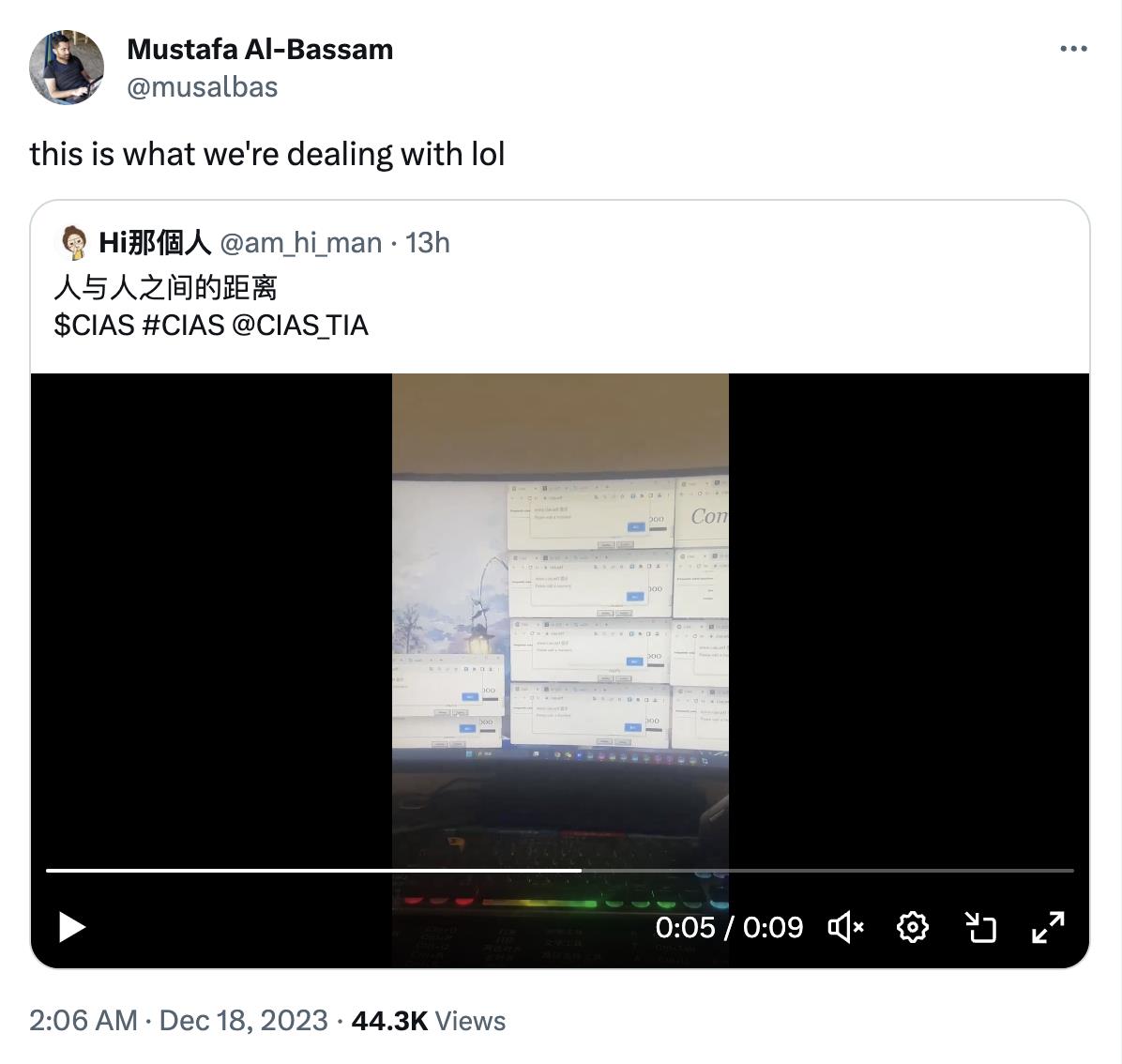
Whether CIAS is an official inscription project from Celestia remains unclear. But one thing is certain—public blockchains can no longer stay indifferent toward inscriptions.
Stress Test “Inscription Edition”
By now, inscriptions are no longer just about Bitcoin. In fact, inscriptions across different chains have effectively become stress tests for those networks.
On December 8, after introducing the Tonado inscription protocol—which triggered a surge in activity—TON network experienced prolonged delays in transaction processing. According to monitoring data from blockchain status bot dTON, starting December 5, TON20, an inscription launched by the Tonano team, generated over 2 million transactions within half an hour, increasing network usage by 61 times. This sudden spike caused severe congestion on the TON network; even though validators were still producing blocks, verification was significantly delayed.
By the afternoon of December 7, over 2.5 million transactions remained unprocessed, and TON’s transaction processing speed dropped to less than one per second. As a result, TON cryptocurrency wallets Wallet and Tonkeeper were forced to suspend services.
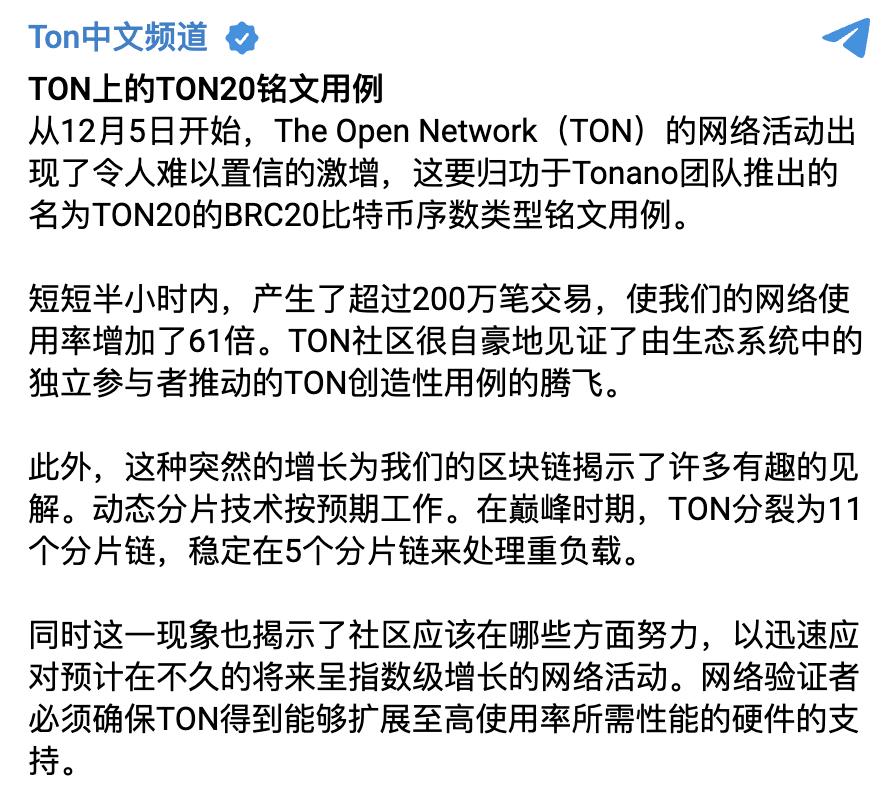
TON inscriptions cause network congestion; Image source: TON Chinese Official Channel
Another public chain, Conflux, underwent a similar stress test. According to ConfluxScan data, driven by the inscription boom, Conflux recorded 1.788 million transactions in a single day on December 15—the highest daily volume this year—with CFX reaching 100,000 transactions per day and active accounts hitting 17,700. Additionally, Conflux’s average daily TPS exceeded 20 for the first time since early April 2021.
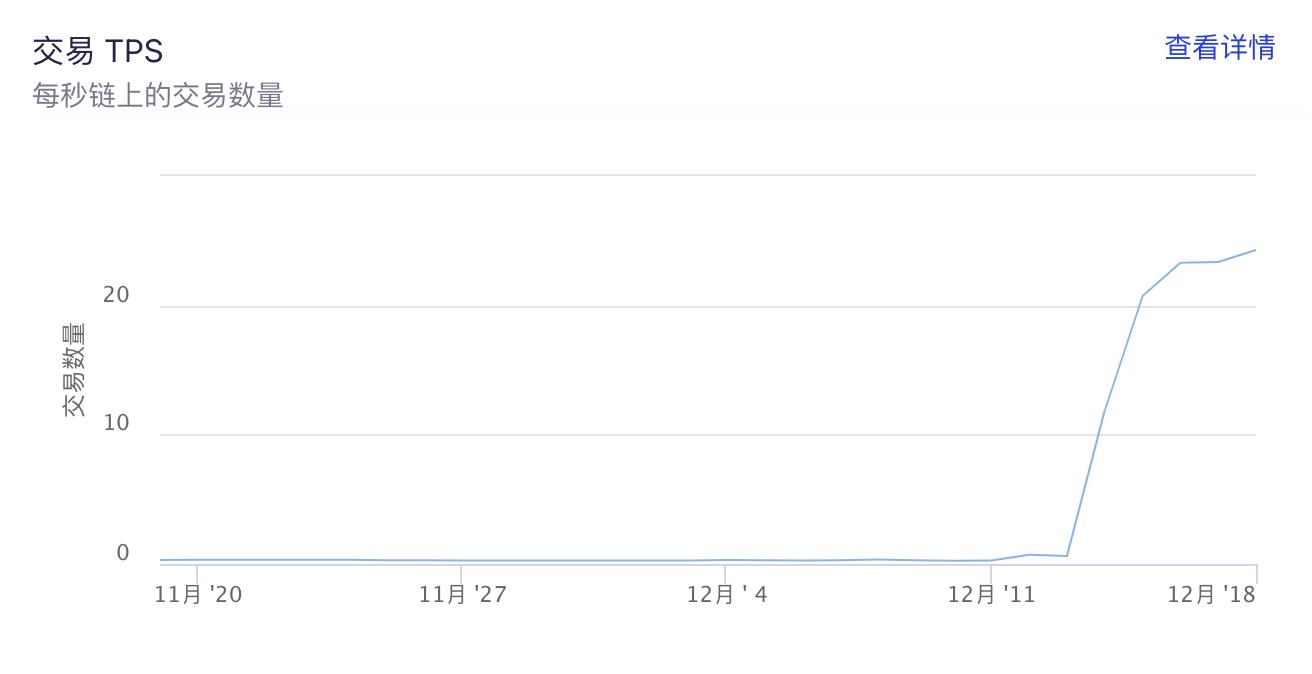
Conflux on-chain TPS; Image source: ConfluxScan
Inscriptions on Avalanche have also indirectly served as stress testers. On December 18, @cryptofishx, co-founder of Trader Joe—the largest DEX on Avalanche—launched an asc-20 standard inscription (Avascription) called BEEG, clarifying it had no roadmap or practical use case and was merely a social experiment.
Reportedly, 37% of BEEG tokens were minted within two hours and fifteen minutes of launch, with around 4,300 holders. @cryptofishx apologized for causing network congestion on Avalanche and initiated discussions on solutions. According to Avascan data, during the minting process, the average gas fee on the Avalanche network reached 5,110.30 nAVAX (approximately $4.41 USD).
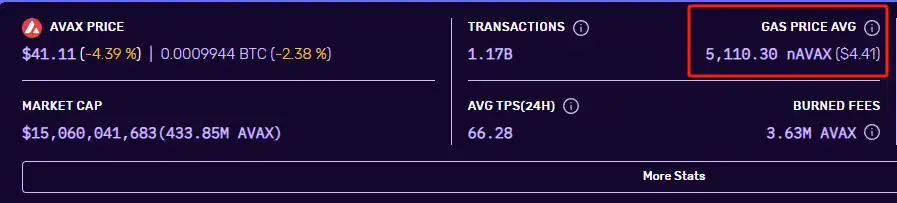
Avalanche network transaction fees; Image source: Avascan
Beyond various public chains, Ethereum Layer 2s are also being put to the test through inscriptions.
On December 16, Arbitrum officially announced that the Arbitrum One sequencer stopped operating at 10:29 AM ET due to a massive surge in network traffic. The official explanation cited a spike in user activity caused by inscription protocols, leading to sequencer failure and ultimately causing network downtime.
According to Arbiscan data, on December 15, transaction volume on Arbitrum surged to 4.39 million—the highest in its history. Meanwhile, Ultrasound Money data showed that the Arbitrum L2 Sequencer Inbox contract burned the most ETH in the past 24 hours, totaling 795.7 ETH.
Following closely behind, another major Layer 2 platform, zkSync, briefly experienced a "downtime" during the SYNC inscription minting on December 17. Blockchain explorers failed to display new blocks. Later, zkSync’s engineering lead tweeted that although unprecedented TPS of 150 was reached during minting, the network continued fulfilling its responsibilities.
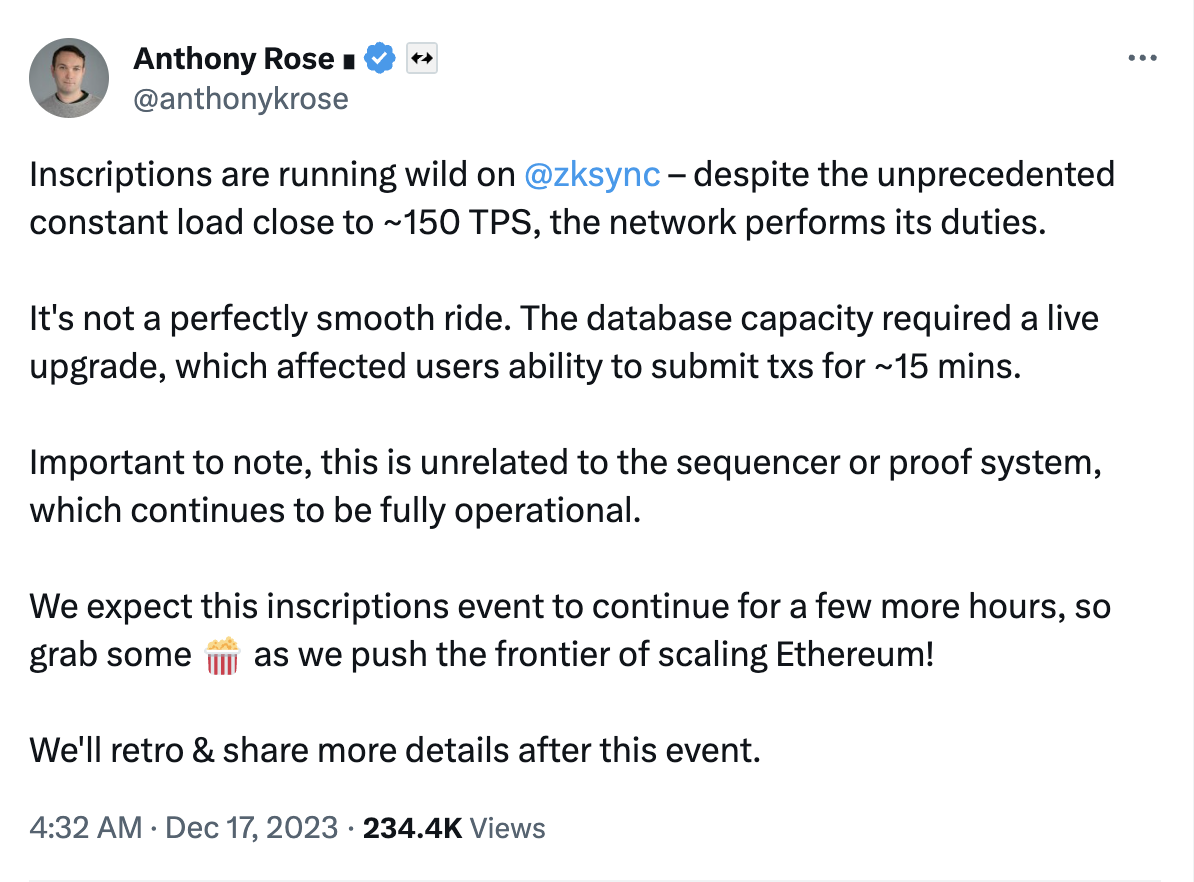
Crypto researcher HaoTian commented that this event served as a good stress test for zkSync, with positive impacts outweighing negatives: “In the long run, the inscription incident didn’t drag Layer 2 performance back to square one—in fact, it provided valuable practical experience for further performance optimization.”
Previously, CEXs were widely recognized as key drivers amplifying the visibility of inscriptions. Now, however, the community jokingly says, ‘a chain isn’t cool unless it has launched an inscription.’ Clearly, momentum has shifted to public chains and Layer 2s. Compared to Bitcoin, newer public chains and L2s have ample block space—they’re not afraid of congestion but rather fear lacking active users and capital.
How Long Can the Frenzy Last?
On December 12, He Yi, co-founder of Binance, stated during a Binance Chinese community AMA that Binance Web3 Wallet currently does not support inscriptions due to prior strategic considerations. She noted that inscriptions resemble NFTs in nature, likely experiencing high cyclical popularity, but their long-term trajectory remains uncertain. Therefore, Binance may indeed have underinvested in this area. However, as an exchange, product decisions cannot be based solely on personal preferences. If something matters to users, efforts must be made to meet demand. Currently, Binance is working overtime on relevant developments and will continue iterating to serve user needs.
This adds another layer of speculation to inscriptions. With an increasing number of inscription projects emerging, this sector has become one of the strongest wealth-generating areas today. Yet, accompanying voices suggest “the inscription cycle has peaked,” with many waiting only for the next price pump to exit profitably.
Many inevitably wonder: “How much longer can the inscription frenzy last?”
From a profit-taking perspective, very few early inscription participants who entered early remain actively involved today. Previously, crypto KOL Riyue Xiaochu wrote about a whale who earned millions of dollars from ORDI in May and then invested in SATS in July, eventually profiting $36 million after its listing on Binance—achieving a massive financial leap. But such cases remain legendary tales within the community. Most others simply hold onto their “tortoise jelly” (a community nickname for worthless inscriptions) and rush toward the next one.
Yet from an infrastructure standpoint, the future of inscriptions remains uncertain. Bitcoin-based inscription infrastructure projects like MultiBit and BitStable, along with their associated tokens, are still under development. While the current wave of inscription enthusiasm across various chains has reignited interest and drawn continuous waves of new participants, the lack of value discovery makes it clear to DeFi-savvy crypto users that for inscriptions to achieve greatness again, far more fuel is needed to ignite a stronger fire.
Now, inscriptions have entered the final euphoric phase typical of previous bull markets—where value takes a backseat to mere hype. Perhaps the real question isn’t how long inscriptions will survive, but how long you believe they will.
Join TechFlow official community to stay tuned
Telegram:https://t.me/TechFlowDaily
X (Twitter):https://x.com/TechFlowPost
X (Twitter) EN:https://x.com/BlockFlow_News
 BlockBeats








