








Smart Inscription Concept
TechFlow Selected TechFlow Selected
Smart Inscription Concept
Smart contracts will not be disrupted by inscriptions.
 Navigating Web3 tides with focused insights
Author: jackygu.eth
As previously concluded: inscriptions are essentially a movement against smart contracts.
So, should we really abandon smart contracts? Should we discard the vast DeFi, NFT, and application ecosystems built around smart contracts over the past six or seven years?
I don't think so.
Recently, I've minted inscriptions across several different chains. When it comes to trading or transferring them afterward, the process is actually quite cumbersome. Each chain has its own listing system, and then each may need to independently develop Swap, staking, and other services. However, in ecosystems like Ethereum, BSC, Polygon, and numerous Layer-2 EVM chains, these problems have already been well solved. Why not leverage these mature ecosystems?
Based on this, I believe combining the fairness principles of inscriptions with the vast smart contract ecosystem presents a significant opportunity. I'm not sure if anyone is working on cross-chain solutions between inscriptions and EVM-based assets, but technically speaking, creating a fully decentralized cross-chain solution would still be challenging today, while an asset-custodial cross-chain service would carry legal risks no one could bear.
Moreover, when revisiting the blog posts written last year by Casey, the creator of Ordinals, we find that he originally proposed the Ordinals protocol to issue NFTs (non-fungible tokens) on Bitcoin, not FTs (fungible tokens—typical examples being ERC20 tokens). However, after the BRC-20 standard based on the Ordinals protocol was launched on March 8th this year, many realized that the Ordinals protocol could also be used for issuing FTs, sparking a wave similar to the ERC20-based token issuance boom from six years ago. Casey has repeatedly expressed negative views toward BRC-20, arguing that the Ordinals protocol has been misused—an opinion that has since become mainstream within the core Bitcoin community (Bitcoin forums). Thus, two months ago, Casey introduced a better protocol specifically designed for FTs: Runes.
From this, we see that inscriptions inherently possess both NFT and FT characteristics: NFTs represent the commodity aspect of inscriptions, while FTs represent their asset aspect—complementary to each other. Therefore, inscriptions represent an entirely new form of digital asset unseen in recent years.
Based on the above understanding, I’ve conceptualized something called “Smart Inscription,” which might have the following features:
-
Built on smart contracts, with fully on-chain accounting.
-
Adhering to fair launch and free minting principles, returning to the original vision and anti-Sybil strategies of
Ferc1.0. -
Extremely low participation cost; likely deployed on
Base/Optimism, with estimated minting fees under $0.15 and deployment fees under $0.30—significantly lower than the Ferc3.0 version’s over $600 deployment fee and more than $20 minting fee. -
Community-driven, allowing direct wallet login and operations through social apps such as Twitter, Discord, Weibo, and WeChat—no need to download new applications (technically enabled by
Wallet As A Service, a model already widely adopted by social apps likefriend.tech, proven secure and convenient). -
The new protocol extends
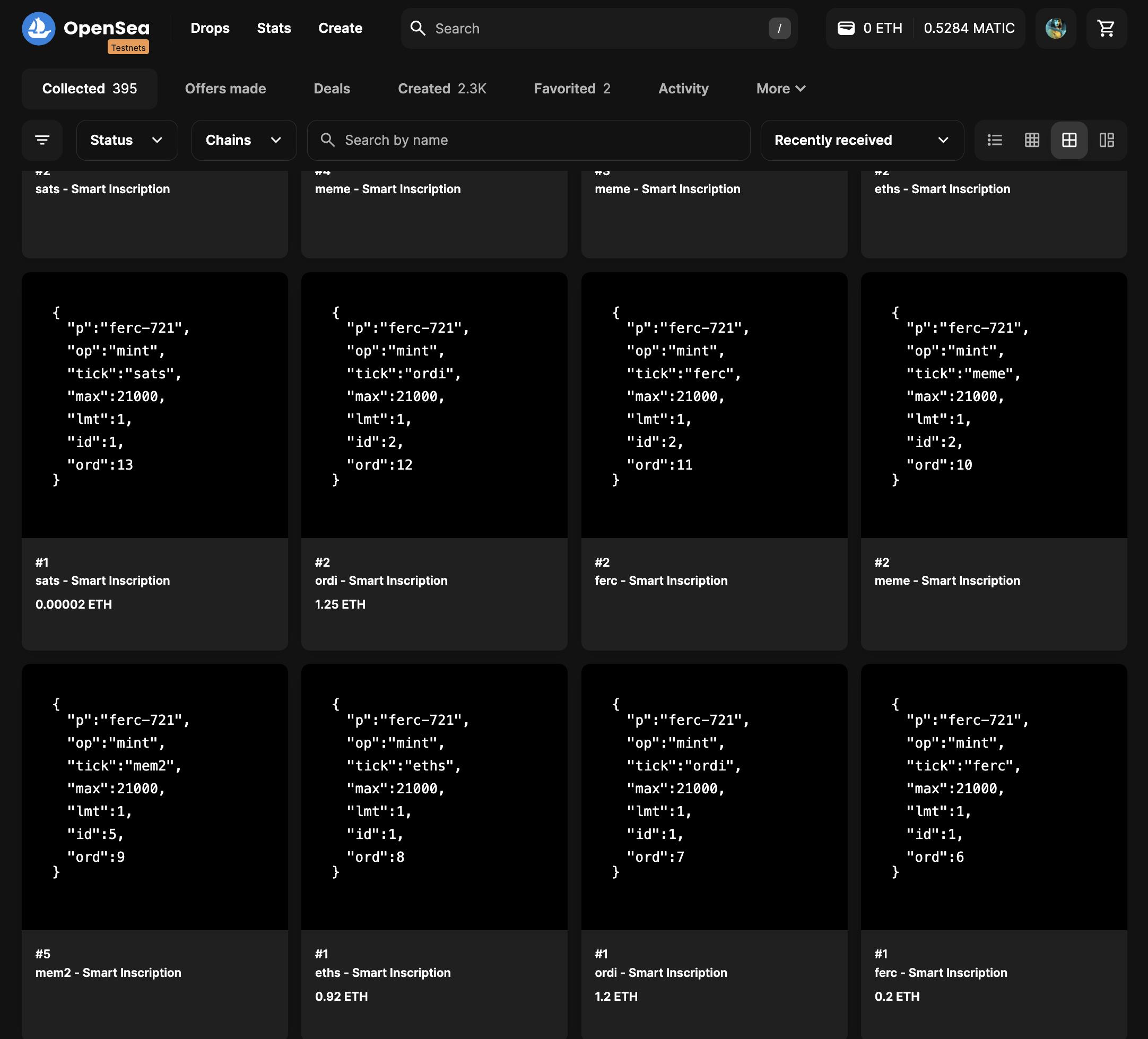
ERC721to implementInscription NFTs. Unlikepfp NFTs,Inscription NFTsareDynamic Text NFTs—similar toLoot(see image below). Their advantage lies in dynamically changing presentation based on on-chain data. For example, when anInscription NFTis converted into anERC20 FT, its state will be visually reflected differently on NFT marketplaces likeOpenSea. -
Inscription NFTscan be freely exchanged withERC20tokens, enabling usage within the larger and more mature DeFi ecosystem. -
Minimalist protocol design: ownerless contracts, all data stored fully on-chain, tamper-proof by anyone.
-
Serverless architecture, fully on-chain operations, no operational overhead, maintenance-free, never downtime.
A few days ago, I formally submitted the above proposal in writing to the FercDAO governance committee. I started coding these past couple of days. If everything goes smoothly, the core functionality is expected to launch this week.
Some might say: "eths" (inscriptions on Ethereum) have already surpassed 10,000 RMB in price, yet Ferc has made little progress—your idea probably won’t work. I admit that as a developer, after launching Ferc1.0 half a year ago, I made many mistakes, including:
-
Getting overly involved in non-technical matters;
-
Allowing the Ferc20 platform to evolve from the fair minting concept of version 1.0 into version 3.0—a fundraising platform—straying from the original ideals of fair launch and free minting.
These errors were fatal and disappointed many friends. Now is the time to correct them.
Others argue that despite Ferc20 starting early, its slow progress caused it to miss this inscription opportunity. I think that's okay. After all, inscriptions have only existed for about half a year and haven't seen substantial innovation yet. They also haven't effectively reached the largest blockchain user base: Ethereum users. So why not give it a try? Can “Smart Inscriptions” spark a paradigm shift in inscriptions and engage the massive community—cultivated over nearly a decade—who deeply believe in blockchain and smart contracts?
Join TechFlow official community to stay tuned
Telegram:https://t.me/TechFlowDaily
X (Twitter):https://x.com/TechFlowPost
X (Twitter) EN:https://x.com/BlockFlow_News









