








Seat allocation: What elements do the breakout, red-hot赛道 possess?
TechFlow Selected TechFlow Selected
Seat allocation: What elements do the breakout, red-hot赛道 possess?
What do the hot sectors in the crypto market have in common, and how can one identify whether a sector has the potential to go mainstream?
 Navigating Web3 tides with focused insights
Author: Jian Shu
I. What Drives the Hype?
There is only one reason behind a trend going viral: it enables more people to become aware of and participate in it. Therefore, all the following factors are analyzed from this perspective. It should be noted that not every trending sector needs to possess all of these elements.
1. Low Participation Barrier
A low participation barrier includes several key points:
-
Simple and easy-to-understand principles
When a concept is simple, even those outside the blockchain industry can quickly grasp it, making it easier to spread than projects with complex mechanisms. Searching for the term "crossing into mainstream" on blockchain media platforms most frequently returns results related to NFTs and blockchain gaming. Products like blockchain games—something already familiar in Web2 or traditional finance (TradFi)—are naturally easier for outsiders to understand and accept. Complex mechanisms act as walls keeping outsiders away. As stated in Visa’s report “The Cryptocurrency Phenomenon: Consumer Attitudes and Usage”: “55% of non-crypto users say a steep learning curve is why they haven’t invested in cryptocurrency.”
-
Minimal or no requirements, i.e., low cost
Many projects have prerequisites such as holding certain NFTs or tokens. While this may reflect a project's popularity and increase the value of its assets, it also excludes broader participation, as rising prices reduce users’ willingness to join.
-
Well-developed supporting infrastructure
The maturity of a sector’s infrastructure determines how user-friendly it is and directly impacts user experience. Overly complicated operations significantly raise the learning curve for newcomers outside the crypto space.
2. Sustained Discussion
-
Profitability effect
Profit potential is the best marketing tool. Whether GameFi or SocialFi, these projects often provide inferior user experiences compared to their Web2 counterparts; users participate primarily due to speculative incentives. Hot money in markets always follows the principle of entropy: capital flows from areas of lower profitability to those of higher returns.
-
Cultural attributes
Cultural elements enhance market discussion and community cohesion, particularly evident in meme and NFT projects. These often feature distinct community cultures and symbols—such as Milady’s anti-idol culture (as introduced by @codeboymadif) or Dogecoin’s Shiba Inu imagery. However, cultural aspects serve only as icing on the cake, since participants are fundamentally driven by speculation. Once prices drop, few will continue supporting the project out of passion.
3. Diverse Competition Rather Than Monopoly
This factor may not apply to some meme sectors but is highly relevant in utility-focused domains. More projects mean fiercer competition, which drives innovation in services and competitive product offerings. This was especially visible during DeFi Summer, when various protocols competed through token incentives, higher APR liquidity pools, and novel features.
4. A Strong Sense of Novelty
There’s an old saying in crypto: “Play new, not old.” New sectors offer greater imagination. Due to their novelty, emerging sectors lack established valuation models—meaning there’s no predictable market cap and thus room for significant upside. This essentially provides ordinary individuals a chance to acquire early, low-cost positions. Mature sectors, having well-defined valuation frameworks, often see VC-backed “god-tier” projects launch at high valuations, leaving little profit opportunity in secondary markets. If only a few benefit from the sector’s growth红利, who will remain interested?
5. Conceptual Imagination of the Sector
The metaverse serves as the best example of this factor. As an expansive concept extending and enhancing the real world, the immense opportunities and revolutionary potential of the metaverse generated widespread excitement, triggering a wave of interest. Metaverse-related tokens such as $Mana and $Sand performed notably well during the last bull run.
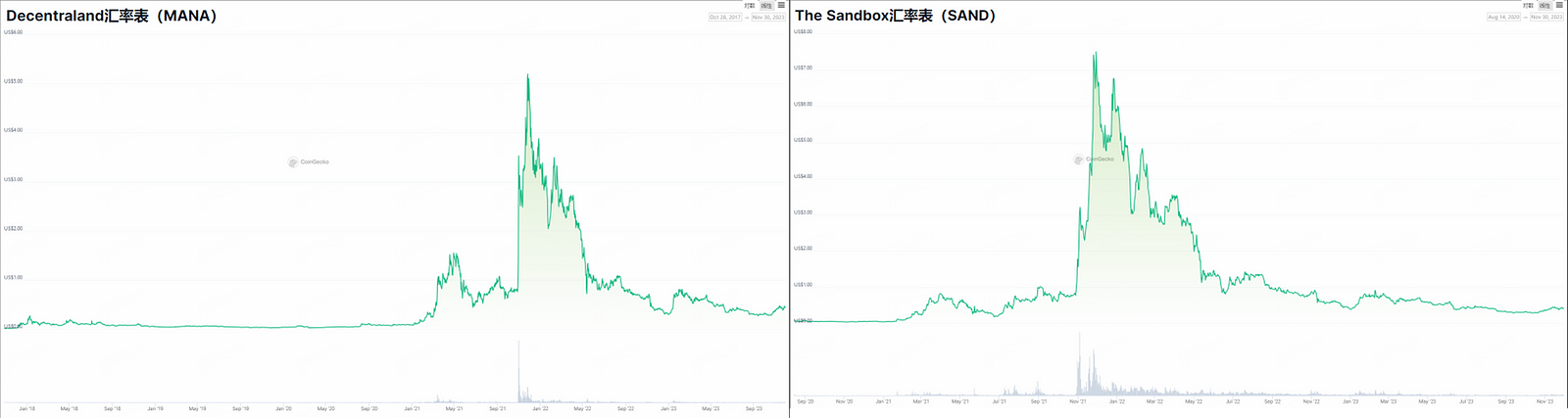 Data source: CoinGecko
6. Active Promotion by Project Teams and Communities
A project cannot gain attention without active promotion from both the team and its community. For instance, recent Ethereum inscriptions like $ETHS and BRC-20’s $rats have seen their respective communities aggressively promoting and driving traffic to their projects.
II. How Can We Safely Exit Amid the Frenzy?
The profile of crypto users has remained unchanged—they are mostly speculators seeking profits—and this won’t shift anytime soon. Once FOMO sentiment ignites the market, crypto users eagerly embrace bubbles. Since these are speculative bubbles, there are no loyal long-term holders committed to holding tokens indefinitely.
At the start of a new bull market, the shiniest projects will be those generating the highest returns—often backed by leverage and Ponzi-like dynamics. When the market turns, these same projects rise fastest and fall hardest, transitioning rapidly from “blue chips” to “rotten garbage.”
Before the bubble bursts, what signals can guide us toward a safe exit?
-
Repetitive cloning without innovation, leading to fragmented capital and attention
After a project goes viral, copycats inevitably emerge—usually simplistic imitations of the leader. This fragments market focus and capital without contributing positively to the sector’s development. As clone projects multiply, the profit-making effect diminishes until exhaustion, making sector decline inevitable. During DeFi Summer, after Sushi launched its vampire attack on Uniswap, numerous other protocols followed by stealing liquidity through high-emission tokens—a zero-sum game across different projects rather than meaningful progress for the sector.
-
Declining热度 and price of leading projects, lacking stable upward momentum
The leading project in a sector undoubtedly sets the pace. If both its热度 and price begin cooling down, it can easily trigger a collapse in market sentiment, dragging similar projects down along with it.
III. Why Is the Bitcoin Ecosystem Booming? Can It Last?
Currently, the hottest topic is undoubtedly the Bitcoin ecosystem, especially various inscription tokens. The massive wealth effect has drawn widespread interest. This rally has been fueled by Bitcoin’s price increase, which boosted overall market sentiment. But why have inscription tokens stood out among so many competing sectors? Let’s analyze them using the above criteria.
In terms of participation barriers, complexity and underdeveloped infrastructure limit further expansion. However, fair access in primary issuance has become a major selling point—retail investors built this small bull market independent of VCs;
Regarding discussion热度, inscription tokens clearly exhibit strong profit potential. Early tokens like $ordi and $sats, and more recent ones like $atom and $pipe, delivered substantial returns. Additionally, BRC-20 tokens sparked a culturally distinctive “zoo” trend, with animal-named inscriptions becoming popular—such as $rats, $bear, $cats—as well as NFT communities launching their own tokens like Black Cat’s $MMSS and Angry Cat’s $UCAT;
On diversity, the Bitcoin ecosystem remains underdeveloped. Despite innovative protocols, average users still lack accessible entry points—it’s still in an early stage. From the perspective of inscriptions, repetitive cloning is now apparent—not just on Bitcoin, but on other chains adopting their own inscription standards. This disperses market attention and capital, making it difficult for non-Bitcoin chains to replicate Bitcoin’s inscription boom;
In novelty, inscriptions represent a new asset class—a fresh concept introduced during the transition from bear to bull market—having never completed a full cycle, they fully meet the “new” criterion;
In conceptual imagination, Bitcoin is the most recognized chain, yet its ecosystem pales in comparison to Ethereum’s. Ethereum originally took over Bitcoin’s role in enabling smart contract development. Now, the growth of Bitcoin’s ecosystem is drawing global crypto attention, attracting both capital and developers. Its future potential is boundless.
In terms of project and community promotion, most readers likely have firsthand experience. When a Twitter influencer mentions buying certain inscriptions, communities rush to flood comment sections with promotions for their own tokens—such as $rats armies spamming replies or launching withdrawal campaigns upon detecting exchange sell-offs. Even the well-known CX Pi coin community reportedly issued its own token $piin, actively promoting and offering代购 services via live streams on platforms like Douyin and Kuaishou, attracting many older retail investors.
In summary, the Bitcoin ecosystem’s surge is driven by: extremely fair participation access, strong profit potential and cultural traits in some inscriptions fueling broad discussions, a novel and imaginative sector concept, and aggressive promotion by individual inscription communities. However, in the short term, multi-chain inscription deployments are fragmenting capital and热度, causing Bitcoin-chain inscriptions to cool down. Yet the Bitcoin ecosystem extends beyond inscriptions—it also includes protocols like RGB, Lightning Network, and BitVM, all still in early development stages, yet to reveal their full potential. Thus, we have good reason to believe the Bitcoin ecosystem will shine brightly in this bull market.
Join TechFlow official community to stay tuned
Telegram:https://t.me/TechFlowDaily
X (Twitter):https://x.com/TechFlowPost
X (Twitter) EN:https://x.com/BlockFlow_News
 @jianshubiji








