








The Block Investigates DWF Labs: The Operating Secrets Behind Its Investments in 470 Projects
TechFlow Selected TechFlow Selected
The Block Investigates DWF Labs: The Operating Secrets Behind Its Investments in 470 Projects
DWF Labs frequently talks about potential price movements when trying to attract the attention of prospective clients, and even when working with clients.
 Navigating Web3 tides with focused insights
By Tim Copeland, The Block
Compiled by ChainCatcher
Earlier this year, a new player emerged in the crypto space—DWF Labs—injecting capital into projects struggling for funding after the collapse of FTX and the broader market downturn.
The firm appeared to be throwing money around. Last year, it raised $20 million for Synthetix, $28 million for blockchain platform Conflux, $40 million for AI platform Fetch.AI, $45 million for the EOS Network Foundation, and $50 million for the Algorand Foundation. According to Foresight News, the company claims to have invested in 470 projects to date, partnering with 35% of the top 1,000 tokens by market cap within just 16 months of its existence.
Yet such aggressive spending by a young company raises questions about how these deals are structured and whether everything is as it seems on the surface.
In April, some of those questions were answered. Reports from The Block and CoinDesk revealed that many of these transactions were not traditional funding rounds but over-the-counter (OTC) deals. Still, lingering uncertainties remain about how DWF Labs conducts business and structures its deals.
To learn more, The Block interviewed 16 clients, potential clients, and individuals with deep knowledge of the firm’s operations, analyzing 10 proposals, contracts, and communications between DWF Labs and its clients or prospects. A key finding: DWF Labs frequently discusses potential price movements when courting and engaging with prospective clients.
Talking About Price Action
Shortly after its founding in September 2022, the trading firm created marketing materials for prospective clients. Obtained and verified by The Block, these materials heavily referenced price action.
Under a section titled "Price Management," the material stated that the trading firm could synchronize with a client's marketing team to help the token’s price react to relevant events.
It then explained how this would work: “Prior to or during significant scheduled news events, algorithms can bias toward one side of the order book, pushing prices upward.”
It added: “Since this is done at passive order levels rather than through actively creating artificial volume, the growth in token price appears organic. Note that while DWF can provide artificial volume, it’s rarely necessary due to competitive pricing.”
At one point, DWF Labs used template language in client proposals explaining that the firm would use its market-making services and proprietary capital to trade clients’ tokens and improve market conditions. This, it claimed, would lead to “bullish sentiment, organic trading activity, and price appreciation.” The Block has seen a proposal sent to a prospective client containing this wording, and a source directly familiar confirmed multiple proposals used similar language.
This messaging extended to verbal conversations. A prospective client told The Block that over the past few months, a DWF Labs employee pointed to charts showing token prices rising after previous collaborations while trying to win their business. A source familiar with the matter said that during calls with hesitant prospects, a DWF Labs executive often brings up past price increases of tokens from partnered projects.
Similar discussions occurred in written form. Earlier this year, a prospective client received messages from a DWF Labs executive confirming they were increasing the token’s price. Additionally, messages provided by a client from early this year show DWF Labs managing partner Andrei Grachev asking how high the client wanted their token price to go and discussing whether the firm could achieve that goal.
More recently, however, two separate documents provided to two different prospective clients over the past few months suggest the firm has phased out this price-management-related language—at least in its sales pitches.
How DWF Labs Conducts Liquidity Investments
DWF Labs focuses on three types of transactions: liquid token investments, locked token investments, and market-making arrangements—often bundling them together.
For liquid token investments, DWF Labs typically attempts to purchase a set amount of tokens using stablecoins at a discount of 5–15% below the current market price, based on terms from three deals reviewed by The Block. Over a period of one month or several months, it buys approximately $100,000–$150,000 worth of tokens daily, priced at the day’s opening rate minus the agreed discount.
This allows project founders to effectively cash out—albeit at a slight discount—while publicly claiming a major investment.
“OTC desks became a godsend for many small projects because they could dump tokens, attach themselves to a bigger name, claim an investment, and extend their runway,” said someone directly familiar with DWF Labs’ operations.
A DWF Labs client confirmed this was exactly why they partnered with the firm—a way to offload tokens without selling directly on the open market.
In a prior interview with The Block, Grachev pushed back against this notion, saying transferring funds to cryptocurrency exchanges doesn’t mean the firm immediately sells the tokens.
“We move coins to exchanges, but we never dump them—I’d say most of our trades last month, even more, we haven’t sold yet—maybe only a small portion,” he said in an April interview.
One controversial practice was DWF Labs frequently announcing token purchases before they were completed. In response to backlash, the firm reportedly changed its approach.
“We’ve learned a lot since the first half of this year,” Grachev told BlockBeats. “We won’t announce anything that hasn’t been completed. If we announce something, it’s already done.”
Structuring Market-Making and Venture Deals
Regarding market-making services, DWF Labs typically offers one-year agreements, according to two proposals seen by The Block and one contract signed with a client. As shown in the two proposals, this may involve loans denominated in project tokens.
At the time of the loan, the firm holds call options allowing it to purchase project tokens at the price set when the agreement was signed—a common feature in market-making contracts. These options can be exercised if the token reaches a certain level (the strike price), protecting the market maker from losses when repaying the loan if the token appreciates during the service period.
“Market makers must display both bids and asks. For downside protection, they must choose projects they’re willing to hold exposure to,” said Jordi Alexander, CIO at Selini Capital. “For upside protection, they need strike prices.” He added that strike prices are usually close to, or slightly above, the initial token price.
According to two sources familiar with other crypto market makers, such strike prices are typically set 100% above the starting token price.
For DWF Labs, however, the terms in two proposals set strike prices at multiples of the initial token price—meaning the firm stands to gain significantly higher returns if the token surges.
“If you’re a market maker, you want the token price to go up. You make money on the option to price these tokens a year later,” said a person familiar with the firm’s operations. “You want to be able to exercise the option below the market price. That’s where the profit is.”
One market-making proposal from DWF Labs explicitly states it will help promote project announcements and boost community engagement. Internally, this is also emphasized. The insider said the company informs employees about upcoming announcements and encourages them to share information to maintain momentum—“strike while the iron is hot.”
But external communication isn't always transparent. A DWF Labs client said, unlike other crypto market makers, the firm rarely provides detailed reports on its market-making activities. “Normally you get a detailed report. Theirs aren’t so detailed. Honestly, we don’t really know what they’re doing with the tokens,” they said. A contract seen by The Block from another client notes that DWF Labs retains discretion over what information to include in such reports.
Another client said they never received any reports from DWF Labs about the market-making services performed. They had to contact the relevant crypto exchange directly to confirm the services were indeed carried out—and they were.
As for venture-style locked token investments, according to one client and two proposals sent to different prospective clients, the firm typically seeks larger discounts—up to 50%—with lock-up periods of one or two years.
Positive Responses
Amid all these transactions, DWF Labs continues to scale operations and expand its influence across the industry. It has also doubled down on select partnerships, such as running validator nodes on the TON blockchain. Some industry partners expressed satisfaction in written comments provided to The Block.
The Algorand Foundation said its $50 million deal was an OTC transaction involving DWF Labs purchasing ALGO tokens in batches over time, completed in July 2023. “At no stage during our negotiations with DWF was there any implication that they would move the market or provide artificial volume,” said Eric Wragge, Global Head of Business Development and Capital Markets at the Algorand Foundation.
The DWF Labs deal with the EOS Network Foundation involved a $45 million purchase of EOS tokens and a $15 million commitment to invest in EOS-based ventures and ecosystem development. “Our strategic partnership with DWF has been highly productive, significantly expanding our ecosystem through cross-collaboration and financial investment. We eagerly anticipate continued success and growth in 2024,” said Yves La Rose, CEO of the EOS Network Foundation.
B, a core team member of memecoin project Floki, said: “We’re extremely satisfied with our collaboration. Floki sold $5 million worth of tokens to DWF Labs. At the institutional level, they provided tremendous support: opening access to their network, helping facilitate exchange listings, connecting us with their portfolio partners, and promoting our brand overall. Their team is also excellent and professional. They usually respond to our requests within minutes, nearly 24/7, and often it’s Andrei himself responding and driving things forward.”
Showcasing Success
Despite ongoing controversies surrounding DWF Labs, the firm and its close associates show no signs of slowing down. In September, HTX (formerly Huobi) awarded Digital Wave Finance its Best Partner Award. On X, Grachev recently announced the firm is undergoing audits by an unspecified Big Four accounting firm and applying for multiple licenses. According to his interview with BlockBeats, the company has already applied for a Virtual Asset Service Provider license in the British Virgin Islands.
Going forward, the firm plans to launch an initial incubation program for crypto companies and create what Grachev describes as a compliant OTC marketplace for cryptocurrencies—positioning itself as a major force among crypto traders.
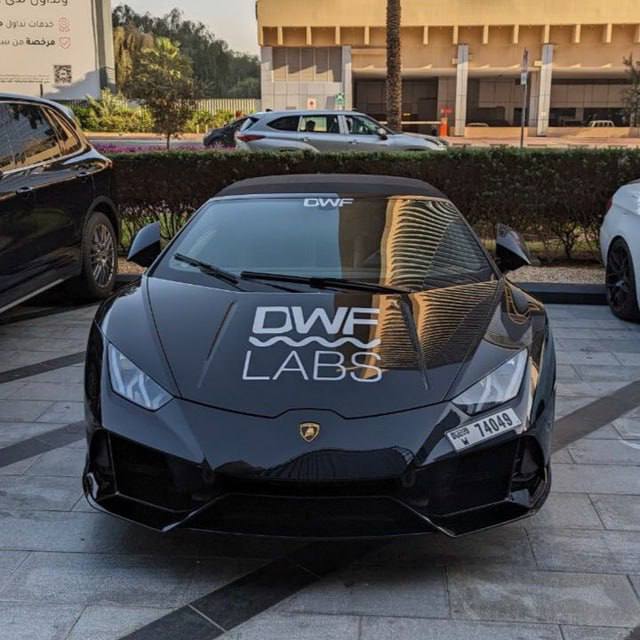
A photo of a Lamborghini bearing the DWF Labs logo
Grachev himself is unapologetic about displaying wealth and celebrating his company’s success. Last month, he sent $22,000 to an anonymous crypto trader on X, instructing them to buy a car within three hours—some observers noted the act mirrored FTX’s former CEO SBF gifting Teslas last year.
Reflecting on DWF Labs’ journey over the past 16 months, Grachev acknowledged past mistakes and admitted the company is “not ideal.” But he claims the firm is raising standards for market-making firms by taking risks and doing things differently.
Join TechFlow official community to stay tuned
Telegram:https://t.me/TechFlowDaily
X (Twitter):https://x.com/TechFlowPost
X (Twitter) EN:https://x.com/BlockFlow_News
 The Block








