November Blockchain Review: Solana's Strong Recovery, Blast's Rapid Rise, and Soaring Web3 Gaming Market Cap
TechFlow Selected TechFlow Selected
November Blockchain Review: Solana's Strong Recovery, Blast's Rapid Rise, and Soaring Web3 Gaming Market Cap
It is worth noting Blast's rapid rise, a new entrant in the Layer 2 space, which attracted approximately $700 million in TVL within just 10 days.
 Navigating Web3 tides with focused insights
Author: stella @footprint.network
November's crypto market was filled with major events, drawing significant attention from Bitcoin ETF speculation to Binance’s $4 billion settlement. While Ethereum continued to dominate in TVL and Layer 2 platforms like Arbitrum remained in focus, we also witnessed Solana’s remarkable recovery and Blast’s meteoric rise. These developments collectively fueled investor enthusiasm and heightened anticipation for the next bull cycle in blockchain.
Key Highlights
Crypto Market Overview
-
Anticipation around spot Bitcoin ETF approvals has fueled bullish sentiment, while positive developments in Middle East conflicts have eased concerns about broader regional instability.
-
The Binance settlement was widely viewed positively, as it reduced systemic risks within the crypto industry and strengthened investor confidence.
Public Chain Overview
-
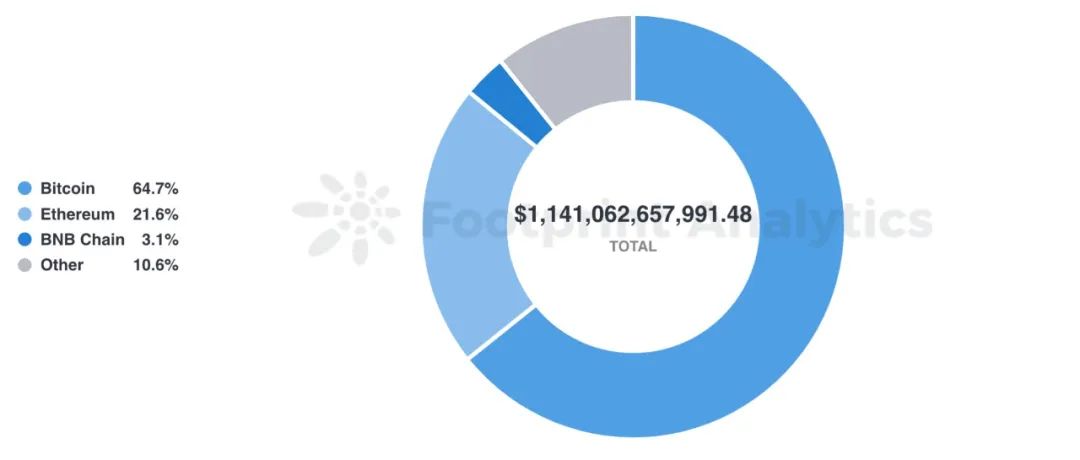
The market capitalization of public chain cryptocurrencies reached $1.14 trillion, with Bitcoin, Ethereum, and BNB Chain leading the market with shares of 64.7%, 21.6%, and 3.1% respectively.
-
Solana ranked fifth with a 1.7% market share and $1.14 billion in TVL, a 51.64% increase from October. Combined with its rising token price, Solana continues to demonstrate an optimistic recovery trend.
Layer 2
-
Notably, Blast rapidly rose as a new entrant in the Layer 2 space, attracting approximately $700 million in TVL within just 10 days.
Blockchain Gaming
-
The total market cap of gaming tokens saw significant growth in November, climbing from $49.2 billion on November 1 to $66.1 billion by November 30.
-
In terms of transaction market share, Solana performed exceptionally well, increasing its share to 13.6%, far surpassing its 4.2% in October.
-
Ronin stood out in November, capturing 21.2% of the market’s trading volume.
NFT
-
In November, Ethereum maintained its dominance in the NFT market with $630 million in trading volume, accounting for 98.5% of the total, a 50.4% increase from October.
-
BNB Chain saw a 4% decline in user numbers compared to October, dropping to 17,000 users—down 73.5% from July’s 63,000.
Funding and Investment Trends
-
Ten funding rounds were completed in the public chain sector, raising a total of $54.9 million.
-
Animoca Brands became TON’s largest validator through an undisclosed investment, aiming to strengthen GameFi on TON.
-
Sei Network received strategic investment from Circle Ventures, which will support the launch of native USDC on the network.
Key Developments
-
As Bitcoin surpassed $38,000, Solana led the gains among Layer 1 blockchains.
-
LayerZero is set to launch its Layer 2 Public Goods Network (PGN).
-
Starknet underwent a version upgrade and migrated its testnet to Sepolia.
-
Paradigm described Blast’s explosive launch as “crossing the line.”
Crypto Market Overview
Financial markets reacted relatively mildly to several potential risks. Anticipation surrounding the approval of a spot Bitcoin ETF fueled bullish sentiment, while positive developments in Middle East conflicts alleviated concerns about broader regional instability. Similarly, the U.S. Consumer Price Index (CPI) continued its downward trend, increasing market optimism regarding potential Federal Reserve rate cuts and a possible “soft landing” for the U.S. economy.
As part of a $4 billion settlement with U.S. authorities, Changpeng Zhao (CZ) stepped down as CEO of Binance on November 21. This settlement concluded extensive investigations by the U.S. Department of Justice and other regulatory agencies into Binance’s alleged violations of anti-money laundering regulations. Upon announcement of the settlement, Bitcoin briefly dipped to $35,800 but stabilized around $36,000–$36,500 the following morning. The market generally viewed the resolution positively, seeing it as a reduction in systemic risk for the crypto industry and a boost to investor confidence.
Public Chain Overview
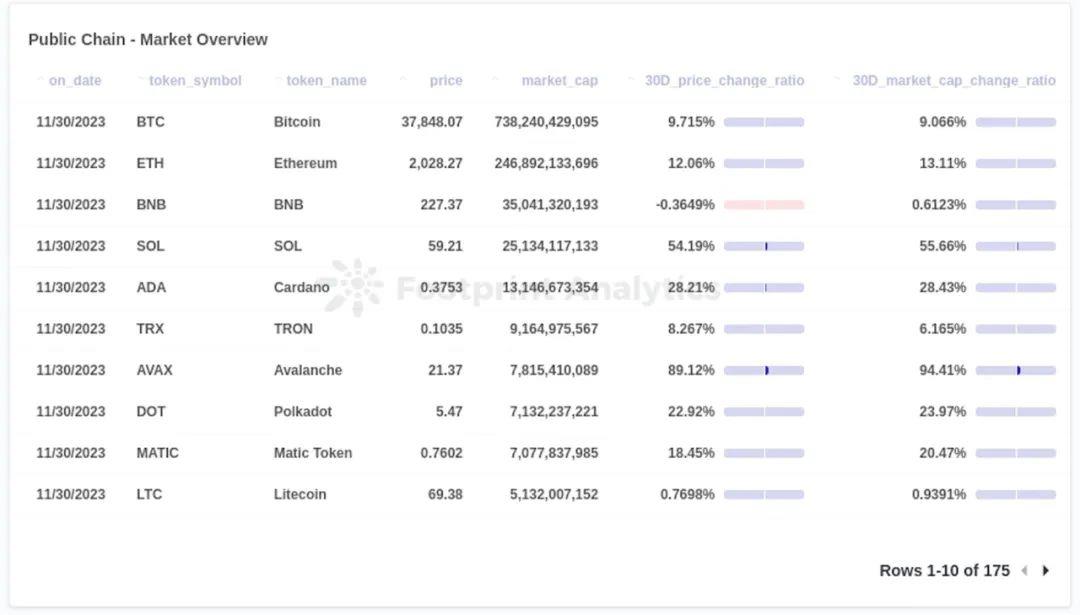
As of November 30, the market capitalization of public chain cryptocurrencies reached $1.14 trillion, with Bitcoin, Ethereum, and BNB Chain leading the market at 64.7%, 21.6%, and 3.1% market share respectively.
Data source: Total Chain Token Market Cap Share
Bitcoin’s price increased by 9.72% in November, closing at $37,848. Ethereum rose by 12.06%, ending the month at $2,028. In contrast, BNB experienced volatility, finishing the month down 0.36%. Notably, after reaching a settlement with U.S. regulators, BNB’s price sharply declined by 10.02% on November 22, falling from $253.4 to $228.0.
In November, Avalanche’s price surged by 89.12%, closing the month at $21.37. Solana also demonstrated strong recovery momentum, with its price increasing by 54.19% to reach $59.21.
Data source: Chain Market Data
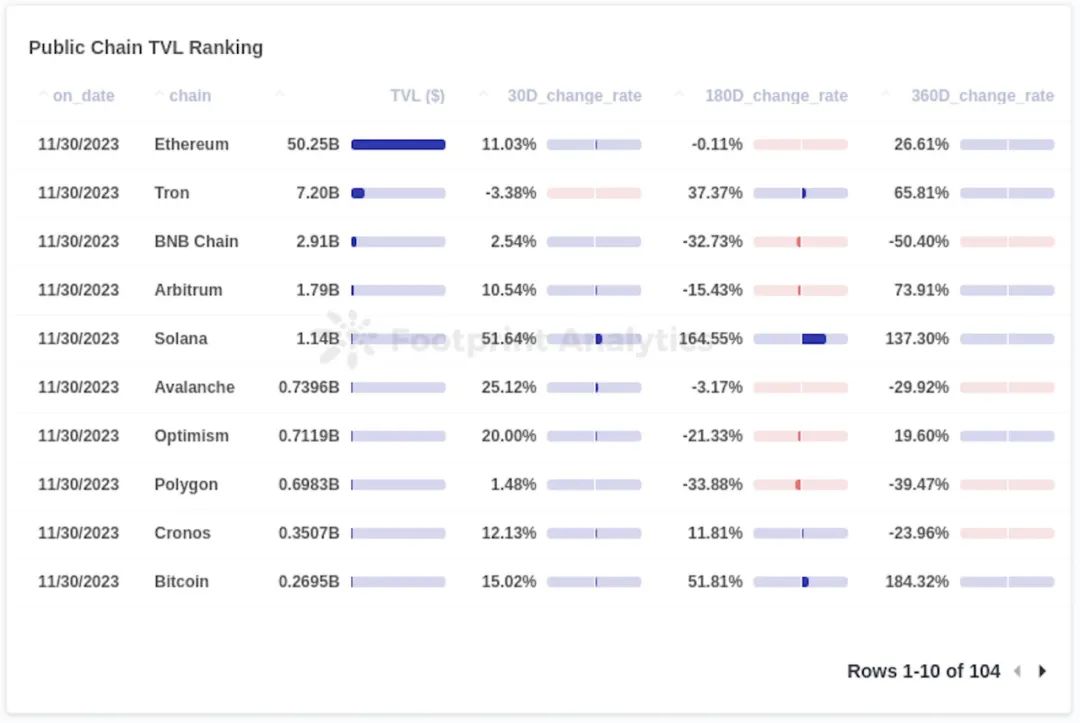
In November, the total TVL across public chains amounted to $68.3 billion. Ethereum maintained its dominant position with a 75.6% market share, holding $50.25 billion in TVL. Tron ranked second with $7.2 billion in TVL, representing 10.8% of the market. BNB Chain came third with a 4.4% share and $2.91 billion in TVL.
Solana ranked fifth with a 1.7% market share and $1.14 billion in TVL, a 51.64% increase from October. Combined with its rising token price, Solana continues to show optimistic signs of recovery.
Solana previously faced challenges due to its association with FTX during FTX’s collapse. Nevertheless, Solana overcame these setbacks and made a strong comeback in 2023. In August, Solana Pay announced integration with Shopify, enabling millions of merchants to use its payment solution. Shortly after in September, Visa, a credit card giant, joined support for Solana by launching USDC settlement on the network. Additionally, the Solana Foundation has been actively working to enhance network stability, decentralization, and innovation through initiatives such as the Hyperdrive hackathon and expansion plans across the Asia-Pacific region. These targeted efforts are crucial for building a more robust and diversified Solana ecosystem.
Data source: Chain TVL Ranking
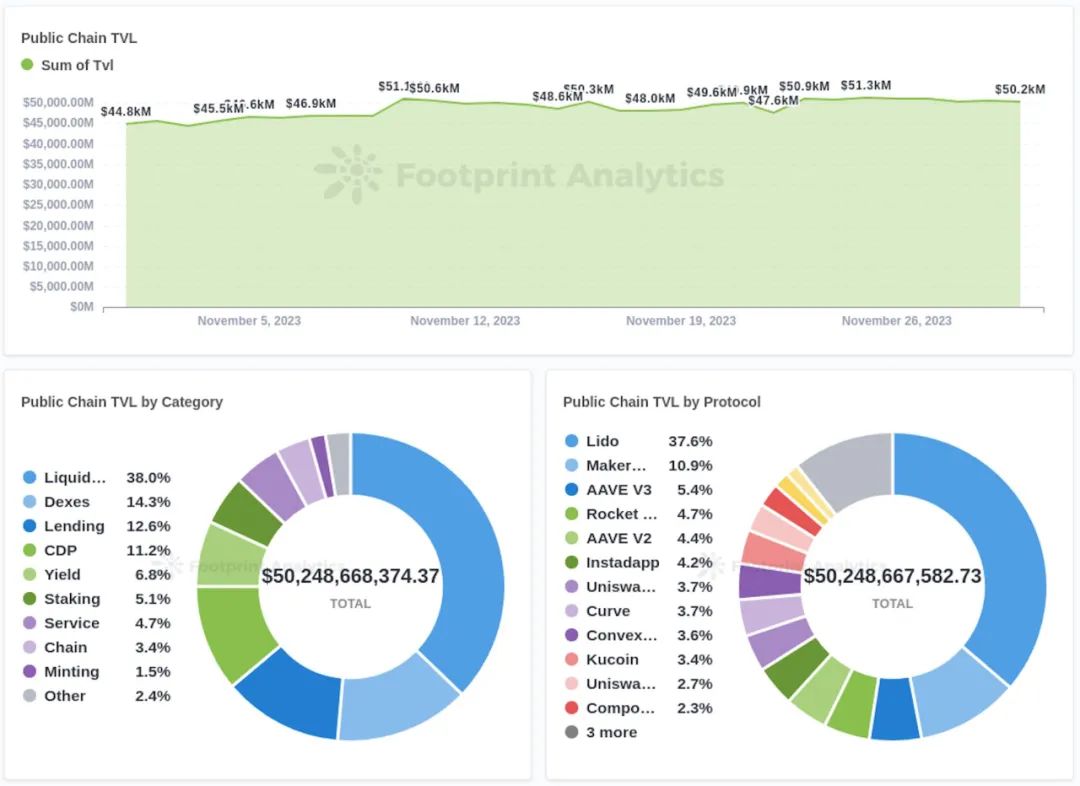
Within Ethereum’s DeFi ecosystem, liquid staking, DEXs, and lending protocols were the most active categories, capturing 38.0%, 14.3%, and 12.6% of the market share respectively. Lido and MakerDAO stood out as the leading projects, holding 37.6% and 10.9% market shares respectively.
Data source: Ethereum Chain Stats
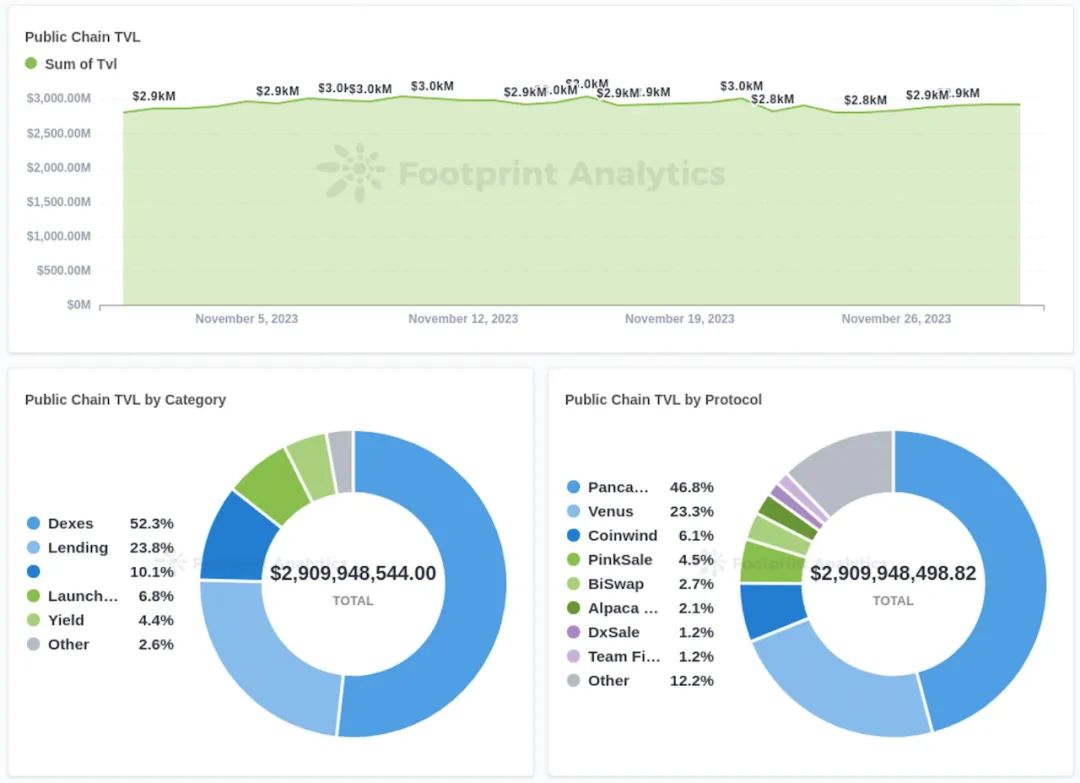
On BNB Chain, DEXs and lending protocols dominated, holding 52.3% and 23.8% of the market share respectively. PancakeSwap and Venus led the chain, capturing 46.8% and 23.3% of the market share respectively.
Data source: BNB Chain Stats
Layer 2
By the end of November, Arbitrum stood out in the Ethereum Layer 2 landscape, capturing 55.97% of the market share with $7.14 billion in TVL. Optimism ranked second with $3.36 billion in TVL, accounting for 26.33% of the market. Other chains with less than 6% market share formed the second tier, including Blast at 5.85%, Base at 4.02%, and zkSync Era at 3.84%. Notably, Blast’s rapid emergence as a new Layer 2 player attracted approximately $700 million in TVL within just 10 days. (Here, "TVL" refers to the cumulative amount deposited and locked in Layer 2 smart contracts.)
In terms of user engagement, zkSync Era took the lead with 2.77 million transactions and 2.31 million unique users. These users refer to those who interacted with Ethereum and bridged funds to Layer 2. The surge in user activity can be attributed to zkSync Era’s early airdrop campaign, which attracted a large number of participants. Since then, zkSync Era has become the most active platform. Starknet closely followed in transaction volume with 1.78 million transactions.
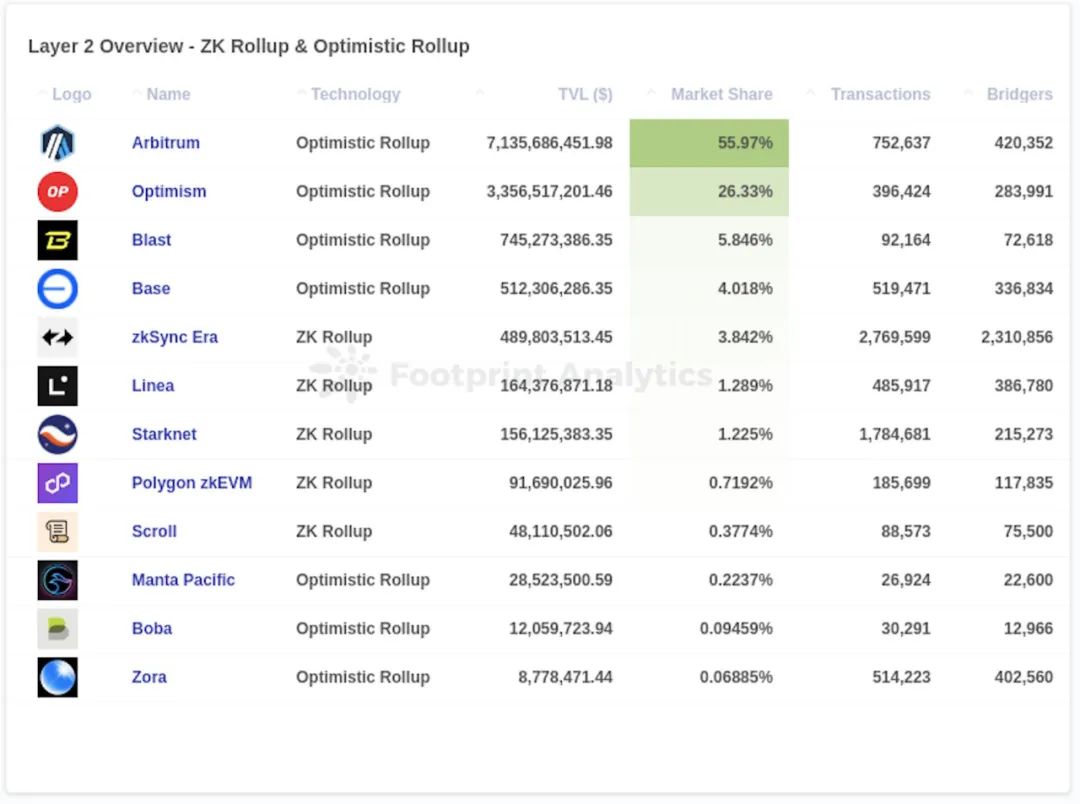
Data source: Layer 2 Overview
Blast’s closed beta launched on November 21, quickly generating buzz on social media. One reason for Blast’s popularity lies in its positioning—it is the first Ethereum Layer 2 solution with a native yield model. Led by Tieshun Roquerre, co-founder of leading NFT marketplace Blur, Blast rapidly amassed $745 million in TVL by the end of November.
Blur’s dominance in the NFT market provided strong support for Blast’s rapid adoption. Additionally, the development team’s background added credibility—members hail from prestigious institutions such as MakerDAO, MIT, Yale University, and Seoul National University. Coupled with a $20 million funding round led by Paradigm and Standard Crypto, these factors further accelerated Blast’s rise. Despite the social media hype, Blast faced criticism over its multi-sig contract, withdrawal restrictions, and referral system design.
Blockchain Gaming
In November, the total market cap of gaming tokens saw significant growth, rising from $49.2 billion on November 1 to $66.1 billion on November 30, reflecting notable progress in the Web3 gaming industry that month. Concurrently, the number of active wallets increased by 18.7% in November, growing from 1.1 million on November 1 to 1.3 million on November 30—aligning with the rapid growth in gaming token market cap.
In terms of game count, established public chains BNB Chain, Ethereum, and Polygon remained leaders with 964, 781, and 479 games respectively.
Over the past five months, overall transaction volume in the gaming sector has continued to decline. Specifically, transaction activity on the Wax blockchain was particularly affected—for example, Alien Worlds saw a significant drop in transaction counts, decreasing by as much as 89 million compared to October.
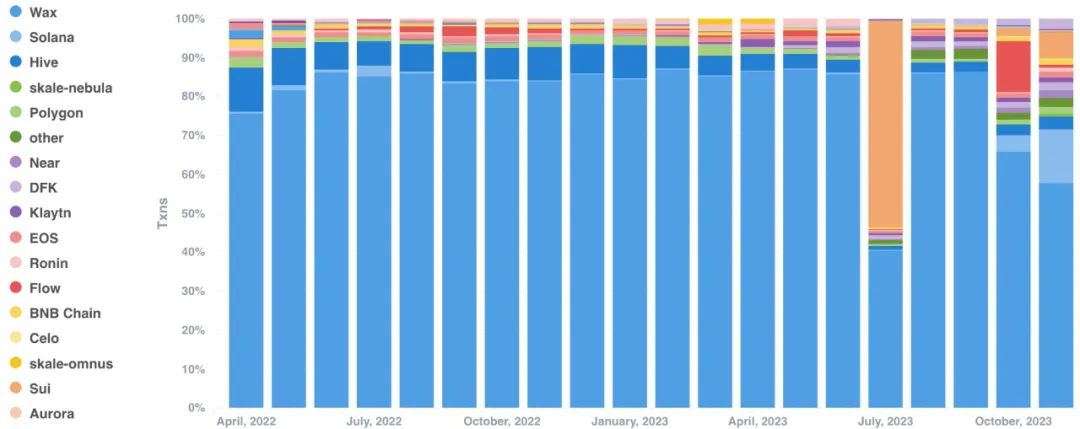
Data source: Monthly Txns Shared
In terms of transaction market share, Solana performed exceptionally well, increasing its share to 13.6%, far exceeding its 4.2% in October. Additionally, Ronin stood out in November, capturing 21.2% of the market’s trading volume.
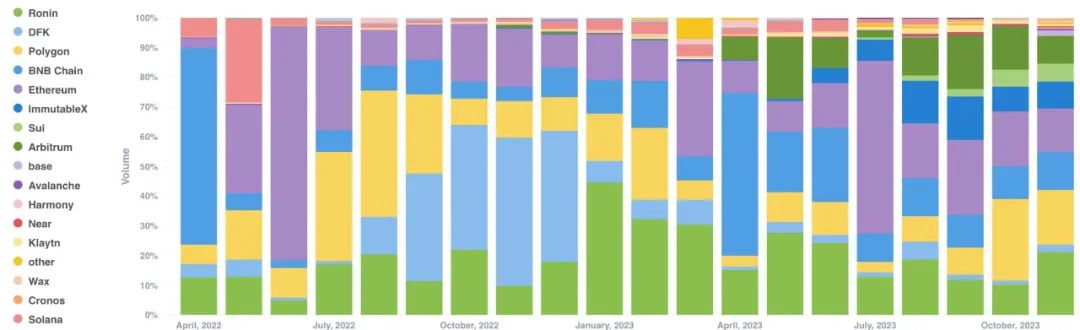
Data source: Monthly Volume Shared
For deeper insights into November’s Web3 gaming industry dynamics and data performance, please refer to the report “Web3 Gaming Industry Overview for November: Market Rebound and Future Trends”.
NFT
In November, Ethereum continued to dominate the NFT market with $630 million in trading volume, accounting for 98.5% of the total—up 50.4% from October.

Data source: Monthly Volume by Chain
In November, Ethereum’s user count (wallets) grew by 7.6% to reach 140,000. In contrast, BNB Chain saw a 4% decline in users compared to October, dropping to 17,000—a 73.5% decrease from July’s 63,000. Meanwhile, Polygon’s user count dropped sharply by 35.3%, totaling 92,000.
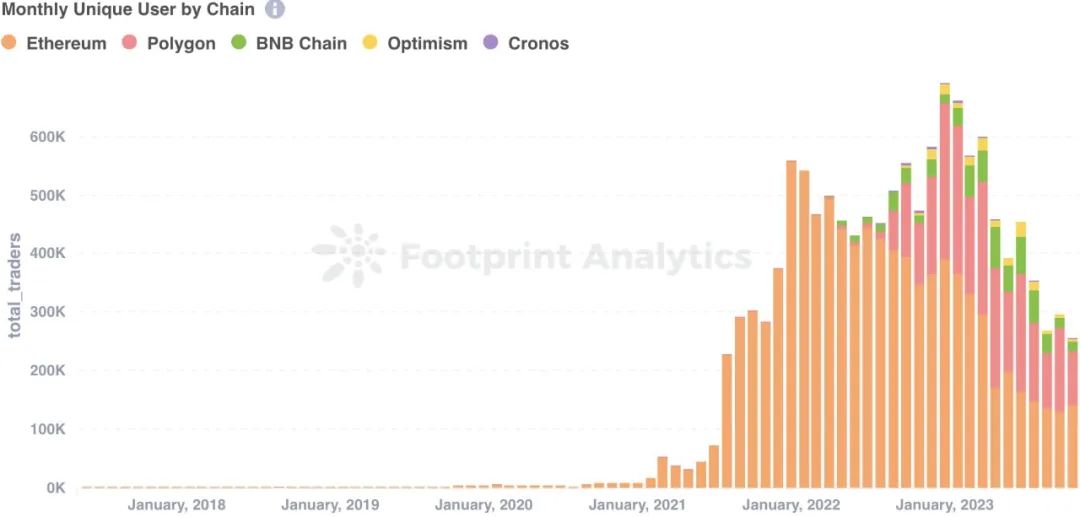
Data source: Monthly Unique Users by Chain
For deeper insights into November’s NFT industry dynamics and data performance, please refer to the report “November NFT Update: Trading Volume Growth and Strengthened Position of Blur”.
Funding and Investment Trends
In November, a series of investments highlighted growing capital interest in blockchain infrastructure. The public chain sector completed ten funding rounds, raising a total of $54.9 million. This wave of capital flowed into a diverse range of innovative projects, including Layer 1 blockchains such as The Open Network (TON), Sei, Klever (which raised $20 million, same below), Saga ($5 million), and Waterfall Network ($2 million), as well as Layer 2 solutions including Blast ($20 million), Kinto ($5 million), Glacier Network ($2.9 million), Layer N, and INTMAX. Among them, TON, Sei, Layer N, and INTMAX did not disclose their funding amounts.
Animoca Brands became TON’s largest validator through an undisclosed investment, aiming to strengthen TON’s GameFi ecosystem. This collaboration will support TON Play, a project enabling game development integrated with Telegram, and provide funding, research, and analytics for applications within the TON ecosystem.
Sei Network received strategic investment from Circle Ventures, the issuer of USDC, which will support the launch of native USDC on the network. This move is part of USDC’s expansion strategy—the stablecoin had previously joined other networks such as NEAR and Optimism as early as August—and Sei is the latest blockchain to adopt it.
Kinto, an Ethereum Layer 2 network utilizing OP stack technology, announced a $5 million raise. The platform features built-in KYC protocols to ensure full compliance with anti-money laundering regulations. Kinto aims to bridge financial institutions and real-world assets with DeFi infrastructure, with its mainnet set for full launch in Q1 2024.
Join TechFlow official community to stay tuned
Telegram:https://t.me/TechFlowDaily
X (Twitter):https://x.com/TechFlowPost
X (Twitter) EN:https://x.com/BlockFlow_News
 Footprint Analytics