









How Can Project Teams Gain Miner Support for Mutual Benefit?
TechFlow Selected TechFlow Selected
How Can Project Teams Gain Miner Support for Mutual Benefit?
As long as the project's returns are high enough, miners will be willing to participate. Then, miners will choose the economic model they prefer.
 Navigating Web3 tides with focused insights
Author: Maggie @Foresight Ventures
TL;DR
In the crypto space, miners are a powerful group. I interviewed several large mining companies to summarize how this group views blockchain projects. If you're a project founder, this will help you understand how to gain support from miners. This article answers the following four questions.
1. What is the current state of miners' survival?
1.1 Declining computing power in mining; excess capacity returning to traditional industries for server leasing or idle use.
-
Since last year, market conditions have been poor—mining profits are low, and many GPU-based projects exist. Many miners have chosen to sell their equipment or return to traditional sectors by leasing servers for graphic rendering, cloud services, etc.
-
Starting in November, the situation began to shift, with some miners reorganizing their computing power back into cryptocurrency mining.
1.2 Only low-end GPUs are used; high-end GPUs are rarely involved in mining.
-
High-end GPUs have seen sharp price increases, making rental or resale immediately profitable—miners are unwilling to commit them to uncertain mining ventures.
-
U.S. GPU export restrictions and the AI boom have led to GPU scarcity and rising prices.
-
The 3090 GPU has risen from a few thousand yuan to 10,000 yuan per unit.
-
The 4090 GPU jumped from 10,000 yuan two months ago to 20,000 yuan today.
-
GPUs in the mining sector are generally low-spec—large quantities of older models like 3080, P106, 1080, and 2080 remain underutilized.
-
Some companies in Shenzhen are now modifying low-end GPUs via soldering techniques to run higher-demand algorithms.
-
Other firms are optimizing AI algorithms through software improvements so they can run on lower-end GPUs such as the 3080.
-
Filecoin mining rigs rarely use 3090 GPUs—they’re hard to find. Most Filecoin miners were purchased between 2020–2021 when the 3080 was top-tier. As rewards declined afterward, further investment ceased. Thus, most Filecoin rigs use 3080 GPUs.
2. What kind of economic model do miners prefer?
First, if a project offers sufficiently high returns, miners will participate. Only then do they consider whether they like its economic model.
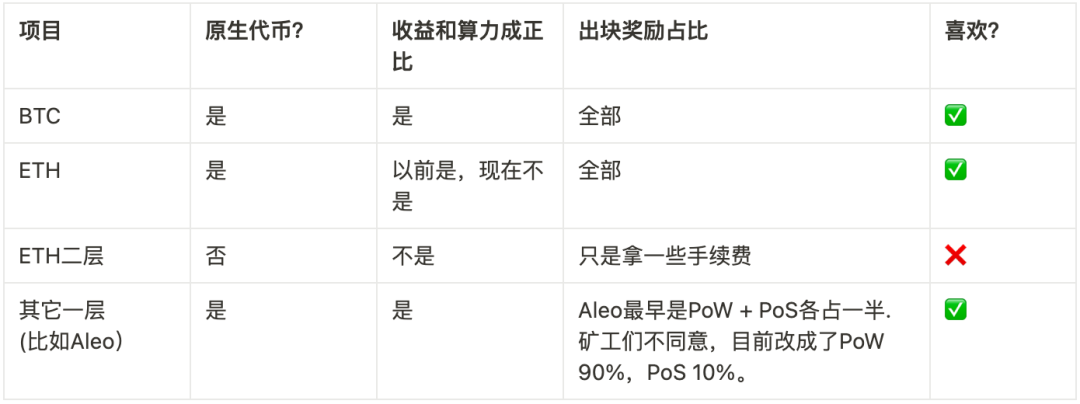
2.1 Miners favor economic models like BTC/Filecoin
-
Layer-1 chains with native tokens.
-
Higher computing power directly translates to higher earnings—if a miner controls 11% of the network's hash rate, they earn approximately 11% of block rewards.
-
Projects where block rewards constitute a large portion of token distribution, e.g., Filecoin allocates 60–70% of its tokens as block rewards. Lower ratios reduce miner interest.
2.2 Miners dislike current PoS and Ethereum L2 models
-
Most Ethereum L2s keep block production controlled by the project team—miners cannot meaningfully participate, even if they do, it’s only as part of the project’s centralized compute pool.
-
Current L2s aim only to decentralize zk provers—the sequencer remains far from decentralized. Miners here earn minimal computation fees, but value capture stays with the project team. It feels like working for the project without real upside, reducing motivation.
-
Miners dislike these economic models. Tokenomics designs effectively trap miners into being low-margin laborers. Profit margins are too thin, leading to low engagement. In such projects, miners are mere bystanders—the success depends on the core team, investors, and market trends. Miners hold no influence.
-
Some L2 projects have already issued tokens, making future efforts to decentralize sequencers or zk provers difficult to incentivize fairly for miners, creating an unfriendly environment for mining operators.
3. What benefits come from having miner support, and how much power do miners really have?
3.1 In most projects, miners play only a minor, peripheral role (e.g., ETH L2).
-
Economic models ignore miner interests—miners are just laborers.
-
Investors and project teams control project outcomes. Miners can only follow along—they lack influence.
3.2 In projects matching miners’ preferred economic models, their impact is significant (e.g., Filecoin).
-
Miners possess strong financial capacity and can deliver on commitments they make.
3.3 Bitcoin is special—miners wield substantial power.
-
Pure PoW with 100% block rewards going to miners—no foundation or VC takes a cut—giving miners immense influence.
-
Miners have strong investment capabilities, can fulfill promises, and even drive chain forks.
-
From the miners’ perspective, halving cuts revenue every four years, making profitability increasingly difficult—anxiety exists. Innovations like Ordinals offer visible opportunities to earn more.
4. Which types of projects should prioritize miner interests, and how to attract them?
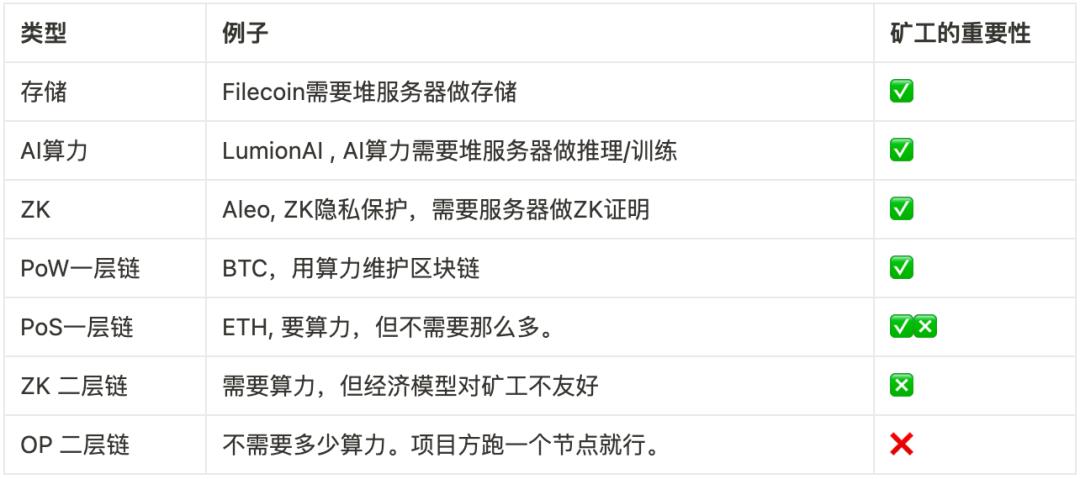
4.1 Projects requiring heavy computational resources must consider miner incentives (ZK, AI compute).
4.2 Preferred collaboration models for miners.
New projects present unknown returns, yet require real investments in facilities and electricity costs. Therefore, the cooperation model matters greatly.
Hardware investment may be negotiable, but miners care deeply about ongoing electricity and data center expenses. To attract miners, it's best to adopt models they prefer.
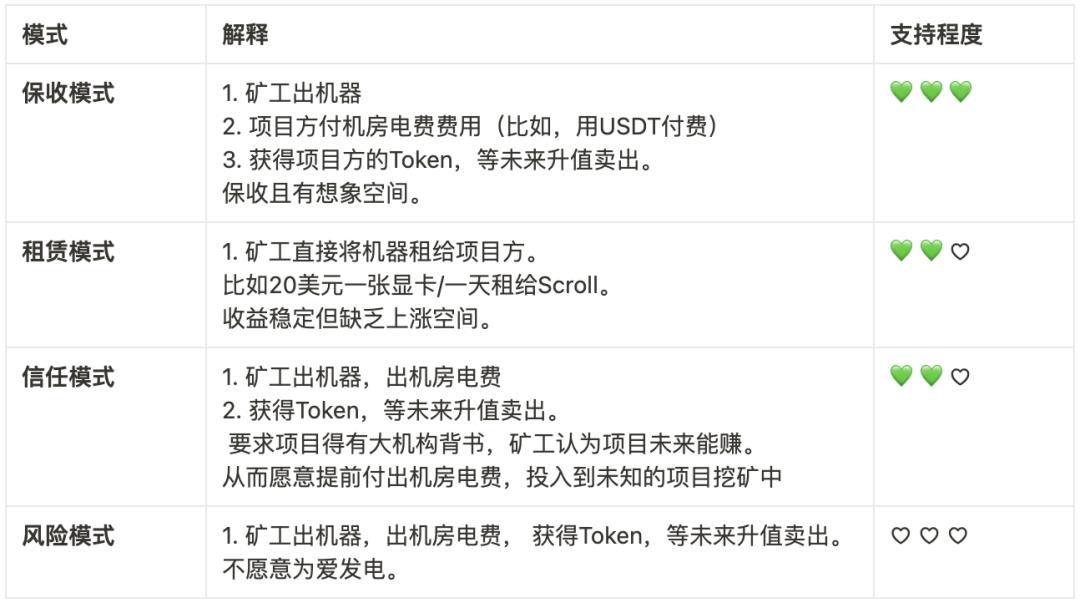
Among these models, the "trust model" works best—it reduces financial pressure on the project. However, this requires a miner-friendly economic design and backing from reputable investors.
5. Summary
-
Projects that demand significant computing resources—such as storage, ZK, AI, and PoW—must fully consider miner incentives when designing their economic models.
-
Miners prefer layer-1 projects with native tokens, high mining reward allocations, and proportional returns based on computing power—models similar to BTC and Filecoin serve as ideal references.
-
New projects should ideally adopt the "trust model"—it reduces financial strain. But this requires a miner-friendly economic structure and strong institutional backing. Otherwise, miners won’t risk real capital on uncertain ventures—they won’t work for free.
Join TechFlow official community to stay tuned
Telegram:https://t.me/TechFlowDaily
X (Twitter):https://x.com/TechFlowPost
X (Twitter) EN:https://x.com/BlockFlow_News
 Foresight Ventures








