








Selling Block Space: The Best Business Model in Crypto
TechFlow Selected TechFlow Selected
Selling Block Space: The Best Business Model in Crypto
This article's key objective is to evaluate block space both as a commodity product and as a model for economic production.
 Navigating Web3 tides with focused insights
Written by: Will Nuelle
Translated by: TechFlow

Introduction
New technologies give rise to new business models. Over the past three decades, many prominent investment firms have built their practices around software investments. Software was first a technological revolution, but also a business model revolution driven by technology. "Software as a Service" ("SaaS") is a business model innovation derived from the technical characteristic of bits being easily replicable—a product with zero marginal cost of replication, recurring annual revenue, and high switching costs. Firms like Insight Partners claim that SaaS is the best business model ever invented, and their success stems from understanding this model better than anyone else.
New technology platforms create powerful new business models and entirely new markets—often fertile ground for outsized investment returns. So far in crypto, only four business models have achieved deep and lasting product-market fit—two are pre-existing (SaaS and exchanges), one is a fork of a familiar model (stablecoins), and one is entirely new (blockspace):
Software-as-a-Service (SaaS): Software companies like Fireblocks and Chainalysis sell their software via subscriptions. Others, such as Alchemy, use usage-based pricing models. Anchorage, Figment, and Blockdaemon are primarily software companies with business models tied to asset management.
Exchanges: Crypto tends to financialize everything, meaning revenue from trading volume has become a stable and viable business model. This includes centralized (off-chain) exchanges, decentralized (on-chain) exchanges, and NFT marketplaces.
Stablecoins/Lending: Stablecoins are an instance of the familiar net interest margin business model, with the only difference being they create an exogenous incentive (on-chain utility) for holders to deposit funds with issuers without expecting yield. Over time, tokenized assets should fall into this broader category as well.
Blockspace: The business model of selling priced computational resources per operation leads to a price × quantity = revenue model. Blockspace exhibits persistent demand network effects, creating defensible moats for winners.
The key objective of this article is to evaluate blockspace as a commodity product and assess its economic production model. We cover pricing, metering, fees, L1s, L2s, calldata and compression, EIP-4844, and more.
Even if you don’t believe blockspace constitutes a “business model,” the sale of blockspace (e.g., total transaction fees) is the purest signal of product demand and should be used to differentiate between various blockspace offerings.
Blockspace is a Product Consumers Buy
Blockspace as a product. It’s important to clarify that blockspace producers aren’t necessarily individual enterprises or corporations. They can be decentralized networks composed of individuals and companies executing the rules of public blockchains like Bitcoin or Ethereum. Whether it's a centralized company or a decentralized blockchain, blockspace is a product sold globally to consumers every 12 seconds.
Blockchains are a new type of computer capable of producing a unique form of computation—one where global consensus exists. Blockchains are infrastructure solutions to the problem of double-spending value on the internet (which handles text, JPGs, etc., more easily than money), while blockspace is the commodity sold to consumers to mitigate this issue. And consumers do pay for it—between $3 billion and $10 billion annually from 2021 to 2023.
Gas prices are signals of demand for blockspace (which itself is a bundle of computation, storage, and bandwidth resources). In this market, there are multiple sellers of blockspace—all L1s, L2s, sidechains, etc., are producers and sellers of blockspace. Ethereum, Avalanche, Arbitrum, Optimism, Polygon, and Binance Smart Chain are all producers and sellers of blockspace.
Blockspace is a business built on network effects, which can form around applications, developers, capital, and users, enabling sustainable increases in unit pricing. Generally, when network effects surround a seller’s blockspace, consumers are willing to pay higher fees per transaction; users need to interact within the same blockspace used by other apps and users.
Every dollar of capital deployed on Ethereum attracts more application developers, who in turn attract more users through compelling applications, and so on—mirroring the viral growth seen in social media apps. In short, users can do more with Ethereum’s blockspace than with Avalanche’s. As Chris Ahn of Haun Ventures wrote, “Becoming more efficient at scale is the ultimate form of defense.”
Network effects partially explain persistent differences in blockspace pricing among sellers:
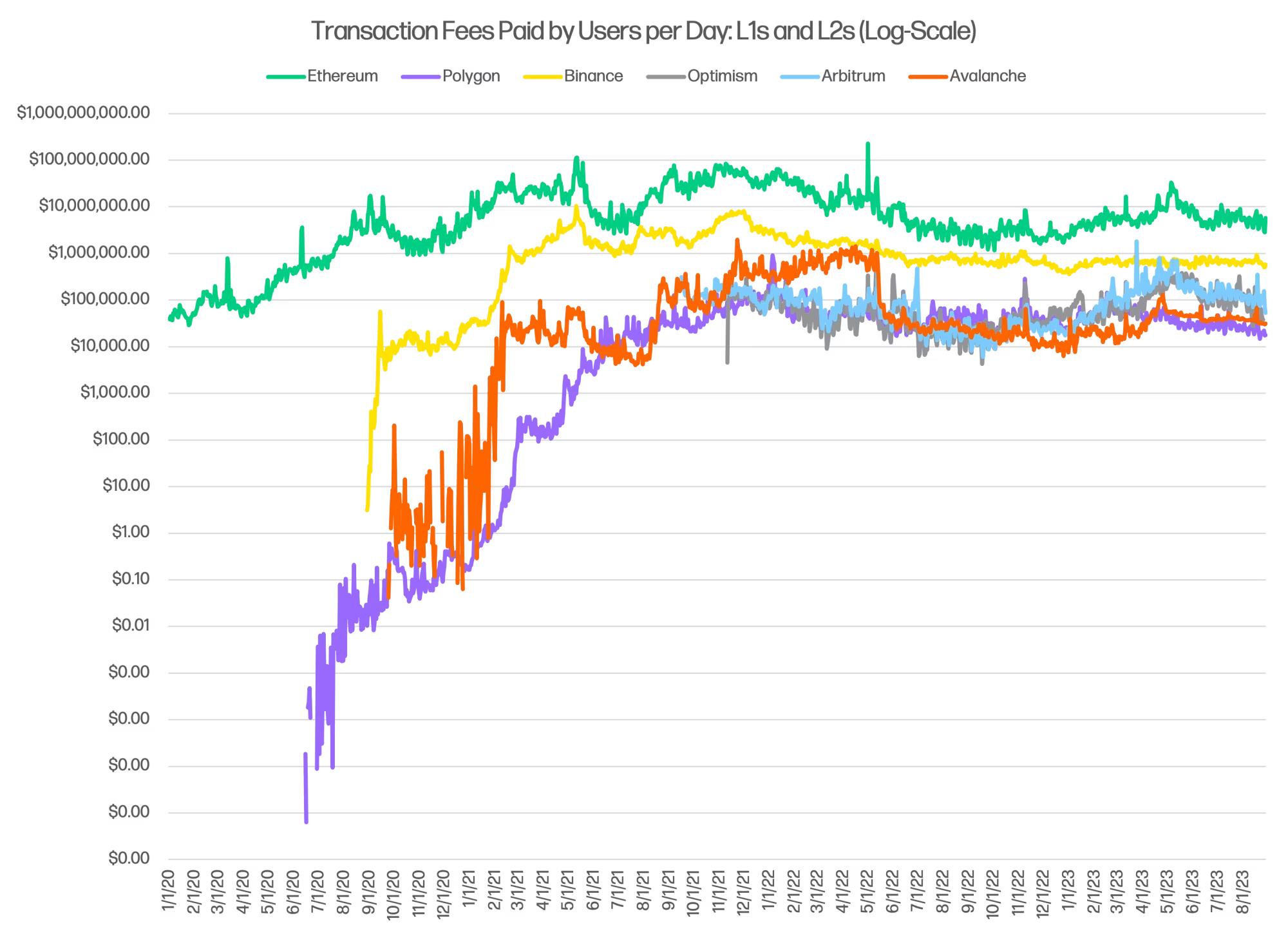
The amount consumers pay in transaction fees measures total demand for blockspace. As blockchain network effects grow (e.g., Polygon in late 2020), daily fees follow an exponential growth trajectory. While network effects exist, blockspace market share undergoes continuous internal rotation. For example, Avalanche and Polygon saw over 100% YoY fee growth in 2022, while Arbitrum and Optimism saw over 142% YoY growth in 2023, indicating a market sensitive to shifts in applications, developers, and users. On Ethereum, pricing was initially done via first-price auctions (consumers bidding to enter the latest block), now managed via EIP-1559 using a PID controller (prices dynamically adjust based on recent demand signals).
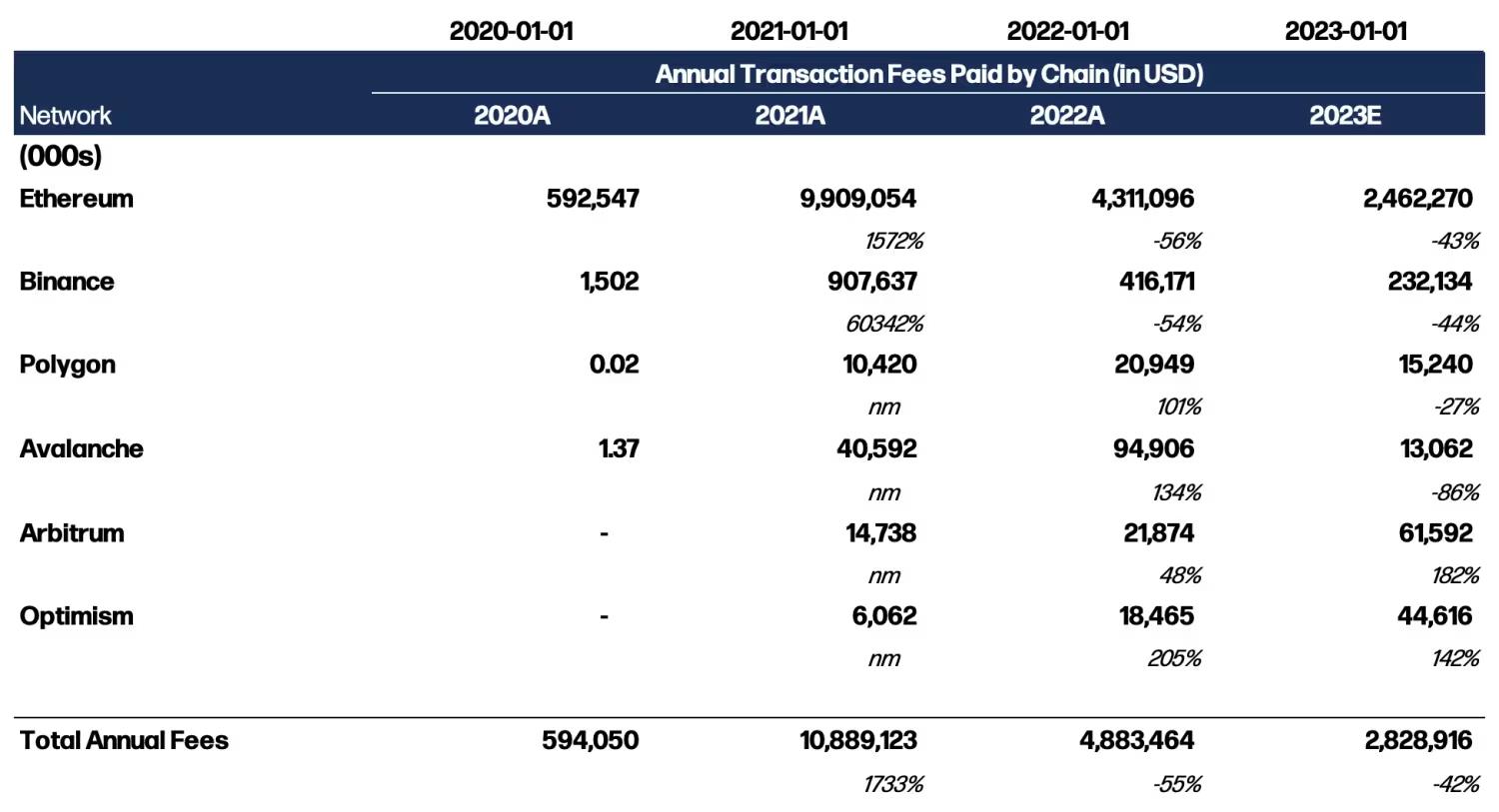
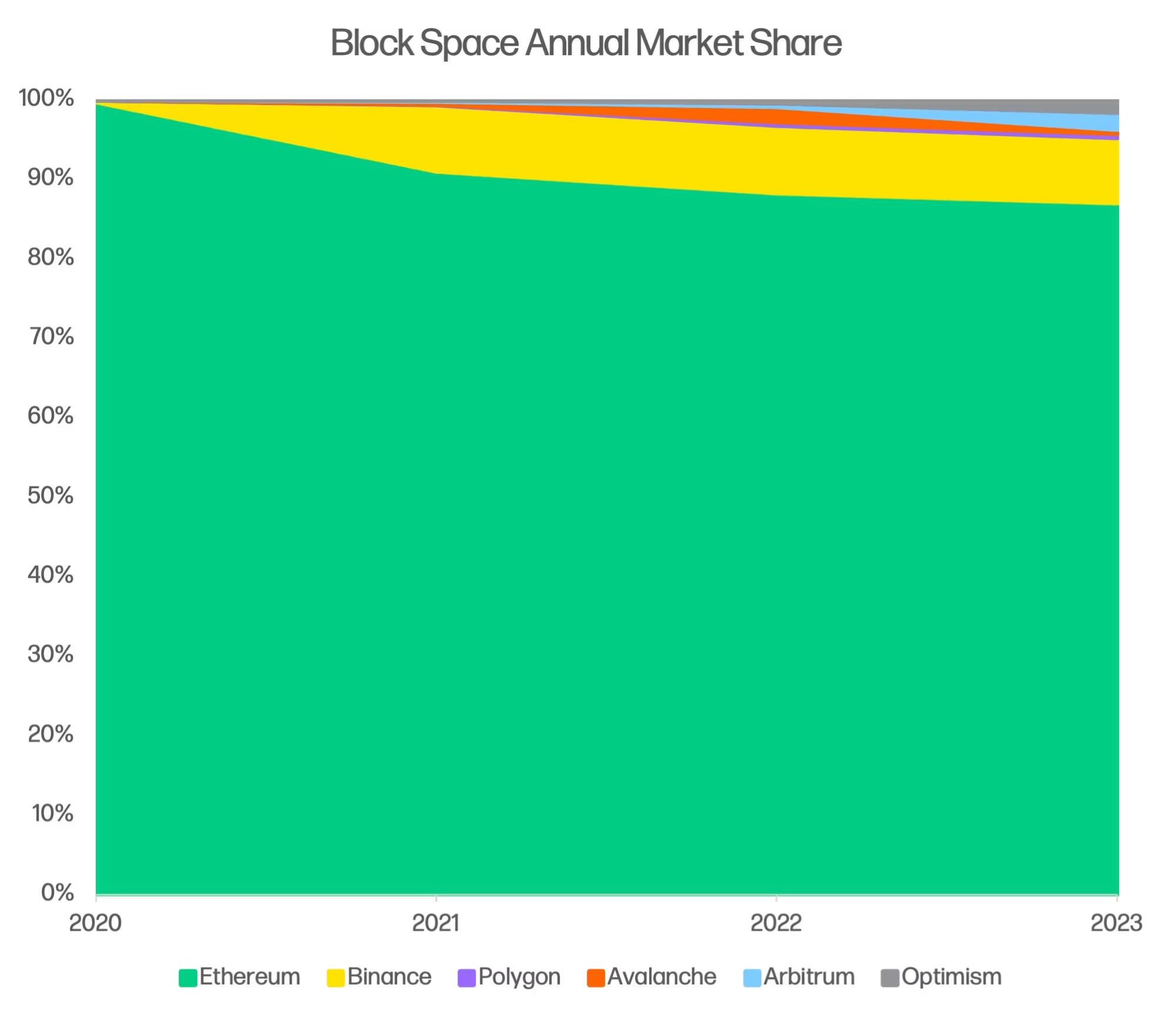
The above table, “Annual Blockspace Market Share,” shows annual transaction fees across six fee-charging blockchains (e.g., Solana). Total fees have trended downward since 2021, dominated by Ethereum, yet the overall blockspace market has grown at a 47.7% CAGR since 2020. Notable “rotation trades” include Alt-L1 rotation (and Polygon) in 2022 and rollup rotation in 2023.
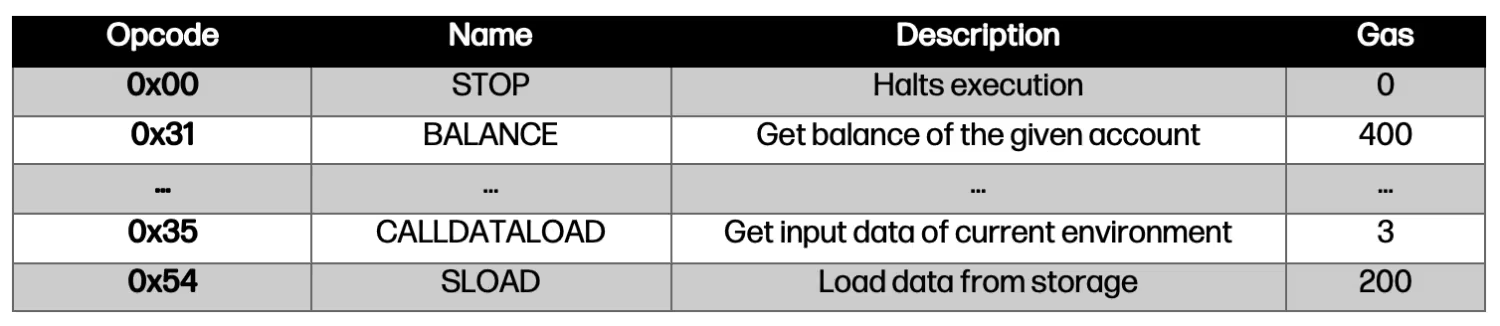
Consumers purchase access to resources on a per-transaction basis—effectively per-operation (“opcode”)—at the moment of execution. They buy rights to compute and bandwidth resources for a fixed duration and indefinite storage rights. In the Ethereum Virtual Machine (EVM), each operation carries a resource cost (gas), which is assigned a price during execution. The chart below shows notable EVM operations and their gas costs:
Another point worth noting is that this arrangement signals the emergence of a new business model paradigm. The uniqueness lies in consumers bearing the cost of accessing blockspace—reversing decades of startups and companies paying rack space or AWS bills to serve customers. Today, once deployed, blockchain applications can run at zero additional cost because users pay for execution. Account abstraction may lead future applications to cover user gas fees, returning blockspace costs to startups and enterprises—similar to today’s rack space and AWS model.
Does the Market Rationally Trust Long-Tail Blockspace More?
The ratio of market cap to annual transaction fees reflects how much value the market assigns to each dollar of fees generated by a blockchain network. A higher multiple means the market places greater trust in each dollar of paid fees within the market cap. Typically, higher multiples are given to assets perceived to have (i) stronger long-term growth prospects, (ii) better conversion of total revenue into profit (i.e., higher margins), and (iii) more stable and predictable future growth and profitability.
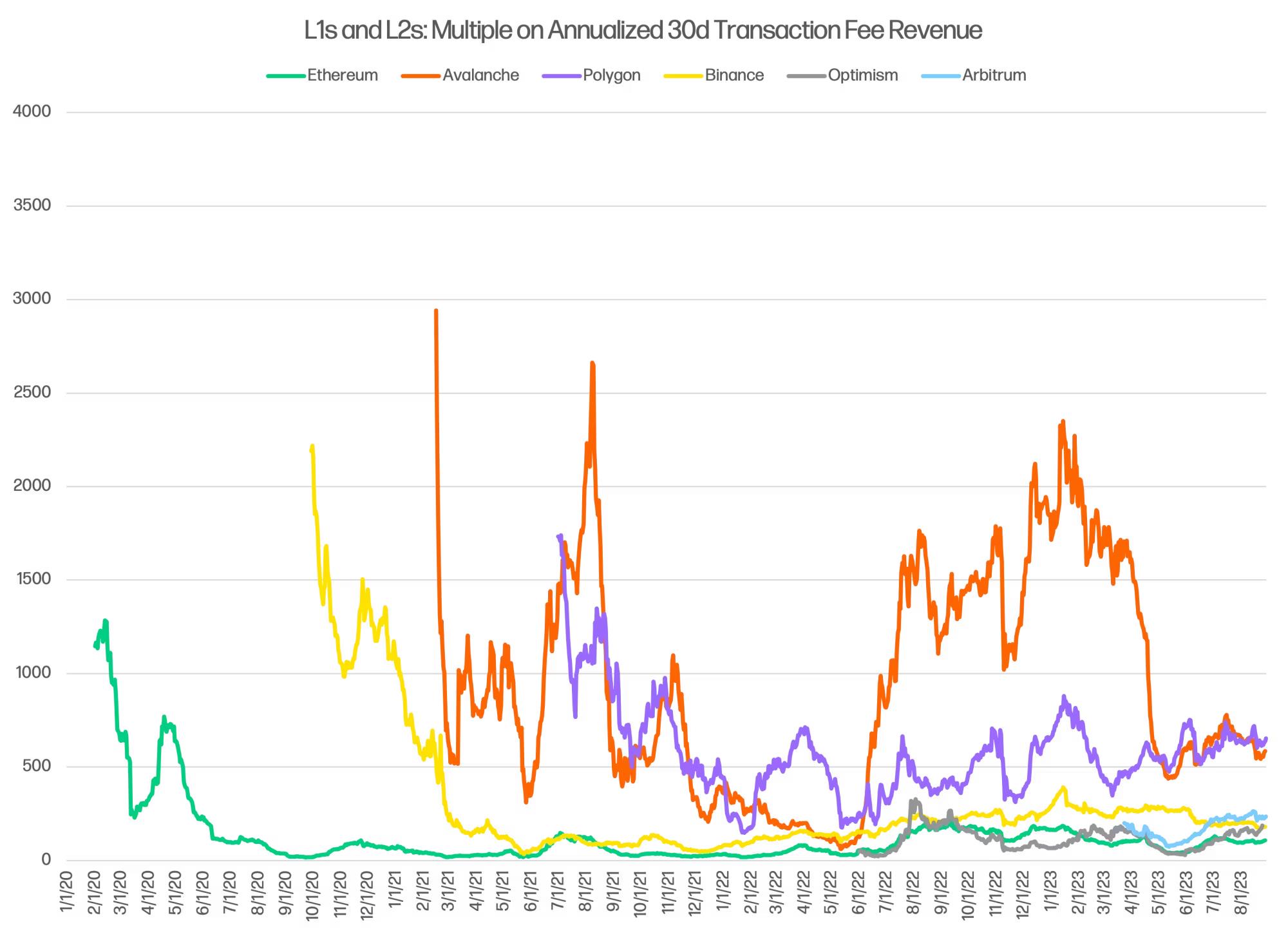
Using this multiple, the market values Ethereum’s “paid fees” at the lowest among the six blockchains—around 100x its annualized fees. At first glance, this seems counterintuitive: Ethereum is striving to become a “macro asset,” akin to Bitcoin, and should command a store-of-value premium plus currency premiums from deep liquidity, staking in protocols, and use as collateral on-chain. Compared to Avalanche, Polygon, Arbitrum, etc., the store-of-value premium should be higher. Qualitatively, Ethereum also boasts stronger, more durable network effects, which should support a relative premium.
On the other hand, the market may reflect Ethereum’s larger capacity constraints at ~15 TPS, and anticipate discounted fee growth over time. Ethereum’s fee growth can only come from rising gas prices, whereas Optimism and Arbitrum can earn more by scaling up and increasing demand. Moreover, currently, Ethereum is at a disadvantage as other chains capture its market share. Rotation toward new alternatives brings growth to places capable of supporting higher scale.
Cost of Blockspace Production
A deeper question isn’t how much blockchains earn per unit of blockspace, but what it costs to produce each unit. This is where the interesting differences lie.
Layer-1 blockchains like Ethereum and Avalanche use token incentives to generate the Sybil resistance required for consensus—proof-of-work and proof-of-stake. As discussed earlier, consensus and data availability are what differentiate blockspace from ordinary computing. The cost of incentivizing this mechanism is the expense L1s incur to create blockspace.
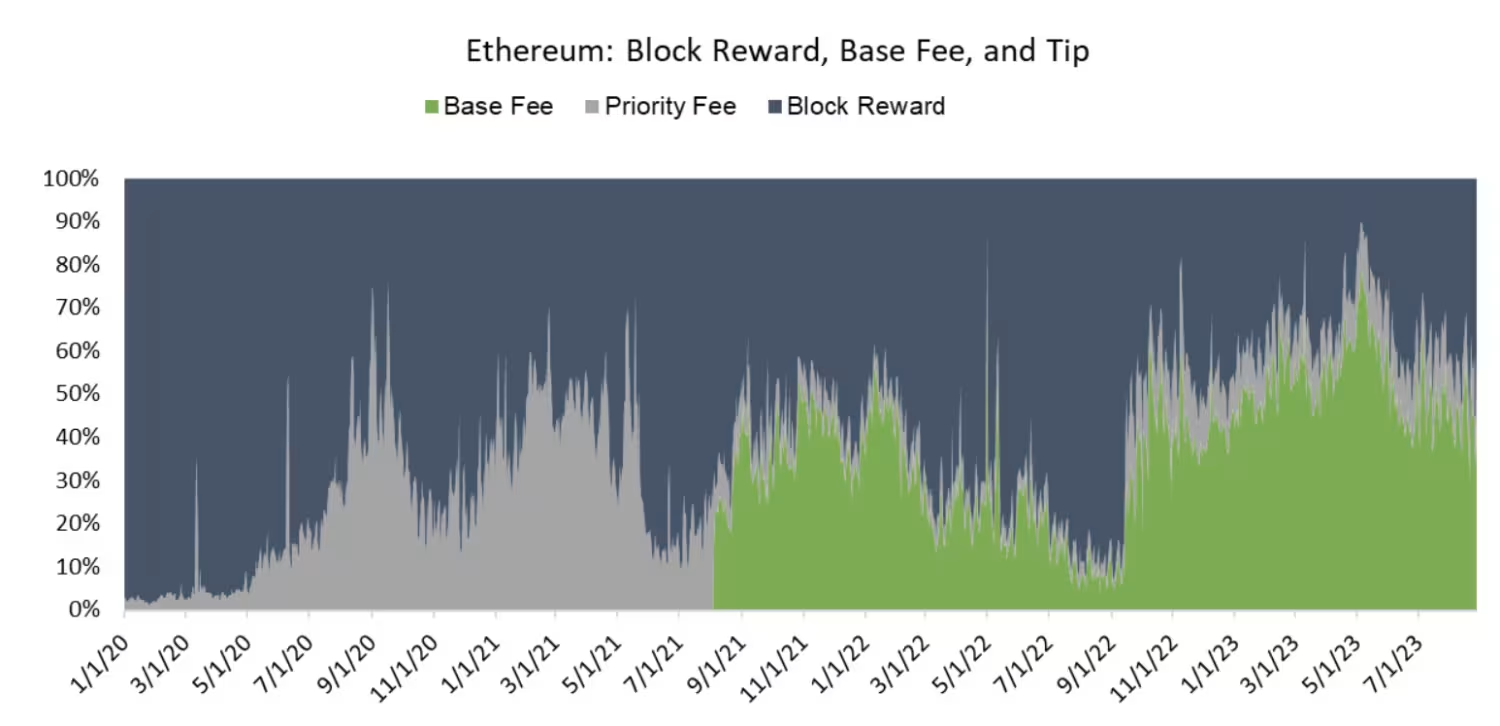
Each Ethereum block consists of base fee, priority fee, and block reward. Base and priority fees are components of transaction fees under EIP-1559. The base fee is burned by the protocol, reducing ETH supply, while the priority fee goes to validators. The block reward represents new issuance.
To incentivize block production under proof-of-work, Ethereum paid an average daily block reward of about 12,600 ETH, peaking at up to $60 million per day in new issuance to motivate blockspace creation. Under proof-of-stake, the situation is more complex: incentives are determined by a complex function, and since The Merge, Ethereum has paid approximately 1,850 ETH daily (scaling proportionally with validator count). In either case, these payments to miners/validators represent the cost of goods sold (COGS) for blockspace.
Describing Ethereum’s blockspace sales in income statement format. The following income statement converts transaction fees and costs (COGS) into USD for proper analysis, as users typically price transactions in dollars. Note that the Ethereum Foundation and associated researchers do not prioritize optimizing transaction fee revenue—it is not an explicit community goal. The goal is clearly the opposite: providing cheap and scalable blockspace.
There is a fundamental paradox in blockspace as a business model: supply constraints increase transaction fees but hinder the core L1 objective of low-latency, low-cost computation.
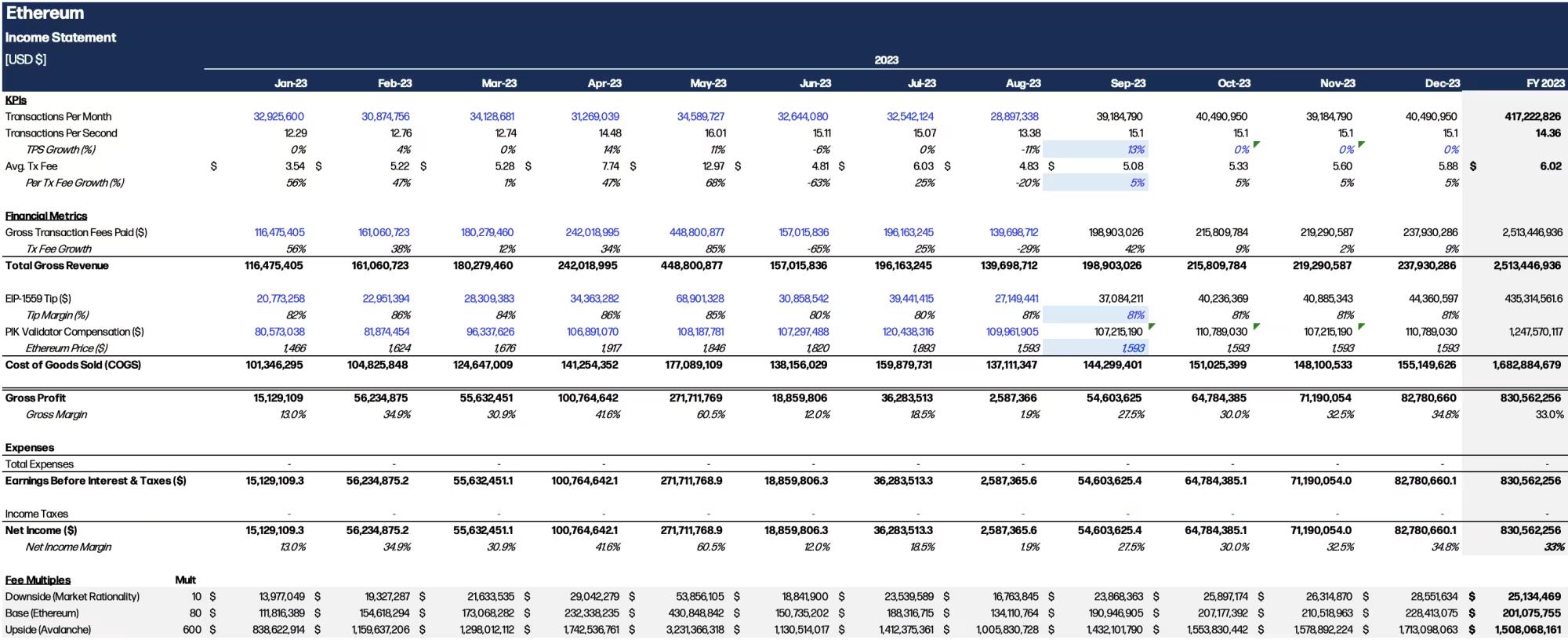
There’s much to discuss regarding this Ethereum income statement, but I’ll distill it into several key points:
1.Fees Must Grow to Maintain Throughput: Ethereum’s transaction throughput won’t exceed ~16 TPS in the foreseeable future, so its only path to revenue growth is increasing transaction fees. This could happen as economic density from L2 batching pushes fees upward.
2. Fees Are Highly Cyclical: Blockspace is not a business with fixed revenue (not yet). It’s highly dependent on user activity.
3. Net Profit Margin Equals Gross Margin: A unique feature of Ethereum and other blockchain networks is that they have no operating expenses (OpEx). All costs are direct costs of producing the product.
Rollups—the dominant form of Layer-2 solutions—do not require external token incentives to produce blockspace. Instead, they purchase it on-demand from Ethereum. Rollups move transaction execution off-chain and batch transaction data into Ethereum’s calldata. Calldata is simply a storage location used alongside EVM transactions.
By moving execution off-chain and batching results, rollups achieve greater scale. Their throughput is effectively unlimited, constrained only by demand and the order-of-magnitude data capacity Ethereum or systems like Celestia can provide to rollups.
Arbitrum Income Statement
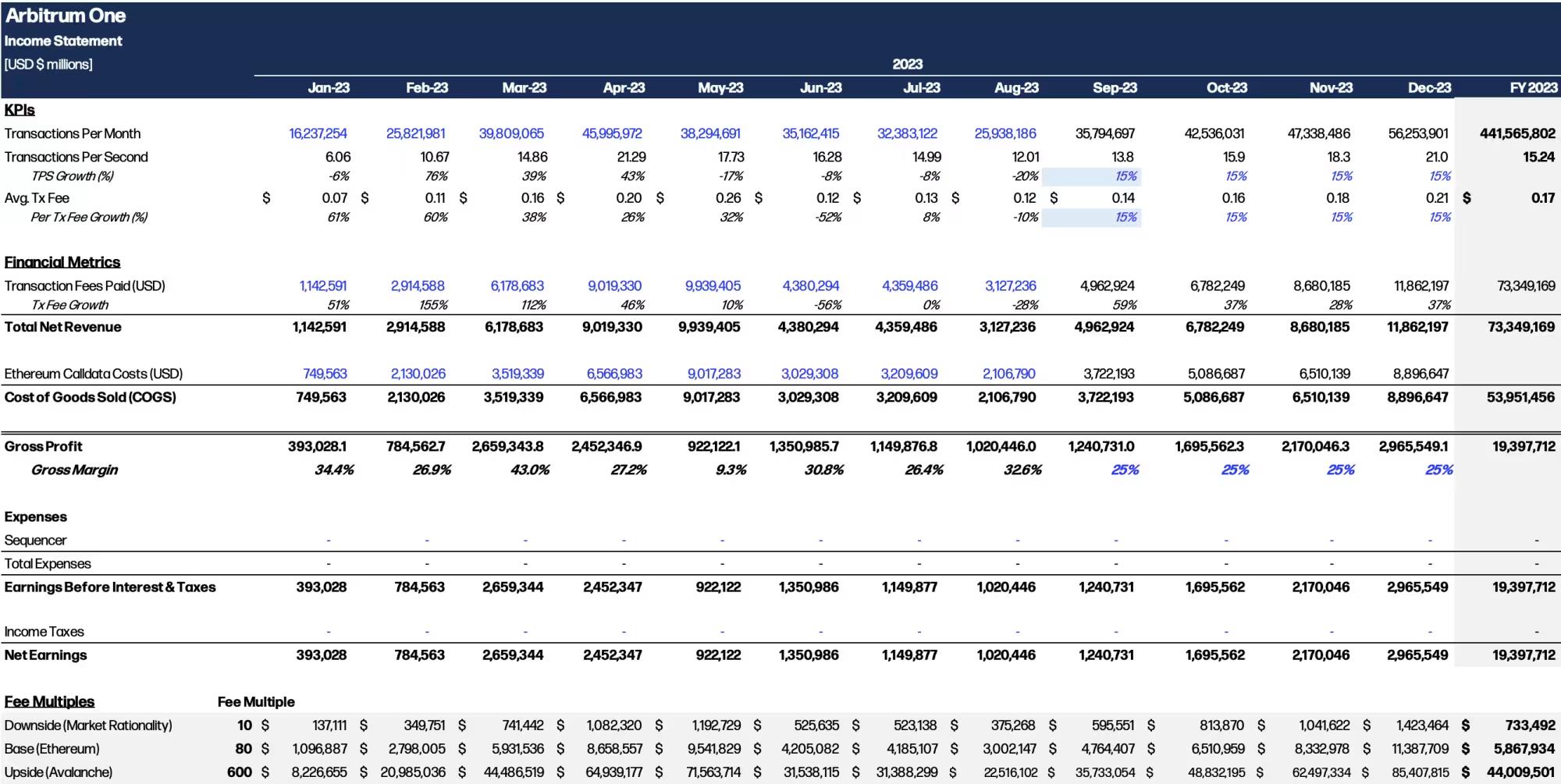
Like Ethereum, Arbitrum has relatively low gross margins, with transaction throughput showing over 30% monthly growth, reaching 21.3 tx/s. Key notes on the Arbitrum income statement:
1.Unlimited Upside Scale: Rollups have no hard scaling ceiling—at least not within several orders of magnitude of current throughput. Throughput is a function of application demand.
2.Sequencers: Currently, Arbitrum’s centralized sequencer—run by Offchain Labs—collects no revenue and passes protocol profits to the DAO (contributing 3,350 ETH to the DAO in May). Sequencer dynamics will evolve and impact the profitability of L2 blockspace sales.
3. Future Margins: In the next section, we’ll discuss changes to Ethereum and Celestia protocols that will reduce L2 calldata costs, lowering COGS for L2s and reducing Ethereum’s fees.
We see fundamental differences between L1s and L2s in blockspace production costs. L1s have variable revenue (fees) and fixed costs (block rewards), while L2s have variable revenue and variable costs. L1s are capacity-constrained (~15 TPS), with inconsistent gross margins (10%–60%), while L2s scale with user demand and maintain consistent ~25% gross margins—potentially rising above 75%.
How would public markets value a company growing revenues 3x YoY with 25% net margins? What if structural improvements could push net margins above 75%?
This is exactly where emerging developments like Arbitrum, Optimism, ZKSync, data compression, EIP-4844, and Celestia stand—innovations poised to drastically cut rollup data costs.
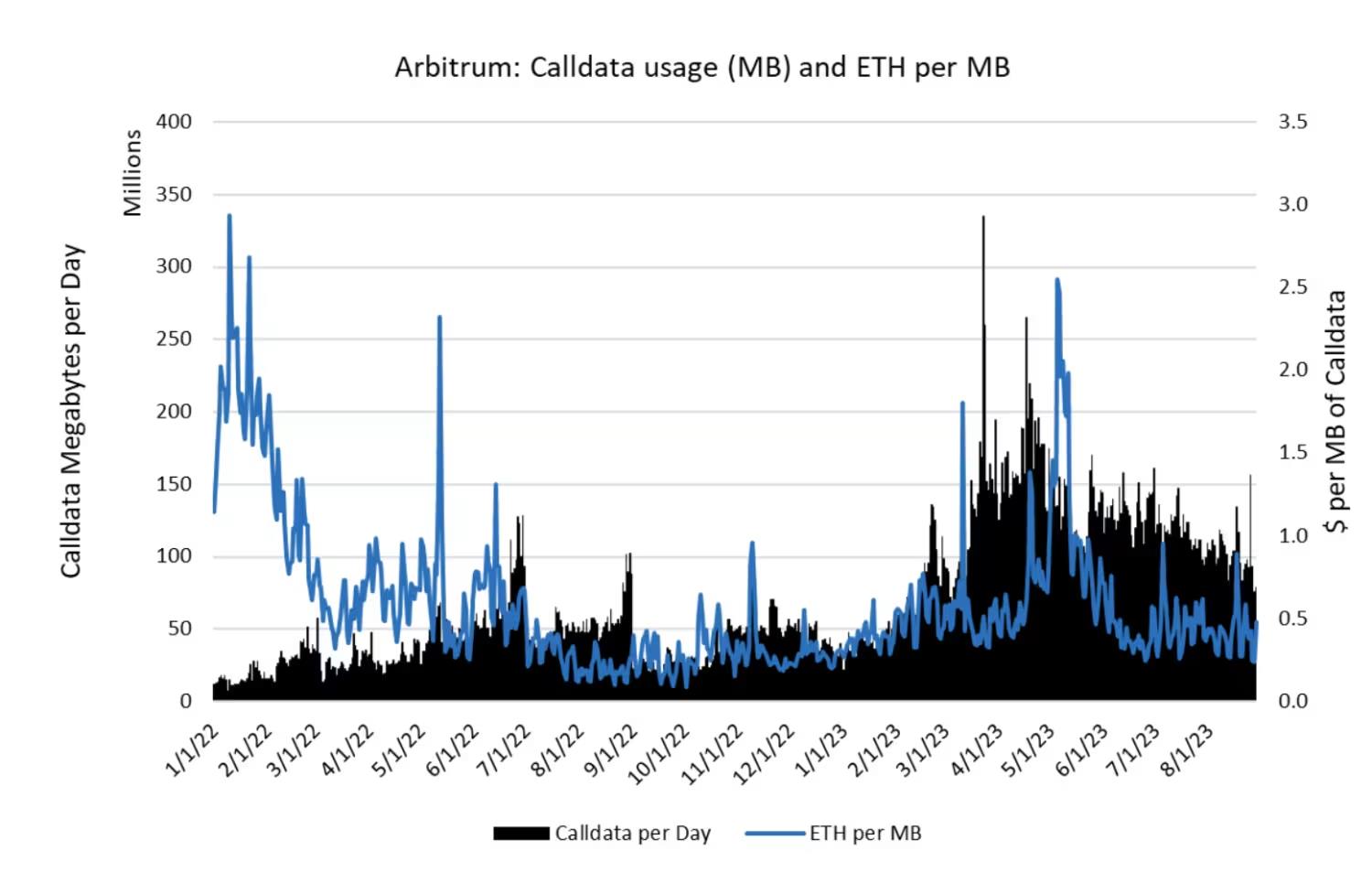
Calldata and Compression. Calldata is a data storage location attached to transactions; rollups use it to source data from Ethereum and store state data on L1.
In August 2023, Arbitrum posted 3.0 GB of data to Ethereum L1 calldata, down from a peak of 5.4 GB in May, at prices of $1,144 and $1,840 per MB respectively. Daily calldata usage closely correlates with daily transaction volume, while calldata prices fluctuate with market demand. Arbitrum’s May throughput equated to 2.2 kb/s, versus 1.2 kb/s in August.
Poorer compression means higher data costs for rollups—higher COGS on the income statement. Economically, rollups can (i) pass higher costs to consumers or (ii) accept lower gross margins amid higher COGS. Rollups still have ample room for further compression, including zero-byte compression, signature aggregation, and eventually stateless compression.
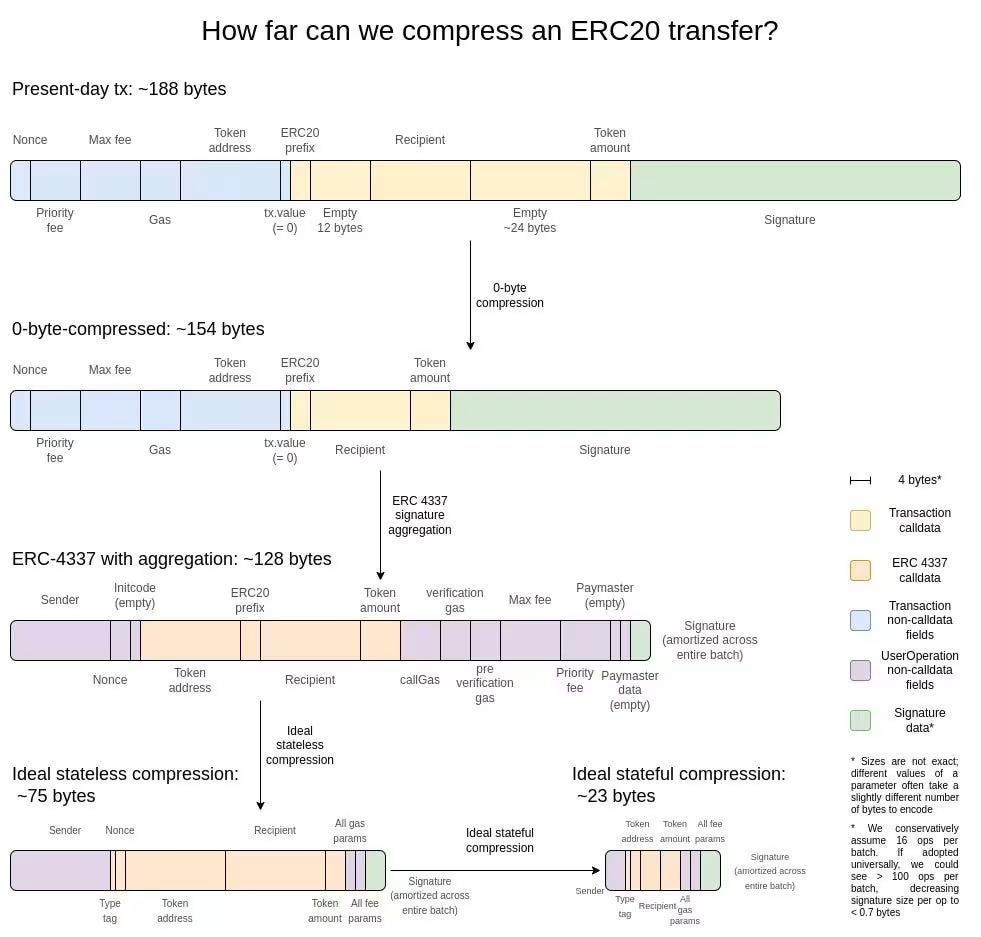
Compression has limits, so Ethereum and other blockchains like Celestia aim to reduce data availability costs. EIP-4844 is an Ethereum upgrade that will dramatically cut rollup data availability costs. The original EIP-4488 design reduced calldata cost from 16 gas per byte to just 3 gas per byte.
Ethereum researchers opted for the more complex EIP-4844, featuring two major adjustments:
1.Blob Space: Instead of placing rollup state directly into calldata, EIP-4844 creates a new “blob space” for rollup data—262 kB per block, or 21.8 kb/s. Currently, Ethereum provides ~175 kB per block, or 14.7 kb/s, giving rollups 1.5x data availability capacity in the short term. Over time, “blob space” will expand to 1 MB per block—5x capacity.
2. Multi-dimensional Fee Markets: EIP-4844 will also introduce separate pricing schemes for blobs and gas (normal Ethereum execution), meaning rollups will face blob gas prices dependent on rollup demand.
The exact impact of EIP-4844 on L2 data costs is hard to predict, but isolated resource modeling suggests 1.5–5x capacity increases, potentially reducing rollup COGS by over 4x over time. A 4x reduction in data costs would bring Arbitrum’s gross margin to 81%. In this scenario, rollups become an extremely exciting business model.
Conclusion: Blockspace as a Business Model
In summary, consumers purchase over $8 million worth of blockspace daily. The way blockchains coordinate the production of this commodity resource gives rise to a business model with unique characteristics: (i) high cyclicality and strong correlation with market volatility, (ii) poor gross margins but attractive operating profits, (iii) network effect-driven, and (iv) software-scale economics.
Is this a good or bad business? My current intuition is that blockspace sales represent a very exciting business model, with clear advantages (network-effect moats) and disadvantages (poor revenue quality due to cyclicality). Another clear downside is that existing regulations prevent these networks from retaining excess cash flows, making them difficult to fit into traditional asset frameworks. If the industry continues building stable application-layer use cases, blockchains with the strongest network effects—like Ethereum, Binance, Arbitrum, and Optimism—could eventually generate hundreds of billions in annual ‘Fees Paid’ revenue while maintaining positive gross and net profit margins. Capturing this excess value will likely involve distributing revenue to DAOs, as Arbitrum does today.
There’s an alternative view on L1, L2, and DA layer economics: the goal isn’t transaction fee revenue, but providing the cheapest blockspace to enable the best application layer. The theory holds that users will ultimately rally around the base assets (ETH, MATIC, AVAX, etc.) of winning platforms as stores of value.
While blockchains may compete on this front, it doesn’t seem like the right framework because (a) stablecoins exist, and mainstream users are more likely to store value in stablecoins rather than AVAX; (b) it’s self-evident that not every L1 token can become a SoV asset; and (c) L2s clearly aren’t participating in this race. The SoV narrative applies only to a few select assets (BTC, ETH, TIA, possibly SOL/other L1 tokens) and will manifest as a premium over their intrinsic economic value.
Finally, several avenues for further exploration remain:
1. Relationship Between MEV and Total Blockspace Value: One exercise is analyzing fee distribution to determine how much revenue stems from MEV activity. As a rough estimate, Proposer-Builder Separation (PBS) generated $247 million in annualized revenue as of April 30.
2. Value Accrual and Competition Among L2s: There are currently nearly 100 rollups, and with lower startup costs, we expect this number to grow from hundreds to thousands. Given the near-term capacity limit of ~22 kb/s between Ethereum and DA, we must consider how competition among L2s will unfold—likely requiring long-tail rollups to gradually adopt Celestia and EigenDA. We expect this competition to occur via COGS pricing.
Join TechFlow official community to stay tuned
Telegram:https://t.me/TechFlowDaily
X (Twitter):https://x.com/TechFlowPost
X (Twitter) EN:https://x.com/BlockFlow_News
 @galaxyhq











