








AMA Recap: The financial data market is huge, and Pyth was born to meet the data demands of the next generation of DeFi
TechFlow Selected TechFlow Selected
AMA Recap: The financial data market is huge, and Pyth was born to meet the data demands of the next generation of DeFi
Pyth Network is currently the largest first-party data oracle in blockchain, primarily focused on low-latency financial market data.
 Navigating Web3 tides with focused insights
On Monday this week, the $PYTH token officially launched on major exchanges. As a rising star in the oracle sector, what makes Pyth unique? And what innovative possibilities does the oracle token $PYTH hold? This Wednesday, we invited Ande from Pyth Data Association to join us for an in-depth discussion.
The conversation was divided into two parts. The first focused on Pyth Network’s underlying principles and core features. The second addressed market-related topics of interest, including Pyth’s recent market dynamics, exchange listings, and valuation. Below is a recap of this AMA session.
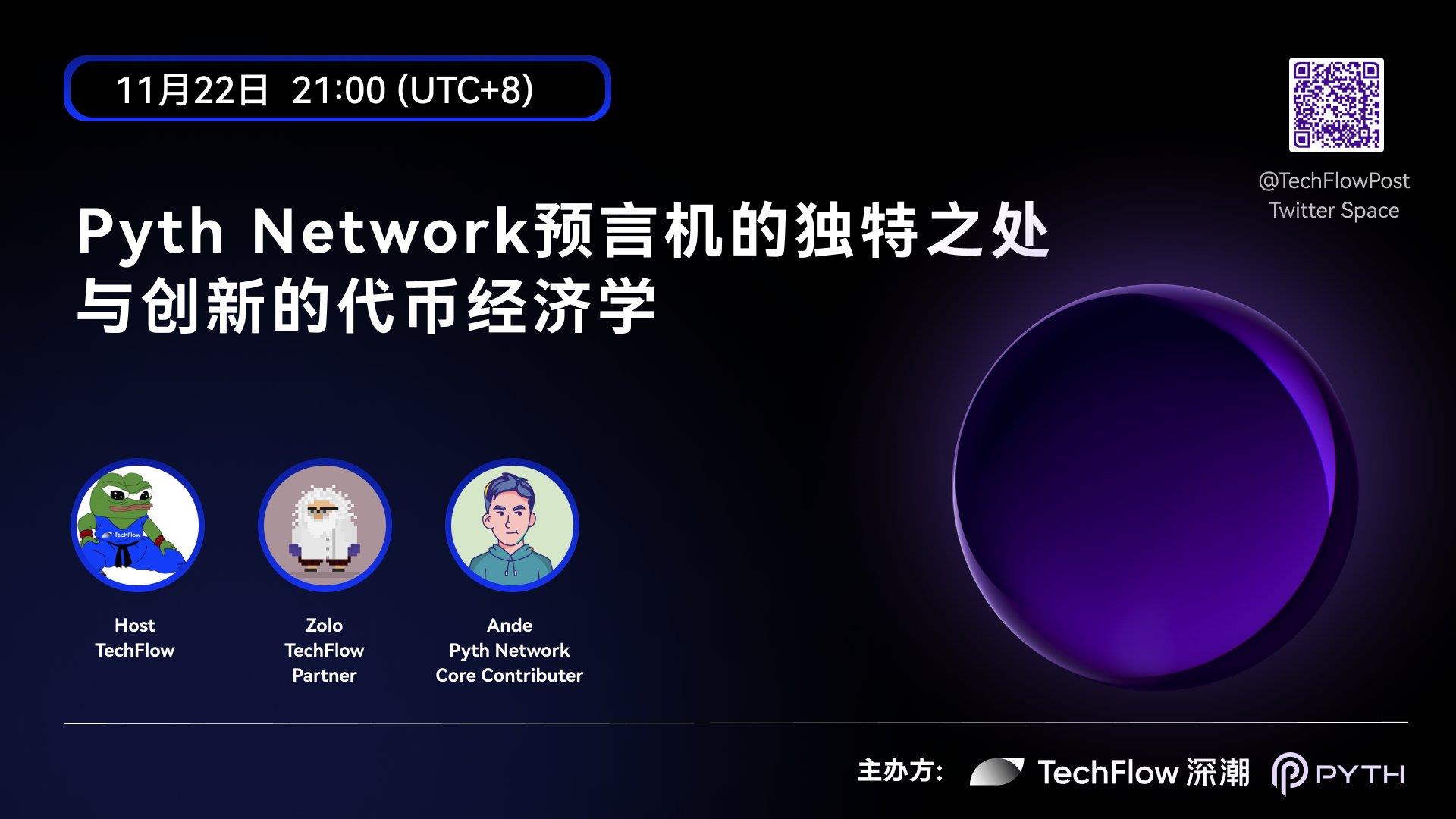
TechFlow: I’m Zolo from TechFlow. It’s a pleasure to have Ande from Pyth Data Association joining us today. On Monday, Pyth launched on major exchanges and attracted significant attention. Let’s start by inviting Ande to give a brief introduction about himself and share what Pyth Network is all about.
Ande: Hello everyone, I'm Ande from Pyth Data Association, a contributor to Pyth Network, primarily responsible for market and partnership development. I'm honored to be invited by TechFlow to participate in today's AMA.
Pyth Network is currently the largest first-party data oracle in blockchain, focusing primarily on low-latency financial market data. We collect this financial market data directly from primary sources, process it through on-chain aggregation algorithms, and publish it across more than 40 blockchains. Oracles serve as essential data middleware because the on-chain world is inherently isolated—we can't directly access off-chain data to feed decentralized applications (dApps). However, dApps, especially DeFi protocols, require real-world data to execute transactions and drive innovation.
Oracles bridge this gap by transporting real-world data onto the blockchain at regular intervals and standardized formats, enabling dApps to integrate and utilize it. Data itself is a critical foundation for DeFi innovation, and oracles play a pivotal role in making this possible.
Pyth Network launched its V1 version in 2021, starting on Solana, where within a year it captured over 90% of Solana’s DeFi market share. In late 2022, Pyth released its V2 version—its cross-chain model known as Pythnet. In less than a year since then, Pyth’s price feeds have been integrated into over 40 different blockchains, supporting more than 200 distinct types of dApps. Pyth offers over 350 unique price feeds, all accessible across these 40+ blockchain ecosystems.
TechFlow: Thank you, Ande. I personally first learned about Pyth back in 2021 when you likely had fewer clients and far less visibility. When people think of oracles, ChainLink immediately comes to mind. You mentioned Pyth is now the largest first-party data oracle network in blockchain. Could you explain why Pyth is needed despite the existence of other oracles like ChainLink, and how your core mechanisms differ?
Ande: Fundamentally, Pyth acts as an intermediary with data providers upstream and data users downstream—both sides present opportunities for innovation in the oracle space.
From the data source perspective, there's a common misconception that financial data is free and readily available from public sources. Contrary to this belief, financial market data is actually highly valuable and typically not free. In 2023 alone, the traditional financial data market exceeded $6 billion USD.
In traditional finance, institutions like the Hong Kong Stock Exchange, Nasdaq, and specialized data firms such as Bloomberg treat data as their core business. This data is extremely valuable and must be purchased for professional use. So, data inherently holds value—unlike other types of information freely available online. But where does this valuable financial data originate?
Financial data comes from exchanges, market makers, and various financial professionals—such as hedge funds engaged in high-frequency trading or daily operations that generate real-time market data. For example, exchanges provide bid-ask spreads and real-time asset prices. Large HFT firms contribute execution-level trade data generated through their operations. These entities can monetize their proprietary data, making it a valuable commercial asset.
Similarly, in crypto and Web3, while data may seem free, it carries immense value. All of Pyth Network’s data comes directly from first-party sources. We don’t rely on third-party nodes that might scrape data from unknown origins. Instead, we partner directly with original data owners—inviting them to consistently publish high-frequency, accurate financial data to ensure reliability, freshness, and stability.
Once collected, Pyth aggregates this data on Pythnet to generate composite price feeds derived from multiple trusted sources. After processing, this data becomes available for downstream dApps. To access it, applications send requests via smart contracts directly to Pythnet—a key architectural difference.
Traditional oracles operate on a push model, broadcasting data periodically to every connected dApp across multiple chains. While manageable at small scale—say, feeding 200 apps or 50–60 chains—the cost grows exponentially when scaling to thousands or tens of thousands of applications. If future DeFi expands to millions of apps across hundreds of blockchains, continuous data pushing becomes economically unsustainable.
DeFi has the potential to grow into a multi-billion or even trillion-dollar industry. The traditional push model simply cannot scale to meet those demands. That’s why Pyth innovated a pull-based oracle architecture: instead of pushing data everywhere, we maintain and update it centrally on Pythnet—an application-specific chain dedicated to data processing. Any DeFi app, on any supported chain, can pull the latest data only when needed.
This design enables infinite scalability. The oracle doesn’t bear growing operational costs tied to broadcast frequency, significantly reducing system load. Freed from bandwidth and cost constraints, we can focus entirely on improving data quality, increasing update frequency, and expanding our network of first-party publishers—all while maintaining high accuracy and stability. Additionally, access is permissionless: any dApp can seamlessly retrieve data without prior coordination. This represents one of Pyth’s most important innovations.
In summary, two major innovations define Pyth: First, sourcing data directly from trusted first-party providers ensures data integrity and credibility. Second, our pull-based model allows seamless scalability to support future growth across billions of DeFi applications.
TechFlow: One particularly interesting point you made is that Pyth accesses first-party data directly from sources and supports large-scale financial data infrastructure. From an end-user perspective—when using DeFi protocols powered by Pyth—how do these technical advantages translate into tangible user experience improvements?
For instance, I’ve seen community members recommend using Pyth-powered platforms for derivatives trading due to faster updates. Could you provide concrete examples illustrating how users benefit from using Pyth-integrated products?
Ande: To understand the necessity of oracle innovation—and the evolution of DeFi—we can break it down chronologically.
During the initial DeFi Summer in 2020, early applications emerged—DEXs, AMMs, basic lending protocols. At that stage, on-chain transaction frequency placed relatively low demands on data update speed.
For example, many DEXs operate order books or AMMs that either don’t require external price feeds or tolerate some slippage. Users set acceptable price ranges, and trades execute based on supply-demand imbalances or pool token balances—no need for real-time pricing.
Lending protocols also didn’t demand frequent price updates. Accurate asset valuation was only required during liquidations, which occur infrequently.
However, we’re now entering a new phase of DeFi innovation—beginning around late 2021 through 2023—where advanced financial instruments are emerging. A prime example is perpetual futures (Perps) on-chain. Perpetuals are derivative contracts whose viability depends entirely on real-time tracking of underlying asset prices. Without continuous, accurate external price feeds, reliable on-chain derivative execution is impossible.
At this stage, data accuracy and high-frequency updates become mission-critical. Legacy oracle solutions designed for earlier-generation DeFi no longer suffice—they weren’t built for high-speed, cross-chain, or ultra-accurate data delivery. As DeFi evolves, so must oracles.
This is where Pyth’s innovation shines. Our model enables near-instantaneous access to fresh, accurate financial data. Using a pull-based approach with data maintained on Pythnet, dApps fetch updates only when needed—with minimal latency.
Take Synthetix—one of Pyth’s largest consumers—as an example. Platforms like Kwenta and Polynomial, built on Synthetix, offer perpetual futures trading. When executing a trade, here’s how it works:
First, the user submits an order. Synthetix then pulls the most up-to-date price feed from Pythnet to determine execution price. If there's even a 3–4 second delay in price delivery, the trade executes based on outdated information. In fast-moving markets, prices can swing dramatically within seconds—making such delays unacceptable.
Pyth leverages Solana’s technology stack to achieve sub-second price updates—approximately every 400 milliseconds. Combined with the pull model, when a user initiates a trade, Synthetix timestamps the request and retrieves the current price from Pythnet in under a second, ensuring precise settlement.
All of this happens at a precise moment—say, exactly at 8:01:01 AM—minimizing execution risk caused by price lag. This level of precision addresses a fundamental challenge posed by next-gen DeFi. I believe Pyth uniquely meets the demanding data requirements of modern DeFi applications, and this use case clearly demonstrates its value.
TechFlow: Interest in Pyth continues to grow. Many users were surprised to learn Pyth already supports over 200 protocols. I first discovered Pyth in late 2021. Over the past two years, what key milestones has Pyth achieved, and how did you navigate the bear market? We're also curious about your team—could you tell us more about Pyth’s journey and the people behind it?
Ande: Thank you. All information about the Pyth team is publicly available on the Pyth Data Association website. Our core contributors come from diverse backgrounds. For example, CEO Mike Cahill has deep roots in traditional finance—he previously worked at Morgan Stanley and later Jump Trading, focusing on securities structuring, HFT strategies, and developing novel financial products before transitioning into blockchain-based financial research.
Many engineers come from leading tech companies like AWS, Microsoft, Google, or top-tier high-frequency trading firms. While our team is diverse, we share a common thread: deep expertise in fintech and traditional finance. I can confidently say every member of the Pyth team understands the mechanics of financial systems. As I mentioned earlier, a widespread misconception is that data today is worthless or freely accessible online—but reality tells a different story.
Financial data constitutes a massive global market. For example, no individual can freely access real-time U.S. stock market data. Publicly available data is delayed by six hours. To get live feeds, you must pay the data owners—like Nasdaq—which generates billions annually from data licensing.
This insight forms the foundation of Pyth’s philosophy: financial data is inherently valuable, contrary to the assumption in the big data era that all digital information should be free. Most non-financial professionals assume data lacks commercial value, leading many to overlook data sourcing as a bottleneck for oracle innovation.
But this is precisely what sets Pyth apart. We recognize the intrinsic value of accurate, high-frequency financial data. By acknowledging this upfront, we invest heavily in securing direct partnerships with first-party data producers—ensuring data accuracy at the source. This foundational principle enabled our entire innovation pipeline.
Put simply, our team deeply understands finance and applies cutting-edge technology to bring core elements of traditional finance on-chain. We believe DeFi and TradFi aren’t opposing forces. Rather, they will eventually converge. There may come a time when we no longer distinguish between TradFi and DeFi—the entire financial world will integrate, allowing traditional finance to leverage the efficiency and accessibility of on-chain systems.
Conversely, DeFi must learn from centuries of financial innovation—mature practices, risk models, and product designs—so that anyone interacting with financial services, whether on-chain or off-chain, enjoys a seamless, familiar experience. This is the future we envision.
With this vision in mind, the team spent over five years preparing before launching the mainnet. Even before the 2021 launch, we spent more than a year laying the groundwork, enabling rapid ecosystem growth post-launch. Since then, we've evolved from V1 to V2, expanded to over 40 blockchains, onboarded 90+ first-party data publishers, and integrated with 200+ dApps—all continuously adopting Pyth data.
Looking at our growth curve and product innovation trajectory, Pyth is accelerating. Once network effects take hold, our pace of growth, innovation, and capability will only increase. This is where Pyth stands today.
TechFlow: Thank you, Ande. Now let’s shift to market and token-related questions. We know Pyth emphasizes a positive-sum business model and highlights various utilities of its token. How do you view the utility of the Pyth token within the overall ecosystem? And how does $PYTH compare to tokens like $LINK?
Ande: Detailed information about tokenomics and design is available in Pyth’s whitepaper and official documentation. Interested readers are encouraged to review those resources directly.
To summarize briefly: Pyth is the only oracle in the sector with fully decentralized, on-chain governance. Alongside the token listing, we launched a permissionless governance system. Users can stake PYTH tokens 1:1 to gain voting power—though governance structures may vary across projects.
Governance is taken very seriously because Pyth DAO is one of the few legally registered DAOs in the industry, formally established as a DAO entity. As outlined in the whitepaper, governance determines key parameters of the network. For example:
- The fee that downstream protocols pay to update Pyth data is governed.
- New price feeds are added via governance proposals.
- Data publisher onboarding requires governance approval.
- Future product developments or feature changes are subject to governance decisions.
Staking PYTH grants meaningful influence over these decisions. Moreover, Pyth’s business model differs fundamentally from traditional oracles. Legacy models resemble Web2: a dApp wanting data must contact the oracle provider and sign a formal contract—a classic service-for-payment arrangement.
Pyth, however, operates natively in Web3. Integration is entirely permissionless. Any dApp can access Pyth’s open APIs and integrate data without contacting the team. What’s required? Simply paying a small data fee on-chain each time a price update is pulled. This fee is determined by governance.
Thus, Pyth’s revenue scales with usage: the more price updates pulled, the higher the fees collected. This process is fully transparent, trustless, and on-chain. Every update is a visible transaction—anyone can verify details and fees via blockchain explorers. This reflects Pyth’s true innovation: a native Web3, permissionless business model.
Within this framework, PYTH tokens serve multiple roles. They act as payment for data fees. Future use cases—such as data staking or claims—will be decided through governance. If the community sees value in introducing staking to enhance token utility and reward holders, a proposal can be submitted. Upon approval, the feature becomes part of the network. Everything evolves organically through decentralized decision-making.
TechFlow: Binance just launched Pyth perpetual contracts, and the price has already surpassed $0.42. Some investors compare $PYTH to $LINK using metrics like circulating market cap or FDV. Do you see any flaws in such comparisons? How should one better evaluate the value of the Pyth token?
Ande: We refrain from commenting extensively or offering financial advice. As participants in the oracle market, some comparison is inevitable.
However, users can refer to objective metrics. Pyth is the largest first-party data oracle. In terms of total dApp integrations, Pyth ranks second among all oracle networks. These are factual benchmarks you can analyze alongside tokenomics and other data to form your own assessment.
TechFlow: Pyth’s token launch received massive attention, yet it wasn’t initially listed on Binance or major Korean exchanges. Can you share any plans regarding future exchange listings?
Ande: Exchange listings aren’t coordinated through direct negotiations. Pyth had no prior communication with Binance regarding the perpetual contract listing. I personally found out only after the announcement was made public. Nearly all exchanges independently chose to list PYTH following our November 20 airdrop announcement.
This wasn’t a result of active outreach or negotiation. Instead, exchanges observed that 15% of PYTH tokens were already circulating and decided to list based on market activity. Their confidence stems from anticipated liquidity and demand.
All we can confirm is that these listings are legitimate—not scams. Whether Pyth will appear on additional exchanges depends solely on each exchange’s internal decision-making process, not ours. We welcome broader availability, but timing remains in their hands.
TechFlow: OK, thanks. I recall you haven’t officially disclosed any fundraising details, correct?
Ande: That’s correct—we have not disclosed any fundraising information.
TechFlow: We’ve noticed many top-tier institutions—including exchanges and market makers—are Pyth partners or publishers. Many users believe that having major market makers involved naturally supports price stability. How do you view this? What specific role do market makers play in your partnership ecosystem?
Ande: Our only relationship with these entities is as data publishers. All collaboration is strictly limited to this function—there are no other operational or strategic partnerships. As I mentioned earlier, exchange listing decisions are made independently based on their own analysis.
These financial institutions are first-party data owners. Our sole objective is to securely obtain their data and deliver it to on-chain DeFi applications. Any perceived alignment beyond data publishing isn’t something we coordinate or control—I can’t provide further insights.
Partnership begins and ends with becoming a Pyth data publisher. Publishers receive a portion of the data usage fees, aligning incentives: the more Pyth is adopted by on-chain and off-chain protocols, the greater the return for publishers. In this sense, our interests are aligned. They are free to make independent decisions based on this economic incentive.
TechFlow: Thank you. One final question: as discussed, PYTH token holders can participate in governance and potentially earn rewards. What are Pyth’s long-term development plans? And how can ordinary users get involved in Pyth’s future growth?
Ande: Regarding long-term plans, the token listing is a significant milestone—but it hasn’t altered our core development roadmap. As an infrastructure project, our focus remains simple: continuously advancing our technical capabilities and driving innovation in on-chain financial data. We’ll keep launching new price feeds, onboarding more publishers, and expanding data diversity.
We plan to gradually introduce traditional financial data—U.S. equities, stock indices, commodities, forex, and more.
Currently, Pyth delivers real-time price feeds. Looking ahead, we’ll expand into new product areas. For example, many protocols require random numbers—Pyth will offer a randomness product. We’re also exploring on-chain risk management tools, including a “liquidity oracle,” among other initiatives still in research and development. Everything we build centers around enhancing on-chain financial data infrastructure.
For users who want to get involved: stay informed, actively participate in governance, and consider integrating Pyth data into your own projects. Your engagement helps shape the future of decentralized finance.
TechFlow: Thank you so much for your insightful answers and sharing. We look forward to Pyth Network’s continued growth and success.
Join TechFlow official community to stay tuned
Telegram:https://t.me/TechFlowDaily
X (Twitter):https://x.com/TechFlowPost
X (Twitter) EN:https://x.com/BlockFlow_News
 深潮TechFlow


