The Three-Way Battle Among BTC, ETH, and Solana Ecosystems
TechFlow Selected TechFlow Selected
The Three-Way Battle Among BTC, ETH, and Solana Ecosystems
Ethereum is facing real competition from Solana as a public blockchain.
 Navigating Web3 tides with focused insights
Author: muneeb.btc
Translated by: SevenUp DAO
1. The competitive dynamics between BTC and ETH are unfolding
In 2021, Ethereum was framed around two key narratives: “ultrasound money” leading to deflation and “flippening”—overtaking Bitcoin.
Currently, the competitive dynamic between Ethereum and Bitcoin has shifted significantly. Since 2021, three new variables have emerged:
(1) Bitcoin has gained broader recognition as the sole inflation hedge and store of value—institutional investment in Bitcoin far exceeds that in Ethereum.
(2) Ethereum is now facing real competition from Solana as a smart contract platform. In 2021, Ethereum dominated the L1 space, but it now faces genuine competition in this market.
(3) Layer-2 solutions for Bitcoin are emerging, challenging the narrative that Bitcoin cannot be used to build applications or that it isn’t a productive asset.
This is not an article about the demise of Ethereum. Ethereum may still have substantial growth potential and has already added immense value to our industry. The goal here is to analyze shifting dynamics and the new landscape.
2. Core attributes of both assets are becoming increasingly distinct
Bitcoin—the inflation-resistant asset
Bitcoin vs. Ethereum: Bitcoin (BTC), as an asset, has more clearly become the primary inflation hedge. Several factors have contributed to this:
(1) Bitcoin’s fixed supply cap of 21 million coins is simpler and more compelling than Ethereum’s dynamic supply post-Merge.
(2) Due to Ordinals, Bitcoin transaction fees have increased fiftyfold, undermining arguments against Bitcoin’s base-layer security.
(3) Institutional adoption of Bitcoin (MicroStrategy, BlackRock, etc.) is far ahead of any altcoin competitor.
Ethereum—the smart contract leader
As a blockchain platform, Ethereum’s market primarily revolves around decentralized applications. Much of the “disruption” narrative is based on growing developer and user activity on Ethereum (e.g., increasing fee revenue). In 2021, there were no real competitors in this space. Other layer-1 chains were dismissed as “ghost towns,” “too small,” or “insecure.” Solana changed that. Other contenders are also rising. Solana’s success also impacts another dimension—the dominance of the EVM. As Solana is not EVM-based, it demonstrates how non-EVM solutions can capture market share.
3. A three-way battle among BTC ecosystem, ETH, and Solana
The bilateral war between Ethereum and Solana
What was once a one-sided battle between Ethereum and Bitcoin has evolved into a two-front war, with Solana joining the fray.
Solana brings increased competition to Ethereum, while the resurgence of Bitcoin developers has driven growth in Bitcoin developer activity and fee markets.
Much of Ethereum’s new user growth will likely occur on its layer-2s like Arbitrum and Optimism. Meanwhile, Bitcoin’s layer-2 solutions, such as the upcoming Stacks Nakamoto upgrade, allow developers and users to run applications on a full virtual machine, with Bitcoin serving as freely transferable assets on the second layer. Solutions like BitVM can greatly enhance trust assumptions for moving value between Bitcoin’s layer-1 and layer-2 without requiring any upgrades to Bitcoin’s base layer.
The three-way battle: BTC ecosystem, ETH, and Solana
The revival of Bitcoin development is happening both at the base layer (Ordinals, BitVM, etc.) and on layer-2s (Stacks Nakamoto, sBTC, ZeroSync, and other emerging rollup projects).
As Bitcoin’s layer-2 solutions and base-layer projects mature further, Ethereum’s two-front war could evolve into a three-way battle:
(1) Bitcoin as an inflation hedge versus Ethereum’s deflationary “ultrasound money” narrative
(2) Solana’s scalability competing against Ethereum’s layer-1 usage, and finally
(3) Bitcoin layer-2s versus Ethereum layer-2s. Currently, this last category is the smallest, but it may mature significantly in 2024.
However, increased competition for Ethereum benefits the industry and decentralization.
4. BTC L2s aren't easy—they still face a trilemma
Bitcoin’s layer-2s, a crucial part of the three-way battle, also face their own “impossible trilemma.”
Among three ideal properties:
(a) Open network
(b) No new token
(c) Full/global virtual machine
developers can only choose two.
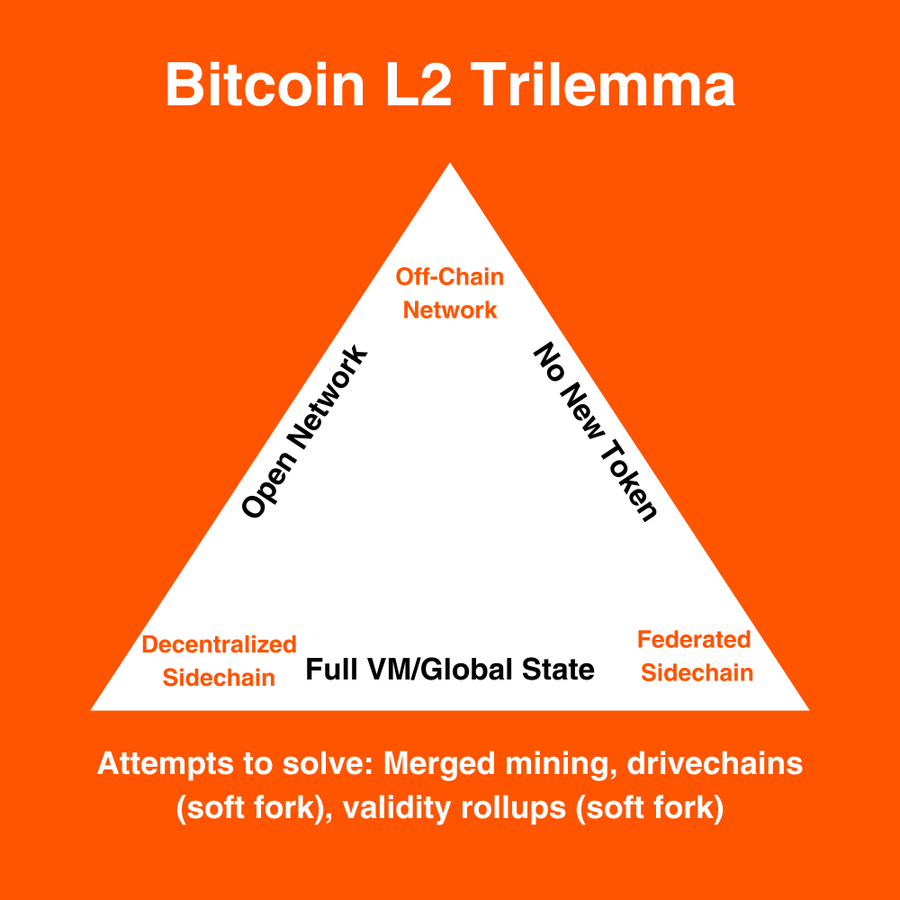
In 2023, interest in Bitcoin layer-2 solutions (or sidechains, if you prefer the term) has clearly increased. Unlike other parts of the crypto industry, the Bitcoin community remains skeptical of new tokens, introducing a unique technical trilemma in designing Bitcoin layer-2s.
The design choices are:
(a) Either an open network (ideal) or a federated system
(b) No new token (ideal) or introducing one
(c) Full/global virtual machine or limited off-chain contracts
Liquid chooses (b) and (c) and operates as a federation. The Lightning Network chooses (a) and (b), but lacks global state or a full virtual machine. Stacks chooses (a) and (c), but introduces a new token (STX).
Efforts to solve this trilemma aim to leverage existing Bitcoin miners for layer-2 validation. RSK and Stacks are examples of this approach. However, miner incentives remain an unresolved issue, as gas fees alone—especially in early stages—may not be sufficient to incentivize participation.
Introducing new opcodes to Bitcoin’s base layer could help resolve this trilemma. For example, adding an opcode like op-snark-verify to Bitcoin’s base layer could enable verification of layer-2 computations.
Soft forks or hard forks to Bitcoin’s base layer are extremely difficult and unlikely to happen in the near term. Therefore, for the coming months and years, we need a vibrant ecosystem of hundreds of Bitcoin layer-2s to grow the Bitcoin economy. This means developers must make trade-offs within the Bitcoin layer-2 trilemma.
Personally, I believe (a) an open network where anyone can participate in mining and join freely, and (b) providing developers with a complete execution environment featuring global state, are essential properties. Most systems like Ethereum and Solana have these two traits, and developers expect them as basic requirements. Overall, let’s encourage diverse experimentation across Bitcoin L2s. The market will determine which technical compromise emerges as the winner.
Join TechFlow official community to stay tuned
Telegram:https://t.me/TechFlowDaily
X (Twitter):https://x.com/TechFlowPost
X (Twitter) EN:https://x.com/BlockFlow_News
 @muneeb