Conversing with Fiat24: A Web3 Bank Built on Blockchain
TechFlow Selected TechFlow Selected
Conversing with Fiat24: A Web3 Bank Built on Blockchain
Fiat24 is leveraging blockchain Web3 technology to drive and redefine the meaning of global banking, finance, and payment applications.
 Navigating Web3 tides with focused insights
Alex Pack, a partner at Dragonfly Capital, once stated: "The goal of DeFi is to reconstruct the global banking system and create an open, permissionless operating environment." In the financial world of DeFi, crypto assets are structured on blockchains, enabling efficient asset transfers and real-time value circulation through various protocols—such as self-custody via Metamask wallets, asset trading on Uniswap, lending and borrowing via Aave and Compound, and value pegging with MakerDAO.
Although we can clearly see the immense value of DeFi and the vast potential offered by composability among on-chain protocols, before reconstructing the global banking system, it's essential first to bridge the traditional global financial markets—which hold over 300 times more value than the current crypto ecosystem. Fiat24 aims to build this bridge between crypto and traditional finance using a protocol-based approach.
In this article, we had an in-depth conversation with Yang, Co-founder of Swiss Web3 fintech company Fiat24, exploring how the Fiat24 Banking Protocol (Additional Fiat Layer for DApps), built by structuring banking logic directly onto the blockchain and driven by smart contracts under Switzerland’s crypto-friendly regulatory framework, is revolutionizing traditional banking, finance, and payment systems.
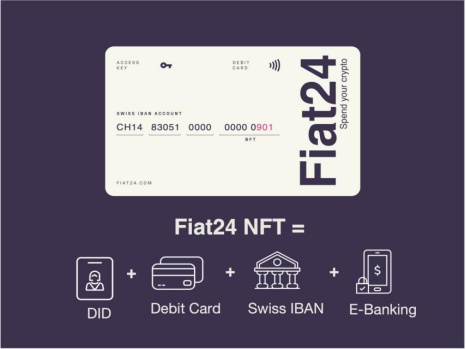
(Fiat24.com)
1. Fiat24 — Web3 Banking
SR Saphirstein AG is a fintech company regulated under Swiss banking law. Its product, Fiat24, is the first decentralized application (DApp) fully built on public blockchain (Arbitrum), where banking logic is entirely structured and operated via smart contracts. It offers users a full suite of Web3 banking services including fiat on/off-ramping, crypto-powered spending, savings, transfers, and currency exchange.
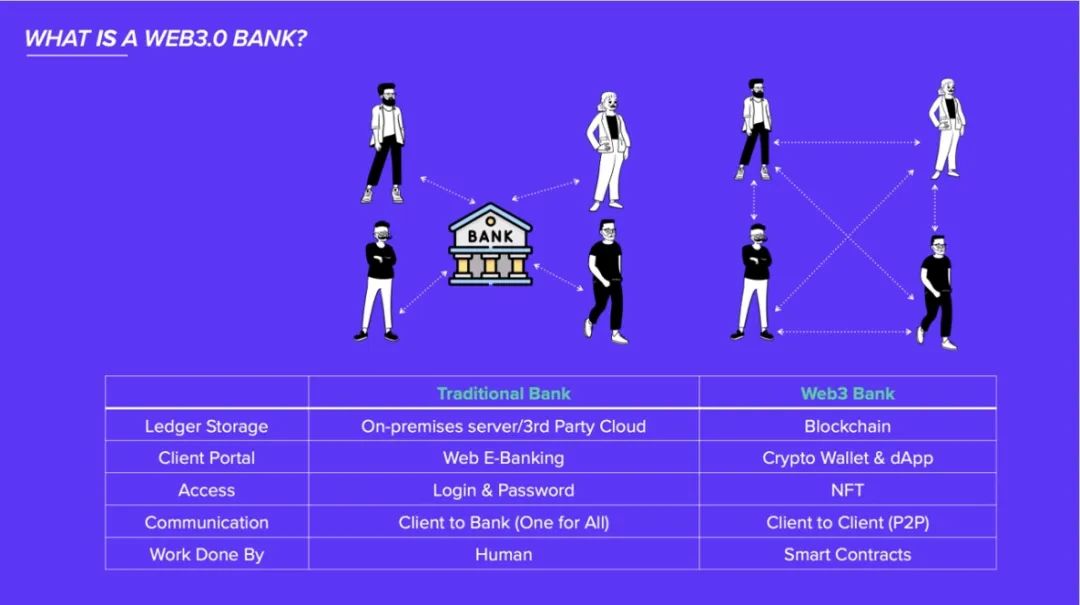
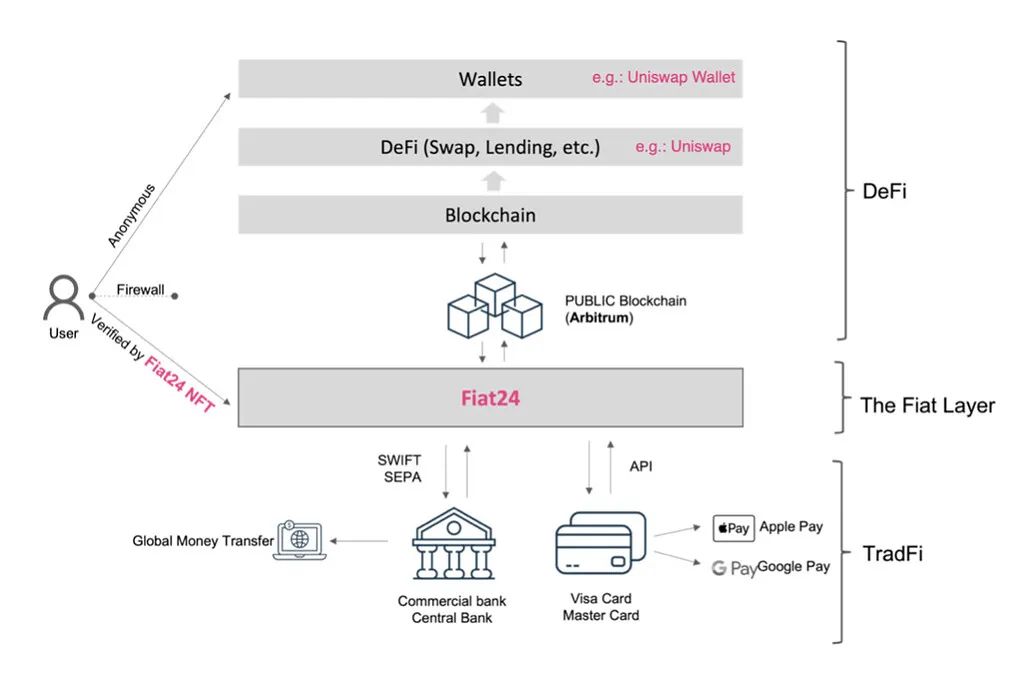
Unlike any traditional bank, Fiat24 targets non-custodial wallet users and uses NFTs to identify user information. Think of Fiat24 as a fiat protocol layer for DApps—an Additional Fiat Layer built beneath applications like Uniswap.
On this fiat protocol layer, Fiat24 provides KYC-verified users with both a Fiat24 NFT Account and a Swiss bank account (Cash Account). The NFT Account allows integration of Web3 payment services—for example, users can connect their crypto wallets to perform on/off-ramp transactions and make crypto-powered payments. Meanwhile, the Swiss Cash Account is directly linked to the Swiss National Bank, the European Central Bank, and the VISA payment network, enabling traditional banking functions such as fiat savings, currency exchange, and merchant settlements.
(Temperature Check - [Issue a Visa Card with Uniswap Logo ])
Fiat24’s innovative blockchain-based banking architecture seamlessly integrates traditional banking services with Web3 blockchain payment innovations, enhancing both convenience and security while eliminating single points of failure. With Fiat24, customers can use their crypto assets stored in MetaMask or any other non-custodial wallet to withdraw fiat, conduct exchanges, and make daily crypto-powered purchases—effectively using their crypto wherever VISA is accepted.
For users who want to put their crypto assets into everyday use, this revolutionary ability to turn crypto wallets into payment solutions represents a true innovation in traditional banking, finance, and payment systems.
2. Fiat24 Born Under Switzerland’s Crypto-Friendly Regulation
On January 1, 2019, the Swiss Federal Parliament introduced the Fintech License under the existing banking regulation to encourage financial innovation. This license can be seen as a simplified version of the high-barrier traditional banking license, designed to lower market entry barriers for innovative fintech companies. It allows license holders to accept public deposits but prohibits them from using those funds for interest-generating activities such as investments or loans.
Switzerland’s supportive regulatory environment—including the Fintech License, ICO regulatory guidelines, and the Distributed Ledger Technology (DLT) Act—has created vast opportunities for business model innovation in fintech, especially in blockchain and digital assets. Fiat24 was born precisely within this context.

(Fiat24.com)
Fiat24’s founding team began in traditional banking and closely followed developments in blockchain and crypto assets. The introduction of the Fintech License prompted them in 2018 to explore whether traditional banking logic could be rebuilt on the blockchain.
Yang said: "Blockchain technology, also known as decentralized ledger technology, was inherently designed for accounting. When we worked in banks, each institution had a back-office team of over a hundred people handling payment reconciliations. With tens of thousands of banks worldwide, each maintaining its own ledger, synchronizing these ledgers perfectly and without error placed enormous demands on the system. Blockchain’s atomic swap capability solves this perfectly, eliminating the need for internal reconciliation departments, significantly improving efficiency and reducing labor costs. It’s the same principle behind why Uniswap operates with just dozens of employees despite high trading volumes, while centralized exchanges require hundreds or even thousands."
As the crypto market evolved, the Fiat24 team recognized that DeFi, as a native on-chain financial infrastructure, could overcome the limitation of the Fintech License (which prohibits interest-bearing operations), while Switzerland’s progressive DLT Act provided a compliant path for crypto businesses.
After three years of continuous dialogue with regulators and practical efforts to convert core banking systems into on-chain smart contracts, Fiat24 obtained the Swiss Financial Market Supervisory Authority (FINMA) Fintech License in 2021, becoming the first Web3 bank—fully built on public blockchain, driven by smart contracts—to offer on/off-ramping, crypto-powered payments, savings, transfers, and currency exchange services.
Fiat24’s innovative blockchain banking architecture, which seamlessly blends traditional financial services with Web3 payment innovations, has attracted top-tier investors and earned recognition as the 2022 Best Emerging Bank (Neobanks & Specialized Players) by Qorus and Accenture.
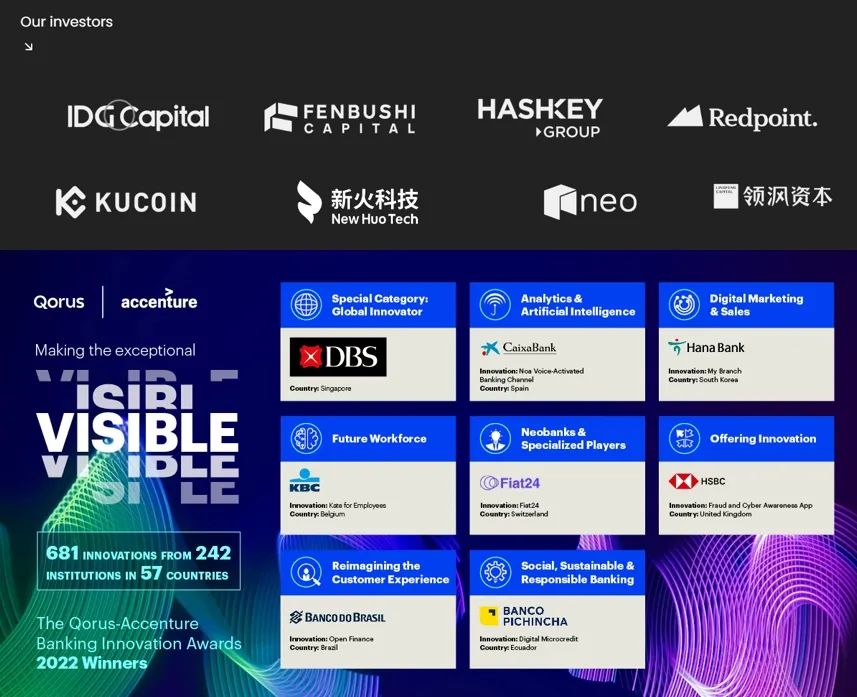
(Qorus and Accenture Announce Winners of 2022 Banking Innovation Awards)
3. Web3 Banking Services Powered by Blockchain Smart Contracts
In our previous Web3 Payment Report, we analyzed the foundational logic of Web3 payments and observed that key Web3 financial infrastructures—payments, custody, wallets, stablecoins—are gradually taking shape. As industry giants like PayPal, Coinbase, VISA, MetaMask, and Telegram deeply integrate their services with Web3—especially payments—the critical questions become: How do we connect fiat and crypto? And how can we leverage Web3 payment advantages to build new business scenarios?
Fiat24 leverages the advantages of Switzerland’s Fintech License to innovatively build banking logic on blockchain and smart contracts, bridging on-chain wallet accounts with off-chain bank accounts. By connecting to real-world payment scenarios via the VISA network, Fiat24 creates viable business models for Web3 banking, finance, and payments. The core of Fiat24’s account system includes the on-chain NFT Account and the off-chain Swiss bank account (Cash Account).
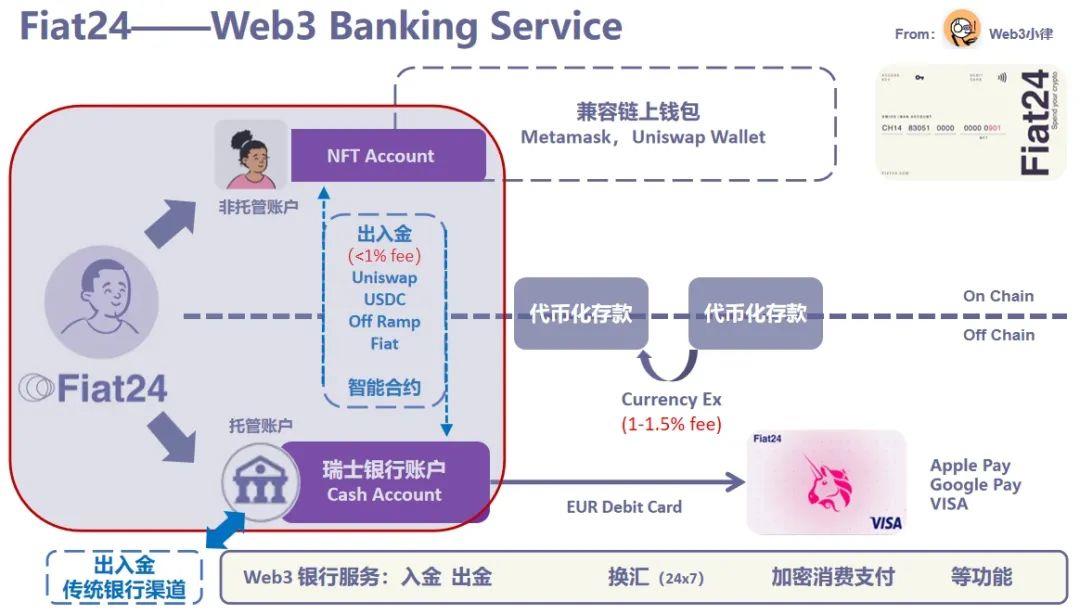
3.1 Connecting the NFT Account with the Swiss Bank Account
Users can access Fiat24 through their crypto wallets and receive a Fiat24 NFT (in guest mode, unregistered). Only after registration and KYC verification does the NFT Account gain the ability to link to the user’s Swiss bank account. Setting KYC identity parameters at the NFT level and using the NFT Account as a user identifier completely replaces traditional usernames and passwords—a revolutionary shift for traditional banking.
Once registered and KYC-verified, Fiat24 opens a CH-prefixed Swiss IBAN bank account for the user. This account is custodied by Fiat24 and regulated under Swiss banking law, offering standard banking functions such as deposits, transfers, and currency exchange.
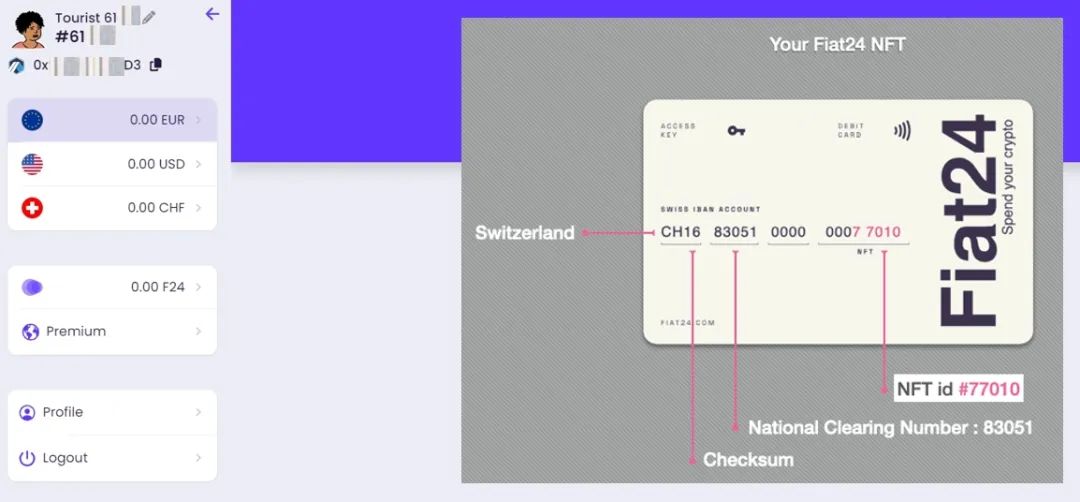
(Fiat24.com)
3.2 Enabling Web3 Payments via Smart Contracts
By linking the NFT Account with the Swiss bank account, Fiat24 further integrates blockchain technology into the traditional financial system.
On/off-ramp payments: In an ETH withdrawal scenario, two main steps occur: (1) converting ETH to USDC; (2) withdrawing USDC as USD via a payment channel. Fiat24 first calls the Uniswap protocol to swap ETH for USDC. Since Fiat24’s banking logic runs on the blockchain, the next step—off-ramping—can be executed directly through its own channels. Both steps are automated via smart contracts.
Crypto-powered spending: Because Fiat24 issues a co-branded VISA debit card to KYC-verified users, it connects to over 40 million VISA merchants, as well as third-party platforms like Apple Pay and Google Pay. In a deeper ETH spending scenario, Fiat24 uses smart contracts to instantly convert ETH to USDC, withdraw USD to the Swiss bank account, and settle payments at merchants via the VISA network.
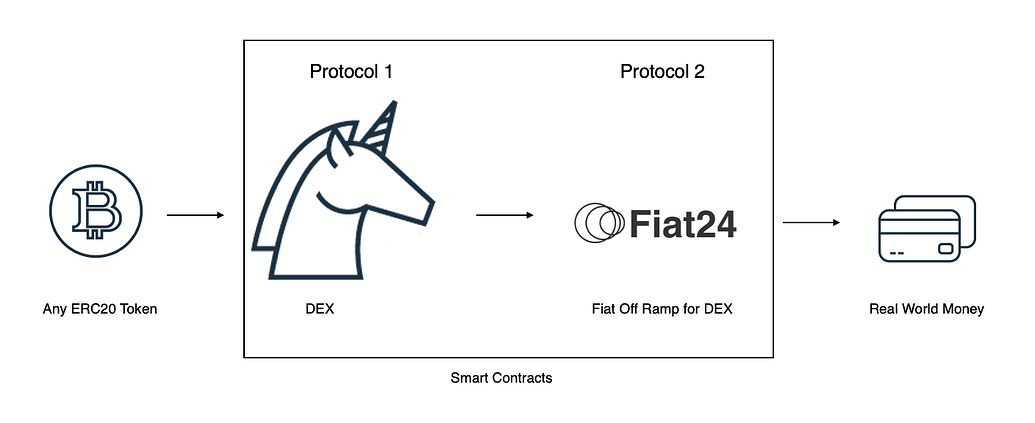
(Temperature Check - [Issue a Visa Card with Uniswap Logo ])
This seamless connection between crypto wallets and bank accounts for crypto-powered spending represents an evolution of traditional banking and payment services. By integrating multiple services—Uniswap swaps, USDC-to-fiat conversion, fiat settlement—and automating the entire flow via smart contracts, Fiat24 delivers a smooth, frictionless user experience from crypto to fiat.
3.3 Compatibility with Traditional Banks and Payment Channels
Backed by its Fintech License, Fiat24 is authorized to join Switzerland’s interbank clearing (SIC) system and holds a settlement account at the Swiss National Bank (the central bank). It is also connected to global payment networks such as SWIFT, SEPA, and VISA, with all real-world payment data recorded on the Arbitrum blockchain.
Beyond standard bank transfers, Fiat24 users can send or receive international wire transfers to/from their Swiss bank accounts. They can also sell crypto assets and withdraw the proceeds as fiat into their Swiss accounts—all powered by smart contracts.
Interestingly, Fiat24 offers foreign exchange (FX) services through tokenized deposits.
According to Yang, Fiat24 initially launched a USD/EUR trading pair on Uniswap to support FX, but due to challenges with oracle-based rate anchoring, trading volume limits, and currency variety, they shifted to tokenizing their own bank deposits on-chain. Using Chainlink to fetch interbank exchange rates, they now offer 24/7 real-time currency conversion. Users may notice gas fees during FX transactions on Fiat24.
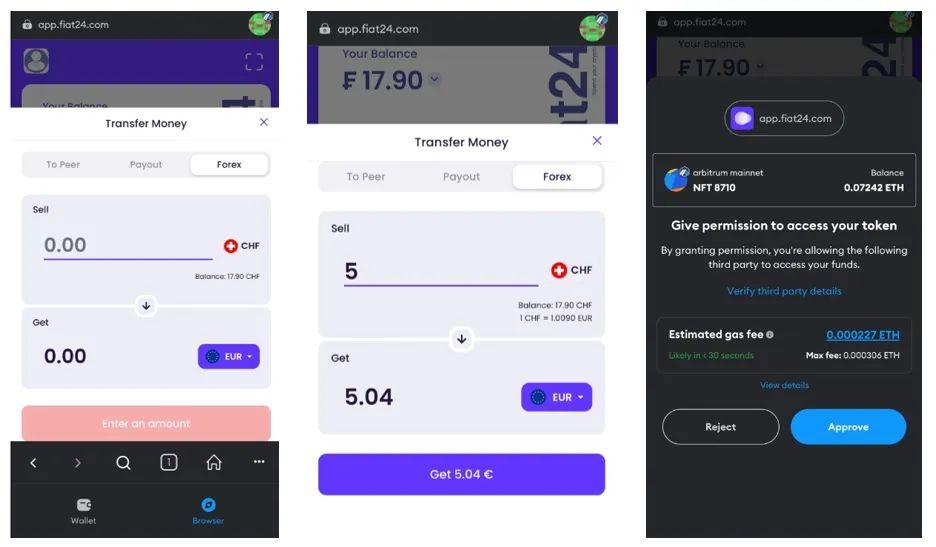
(Fiat24.com)
Fiat24’s architecture seamlessly merges traditional banking services with blockchain innovation. By building banking logic on the blockchain and driving operations via smart contracts, it fully replicates traditional bank back-end systems. On the business side, it enables perfect integration of Web3 payments—including on/off-ramps and crypto spending—via its NFT and Swiss bank accounts, while also supporting core traditional banking functions such as payments, FX, and transfers.
4. Becoming the Fiat Protocol Layer for DApps
"Just as Chainlink positions itself as decentralized oracle network infrastructure, Fiat24’s positioning is decentralized digital banking infrastructure—the fiat protocol layer for DApps," said Yang. "We believe DEXs will eventually replace CEXs. However, unlike CEXs that have built-in payment rails, the biggest weakness of DEXs is that traditional banks cannot interface with a protocol—they won’t grant APIs or open accounts to a smart contract. Fiat24 solves this perfectly by combining NFT Accounts with Swiss bank accounts: connecting to protocols on-chain and to traditional finance off-chain."
Since Fiat24 operates as a protocol-driven DApp, users can easily access www.fiat24.com through non-custodial wallets like MetaMask or Uniswap Wallet to enter the Swiss banking portal. The KYC process being handled at the NFT level ensures users remain anonymous when using other DApps.
For DApp developers, because it’s a protocol-to-protocol collaboration, they can directly integrate Fiat24’s protocol—effectively giving their DApp instant access to a Swiss online banking account and solving the long-standing lack of fiat functionality in most DApps.
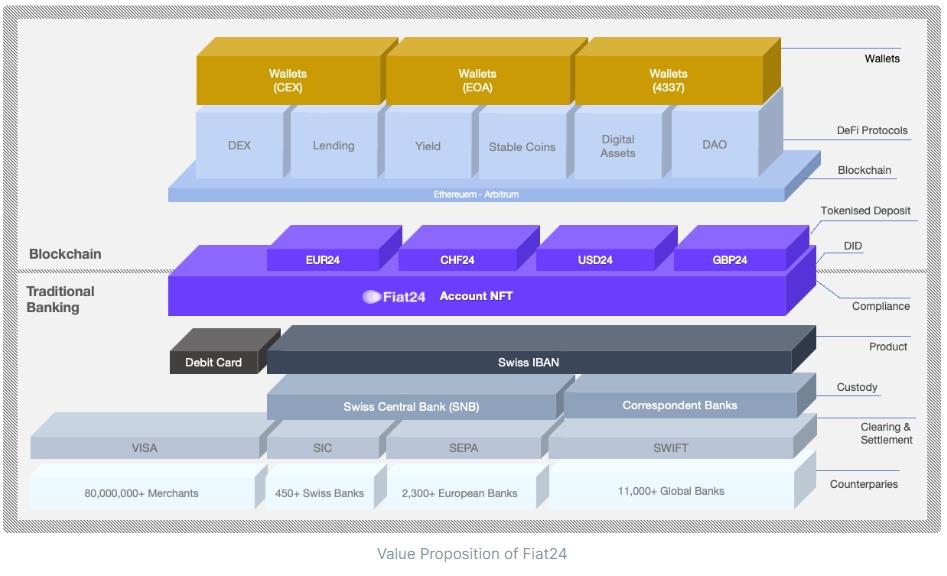
(Fiat24.com)
Currently, Fiat24 is actively collaborating with crypto wallet teams to add a fiat protocol layer to non-custodial wallets, enabling seamless connectivity between on-chain crypto assets and off-chain Swiss bank assets.
This is highly valuable for wallet users: they gain access to a prestigious Swiss bank account—normally requiring a minimum deposit of 500,000 CHF—along with full banking services, and can use Fiat24’s VISA integration for convenient crypto-powered spending.
As a fiat protocol layer for DApps, Fiat24 can seamlessly integrate with various DApps and is equally applicable to DeFi, DEX, GameFi, and beyond.
Imagine a typical day: accessing Fiat24’s DApp via a signed NFT, a user can buy their morning Starbucks coffee using crypto assets stored in MetaMask or any non-custodial wallet, then later enjoy drinks at any VISA-accepting bar after work—achieving “coffee in the morning, alcohol at night.”
For users seeking to use crypto in daily life, Fiat24’s innovative Web3 banking architecture and seamless payment solutions are truly revolutionary.
5. Fiat24’s Future Outlook
Currently, Fiat24 serves only EU and Swiss users and supports three currencies. However, Yang stated, with expanding market reach and surging user demand, Fiat24 plans to extend services to Southeast Asia and the Americas in early 2024, supporting additional currencies.
5.1 Outlook on Wallet Integration
Leveraging its role as the fiat protocol layer for DApps, Fiat24 will integrate with more crypto wallet entry points via protocol-to-protocol partnerships, seamlessly connecting B2B wallet providers—essentially embedding a Fiat24 Swiss online banking interface directly into DApps.
Additionally, Fiat24 can issue co-branded crypto debit cards to wallet providers, unlocking more spending scenarios for users and empowering wallet platforms with enhanced offerings.
We’re already seeing massive wallet gateways like MetaMask integrate numerous Web3 financial infrastructures, offering nearly all core exchange functions—Buy, Sell, Swap, Bridge, Stake, Send. As wallet UX improves, they may leapfrog ahead. This explains why OKX places such strategic importance on its OKX Wallet.
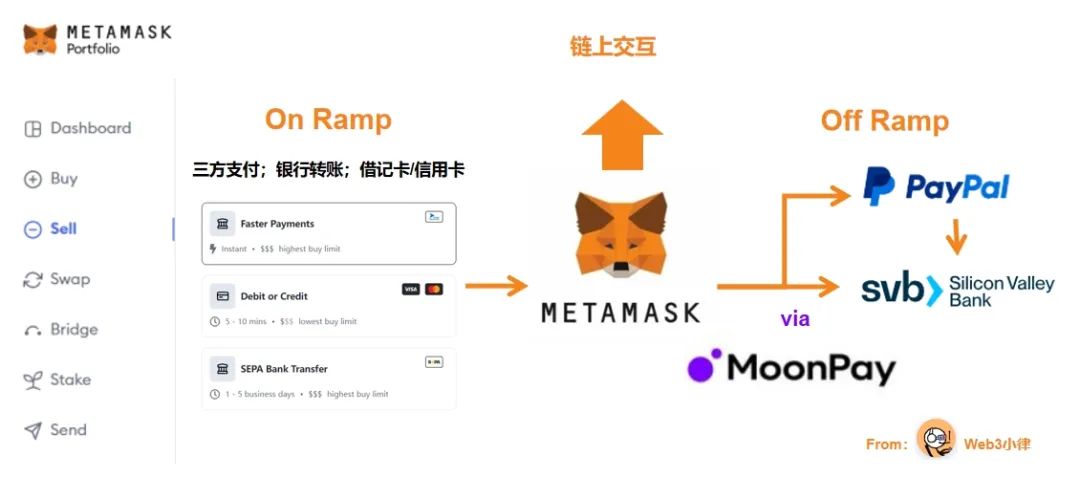
5.2 Tokenomics Roadmap
While continuing to partner with wallet providers and expand product capabilities, Fiat24 plans to launch a token fundraising round by late 2023 or early 2024. At that point, Fiat24’s positioning will become even clearer—as the fiat protocol layer for DApps and a critical infrastructure component of the Web3 ecosystem.
The F24 Token is designed to strengthen connections among participants in the Fiat24 ecosystem. As a utility token, F24 empowers users: (1) For individual and enterprise clients, holding F24 Tokens enables customized bank card number ranges, higher spending limits, and fee discounts; (2) For wallet providers, burning F24 Tokens allows them to offer streamlined account opening and online banking access to their users.
On tokenomics, F24 follows a deflationary model. According to its whitepaper, 50% of the total token supply will be allocated to community participants to support sustainable ecosystem growth, 20% to early team members and investors, and the remaining 30% retained in the project treasury to fund operations, development, compliance, and partnerships—jointly driving the long-term success of the Fiat24 ecosystem.
6. Final Thoughts
Undeniably, a revolution is unfolding in global financial payments. Web3 transformation, led by blockchain technology, is progressively penetrating traditional banking, finance, and payment infrastructures through payments, wallets, custody, and stablecoins—mirrored by the full-scale push into Web3 payments by industry leaders.
For traditional banking, digital banks have acted as catalysts for financial digitization—but significant shortcomings remain, ripe for improvement via blockchain. Users still log in with outdated usernames and passwords, while transaction codes are often sent via SMS. These cumbersome processes expose systems to human error and manipulation, undermining security. Moreover, ledger records and processing logic are typically managed in closed back-end systems, creating single points of failure and exposing sensitive data.
Innovative fintech companies like Fiat24 are reimagining the foundational principles of traditional banking, finance, and payments. At the same time, traditional giants like PayPal and VISA are making bold moves into Web3 fintech. Through collective effort, the fundamental architecture of banking, finance, and payments will transform—leveraging breakthrough technologies to enhance security, efficiency, and permissionless access to global financial networks.
Transforming traditional banking, finance, and payments won’t happen overnight—it involves too many stakeholders. Yet Fiat24 is pioneering a new model for value transfer by harnessing blockchain and smart contracts, bridging on-chain and off-chain worlds through a single DApp. Fiat24 is advancing—and redefining—the very meaning of global banking, finance, and payment applications through Web3 and blockchain technology.
Join TechFlow official community to stay tuned
Telegram:https://t.me/TechFlowDaily
X (Twitter):https://x.com/TechFlowPost
X (Twitter) EN:https://x.com/BlockFlow_News
 0xWillmfer