A New Journey for Digital Gold: Exploring Diversification and Protocol Innovation in the Bitcoin Ecosystem
TechFlow Selected TechFlow Selected
A New Journey for Digital Gold: Exploring Diversification and Protocol Innovation in the Bitcoin Ecosystem
This article will analyze the ecosystem of other applications for BTC.
 Navigating Web3 tides with focused insights
Author: @YBBCapital Researcher Ac-Core
Preface
The concept of Bitcoin (BTC) was first introduced by Satoshi Nakamoto on November 1, 2008. Bitcoin officially came into existence on January 3, 2009. After decades of industry development, Bitcoin has been racing along the path of value storage and digital gold, with its market value rising from a time when 10,000 bitcoins could buy a single pizza to today’s valuation of $664.22 billion. However, current developments in the BTC ecosystem are still just minor experiments. Beyond BTC's intrinsic value, we must patiently explore what lies ahead. This article aims to analyze other application ecosystems within the BTC network.
BTC Overview
In 2009, a cryptographer named Satoshi Nakamoto published a paper titled "Bitcoin: A Peer-to-Peer Electronic Cash System," describing an electronic currency system powered by peer-to-peer technology that enables online payments to be sent directly from one party to another without going through any financial institution. Bitcoin gradually spread worldwide and gained widespread attention. It possesses at least three attributes: technological, sociological, and financial.
-
Technical Attributes:
From a technical standpoint, Bitcoin’s network protocol is a decentralized, peer-to-peer transmission protocol—essentially a massive public ledger that cannot be manipulated by any third party or altered. It relies on blockchain technology to record all transaction data across the network, ensuring no double-spending or fraudulent payments occur.
-
Sociological Attributes:
Compared to today’s internet, blockchain uses distributed ledger technology—digitally shared transaction records across the network—with characteristics of decentralization, immutability, and unchangeability. These features have fostered an ideological shift toward information freedom that impacts everyone. As a fully decentralized digital currency, Bitcoin does not rely on any central authority for issuance and can transfer value across borders and currencies without relying on banking systems, giving it strong sociological implications related to information freedom and cross-border payments.
-
Financial Attributes:
From a financial perspective, Bitcoin is seen as a digital gold investment or a globally standardized digital asset. Compared to physical gold, Bitcoin offers fixed supply, portability, low transaction costs, and appeal to younger investors, leading more individual and institutional investors to recognize its investment value. Operating on the global internet, Bitcoin functions as an efficient, low-cost payment and circulation tool in specific scenarios such as cross-border payments and virtual economies. For example, Nasdaq entered the Bitcoin space in January 2015 via the New York Stock Exchange, and recently Grayscale and BlackRock have started launching Bitcoin-related ETFs.
Looking at the broader blockchain landscape today, Bitcoin’s ecosystem remains sparse compared to Ethereum’s. The Lightning Network, launched in 2019, signaled a new direction. Other notable developments include Stacks introduced in 2021, Lightning Labs’ recent mainnet launch of Taproot Assets, and BitVM—the Turing-complete Bitcoin contract—emerging as rare bright spots in Bitcoin’s ecosystem.
New Landscape of the Bitcoin Ecosystem
BitVM:
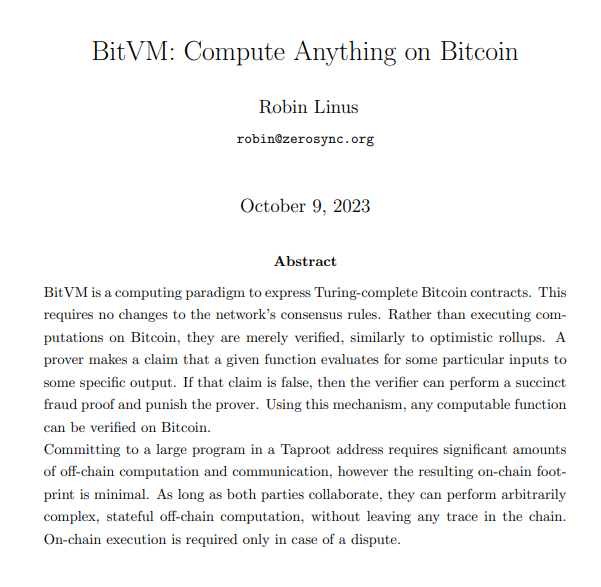
Image source: BitVM Whitepaper
Recently, Robin Linus, lead of the ZeroSync project, released a whitepaper titled "BitVM: Compute Anything On Bitcoin," sparking significant discussion. BitVM stands for "Bitcoin Virtual Machine." It proposes a solution for Turing-complete smart contracts on Bitcoin without altering Bitcoin’s consensus rules, enabling verification of any computable function and allowing developers to run complex contracts while preserving Bitcoin’s core principles.
However, Bitcoin’s programmability is widely known to be extremely limited due to the blockchain trilemma—decentralization, security, and scalability—where Bitcoin prioritizes decentralization and security at the expense of scalability. Bitcoin only supports three script formats: Pay to Public Key (P2PK), Pay to Public Key Hash (P2PKH), and Pay to Script Hash (P2SH), which underpins multisignature schemes.
-
Pay to Public Key (P2PK): This contract sends Bitcoin to a Bitcoin address.
-
Pay to Public Key Hash (P2PKH): This contract also sends Bitcoin to a Bitcoin address.
-
Pay to Script Hash (P2SH): An application form of multisignature scripts.
Bitcoin’s limited programming capability stems from its Script language supporting only basic logic and a restricted set of opcodes, preventing the development of complex smart contracts on the Bitcoin network. Its non-Turing-complete scripting ensures security by disallowing arbitrary computation or loops. Unlike executing computations directly on Bitcoin, BitVM focuses solely on verifying them—a model similar to other native Bitcoin layer-2 scaling solutions. According to the whitepaper, it achieves this primarily through OP-Rollup, fraud proofs, Taproot Leaves, and Bitcoin Script.
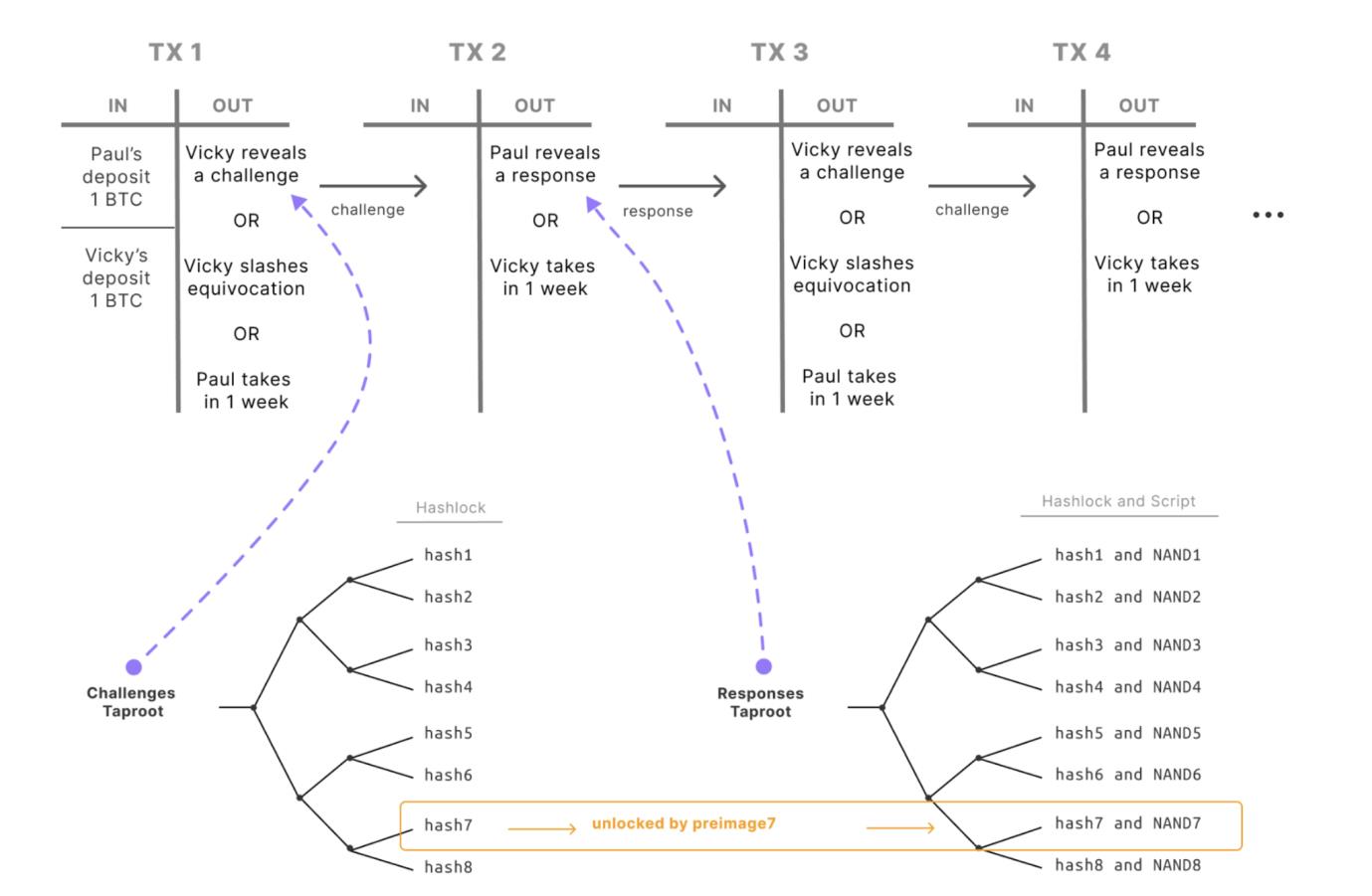
Image source: BitVM Whitepaper
Given Bitcoin’s original design limitations around complex computation and smart contracts, BitVM introduces a unique extension approach involving the following key roles:
-
Prover and Verifier: The prover generates a proof based on input data, while the verifier checks the computational result without knowing the actual content, ensuring accuracy.
-
Off-chain Computation and On-chain Proof: To maintain Bitcoin’s consensus integrity, BitVM moves most computation off-chain to enhance flexibility. The controversial on-chain proof mechanism involves verifiers and provers using a fraud-proof method akin to Optimistic Rollups to validate data correctness. BitVM’s innovation lies in using Taproot address matrices or Taptrees to implement binary circuit-like program instructions, combining them to execute complete contracts [1].
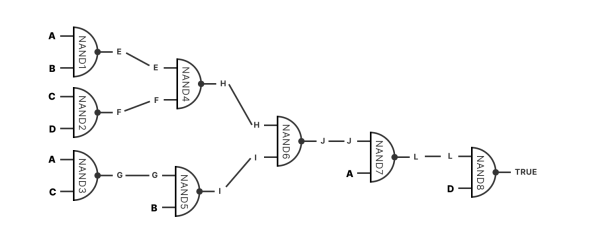
Image source: BitVM Whitepaper
However, controversy remains:
BitVM writes “simple code” into the Script of a Taproot address and treats it as a UTXO (see explanation below) spending condition. While Script is natively supported by Bitcoin and considered a type of Output, BitVM’s smart contracts merely use custom “scripts” in Outputs that are then centrally interpreted. The difference lies in whether parsing occurs within the Bitcoin network or is defined and executed externally. Since BitVM relies on Outputs rather than Scripts to enable smart contracts, concerns about centralized operation models arise.
Taproot Assets on Lightning Network
Taproot Assets:
On October 18, 2023, Lightning Labs launched the mainnet Alpha version of Taproot Assets based on UTXO. With the mainnet live, Bitcoin’s Lightning Network evolves into a legitimate multi-asset network, targeting institutions and asset issuers, enabling instant, low-cost, high-capacity transaction protocols via the Lightning Network.
Following El Salvador’s adoption of Bitcoin as legal tender in 2021, the Lightning community experienced explosive growth, with users worldwide enjoying instant settlement, low fees, and financial-intermediary-free peer-to-peer Bitcoin transactions. Lightning Labs continues enhancing services, enabling developers to integrate stablecoins into their applications via Bitcoin infrastructure. Developers are also experimenting with programmable coupon payments for real-world assets like gold, U.S. Treasuries, and corporate bonds. Two critical components underpin Taproot Assets: the Lightning Network and Taproot.
Image source: Lightning Labs official website
Lightning Network:
Currently, Bitcoin limits transaction processing to approximately 2,500 transactions per 10-minute block confirmation. This cap, agreed upon by the Bitcoin community and developers, prioritizes decentralization and security over scalability.
The Lightning Network, first proposed in February 2015 by Joseph Poon and Thaddeus Dryja and launched in March 2018, is a Layer-2 scaling solution for Bitcoin. It allows participants to create smart contracts off-chain, addressing Bitcoin’s scalability and high-fee issues, enabling near-zero transaction fees.
The core idea behind the Lightning Network is simple: participants deposit funds into a shared off-chain wallet (smart contract), transact instantly among themselves, and only settle the final state on-chain. While a major upgrade to the Bitcoin protocol, it introduces a new challenge—liquidity constraints for receiving parties within the network.
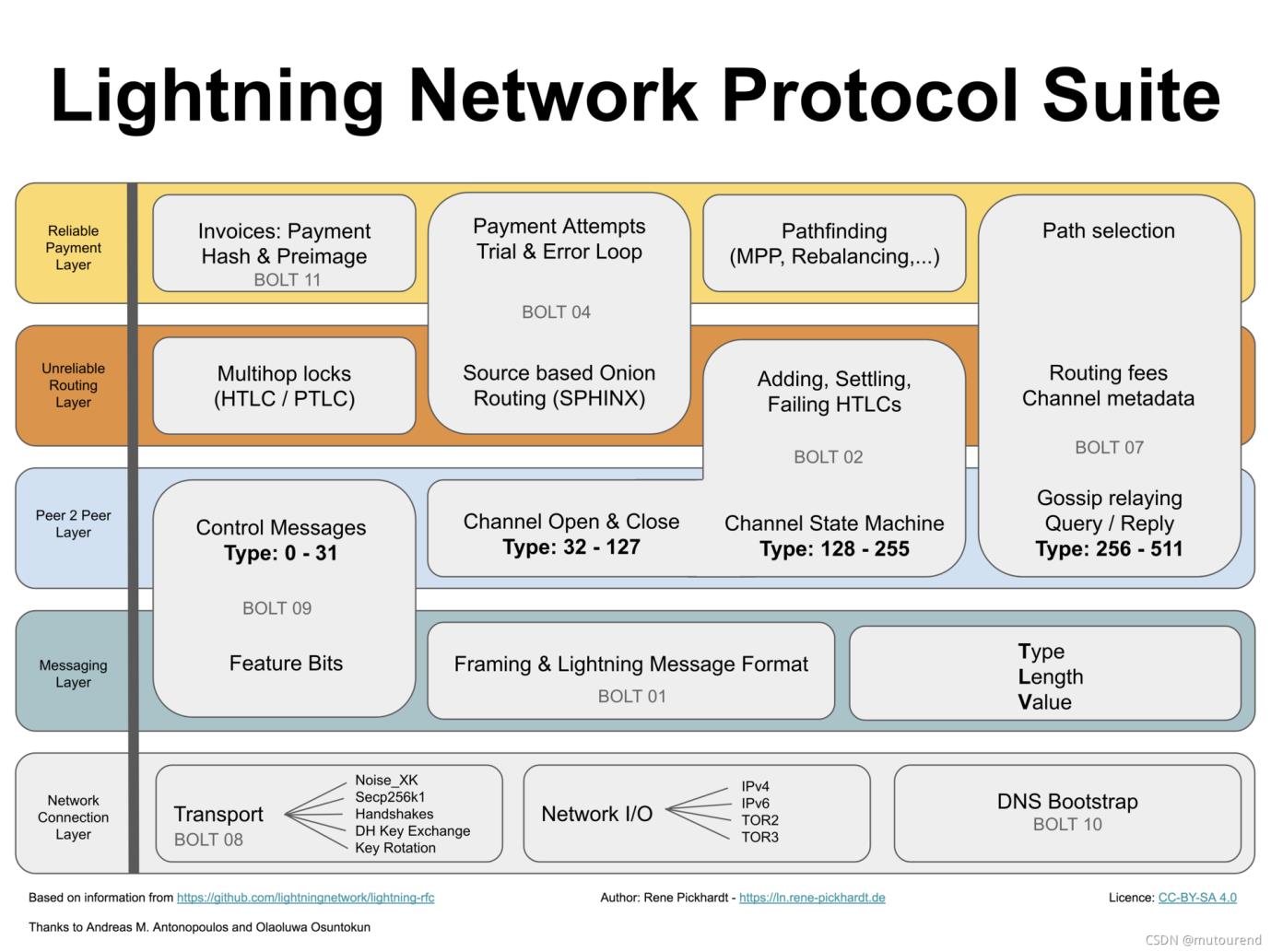
Image source: CSDN @mutourend
Taproot:
Bitcoin’s innovation largely stems from the 2017 Segregated Witness (SegWit) upgrade and the 2021 Taproot upgrade. SegWit expanded throughput by introducing a block field to store “witness data”—signatures and public keys—but size limitations were imposed due to potential vulnerabilities. The Taproot upgrade brought two major improvements: MAST + Schnorr signatures, resolving prior security issues and removing old SegWit restrictions [5].
Core Features of Taproot Assets:
1. Stablecoin Issuance: PayPal, the world’s largest payment app, issued its own USD-pegged stablecoin PYUSD after becoming a dominant payment channel—effectively evolving from a payment medium to a value carrier. Taproot Assets shares this vision, leveraging Bitcoin’s inherent value to provide stablecoins in a borderless financial world. For instance, users could issue a new stablecoin taUSD and deposit both BTC and taUSD into a Lightning Network channel via a single Bitcoin transaction, enabling DeFi operations—the core functionality of Taproot Assets on Lightning.
2. Multi-Universe Mode: Universes are repositories storing all information needed to initialize and sync a Taproot Asset wallet. Even if an issuer’s server fails, multiple Universe servers can verify asset validity, reducing reliance on third-party off-chain data storage.
3. Asset Issuance and Redemption API: Similar to corporate bonds, proof of destruction transactions can be uploaded on-chain, allowing users to trade various assets on Bitcoin as easily as investing in stocks or bonds in the real world. This opens possibilities for mapping real-world assets (RWA). Multiple asset sets can be minted over time while maintaining fungibility, and the redemption API simplifies asset retirement for issuers.
4. Asynchronous Receiving Function: Provides developers tools to attach Uniform Resource Identifiers (URIs) to on-chain addresses.
5. Scalability: A new build-loadtest command enables stress testing of the software. While Lightning may not be Bitcoin’s ultimate scaling solution, direct integration with the Lightning Network offers vast potential for fast, low-cost stablecoin transactions in a borderless financial ecosystem.
RGB Protocol:
RGB is developed by the LNP/BP Standards Association (Lightning Network Protocol / Bitcoin Protocol), a nonprofit overseeing development across Bitcoin layers, including Bitcoin, Lightning, and RGB smart contracts. RGB is a scalable, privacy-preserving smart contract system for Bitcoin and Lightning, aiming to run complex contracts on UTXOs and bring them into the Bitcoin ecosystem. Officially described as a suite of scalable and confidential smart contract protocols for issuing and transferring assets and broader rights, RGB builds on Peter Todd’s 2016 concepts of client-side validation and single-use seals, operating as a client-validated smart contract system on Bitcoin’s Layer-2 or off-chain. Understanding RGB requires grasping four key elements:
Single-Use Seals:
As the name suggests, a single-use seal acts like a tamper-evident sticker applied to an object, allowing it to be opened only once, thus preventing double-spending. Unlike Ethereum’s account-based model, Bitcoin uses wallet addresses where Unspent Transaction Outputs (UTXOs) serve as seals.
To understand single-use seals, one must first grasp UTXO—a ledger model where each transaction has inputs and outputs. The output of a transfer is the recipient’s address and amount, stored in the UTXO set. Each input references a prior output, making transactions traceable. Thus, Bitcoin’s transaction outputs can act as single-use seals.
According to the RGB documentation, a UTXO functions as a seal: sealed upon creation, unsealed upon spending. Per Bitcoin’s consensus rules, an output can only be spent once. Using it as a seal means the economic incentives securing Bitcoin’s consensus also guarantee the seal can only be broken once [2].
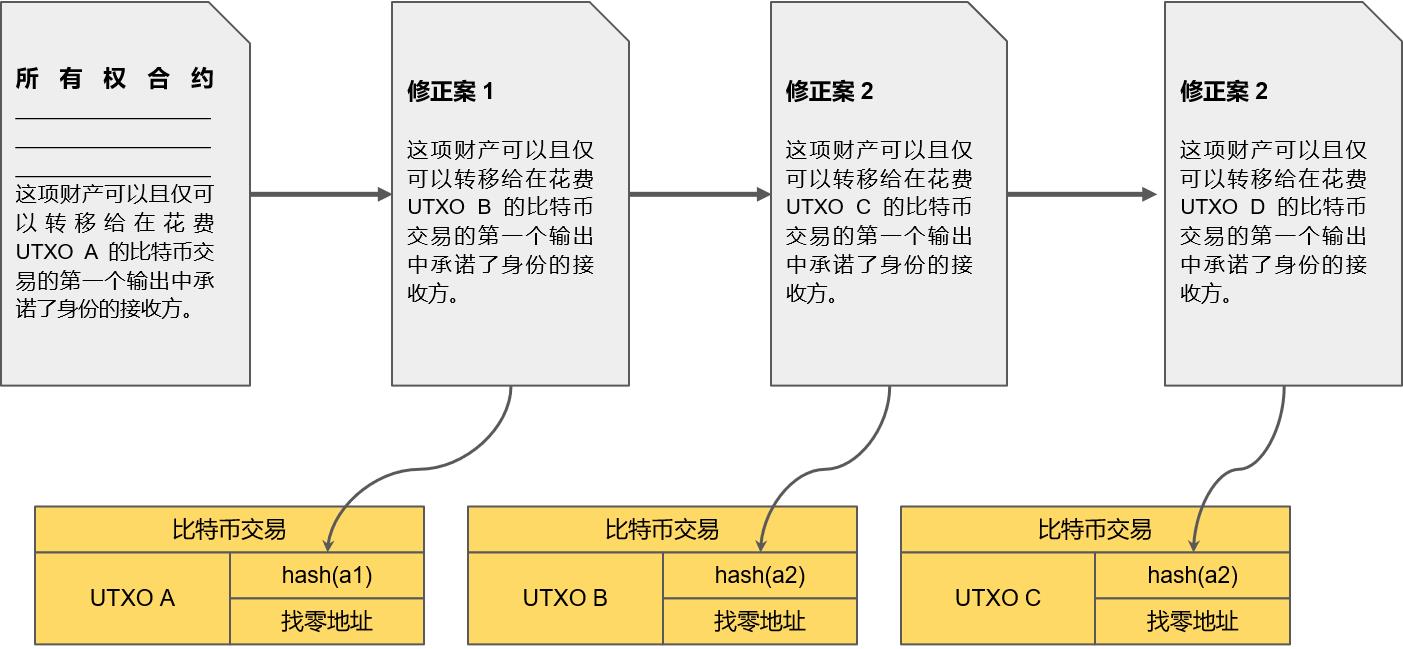
Image source: RGB Docs Chinese Official
Client-Side Validation and Deterministic Bitcoin Commitments:
Client-side validation, introduced by Peter Todd in 2016, posits that in Bitcoin’s PoW consensus, full-state validation isn’t required by every node. Instead, only parties involved in a specific state transition need to validate it. This is achieved by converting state changes into short, deterministic Bitcoin commitments using cryptographic hash functions. These commitments require a “Proof-of-Publication” and exhibit three traits: receipt proof, non-publication proof, and membership proof. In essence, OpenTimeStamps was the first protocol in this domain, followed by RGB, forming a family of client-validated protocols [3].
RGB leverages the Bitcoin blockchain to prevent double-spending by committing state transitions to specific Bitcoin transactions—spending the UTXO currently holding the right being transferred. This ensures multiple state transitions can be committed to a single Bitcoin transaction, but each transition can only be committed once to avoid double-spending.
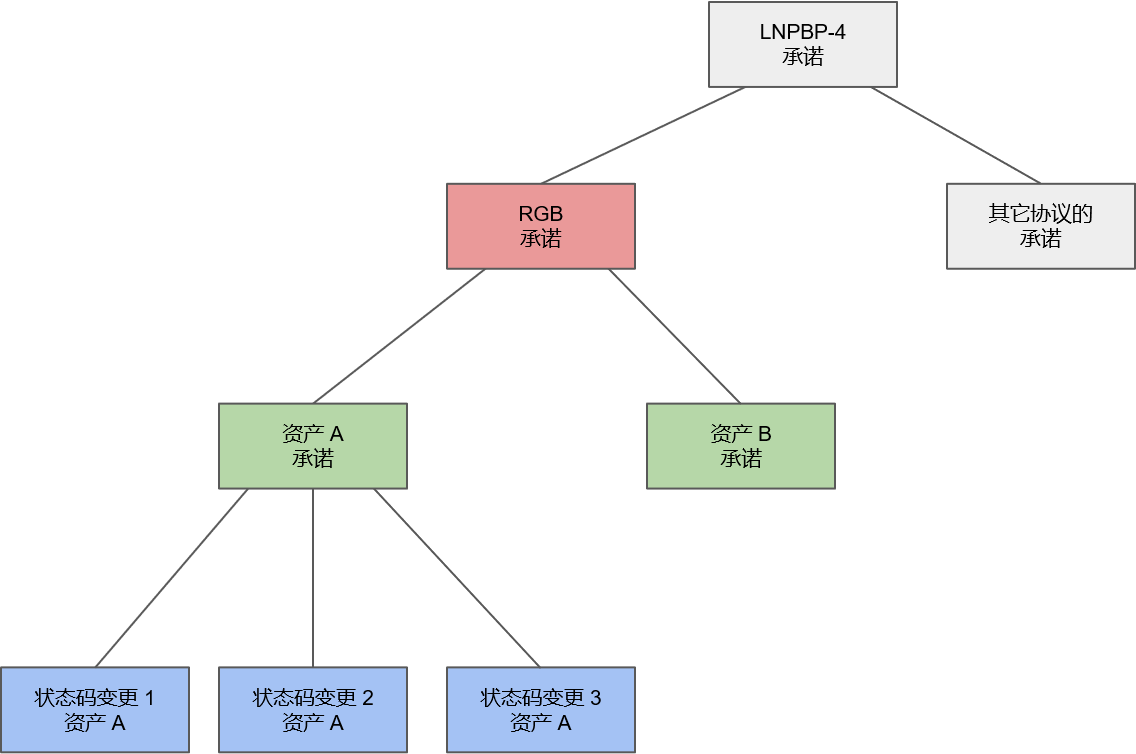
Image source: RGB Docs Chinese Official
Compatibility with Lightning Network:
When an RGB state transition is committed to a Bitcoin transaction, it doesn’t need immediate on-chain settlement. It can instead become part of a Lightning Network payment channel, inheriting its security and leveraging Lightning’s channels for broader digital asset circulation.
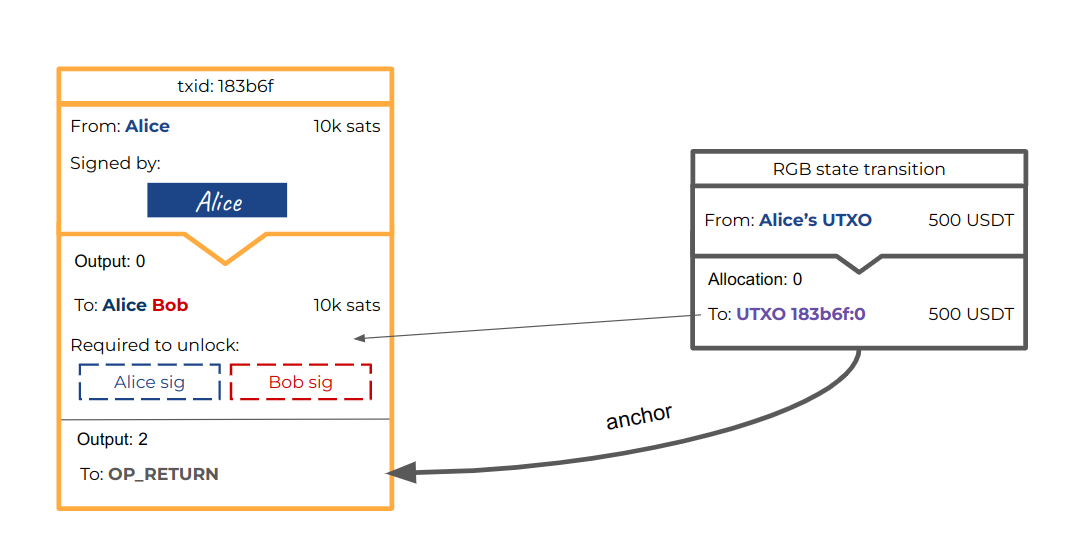
Image source: RGB Docs Chinese Official
RGB v0.10 Update:
According to Waterdrip Capital’s analysis, the upgrade primarily enhances flexibility and security, summarized as follows:
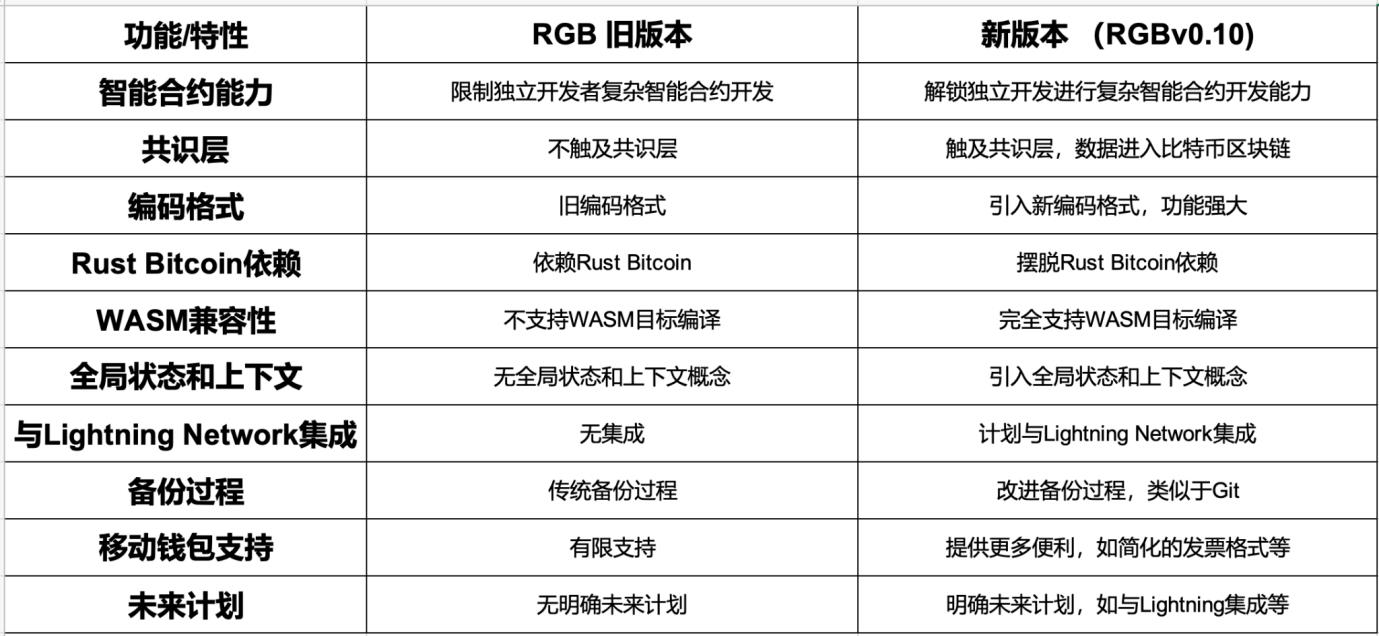
Image source: Waterdrip Capital
Although conceptualized in 2016, RGB has yet to gain broad attention or adoption, likely due to early versions’ functional limitations and high developer learning curves. With the arrival of RGB v0.10, the question remains: will RGB unlock greater potential in the future?
Bitcoin Sidechains: Stacks, Liquid, RSK, Drivechain
In 2016, Blockstream proposed pegged sidechains as a viable path to scale Bitcoin. Sidechains are often described as minimally-trusted blockchains enabling payments with foreign crypto assets (native assets from other chains). Benefits include user asset issuance, stateful smart contracts supporting DeFi, commitment chaining, faster settlement finality, and enhanced privacy.
Stacks:
Image source: Stacks Chinese Official
Basic Working Principle:
First, consider Stacks. Although it doesn’t explicitly label itself a sidechain, its classification remains debated. It aims to link directly to the Bitcoin chain via its unique Proof of Transfer (PoX) consensus mechanism, achieving high decentralization and scalability without additional environmental impact.
Stacks is an open-source Layer-2 blockchain for Bitcoin, bringing smart contracts and decentralized applications (dApps) to Bitcoin. Originally named Blockstack, its foundational work began as early as 2013. Stacks’ architecture includes a core layer and subnets, allowing developers and users to choose between them: the mainnet offers high decentralization but lower throughput, while subnets offer lower decentralization but higher throughput.
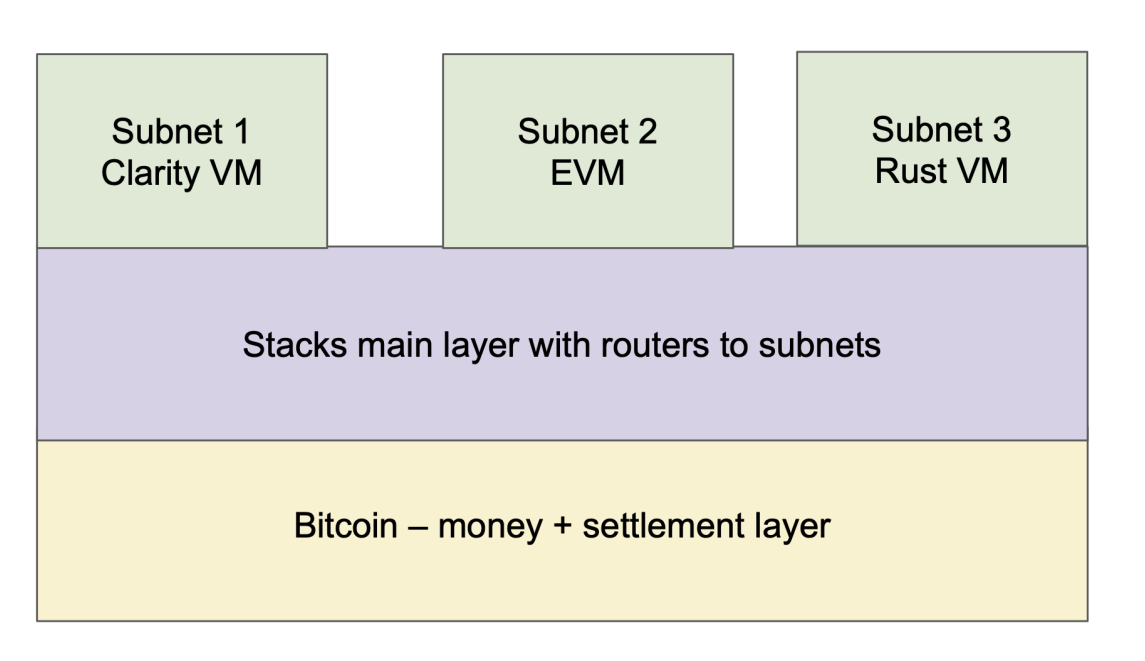
Image source: Stacks Whitepaper
The Stacks core layer interacts with Bitcoin via the PoX mechanism. PoX resembles a Proof-of-Stake (PoS) staking system and is a variant of Proof-of-Burn (PoB), granting Stacks miners the right to mine blocks by “burning” portions of their tokens (native assets or other cryptocurrencies). By burning tokens, Stacks miners earn more block rewards and receive BTC for helping secure the network. The interaction works as follows:
In Stacks, Proof of Transfer requires miners to send Bitcoin to other Stacks network participants (on the Bitcoin network, not to burn addresses). Since Stacks can read Bitcoin’s network state, it verifies these transactions and randomly selects the winning miner for the block, rewarding them with STX, Stacks’ native token.
When interacting with Bitcoin, Stacks does not modify Bitcoin’s base-layer protocol. Instead, Stacks transactions are bundled, with Bitcoin acting solely as the final settlement layer before validation and confirmation. The history of Stacks blocks is permanently recorded on the Bitcoin blockchain.
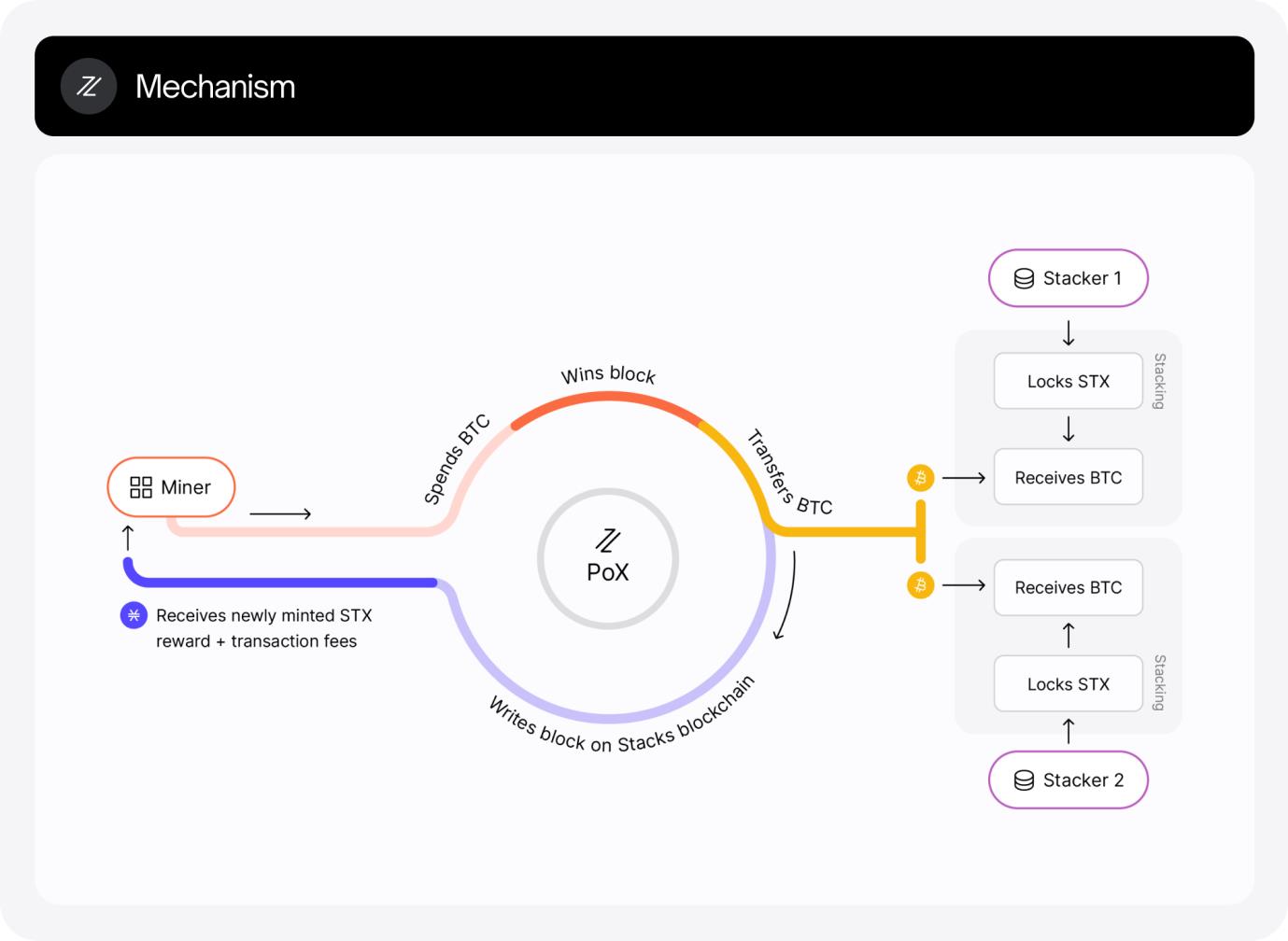
Image source: Stacks Whitepaper
Clarity Smart Contracts:
Stacks uses a language called “Clarity” [4] for creating smart contracts—specifically designed for Stacks and optimized for predictability and security. Clarity is intentionally Turing-incomplete to avoid “Turing complexity.” Its contract code is public and directly accessible on-chain, enabling developers to test code before execution. This allows building dApps that benefit from Bitcoin’s security and stability while adding new functionalities. What innovations can we achieve with Clarity on Stacks, and what are its pros and cons?
What Can Be Done:
1. Build decentralized applications on Bitcoin and migrate DeFi components;
2. Create native assets on Stacks.
Advantages:
1. Security: Inherits Bitcoin’s robust security, highly resistant to attacks;
2. Interoperability: First-layer smart contracts can communicate with other blockchains;
3. Scalability: PoX consensus enables faster transaction finality and higher scalability by leveraging Bitcoin.
Disadvantages:
1. Its unique architecture presents a learning curve for developers. Whether it can attract sufficient developer interest from Ethereum and MOVE-based ecosystems before reaching full potential remains crucial;
2. Regulatory uncertainty surrounding STX mining and stacking could impact Layer-2 development and operations.
Liquid:
Image source: LBTC Official
Turning to Liquid—it’s not just a Bitcoin sidechain but also a settlement network connecting global cryptocurrency exchanges and institutions. Core features include fast settlement, strong privacy, digital asset issuance, and Bitcoin pegging, enabling faster Bitcoin transactions and asset tokenization of fiat currencies, securities, and other cryptocurrencies by members.
Like RSK, Liquid relies on federated multisignature mechanisms to lock Bitcoin on the sidechain, issuing them as native sidechain currency. However, their pegging designs differ significantly. Both currently operate with 15 federation members: Liquid requires 11 signatures to issue Bitcoin, while RSK requires 8. Liquid appears to prioritize security over usability, whereas RSK favors usability over security.
Overall, Liquid is a sidechain platform designed to provide shared liquidity for exchanges, emphasizing protocol simplicity, security, and privacy.
RSK:
Image source: Mt Pelerin Official
RSK is another sidechain with native token RBTC, aiming to be a cornerstone of financial inclusion, focusing on decentralized finance (DeFi). Secured by Bitcoin miners, RSK is a stateful smart contract platform that enhances Bitcoin’s ecosystem by expanding its monetary utility. DApps can be built using the Solidity compiler and Web3 libraries, achieving Ethereum compatibility. Additionally, it leverages the RIF Lumino payment channel network for expanded on-chain capacity and off-chain transactions.
RSK targets broader use cases by adopting a stateful VM to improve openness and programmability. Ethereum-compatible, it enables migration of Ethereum dApps and tools. In contrast, Liquid focuses on being a highly efficient specialized tool.
Drivechain
Drivechain is an open Bitcoin sidechain protocol enabling customizable sidechains tailored to specific needs. BIP-300/301 proposes “allowing developers to add features and functionality to the Bitcoin world without modifying Bitcoin’s core code.” It creates Bitcoin sidechains secured by Bitcoin miners, using Bitcoin as a secure Layer-1 foundation while enabling diverse Layer-2 scalability use cases. Notably, BIP-300 “Hashrate Escrows” compresses 3–6 months of transaction data into 32-byte Container UTXOs, while BIP-301 “Blind Merged Mining” maintains network security via merged mining, similar to RSK.
By creating sidechains tailored to specific application needs, and treating sidechains as Layer-2 solutions, Drivechain bypasses Bitcoin’s 1MB block size limit. Currently, seven BIP-300-based sidechains are in development, continuously attracting Bitcoin community members and enthusiasts (brief examples only, see [6] for details):
-
EVM Sidechain: EthSide
-
Digital Asset/Colored Coin/NFT Sidechain: BitAssets
-
High-Throughput Sidechain: Thunder Network
-
Prediction Market Sidechain: Hivemind
-
Privacy Sidechain: zSide
-
Distributed DNS Sidechain: BitNames
-
Storage Sidechain: Filecoin
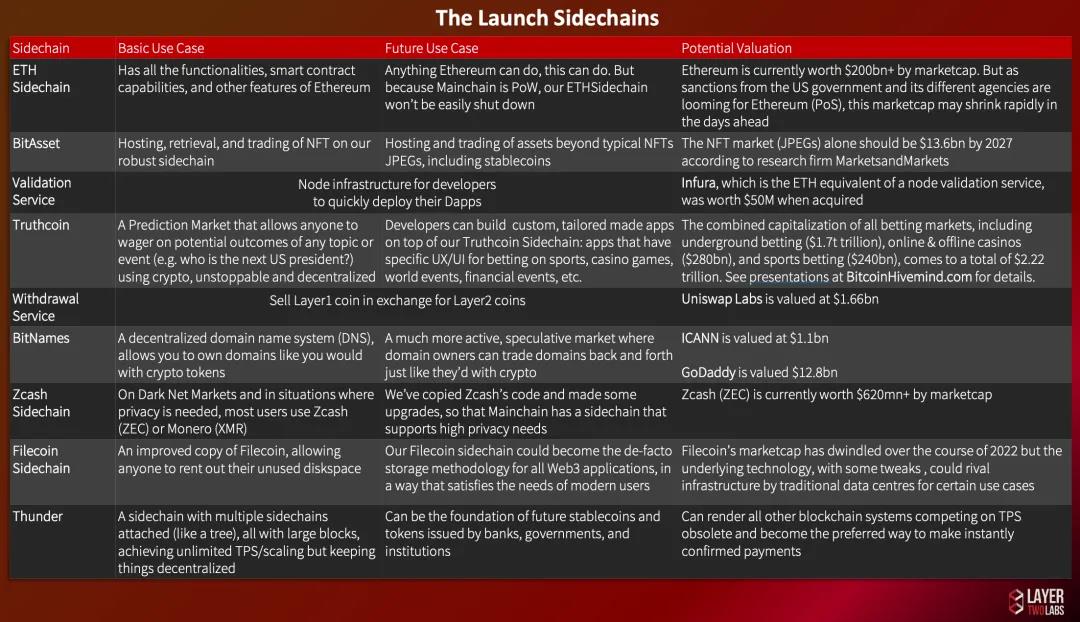
Image source: LayerTwo Labs Asia Community
Ordinals Protocol and BRC-20:
UniSat Wallet is a popular Chrome extension wallet in the Bitcoin ecosystem, enabling users to store, mint, and transfer BRC-20 tokens. It offers various Bitcoin ecosystem services including buying/selling BTC, NFTs, and domains.
Origin of BRC-20
As explained earlier regarding UTXO mechanics, every transaction generates numerous inputs and outputs (reflecting balance changes). Since each Bitcoin consists of 100 million satoshis (1 BTC = 10^8 sats), and each satoshi has a unique ordinal number and cannot be subdivided, meaning each satoshi can be assigned specific meaning based on its ordinal position. For example, 50 BTC on the network can be represented as: 4,999,999,999 sats.
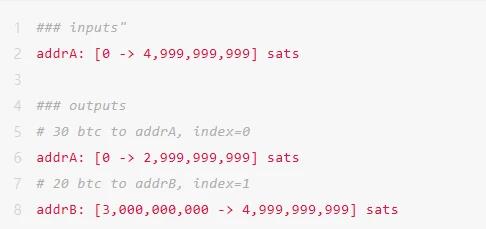
Image source: Shisi Jun
While the Ordinals protocol and self-proclaimed BRC-20 standard exhibit overly centralized traits and lack formal validation mechanisms, their market-driven popularity has undeniably drawn renewed attention to Bitcoin’s ecosystem and Layer-2 developments, refocusing public interest back onto Bitcoin.
Summary:
Bitcoin sacrificed scalability at inception to maximize decentralization and security. Yet, this very constraint—and Bitcoin’s unparalleled security as the most successful blockchain network—has inspired immense creativity among developers and researchers.
Supporters of Bitcoin’s ecosystem are broadly divided into conservative and radical camps. Conservatives believe Bitcoin must remain pure—a digital gold solely for value storage—requiring no further scalability. Radicals advocate for expansion to embrace native applications, maximizing Bitcoin’s transactional utility for long-term growth. Perhaps we can leave this pivotal question to the future—time will tell.
References:
[1]https://twitter.com/tmel0211/status/1715627595004543032
[2]https://docs.rgb.info/v/zh/she-ji
[3]https://blackpaper.rgb.tech/consensus-layer/3.-client-side-validation
[5]https://www.odaily.news/post/5169725
[6]https://layertwolabsasia.medium.com/seven-sidechains-overview-538e76352e6c
Join TechFlow official community to stay tuned
Telegram:https://t.me/TechFlowDaily
X (Twitter):https://x.com/TechFlowPost
X (Twitter) EN:https://x.com/BlockFlow_News
 @YBBCapital