
FT Hype Cools Down, Where Is the Future of Web3 Social?
TechFlow Selected TechFlow Selected
FT Hype Cools Down, Where Is the Future of Web3 Social?
Social projects must prioritize product quality—only with a good product can you acquire long-term, deeply engaged users.
 Navigating Web3 tides with focused insights
1. When will the current FriendTech hype end?
Let’s talk about the future of Web3 social:
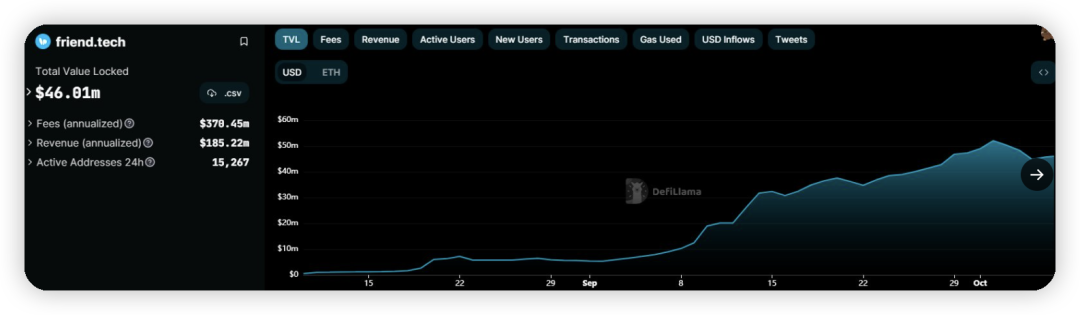
The trend is clearly cooling down. Growth has slowed, TVL remains around $40M+, some major influencers have started selling their keys, and disputes are emerging one after another;
Market sentiment is gradually returning to calm. Previously, emotions were in an extreme FOMO state: indeed, with soaring TVL, KOL shilling, overwhelming discussions on Twitter, and constantly rising portfolio values, it was hard not to get adrenaline pumping and blood rushing;
But after a few days of pullback, many people are likely thinking more rationally now—after all, even @machibigbrother's entry didn’t drive further TVL growth;
If this continues, FriendTech will inevitably keep declining, as its core mechanism isn't complex, and key utilities have already been explored into several common patterns. Without sustained growth, most retail investors won’t be able to profit consistently and may rush to exit early to avoid getting rekt;
So back to the question: when will this wave end? I believe it depends on official adjustments. The project team's upcoming feature updates, gameplay changes, and economic model design will play a crucial role in FriendTech’s long-term sustainability;
After all, FT’s current functionality is too basic to serve as a solid knowledge monetization product; room owners can't endlessly generate content. Most importantly, big players depositing hundreds of ETH aren’t here purely for consumption—they’ll eventually withdraw liquidity. Therefore, tokenomics design is key to stabilizing TVL and preventing a cascade of mass exits.
2. Is FriendTech a revolutionary Web3 social project?
FriendTech is undoubtedly an outstanding social project. Its innovative mechanics, integration of social and crypto, massive buzz and discussion volume, high TVL and profitability—all confirm that FT holds significant importance for the SocialFi space;
However, FT still has many shortcomings—or put differently, huge room for improvement:
❶ First, the commonly criticized high trading fees and bots mean that apart from top room owners, most profits go to the project team and arbitrageurs—this is precisely why most retail users hesitate to engage deeply.
❷ Lack of features. I won’t dwell on UI, but current social activities are limited to text and image chats within Rooms—too restrictive. Room owners have come up with creative ways to enhance their key utility, but they must rely on external platforms or tools; Rooms don’t even have basic functions like giveaways or voting.
❸ In SocialFi, the "Fi" component carries too much weight. Ponzi schemes eventually collapse—if the product fails to retain users, once the economy breaks, it will be deserted.
Of course, the project has only been live for three months—the future depends on what the team does next.
3. How should we view FriendTech clones and other social projects?
Recently popular clones include Stars Arena and CipherRip. One thing they’ve done right is adding tweet-like posting and tipping features, slightly diversifying Web3 social activities. But they’re unlikely to pose a serious threat to FT.
Previously, we often referred to CyberConnect (social graph) and Lens Protocol (base-layer protocol) as social leaders, but now the market seems to favor tool-based projects with fun mechanics.
The ideal Web3 social super app in my mind should have:
- A public feed similar to Twitter or Weibo
- Private groups, public groups, holdings-based groups, and paid access groups
- Voice and video livestreaming capabilities
- An open-source platform with APIs to connect with other dApps, enabling independent developers to build mini-apps
Currently, DeBox comes closest, though its financial mechanics could use more innovation.
4. Finally, three personal thoughts on Web3 Social
❶ Both SocialFi and GameFi can be seen as P2E, but their biggest difference is: In GameFi, you only earn in-game rewards (NFTs and tokens), which easily spiral downward as token prices fall and new users decline; whereas in SocialFi, beyond token rewards, you also gain traffic and influence—enabling monetization across other platforms and channels. So even if a SocialFi project isn’t profitable, you still have incentives to keep engaging. Thus, SocialFi has greater longevity and higher ceilings than GameFi.
❷ Social projects must focus heavily on product development to meet Web3 user needs (e.g., giveaways,红包, voting, governance, treasuries)—this is a long-term refinement process. Only great products can attract loyal, engaged users.
❸ Don’t aim to replace Twitter or become a “Twitter killer.” Doing so only cuts off a vital channel for attracting Web2 users. Embrace Twitter instead—use open platforms and APIs to funnel traffic and enable richer interactions.
Join TechFlow official community to stay tuned
Telegram:https://t.me/TechFlowDaily
X (Twitter):https://x.com/TechFlowPost
X (Twitter) EN:https://x.com/BlockFlow_News
 @0xDy_eth