
How to scientifically do User Acquisition in Web3?
TechFlow Selected TechFlow Selected
How to scientifically do User Acquisition in Web3?
To acquire users with such precision, one must deeply understand them.
 Navigating Web3 tides with focused insights
Author: Simon, IOSG Ventures
Topics Discussed
-
Why is user acquisition extremely difficult for Web3 games?
-
Will traffic distribution platforms (e.g., marketplaces, aggregators, social media) continue to control their attribution engines? Or will the openness and permissionless nature of Web3 data allow third-party attribution protocols to provide stronger user behavior tracking and analytics?
-
What unique attention economy models will emerge in Web3? How can they integrate with advertising?
Part 1: UA for Web3 Games
Traditional game UA/marketing experts are likely familiar with calculations like this:
The 180-day LTV (Life-Time Value) of iOS users is $5, and our CAC (customer acquisition cost) on Facebook North America is $4, with a daily spend of $80k. Mathematically, does this constitute a business with positive ROI (Return on Investment)?
Traditional mobile app user acquisition is more science than art—every step is quantifiable. Marketers and UA specialists can input such data into long-used spreadsheets to project LTV-to-CAC ratios and determine whether a given mobile app/game has a viable, profitable business model.
However, to acquire users so precisely, we need deep insights into user behavior.
In traditional gaming contexts, users are relatively easy to identify and analyze—they are often traceable to specific mobile devices. Even with some inaccuracies (e.g., one user operating multiple devices), we can still link a device to a series of in-game and out-of-game behaviors. This allows UA experts to identify which channels brought users into the game, calculate each channel’s ROI, and adjust spending accordingly.
Yet in the Web3 world, we cannot take user tracking and attribution for granted.
While traditionally distributed games (app stores, PC platforms, console shops) benefit from mature data pipelines provided by established distribution channels—enabling publishers to deeply understand user behavior and preferences—wallet-based tracking and platform policies create significant hurdles for user acquisition in Web3 games.
1. Wallet Attribution
Since Web3 games require wallet connections, game companies need to directly map wallets to individual players. However, in the Web3 world, wallets are often not uniquely tied to specific users.
Moreover, the contents of any given wallet change over time—NFTs and tokens may be traded in and out at any moment, asset values fluctuate, and some assets might not even belong to the wallet holder. This makes estimating LTV based solely on wallet content extremely challenging.
Wallets also obscure real-world identities, making targeted advertising more difficult. Some wallets may not be operated by humans at all, but by bots or AI. Bot-controlled wallets could even have negative LTV, as bots often act as economic extractors in Web3 games.
This challenge, however, opens opportunities for projects like Thirdwave and Slise that specialize in wallet profiling. These projects use algorithms or manual indexing to organize on-chain data, uncovering user personas behind wallets and laying the groundwork for targeted advertising.
2. Platform Policy
Traditional game distribution platforms are constrained by Google and Apple's revenue-sharing models, leading to hesitant and ambiguous attitudes toward Web3 games. Currently, any NFT purchase on iOS and Android must go through IAP (In-App Purchase), allowing Google and Apple to continue taking their 30% cut while severely limiting the utility of NFTs.
Console developers are quietly investing in and developing Web3 games but remain cautious in their public stance.
On PC, Steam remains wary of blockchain, while Epic embraces it openly.
Overall, due to uncertainty and the lack of publishing infrastructure—both missing Web2 publishing interfaces and underdeveloped native Web3 publishing tools—many Web3 game projects opt for the easier path: building browser-based games.
While browser-based games align well with current infrastructure capabilities, the absence of user data persistence renders traditional cost-per-install metrics useless. Even if a wallet can be traced back to its source channel, players can easily connect or disconnect wallets, making it hard to determine whether a user has truly been "acquired" or was just casually exploring.
1. If we cannot accurately estimate LTV,
2. If we cannot accurately trace CAC,
3. Can Web3 truly enable scientific user acquisition?
Not to mention that user acquisition in Web2 is already hitting bottlenecks due to Apple’s privacy policies, and ad prices are rising steadily.
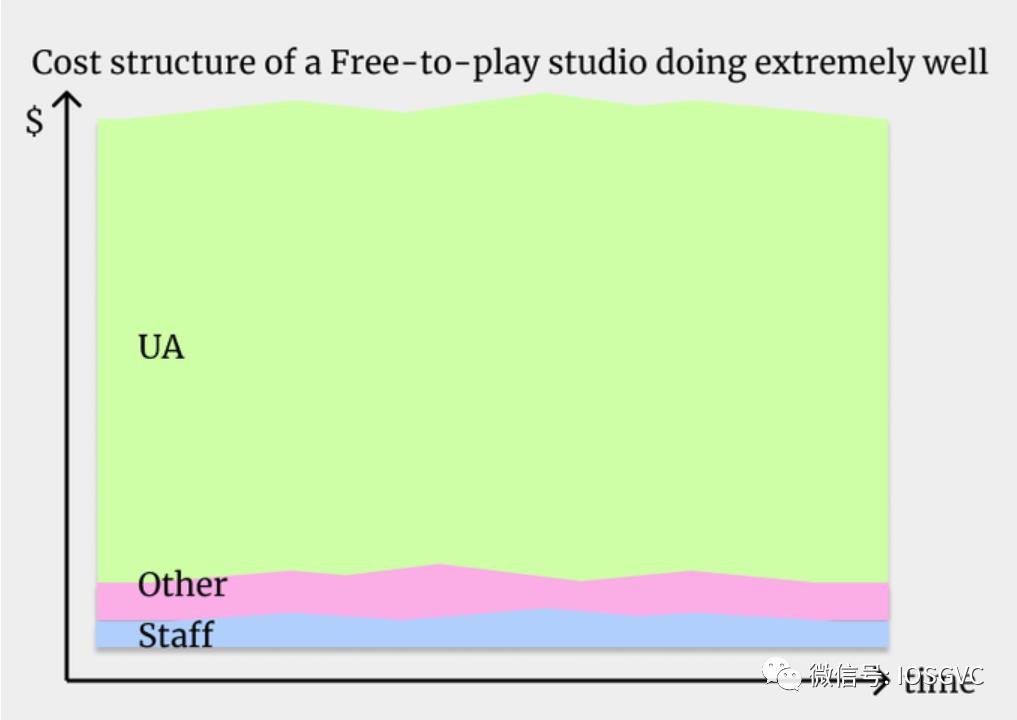
Source: Joakim Achren / Twitter
A Web3 game aiming for mass adoption faces challenges including user onboarding, traffic source tracking, LTV monitoring, and platform policy constraints. Compared to their Web2 counterparts—which benefit from years of UA data and clearly quantifiable funnel metrics—Web3 games are at an absolute disadvantage.
Therefore, traditional performance marketing is often a poor choice for most early-stage, capital-rich Web3-native projects or those with only minimal Web3 integration.
From a traditional gaming industry perspective, this poses a major challenge for game startups. Yet at the same time, Web3 offers a range of unique, Web3-native user acquisition solutions.
Part 2: Crypto Native Ads Stack
In the Web3 world, using advertising as a business model is always controversial.
For many consumers, ads carry negative connotations. Web2 giants leverage vast amounts of user data to deliver hyper-targeted ads, leaving users with little control. Meanwhile, most small individual creators struggle to monetize ads reliably and turn instead to subscriptions.
Objectively speaking, advertising combines product distribution goals with stable revenue streams, making it one of the most successful business models in commercial history.
That’s why social media giants and search engines subsidize their platforms with ads, and top content creators earn money through ads—not subscriptions—on platforms like Substack and Spotify.
But Web3’s openness disrupts traditional platform business models—models built on relatively closed user data and strong user-platform lock-in. Let’s define the Web3 advertising stack within the context of data openness. Its core components include advertisers, ad protocols, markets, and applications.
The Web3 ad stack doesn’t need to mirror the Web2 version. While all components are crucial for a Web3-native ad ecosystem, we should focus on the fundamental unit: the ad itself.
Potential Web3 Advertising Models
-
Ad Assetization: Turning ads into NFTs, referral links into NFTs, or using NFTs as proof of ownership for ad space
-
Token-Powered Attention: Tokenizing user attention and enabling token-based transactions and incentives (attention assets: homepage content, storefront placement)
-
On-chain/Off-chain Integrated Targeting: Bridging off-chain and on-chain user profiles
Ad Assetization
CryptoSlam experimented with this form of advertising early on. CS once sold NFTs granting holders rights to banner ad space on its homepage. Each NFT corresponded to a specific date for displaying a banner on the CryptoSlam homepage.
Taking this further, CryptoSlam could tokenize its ad inventory as NFTs and create a secondary market, generating ongoing royalty revenue. Platforms or ad protocols could enforce royalties on ad NFTs, requiring buyers to pay royalties to secure ad placements. Compared to traditional ad sales, a financialized ad market improves supply-demand alignment and enables micro/small advertisers to access suitable ad resources.
Beyond NFT ads, crypto can also enable more efficient referral mechanisms (e.g., “Pinduoduo-style” user acquisition). Tools like [ShareMint] allow crypto projects to generate on-chain referral links, dynamically reward referrers, and run targeted token incentive programs.
On the music NFT platform [Sound.xyz], fans earn 5% of the tokens minted by creators via their referral links and playlists.
As more user behaviors move on-chain, future incentive schemes could empower referrers to create value at various stages of the product marketing lifecycle.
Token-Powered Attention
On social networks and search engines, advertisers pay for extra visibility. In Web2, paying Google boosts a site’s ranking in search results. In Web3, traffic hubs can use tokens to price attention assets.
The NFT art platform SuperRare uses its RARE token for curation in several ways. First, RARE token holders have curatorial rights, deciding which entities or individuals can open stores on SuperRare.
On SuperRare, galleries are valuable attention assets—top galleries receive more views and higher sales. In a sense, better galleries equal better ad placements.
Further imagine users staking tokens to determine which store appears first on their personal homepage/marketplace/social app. In this model, curation tokens become a form of “streamed advertising,” where a portion of store and protocol revenues flows back to token holders.
User-advertiser interaction becomes bidirectional—users decide what ads they want to see. This also allows tokens to capture additional value and enables revenue sharing among platform stakeholders.
On-chain/Off-chain Integrated Targeted Advertising
Several companies, including Slise and Hypelab, are building protocols focused on user activity tracking. Simply put, they aim to link users’ Web3 and Web2 identities to construct comprehensive user profiles.
For example, suppose an NFT marketplace wants to measure the effectiveness of its marketing campaign. By using an attribution protocol, the marketplace can track whether an individual who clicked a referral link or Twitter ad 1) actually used their protocol and 2) purchased assets through the marketplace.
Currently, few Web3 companies or protocols use advertising as a business model, but the evolution of this space is somewhat predictable.
While the vision of a grand, cross-platform, generalized Web3-native ad protocol is exciting, the lack of control over content/attention distribution will bottleneck its widespread adoption.
Conversely, apps or marketplaces controlling user distribution and attention may attempt to manage their own ad experiences for various reasons, and user tracking engines may be acquired by large SocialFi platforms.
Regardless of how old Web2 power struggles replay themselves, one thing is certain: in the relatively open data environment of Web3, attribution engines capable of synthesizing real user profiles have far greater potential than their Web2 counterparts. Given that Web2 AdSense sold for $102 million, what do you think a Web3-native AdSense would be worth?
Join TechFlow official community to stay tuned
Telegram:https://t.me/TechFlowDaily
X (Twitter):https://x.com/TechFlowPost
X (Twitter) EN:https://x.com/BlockFlow_News
 IOSG Ventures