








Correctly Evaluating Block Space: The Most Valuable Commodity in the Crypto World
TechFlow Selected TechFlow Selected
Correctly Evaluating Block Space: The Most Valuable Commodity in the Crypto World
Block space is a type of commodity that can be easily rated according to common characteristics such as security, flexibility, and decentralization.
 Navigating Web3 tides with focused insights
Written by: nate
Translated by: TechFlow
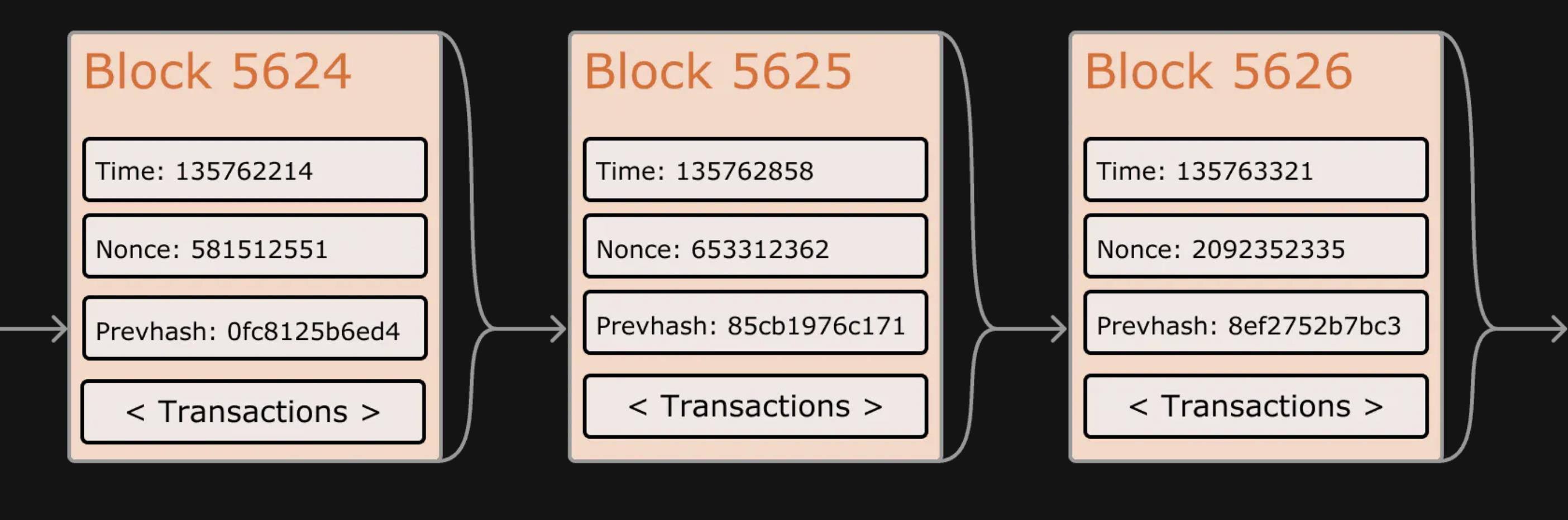
Performing transactions, storing data, and computation on a blockchain is blockspace. Intuitively, transactions included in a block constitute blockspace.
In various articles, posts, and podcasts, blockspace is increasingly referred to as the "best product" or "most important commodity." Understanding what blockspace is, and how its value is created and assessed, can be confusing—especially since it continues to evolve rapidly.
Not all blockspace is equal; they actually differ significantly. Blockspace is a class of commodity that can be easily rated based on common characteristics such as security, flexibility, and decentralization. This article will detail each characteristic with examples, then explore the market participants behind what is currently the most valuable digital commodity.
First, a brief overview of consensus mechanisms securing blockspace:
Proof-of-Work (PoW) requires miners to solve complex mathematical problems to validate transactions and create new blocks. The first miner to solve the problem receives newly minted tokens as a reward. Solving these problems requires massive computational power, making it difficult for any single miner to control more than 50% of the network's computing power. If a miner controls over 50%, they could launch a 51% attack. In a 51% attack, the miner with majority computing power can manipulate transactions and even reverse them, potentially enabling double-spending. Today, nearly all PoW production is done through mining pools.
Proof-of-Stake (PoS) is a newer consensus mechanism requiring users (called validators) to lock up a certain amount of cryptocurrency as collateral to validate transactions and create new blocks. Validators are selected based on the number of tokens they stake and have incentives to act in the network’s best interest.
Quality
Blockspace can be constructed and generated in many different ways and used for various purposes. Each blockspace market has different levels of security, decentralization, and guarantees, along with varying choices regarding block size, frequency, and validation methods. When deciding to participate in the blockspace economy, you may want to assess several different qualities.
Security
Perhaps the most important quality is the blockchain’s security. How many resources and effort would it take to attack the chain? This is often referred to as a "51% attack," though other consensus mechanisms only require agreement from 33% of producers.
A common metric for measuring blockchain security is to examine the “cost of attack.” How much would it cost in resources to rent and/or purchase enough hashpower/stake to control 51% of the network?
Full takeovers of blockchains are extremely rare, having occurred only a few times historically—one being Justin Sun’s takeover of the Steem blockchain. I often wonder why chains like Dash, Bitcoin SV, or even well-known ones like Zcash haven’t seen more full takeovers. But if their security is so poor, it’s easy to infer their other qualities are equally bad—or worse.
More common attacks are simple blockchain reorganizations. These are frequently observed on blockchains like Polygon, which often undergoes reorgs. It should be noted that due to Polygon’s probabilistic consensus, not all reorgs are necessarily malicious. However, reorgs can also be attacks where producers rearrange transactions in previously confirmed blocks for their own benefit.
To better understand the issues posed by reorgs, consider this example: A small company bids on an advertisement billboard along a popular highway. After intense competition with a rival, the company owner pays 20% more than initially expected. Satisfied with the ad placement, they send their design to the billboard company. Weeks later, the small business owner drives by to see the billboard, only to find their competitor’s ad displayed instead. This mirrors what happens during a reorg—your previously paid transaction gets “rolled back” and reorganized.
For those consuming blockspace, security may be the most critical feature—they want assurance that their paid transactions are secure and relatively immutable. This directly impacts the value of blockspace, producers’ willingness to spend resources creating it, and ultimately traders’ interest in trading it.
Decentralization
Blockchain decentralization is just as crucial as security and another key quality. Decentralization consists of several equally important aspects:
-
Nakamoto coefficient;
-
Diverse operators;
-
Geographic distribution;
-
Client diversity;
-
Unique hardware.
The Nakamoto coefficient is undoubtedly the most commonly used metric for measuring blockchain decentralization. It's a very simple formula: the percentage of validators or hashpower required to compromise the network, helping gauge how many colluding parties would be needed to successfully disrupt normal blockchain operations.
Just as important as the total number of participants is the number of distinct entities that need to collude. For example, Coinbase operates about 7% of Ethereum validators. Lido, a liquid staking provider, currently accounts for approximately 33% of Ethereum’s validators. Lido itself isn't a validator but partners with trusted operators like Coinbase. Adding Lido’s underlying share plus the number of validators it represents, Coinbase effectively controls around 12% of the entire network.
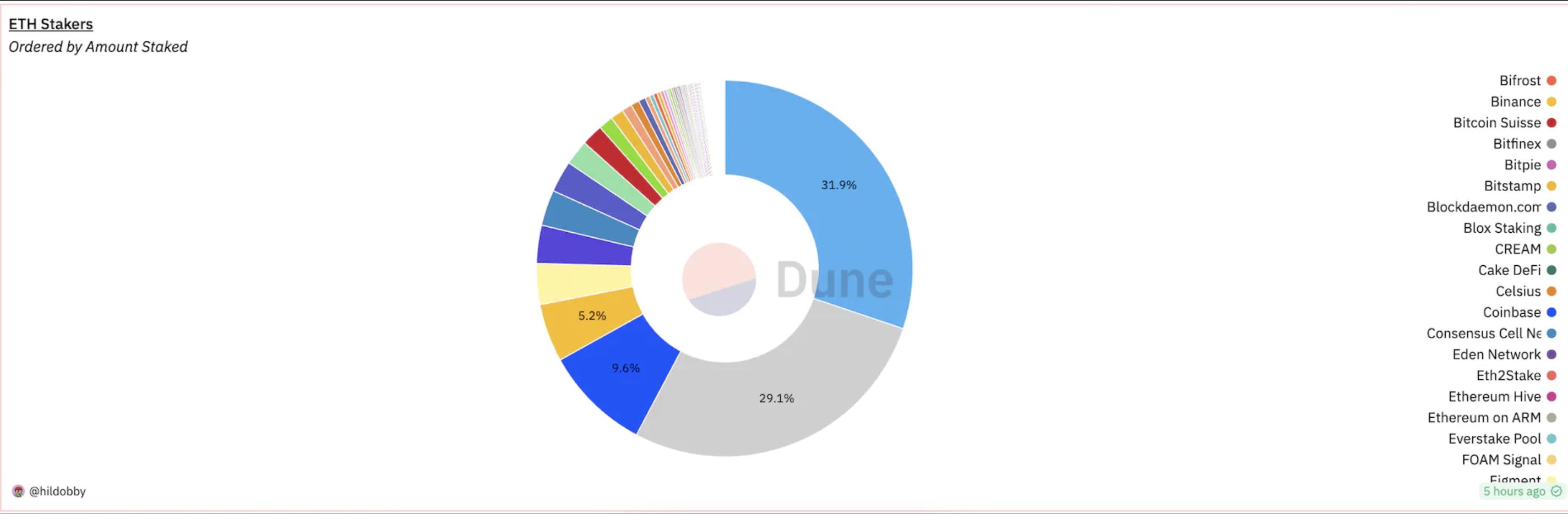
Bitcoin is often considered the leader in decentralization, yet its Nakamoto coefficient is only around 5. While there are indeed many unique block producers, Bitcoin mining pools have full control over transaction ordering within blocks (until Stratum V2 is fully implemented and adopted).
Throughout most of Bitcoin’s history, one or two mining pools have controlled over 33% of the hashpower, thereby controlling transaction ordering in given blocks.
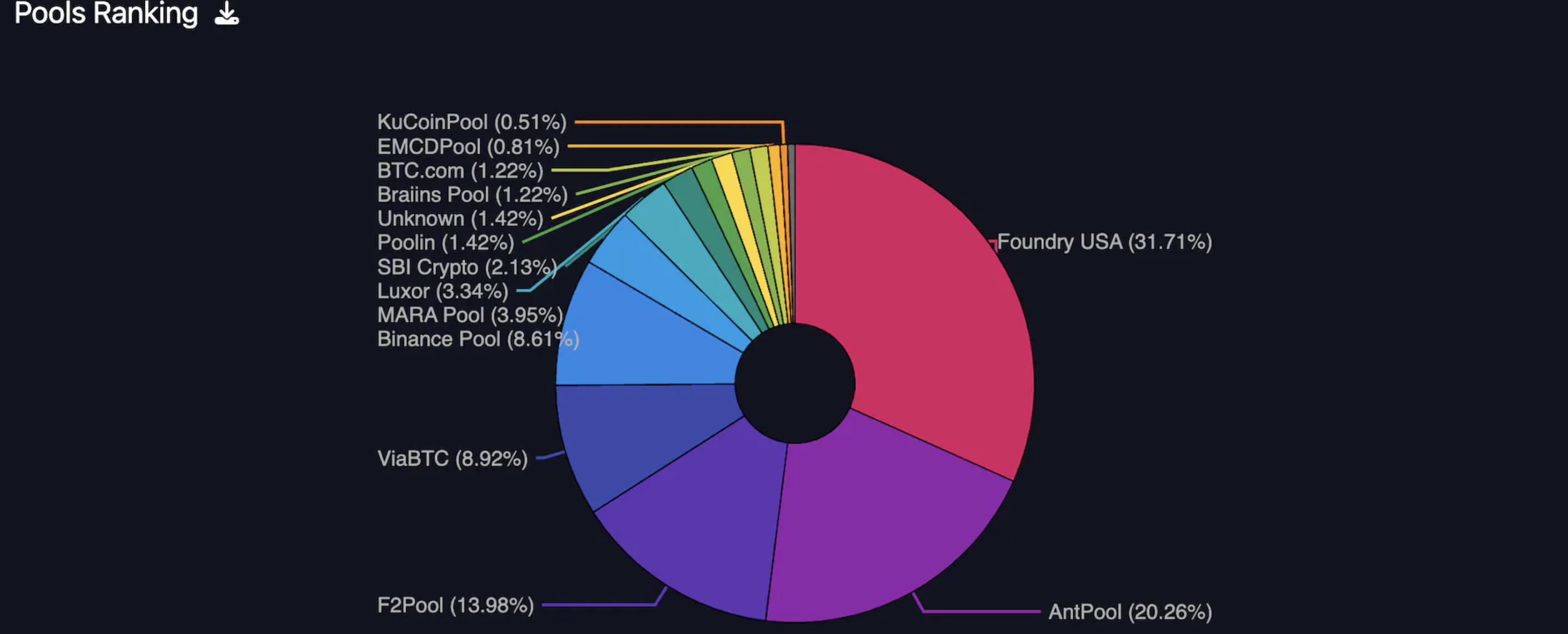
Some market participants deeply care about the order of their transactions within specific blocks, and complete control by a single party significantly reduces the quality of blockspace for them. Note that the same applies to rollups with a single sequencer.
Having a single entity order/build most of the blockspace intuitively harms decentralization and may also allow producers to extract significant additional value. This is commonly known as Maximum Extractable Value (MEV), where producers can capture substantial profits. It's also important to note that MEV helps certain applications function properly—examples include liquidations, arbitrage to maintain market competitiveness, and searchers required for rebalancing products like Squeeth.
MEV is a huge and important concept when discussing blockspace (the MEV supply chain itself is now a multi-billion dollar industry), warranting its own dedicated article. But here are a few key points to know:
Establishing an independent MEV supply chain is critical to avoid harming blockspace consumers. Many protocols are addressing this issue:
-
Flashbots;
-
Jito on Solana;
-
Skip on Cosmos;
-
Stratum V2 on Bitcoin;
-
(Still waiting for MEV solutions from Polkadot and Near)
MEV also exists on Bitcoin, with large mining pools already extracting it. The amount of MEV available is directly related to the value of the given blockspace.
Size, Quantity, Validation
The actual specifications of blockspace are also an important factor when judging quality. These are very straightforward and clearly defined:
-
How big is a block? How many transactions can a block hold? How much data can fit in a block?
-
How frequently are blocks produced? How many blocks are generated per day?
-
How does the network reach consensus on blocks?
Questions about blockspace size and quantity are typically considerations for consumers or traders. If a consumer wants their transaction finalized within one hour, how many blocks are available to bid for space? As a trader, how scarce is blockspace?
Assessing how a network reaches consensus on blocks might matter more to institutional consumers—perhaps a fund or trading firm—but even more likely to applications built atop given blockspace, such as exchanges, custody services, or Layer 2s. An exchange might evaluate the consensus formation method because it could impact user execution. Examples of how different network participants achieve consensus:
Round-robin / Leader election:
-
In round-robin systems, validators are periodically selected to build, propose, and exclusively include entire blocks.
-
Examples include Solana, Cosmos, and Polygon.
General consensus:
-
In general consensus networks, producers broadcast blocks to the network REST, and the block is added if consistent.
-
Example: Bitcoin.
Single sequencer:
-
Most Layer 2 networks implement a single sequencer who orders all transactions, forms them into blocks, and publishes them to Layer 1 or a data availability layer.
-
Examples include Arbitrum and Optimism.
The method of reaching consensus produces slightly different impacts on exchange executions.
Round-robin leader election is typically very fast, but for networks that haven’t abstracted the block-building layer, it gives an advantage to exchange participants who are validators.
General consensus offers the fairest execution for exchange users but currently struggles with throughput. As of 2023, we haven’t yet seen a fully functional and fast orderbook operating on a blockchain using general consensus.
Exchanges built on current networks with centralized sequencers must assess the likelihood of frontrunning or extraction of certain value types by the sequencer operator in transaction ordering.
A fourth option for exchanges is to run parts of their infrastructure off-chain, such as their orderbook. This is also emphasized in hybrid AMM and orderbook designs.
Availability
Ensuring blockspace consumption, access, and production are widely available and consistently usable is crucial.
Can you easily access blockspace? Is it always available, or are there chain halts or downtime? How easy is it to run your own RPC node or access publicly available nodes? Do RPCs frequently overload? Do they maintain consistent uptime?
Uptime
As a consumer, reliable access to the blockspace market is essential. If a blockchain frequently halts or goes down, you cannot reliably use it.
For example, suppose you're a new liquidity provider wanting to supply capital to a concentrated liquidity AMM and choosing between Solana and Ethereum. Judging solely by availability characteristics, the choice is clear: over the past year, Solana and seemingly all Layer 2s have experienced days-long downtimes where the entire chain became completely unusable.
Chain State and Storage
As a producer (and possibly also as a consumer), accessibility of downloading, verifying, and storing the full chain state may be an important consideration.
As a blockspace producer, you want to ensure maximum uptime and minimal dependency on others in case they go offline. Some blockchains like Solana or Near actually require you to download chain data snapshots from AWS S3, Google BigTable, or other validators, offering little to no ability to independently sync and store chain data yourself.
Chain state and storage are also critical considerations for applications or protocols needing historical data. Fully syncing a node on Bitcoin or Ethereum takes only a few days and provides complete historical data. In contrast, Solana’s full chain state is primarily stored in Google BigTable databases requiring petabytes of data, making it nearly impossible for any ordinary user to sync and store locally.
Cost and Fees
Blockspace is valuable and involves various costs and fees associated with its production and consumption.
As a producer, there are more traditional costs such as upfront purchases and/or ongoing expenses for the hardware and software needed to operate on the network. In most cases, initial capital expenditure to stake tokens as collateral is also required (as in PoS networks). In return, you usually receive block rewards from the network, which may also include fees paid by consumers of the blockspace you produce.
As a consumer, to use blockspace on a given network, you must pay fees to block producers (this doesn’t include additional fees you might pay to interact with specific protocols).
Costs and fees vary depending on blockchain implementation and fee market design. Typically, chains implement one of the following designs:
-
Priority gas auctions (PGA): Consumers wanting to use blockspace submit their transaction with a specified fee, entering the mempool. Since producers earn fees from transactions in the block, they (typically) order transactions by highest fee. This is a very simple fee market design and the most common.
-
EIP-1559: Consumers wanting to use blockspace pay a base fee (which is burned) and a priority fee (or tip) to the block producer. It was introduced to provide more consistent fee estimation for consumers.
Fee market design greatly influences how much consumers pay, their willingness to pay, and producers' expected earnings from block production.
Flexibility
Blockspace can be highly adaptive or very static. Most of the time, consumers may prefer stable and predictable space, but in certain use cases, consumers (often protocols) may desire highly adaptable and flexible space.
Flexible blockspace means constructing blocks differently across various use cases. This could involve adding pre- and post-processing instructions at the validator level, allowing fluctuating block sizes, or abstracting block construction.
For instance, imagine you’re a lending protocol exploring launching your own blockchain. You have several options to consider:
-
Cosmos-based appchain;
-
Rollup based on Optimism or Arbitrum tech stack;
-
Building a parachain on Polkadot.
Each has different considerations regarding security, decentralization, and usability.
-
Cosmos appchains require you to bootstrap your own security by incentivizing a validator set, but offer great flexibility in consensus, block building, and transaction execution.
-
Building a rollup using the Optimism tech stack (currently) is more centralized due to a single sequencer, but allows for very fast EVM-compatible blockspace.
-
Polkadot parachains let you leverage Polkadot’s shared security model, but require bidding a significant amount of DOT in an auction to be included.
In short:
-
Cosmos appchains offer ultimate flexibility in blockspace creation, control, and security.
-
Rollups offer flexible blockspace creation, but control and security are currently limited to a single centralized sequencer.
-
Parachains derive security from the Polkadot mainnet... but at a high cost.
Bitcoin, Ethereum, Polkadot, etc., generate general-purpose blockspace. Osmosis, Aevo, Lyra, Sentential use customized and specialized blockspace to improve their products.
Over recent months, products like Caldera and Conduit have made launching OpStack, Arbitrum, or other rollups/appchains easier.
Market Participants
The blockspace market is highly complex but can broadly be divided into producers and consumers.
Producers
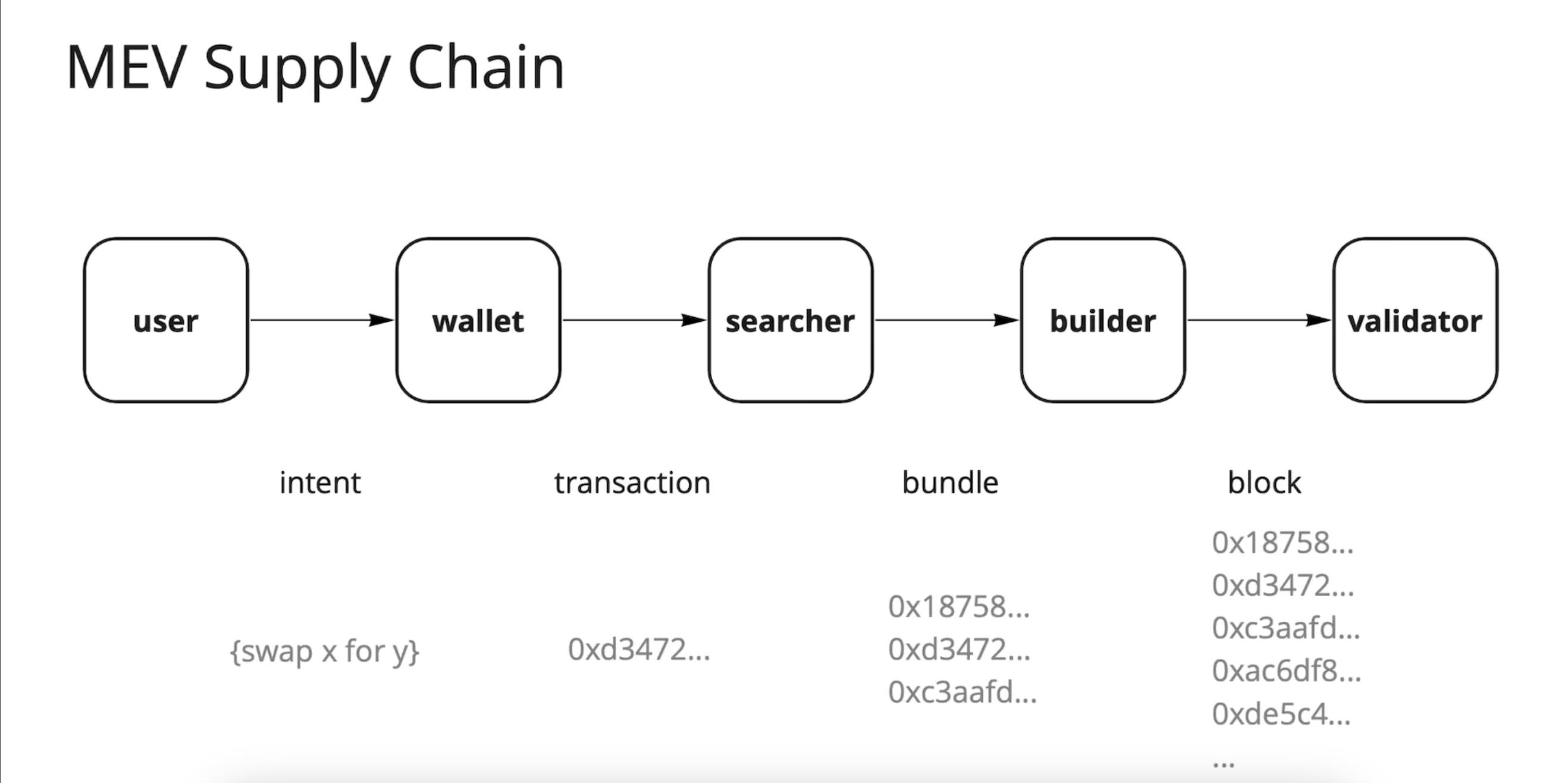
Blockspace producers are network participants who take a set of pending transactions and actually construct them into blocks by ordering them. This is typically one of the roles of validators, miners, or mining pools on a given chain. With the rise of MEV protocols, block construction has largely been outsourced to separate actors called builders. The “MEV supply chain” is now highly complex, involving many different actors, as shown in the diagram below.
In Proof-of-Work, mining pools have full autonomy over transaction ordering in blocks mined by pool members. With the release and adoption of Stratum V2, this will change, allowing individual miners to express transaction ordering preferences to mining pools.
Producers aim to create high-value blockspace, or expect it to become valuable in the future. Below is a list of major producers across various blockchains:
-
Coinbase Cloud;
-
Chorus One;
-
Jump Crypto;
-
Figment;
-
Marathon;
-
Galaxy Digital;
-
Riot;
-
Foundry.
Consumers
Consumers are any entities using the produced blockspace. Actual uses can vary widely—transfers, swaps/trading, other financial transactions, etc.
However, the largest consumers are often overlooked. Asset issuers, exchanges, and protocols built on blockchains are often among the biggest consumers. Below is a list of major consumer protocols/companies:
-
Asset issuers such as Circle, Tether, Paxos;
-
Centralized exchanges such as Coinbase, Binance;
-
Layer 2s such as Arbitrum, Optimism (increasingly common as many application teams deploy their own rollups);
-
And of course, large users/traders.
Valuation
Demand for blockspace can vary greatly. Data Always provided a great overview of blockspace demand in 2022. Below is a table showing blockspace fees for major protocols:
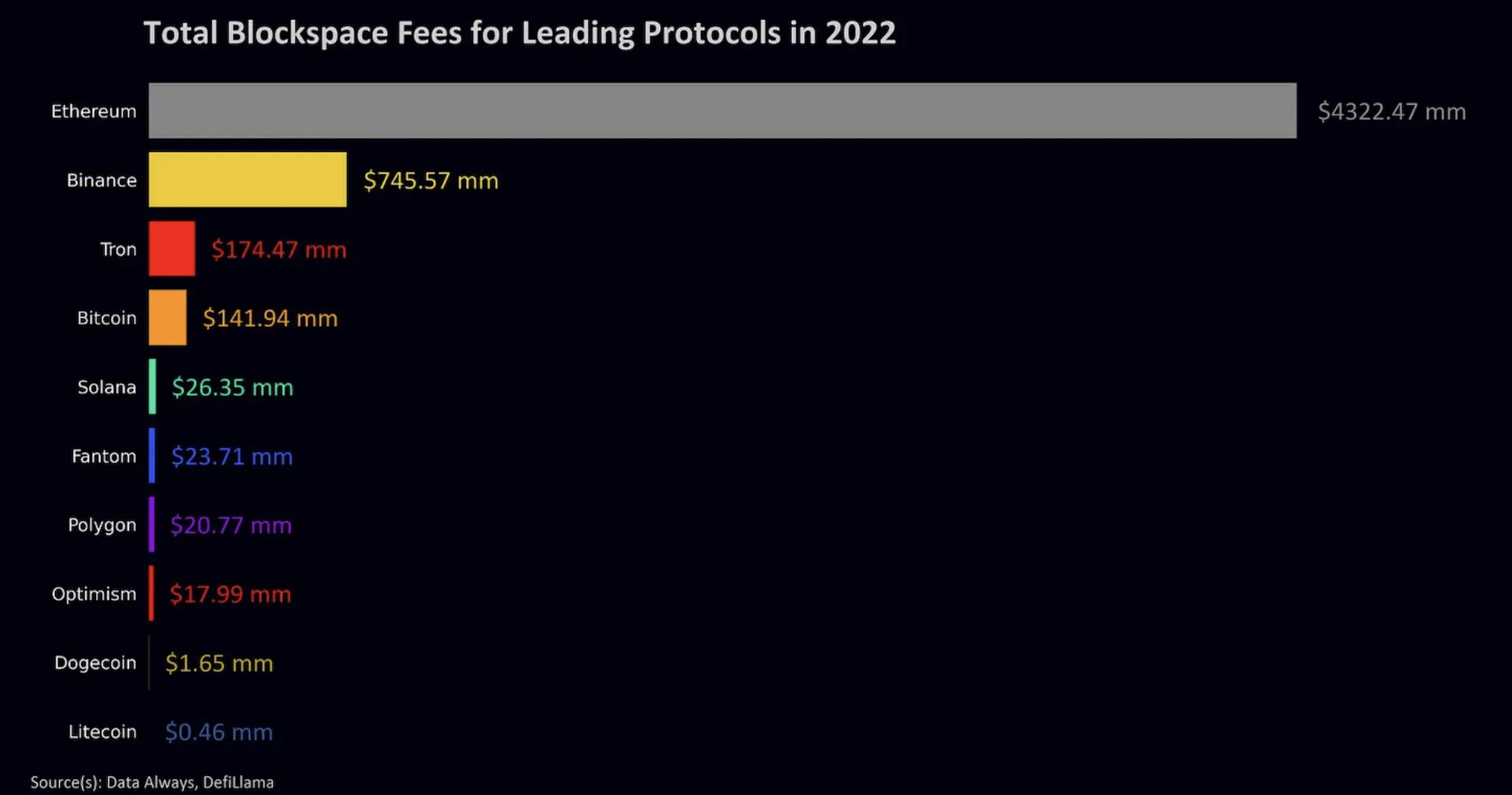
It’s worth noting that most fees paid in native protocol tokens are block subsidies. A more meaningful indicator of real demand and growth is the percentage of user transaction fees relative to total block rewards. For example, on Bitcoin this averages about 2–4%, while on Ethereum it’s similar during low activity periods but can spike above 60%. When tracking protocols with mature MEV supply chains, tips should also be included.
Some chains have developed unique fee markets—an example being Ethereum’s EIP-1559. This upgrade had multiple goals, such as reducing fee volatility, but also an important long-term goal: preventing blockchain instability in a world without continuous native token issuance. 1559 burns the base fee and allocates priority fees to validators, reducing the importance of block subsidies in overall block rewards.
To maintain its promise of cheap fees, Solana created a native fee market where transaction fees are natively tied to interactions with each contract. If there's high demand for an NFT mint on Magic Eden, transaction fees on Jupiter won’t increase. This change is highly consumer-centric, as it effectively reduces the fees validators can expect. However, considering Solana has a robust MEV supply chain, native fee markets could attract more users, leading to higher fees via MEV tips.
Blockspace valuation is still in its very early stages. On most chains, the majority of block rewards come from predictable block subsidies, so rewards and corresponding valuations don’t vary much. But as halvings occur, demand increases, and MEV supply chains develop, transaction fees/tips will make up an increasing share of total block rewards. Valuation will become less predictable and introduce unique trading opportunities.
Trading
Pricing of blockspace is terrible. In many cases, blockchains misprice payments to producers by continuing to inflate more tokens for awful-quality blockspace. Most blockspace is cheap and abundant, with only a small fraction being highly valuable.
This is where I look forward to new implementations of block rewards and fee markets. Currently, most blockchains propose static block subsidies in whitepapers, perhaps aligned with some deflationary schedule. But how can they accurately price their blockspace before launching? I look forward to new approaches for determining block subsidies.
Given how nascent these markets are, you might be a producer or consumer without even realizing you can trade blockspace. Currently, such trades are typically expressed as swaps, forwards, and futures, but more unique instruments exist, such as royalties, block inclusion reservations, and gas tokens.
Primary places currently trading blockspace include:
-
Luxor, where you can trade non-deliverable forward contracts (“Hashprice”) for Bitcoin.
-
Alkimiya, a more flexible swap market where you can trade Bitcoin and Ethereum blockspace swaps, possibly including gas swaps.
Some projects with significant potential:
-
Overlay, a perpetual futures platform allowing trading of native data feeds, explicitly mentioning various blockspace components in its documentation.
-
Oiler, offering multiple products, one being Pitchlake, where you can trade Ethereum’s base fee.
-
Volmex, a volatility trading platform—I can envision it eventually launching something like a fee or validator reward volatility index.
An interesting product idea is forming a blockspace quality index based on the above characteristics and creating a cross-blockchain blockspace swap market—for example, swapping demand between Bitcoin and Ethereum blockspace.
Beyond speculative markets like Luxor and Alkimiya, these markets are critically important for transferring risk between blockspace producers and risk-takers. As public companies and energy firms enter Bitcoin production, they’ll want to reduce cash flow volatility. As Layer 2s grow more complex, they’ll want to hedge Layer 1 transaction fees. As exchanges and asset issuers seek more efficient operations, hedging variable transaction costs becomes increasingly important.
Overall, I’m extremely excited about introducing stronger capital markets around blockspace consumption and production and am eager to see how this evolves.
Join TechFlow official community to stay tuned
Telegram:https://t.me/TechFlowDaily
X (Twitter):https://x.com/TechFlowPost
X (Twitter) EN:https://x.com/BlockFlow_News
 @0xperp










