








The Dark Side of Crypto: Terrorist Financing, Fraud, and Mining—A New Haven for Sanctions Evasion?
TechFlow Selected TechFlow Selected
The Dark Side of Crypto: Terrorist Financing, Fraud, and Mining—A New Haven for Sanctions Evasion?
Terrorists are attempting to use new and lesser-known encrypted tokens, making traditional screening procedures that only cover conventional assets more likely to miss terrorist financing.
 Navigating Web3 tides with focused insights
Author: Elliptic
Compiled by: TechFlow

Terrorist organizations are increasingly engaging with the cryptocurrency sector and leveraging developments in blockchain technology to raise funds while evading detection by authorities. The United Nations estimates that cryptocurrencies could account for up to 20% of terrorist financing.
We have found that major terrorist groups such as Al-Qaeda, Hamas's Al-Qassam Brigades, and the Islamic State have been using crypto assets to achieve a growing range of objectives. These include sanctions evasion, cybercrime, extortion, investment trading, public fundraising, and internal value transfers.
Our analysis has identified terrorist financing involving more than 30 different crypto assets, including DeFi governance tokens and stablecoins. Crucially, extremist groups have moved away from Bitcoin, highlighting the importance of law enforcement access to multi-asset tracking capabilities.
We observe that most terrorist organizations and individuals now increasingly use Tether (USDT) stablecoins, although the number of assets from which terrorist funding may originate continues to diversify.
Moreover, we have examined how extremist organizations raise funds within the crypto space, including through public fundraising campaigns, cryptocurrency mining, mining pools, and DeFi trading and investments.
Public Fundraising
Arguably, the most common form of cryptocurrency-based terrorist financing is through donations collected via social media channels or dedicated websites, which provide a designated cryptocurrency wallet address for contributions.
Our research shows that public fundraising campaigns have raised amounts ranging from hundreds of dollars to over $1 million in cryptocurrency. Major terrorist organizations such as the Islamic State, Al-Qaeda, and the Al-Qassam Brigades have collectively raised over $3 million through public crypto fundraising campaigns.
We also found links between cryptocurrency usage and geopolitical events. For example, wallets associated with the Palestinian Islamic Jihad (PIJ) appear correlated with escalations in conflict in Israel, the West Bank, and the Gaza Strip.
Additionally, donation campaigns have adapted following a series of high-profile seizures of terrorist organization wallets led by the United States and Israel since 2020. While some groups (such as Al-Qassam) have paused fundraising due to increased risks, others have responded by accepting only privacy-focused cryptocurrencies to conceal their activities.
Fraud and Darknet Activities
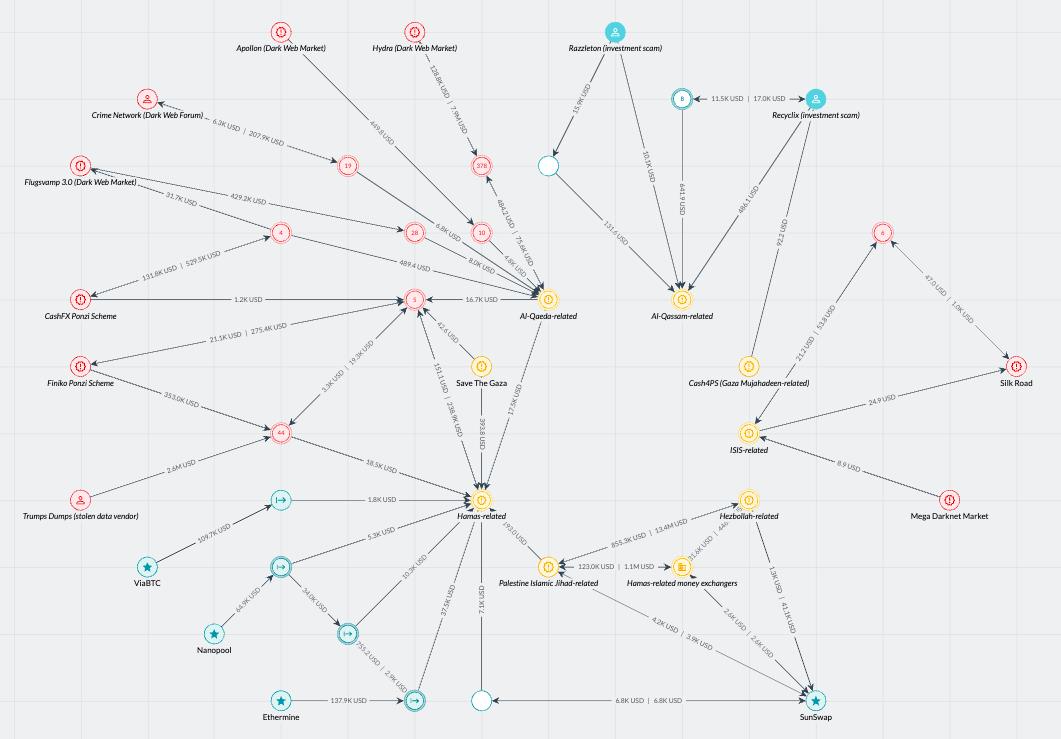
Using our forensic investigation tool, Elliptic Investigator, we can trace fund flows between wallets linked to several major terrorist organizations and various sources—including stolen credit card vendors, darknet markets, Ponzi schemes, and cryptocurrency investment scams.
This activity reflects the association of terrorists with other profit-driven and weapons-acquisition methods. Links between terrorist financing and credit card fraud have already been demonstrated in several seizure cases and criminal prosecutions in the United States and the United Kingdom.
DeFi Trading and Investments
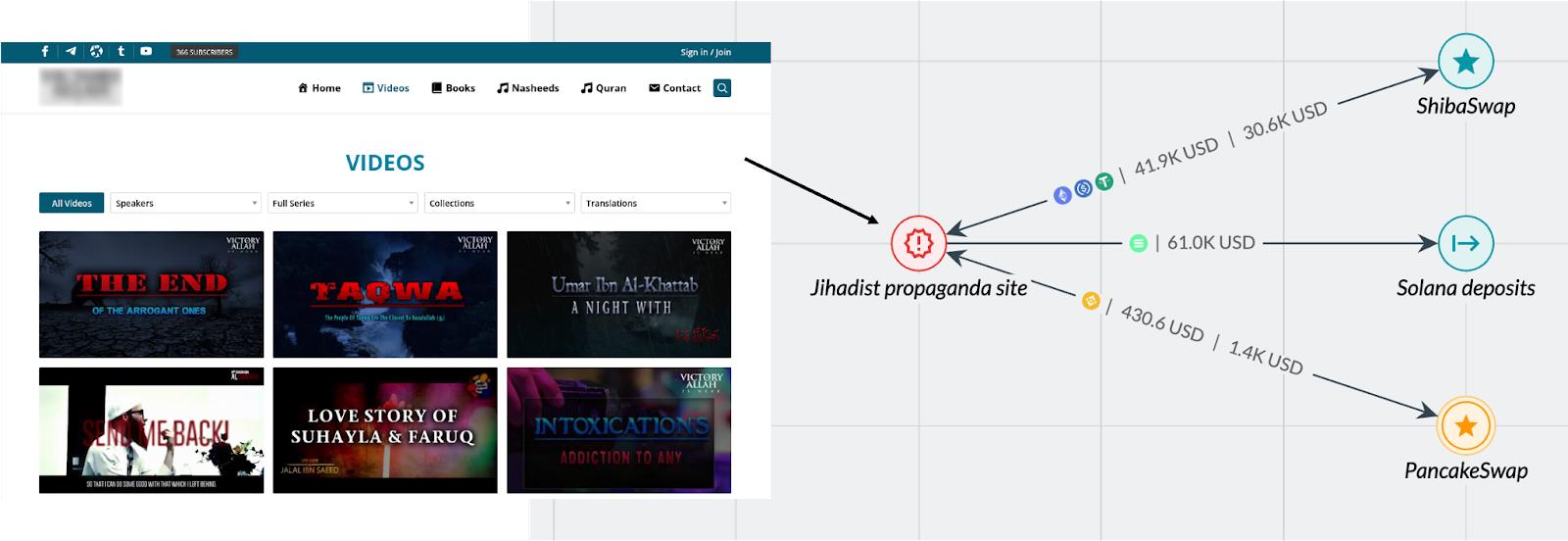
Although terrorist exploitation of DeFi remains rarely observed, one specific case study—featuring one of the most financially successful terrorist entities in the crypto space—highlights this emerging risk and illustrates how DeFi technologies can be exploited.
A particular website we chose to anonymize received funds from addresses closely tied to DeFi protocols, indicating that a significant portion of incoming assets were not donations but rather investment returns generated by the site’s administrators.
Indeed, over 21% of their funds on the Ethereum and Binance Smart Chain (BSC) blockchains originated from decentralized exchanges, with accounts holding various stablecoins and DeFi-specific assets.
Overall, the website received over $300,000 in crypto assets, including $51,000 in Solana (SOL). Wallet records show a profit of $10,000 solely from SOL investments. Proceeds from these trades came from both centralized exchanges and were converted into stablecoins, including over $250,000 in USD Coin (USDC).
Cryptocurrency Mining
Terrorist organizations are exploiting cryptocurrency mining for multiple purposes, including evading sanctions and financing terrorism.
Iran, which funds terrorist-affiliated groups such as Hezbollah and the Islamic Revolutionary Guard Corps (IRGC), has turned to cryptocurrency mining to circumvent international sanctions.
Meanwhile, blockchain analysis has revealed that other terrorist groups, including Al-Qaeda and Al-Qassam, are also involved in mining operations. The Islamic State has even shared guides on cryptocurrency mining along with links to preferred mining pools.

Conclusion
Our research can help law enforcement investigators identify and respond to the latest techniques used by terrorist organizations to evade detection and raise funds.
Furthermore, as terrorists experiment with new and lesser-known crypto tokens, traditional screening processes focused only on conventional assets are more likely to miss terrorist financing. Extremist groups continue to seek novel ways to monetize or disguise funds supporting terrorist activities, often through cross-chain and cross-asset movements.
Join TechFlow official community to stay tuned
Telegram:https://t.me/TechFlowDaily
X (Twitter):https://x.com/TechFlowPost
X (Twitter) EN:https://x.com/BlockFlow_News
 @elliptic









