








Deep Dive into Stacks: A New Chapter for Bitcoin Smart Contracts and DApps
TechFlow Selected TechFlow Selected
Deep Dive into Stacks: A New Chapter for Bitcoin Smart Contracts and DApps
Stacks enables smart contracts and dApps on Bitcoin, which could spark the development of a new ecosystem of developers and users, thereby increasing Bitcoin's usage and value.
 Navigating Web3 tides with focused insights
1. Abstract
This research report provides an in-depth analysis of the Stacks project, an innovative blockchain technology that links itself to the Bitcoin chain through its unique Proof of Transfer (PoX) consensus mechanism, achieving high decentralization and scalability without additional environmental impact. By enabling smart contract functionality, Stacks transforms Bitcoin into a fully programmable asset, thereby expanding the application scenarios for decentralized applications (dApps).
The report details the core components of Stacks, including how it leverages Bitcoin’s state and security, and highlights the features and advantages of using Clarity—a secure smart contract language—for developing contracts. Furthermore, it explains the workings of the Proof of Transfer (PoX) consensus mechanism and how it builds upon Bitcoin’s proof-of-work infrastructure.
2. Project Introduction
Stacks is a blockchain project linked directly to the Bitcoin blockchain. Its goal is to provide a platform that shares Bitcoin's security and settles transactions on the Bitcoin chain. By extending Bitcoin’s capabilities, Stacks enables Bitcoin to become a fully programmable asset, unlocking trillions of dollars in dormant Bitcoin capital and broadening the use cases for decentralized applications.
The Stacks project connects to Bitcoin via its novel consensus mechanism, proof of transfer (PoX). PoX allows the Stacks chain to inherit Bitcoin’s security while enabling STX token holders to earn Bitcoin rewards through “Stacking.” This mechanism adds new functionalities—such as smart contracts and faster transactions—on top of Bitcoin’s proven security, significantly enhancing Bitcoin’s usability and scalability.
Stacks’ vision is to build a fully decentralized network and application ecosystem rooted in Bitcoin. By introducing new tools such as smart contracts and rapid transaction processing, the Stacks project aims to advance Bitcoin and its ecosystem, ultimately contributing to a more secure, fair, and open Web3.
3. Project Architecture
Stacks utilizes its unique Proof of Transfer (PoX) consensus mechanism to link with the Bitcoin blockchain. This integration allows Stacks to leverage Bitcoin’s state and security, offering a more secure and reliable platform for decentralized applications (dApps) and smart contracts. All transactions on Stacks are settled on the Bitcoin chain, inheriting Bitcoin’s robust security.
The Stacks smart contract layer offers the following innovative features:
S (Secured): Finality of Stacks transactions confirmed by Bitcoin.
After approximately 100 Bitcoin blocks—or about one day—transactions on the Stacks layer are secured by Bitcoin’s entire hashing power. Reversing these transactions would require an attacker to reorganize the Bitcoin blockchain. Transactions on Stacks are settled on Bitcoin and inherit Bitcoin’s finality. Moreover, the Stacks layer fully forks Bitcoin, meaning any fork on Bitcoin (soft or hard) is reflected on the Stacks chain. This ensures Stacks evolves alongside Bitcoin without diverging.
T (Trust-minimized): Trust-minimized Bitcoin peg; writable Bitcoin.
Stacks introduces a new decentralized, non-custodial Bitcoin-pegged asset called sBTC. This allows smart contracts to operate faster and cheaper with Bitcoin-backed assets, without compromising security. It also enables contracts on the Stacks layer to write trustlessly to Bitcoin via peg-in transactions.
A (Atomic): Atomic Bitcoin interactions and Bitcoin-address-owned assets.
Atomic swaps and assets: Stacks supports atomic swaps with Bitcoin, allowing Bitcoin addresses to own and transfer assets defined on the Stacks layer. Magic swap and dual swap are live examples of trustless atomic swaps between Bitcoin L1 and Stacks-layer assets. Additionally, users can choose to hold Stacks-layer assets—such as STX, stablecoins, and NFTs—directly in their Bitcoin addresses and transfer them using Bitcoin L1 transactions.
C (Clarity): The Clarity language—secure and deterministic smart contracts.
Stacks supports Clarity, a secure and deterministic smart contract language. With Clarity, developers can mathematically determine exactly what a contract can and cannot do before execution. Decentralized peg contracts benefit from Clarity’s safety properties. As of December 2022, over 5,000 Clarity contracts have been deployed on the Stacks layer. Clarity also eliminates the “gas estimation” problem common in other smart contract languages like Solidity. On Stacks, transaction fees are known precisely before execution, preventing failed transactions due to insufficient gas. Bitcoin-pegged assets such as sBTC are created and managed via special smart contracts called decentralized peg contracts, which leverage Clarity’s security to ensure safe and reliable operations.
K (Knowledge): Full knowledge of Bitcoin’s state; readable Bitcoin.
Stacks has full visibility into Bitcoin’s state, enabling trustless reading of Bitcoin transactions and state changes, and executing smart contracts triggered by Bitcoin activity. This read capability helps maintain consistency between the decentralized peg state (e.g., sBTC) and BTC locked on Bitcoin L1. Whenever a transaction occurs on Bitcoin, Stacks reads the change and updates sBTC accordingly, ensuring users’ sBTC remains synchronized with their locked BTC.
S (Scalable): Scalability with fast transactions settled on Bitcoin.
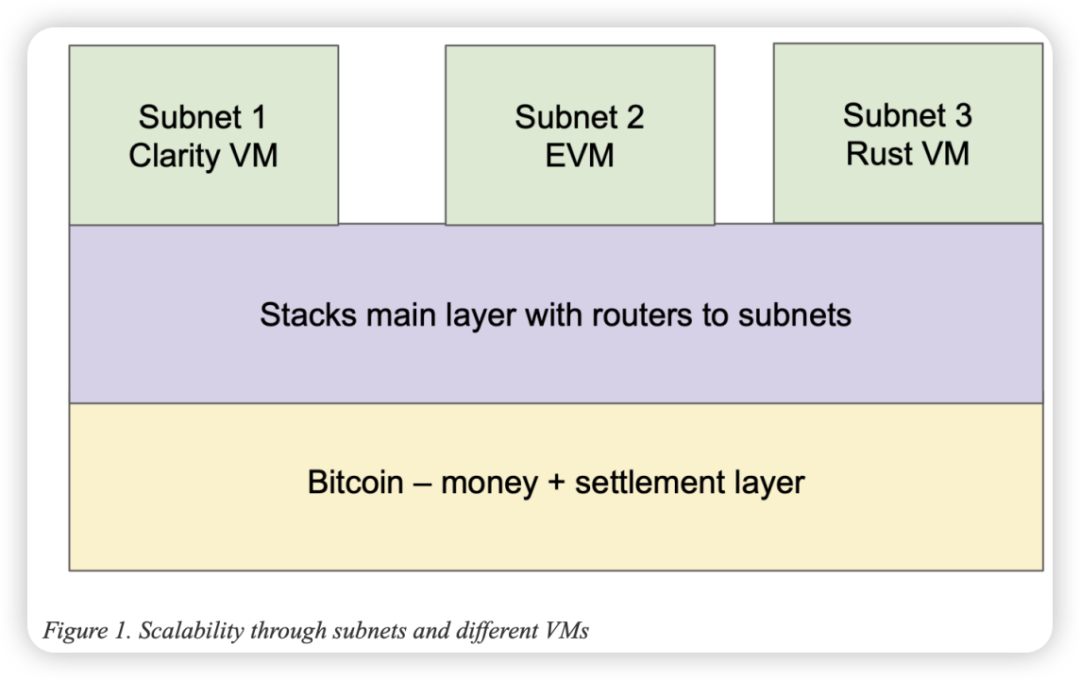
Stacks improves transaction speed by generating Stacks blocks faster than Bitcoin blocks. This allows transactions on the Stacks network to be processed and confirmed more quickly than on Bitcoin. Subnets serve as a scalable layer within the Stacks network, allowing different trade-offs between performance and decentralization. Subnets can be optimized based on specific needs—such as faster speeds or higher decentralization. Subnets support multiple programming languages and execution environments, including Ethereum’s Solidity and EVM (Ethereum Virtual Machine). This means Ethereum-based smart contracts can run on Stacks, use Bitcoin-pegged assets, and settle transactions on Bitcoin, greatly expanding Stacks’ compatibility and utility.
Proof of Transfer (PoX) Consensus Mechanism
Proof of Transfer (PoX) is the core innovation of the Stacks project. This novel consensus mechanism leverages Bitcoin’s proof-of-work (PoW) to achieve high decentralization and scalability. In PoX, nodes on the Stacks chain participate in block creation by “burning” Bitcoin—sending BTC to an unrecoverable address—as proof of contribution to network security. These nodes then have a chance to be selected to create new blocks and are rewarded with STX tokens.
The Stacks layer relies on both STX and BTC for its innovative PoX consensus, bridging the Stacks and Bitcoin layers. PoX is conceptually similar to Bitcoin’s proof-of-work: just as Bitcoin miners spend electricity to earn BTC, Stacks PoX miners spend BTC to earn STX. Like PoW, PoX uses a Nakamoto-style single-leader election: miners bid by spending BTC, and leaders are chosen probabilistically based on bid weight. Leader selection occurs on the Bitcoin chain, while new blocks are written on the Stacks layer. Thus, PoX reuses work already performed by Bitcoin miners without consuming significant additional energy—only requiring standard computing devices to run Stacks nodes and submit BTC bids.
Another key component of PoX is “Stacking,” which allows STX token holders to contribute to network security. By choosing to “Stack” their tokens, holders receive periodic Bitcoin rewards. This unique mechanism enables participants in the Stacks network to earn Bitcoin directly, further strengthening the bond between Stacks and Bitcoin.
Stacks is a deeply and continuously connected smart contract layer for Bitcoin, distinct from sidechains like RSK and Liquid. The Stacks layer allows applications and smart contracts to use Bitcoin (BTC) as their asset or currency and settle transactions on the Bitcoin mainchain. Its goal is to expand the Bitcoin economy by transforming BTC from a passive asset into a productive one and enabling diverse decentralized applications. Like RSK and Liquid, the Stacks layer maintains its own global ledger and execution environment to support smart contracts and prevent congestion on the Bitcoin blockchain. However, Stacks stands out by offering most of the ideal attributes for Bitcoin-based smart contracts, along with high-performance mechanisms such as fast blocks, decentralized pegging, and subnets.
4. Project Applications
Enabling Bitcoin as a Fully Programmable Asset
Stacks unlocks new functionalities and use cases for Bitcoin. By leveraging Stacks, Bitcoin can function as a fully programmable asset within decentralized applications and smart contracts. This innovation opens up widespread applications in decentralized finance (DeFi), including lending, insurance, prediction markets, and more.
With the Stacks layer, developers can build any application they could on other smart contract platforms—such as Ethereum, Solana, or Avalanche—but using BTC as their asset/currency and settling transactions on the Bitcoin blockchain. They can do so either on the Clarity VM or via subnets supporting Solidity or other EVM-compatible languages. Users can also natively exchange BTC for stablecoins and NFTs directly from the Bitcoin chain.
Unlocking Passive Bitcoin Capital
Through its smart contracts and dApps, Stacks unlocks idle Bitcoin capital, enabling it to generate greater value. For example, Bitcoin holders can deposit their BTC into decentralized lending platforms on Stacks to earn interest. Additionally, they can participate in Stacks’ “Stacking” mechanism, locking their BTC to support network security and earning Bitcoin rewards in return.
Fast Bitcoin Transactions
Beyond these features, Stacks also enables faster Bitcoin transactions. Due to Bitcoin’s design, transaction speeds are inherently slow, which can limit certain applications.
The Stacks Bitcoin layer introduces additional performance features for higher throughput, flexibility, and security. While Stacks prioritizes decentralization over low latency or high throughput—ensuring users in remote areas can run full nodes using regular laptops and home internet—the subnet layer can deliver higher performance. Subnets support smart contracts and allow different trade-offs between decentralization and performance compared to the main Stacks chain. Individual subnets may support various programming languages and execution environments. Some may prioritize Clarity and Clarity VM for enhanced security, while others may support Ethereum’s Solidity and EVM compatibility, easing integration and development while leveraging existing Ethereum tooling. With Stacks, users can conduct faster Bitcoin transactions, making Bitcoin viable for daily payments and micropayments.
5. Team Background
Currently, Stacks is a collaborative effort involving multiple independent entities and a vibrant community. Initially, the project was led by Blockstack PBC (now renamed Hiro Systems PBC, or simply Hiro). Hiro comprises 66 team members, founded by Muneeb Ali. Key team members bring extensive experience in distributed systems, including six PhDs in the field and two scientists who have received the U.S. Presidential Early Career Award.
Muneeb Ali, co-founder of Stacks and CEO of Hiro, holds a Ph.D. in Computer Science from Princeton University, focusing on full-stack solutions for decentralized applications.
Jude Nelson, Research Scientist at the Stacks Foundation and former Engineering Partner at Hiro, earned his Ph.D. in Computer Science from Princeton and was a core member of PlanetLab, which won the ACM Test of Time Award for enabling planetary-scale experiments.
Aaron Blankstein, engineer, joined the Blockstack engineering team after earning his Ph.D. in 2017.
Mike Freedman, technical advisor at Hiro, is a professor of Distributed Systems at Princeton University.
Albert Wenger, board member at Hiro and Managing Partner at Union Square Ventures (USV), previously served as President of del.icio.us before its acquisition by Yahoo. He is also an angel investor with early stakes in Etsy and Tumblr.
6. Funding Information
The token sale raised approximately $75.6 million by selling 609.2 million STX tokens. Founders and team received 253.1 million tokens. By the end of 2019, 441 million STX tokens were unlocked, with 36% allocated to employees, founders, and Series A investors, and 52% held by Reg D investors.
7. Development Achievements
Notable projects currently active on the Stacks network include:
Wallets:
Hiro Wallet is the most widely used open-source wallet on the Stacks chain, enabling users to store, receive, and send assets on the Stacks network. It supports Ordinals but has not yet integrated the Lightning Network.
Xverse is a non-custodial wallet for storing, receiving, and sending Stacks blockchain assets. It supports Ordinals and includes biometric authentication for enhanced security and convenience, though it does not yet support the Lightning Network.
GoSats is a Bitcoin wallet developed by an Indian team focused on the Indian community, aiming to enable every shopper, consumer, and saver to use BTC. It has launched products such as the GoSats Visa card and loyalty programs.
DeFi:
ALEX is a decentralized exchange (Dex) built on the Stacks chain, supported by the non-profit ALEX Lab Foundation. It offers trading, staking, liquidity mining, cross-chain swaps, and a Launchpad featuring lottery and IDO functions.
Stackswap claims to be the first fully functional Dex on the Bitcoin chain, supporting asset trading, liquidity mining, staking, cross-chain swaps, Launchpad, and NFTs, and has issued the STSW token.
UWU is a lending protocol built on the Stacks chain based on the UWU Cash stablecoin, designed by nickole.btc from BitAcademy. Currently in testing phase, users can apply via community forms to gain access.
Liquid Staking:
Planbetter is a liquid staking protocol on the Stacks chain, with over 88,000 Stackers having staked 280 million STX and collectively earned 25.42 BTC in rewards.
NFTs:
Gamma is an NFT marketplace built for Bitcoin NFTs, already integrated with both Stacks and Ordinals.
Boom is a native NFT platform on the Stacks chain that introduced a new NFT type: Boomboxes. It allows users to delegate-lock their STX and receive an NFT as a certificate for automatically claiming reward portions.
TradePort is a multi-chain aggregated NFT marketplace currently supporting Stacks and Near, with plans to expand to Aptos and Sui.
8. Economic Model
The initial supply is 1.32 billion STX, with annual inflation leading to a projected total supply of 1.842 billion by 2050 (2.052 billion under v1).
STX is used to register digital assets (e.g., usernames, software licenses, podcasts) on Stacks 2.0 and to deploy and run smart contracts—similar to gas fees on Ethereum. It is consumed for network operations and serves as an incentive for miners running nodes and developers building dApps.
The primary role of STX is to power the Stacks 2.0 network and balance its internal mechanisms. The long-term value of STX fundamentally depends on the growth of the Stacks network and demand for Clarity smart contracts.
On Stacks 2.0, STX can be obtained by participating in the PoX consensus—submitting BTC to earn STX, or staking STX to earn BTC. During each staking reward cycle, participants receive BTC transferred by miners as part of the Proof of Transfer. Once the lock-up period ends, the STX is unlocked and can be freely used or restaked.
9. Advantages and Risks
Advantages
-
Smart Contract Capability for Bitcoin: Stacks brings smart contracts and dApp functionality to Bitcoin, potentially attracting a large user and developer base. This could catalyze a new ecosystem around Bitcoin, increasing its usage and value.
-
New Applications and Use Cases: By enabling Bitcoin as a base asset for smart contracts, Stacks opens doors to new applications such as DeFi and NFTs.
-
Contribution to the Bitcoin Economy: By enabling Bitcoin to participate in smart contracts and dApps, Stacks could positively impact the Bitcoin economy. This may increase demand for Bitcoin, boosting its value. Additionally, by bringing transaction fees to the Bitcoin network, Stacks could help sustain Bitcoin’s long-term security.
Risks
-
Technology Development and Adoption: Although Stacks adds smart contract and dApp capabilities to Bitcoin, the adoption and maturity of this technology face challenges. While Clarity is secure, it is unfamiliar to many developers. Additionally, while subnets offer improved performance and flexibility, their implementation and governance present technical and operational hurdles.
-
Network Effects and User Adoption: Stacks must attract a critical mass of users and developers to realize its potential. This will take time and requires overcoming the strong network effects of established platforms like Ethereum.
-
Regulatory Risk: Certain Stacks features, such as STX mining and Stacking, may face regulatory restrictions in some jurisdictions. Moreover, the evolving global regulatory landscape for cryptocurrencies and smart contracts could impact Stacks’ development.
Overall, despite facing several challenges, Stacks presents a promising outlook. If these challenges are successfully addressed, Stacks could have a profound impact on Bitcoin and the broader cryptocurrency ecosystem.
Join TechFlow official community to stay tuned
Telegram:https://t.me/TechFlowDaily
X (Twitter):https://x.com/TechFlowPost
X (Twitter) EN:https://x.com/BlockFlow_News
 Web3CN


