








A Comprehensive Analysis of Web3 Advertising Technology: Data Sovereignty, Current Challenges, and the Ecosystem Landscape
TechFlow Selected TechFlow Selected
A Comprehensive Analysis of Web3 Advertising Technology: Data Sovereignty, Current Challenges, and the Ecosystem Landscape
Web3 AdTech empowers you to control and monetize your data, which is where it truly differentiates from Web2.
 Navigating Web3 tides with focused insights
Written by: VIKRAMADITYA SINGH, SAM KIM
Translated by: TechFlow
What is AdTech, and How Does It Work in Web2?
$377.47 billion.
This was the revenue Google, Facebook, and Amazon generated from advertising in 2022 alone. Facebook derived 97.5% of its revenue, and Google 80.2%, from their advertising services. In stark contrast to this massive figure, there has been little discussion about such AdTech at recent Web3 conferences.
Advertising technology, commonly known as AdTech, is likely the most important factor shaping your internet browsing and social media experience. Traditionally, AdTech refers to all the technological services and infrastructure involved in buying, selling, delivering, tracking, and analyzing digital ads and campaigns. There are three primary participants in AdTech:
-
Publishers: They own or supply digital ad space. Examples include news and media content distributors (like The New York Times, Warner Bros), podcasts, video creators (such as YouTube channels, TikTok creators), gaming platforms, and software applications.
-
Advertisers: These are the buyers of the ad space offered by publishers. For instance, if Samsung launches a new phone, it might purchase ad space on The Verge.
-
Ad Networks and Exchanges: Essentially, they aggregate ad inventory from publishers and sell it to advertisers. In doing so, they group inventory by verticals, ad formats, and demographics, allowing advertisers to buy ads more precisely targeted to their ideal customer base. Popular ad networks include Google AdSense and Facebook Ads. Ad exchanges are a slightly more advanced version where advertisers pay per impression. Notable examples include Google AdX and OpenX.
Currently, five tech giants—Google, Facebook, Amazon, Alibaba, and ByteDance—control over half of the Web2 advertising market. We now know that the product isn't the app or service itself—it's the user. By leveraging users as data collection points, Big Tech sells the data collected (after running sophisticated models) to advertisers. You are their primary revenue source.
Note: The scope of AdTech also includes several subdomains such as attribution, customer relationship management (CRMs), growth analytics, community automation, and similar platforms. However, there’s no consensus on exactly what “AdTech” encompasses, so some may consider these subfields part of growth. While not incorrect, for simplicity we’ll collectively refer to advertising and growth services under the umbrella term AdTech.
What’s Changing in Web2 AdTech?
Given that over 80% of major tech companies’ revenue comes from AdTech, it’s no surprise their predictive targeting models are extremely effective. However, the Web2 model faces limitations. First, it depends on the breadth and quality of available data. Second, it’s constrained by statistical principles. Essentially, Web2 data models use demographic, psychographic, and behavioral data as proxies to predict future purchasing behavior. Thus, even with vast amounts of data, Web2 models can only make predictions—not definitive assertions—though often highly accurate ones.
However, rising user demand for greater privacy through transparency and control over data usage has driven inevitable regulatory efforts to curb rampant data collection. Among these, the General Data Protection Regulation (GDPR) stands out. One of GDPR’s key elements is the “opt-in” consent requirement—this is why you see cookie acceptance/rejection prompts when visiting websites. Regarding cookies, the industry is actively phasing out third-party cookies. In 2020, Google announced plans to eliminate third-party cookies in Chrome by 2023, pledging not to replace them with alternative identifiers for individual tracking.
While these regulations have improved privacy protection, they come with critical flaws. Since consumers now explicitly opt in to tracking cookies, those who do consent become far more trackable. This higher-quality data increases ad pricing. Meanwhile, smaller advertisers and businesses reliant on third-party cookies now collect less data and conduct less business due to consumer opt-outs. This places them at a clear disadvantage compared to large tech firms capable of leveraging first-party ecosystems. Consequently, rather than weakening Big Tech’s dominance in the data economy, GDPR has further entrenched their power.
How Is Web3 AdTech Different From Traditional Web2 AdTech?
Web3 introduces a paradigm shift to traditional Web2 AdTech. It presents a fascinating dynamic around on-chain data—it belongs to no one, yet everyone.
In one sense, it belongs to no one because in Web3, you’re no longer Alice or Bob—you're just an alphanumeric string (0x...), your wallet address. No one knows your skin color, age, or location. This means you, as a user, are no longer the product. You return to your original role—a consumer, not a data point. Your entire transaction history lives publicly on-chain: what your wallet has bought or sold, which NFTs you own, which DeFi protocols you’ve interacted with—all transparent and accessible. This becomes particularly interesting when comparing how Web2 ad algorithms work versus how they could function in Web3.
As mentioned, Web2 models make strong predictions but cannot deliver certainty. In Web3, the nature of available data changes this dynamic. A Web2 model might predict you've already bought the Air Force Ones you were eyeing during Nike’s sale last week, so it stops showing sneaker ads. A Web3 model, however, knows definitively that you purchased the Milady NFT you'd wanted for a month, so it won’t show Milady ads anymore. This subtle line between prediction (Web2) and assertion (Web3) will significantly impact upcoming Web3 projects aiming to attract and onboard users.
Moreover, the absence of demographic and personal data sparks two schools of thought. One questions the strength of Web3 models, arguing they lack access to traditional psychographic and behavioral data crucial for current Web2 predictive accuracy. The other challenges whether such sensitive data is truly necessary. Do you really need someone’s age, gender, race, or other private details to make accurate predictions? This view suggests abstracting away the human behind a wallet address may not be so bad. Perhaps who you are no longer matters.
Thus, we can envision AdTech along a spectrum: one end representing invasive data mining and oppressive privacy practices (Web2), the other (current Web3) prioritizing maximum privacy but with underdeveloped or limited ad algorithms.
Clearly, the optimal solution lies somewhere between these extremes. This is where Web3’s true potential resides. We recognize wallet data alone is insufficient to power Web3 AdTech. So how might we enhance this while safeguarding consumer privacy? Simply put, allow users to monetize their data by voluntarily sharing it. Currently, Web2 uses opt-in mechanisms where users "consent" to share data but receive nothing tangible in return—only more targeted ads. With Web3, data exchange platforms or integrated solutions could let users opt in and voluntarily provide personal data in exchange for monetary compensation. Additionally, some advocate compensating users via micropayments when conversions occur across multi-touch attribution paths. Fundamentally, your data belongs to you—and when you choose to share it, you should be rewarded.
Let’s quickly recap why Web3 AdTech is exciting:
-
You, the user, are no longer the product of Big Tech.
-
It eliminates human bias present in current ad and tracking AI/ML models.
-
Web3 brings transparency and vast on-chain data.
-
Web3 AdTech models can make definitive assertions, not just predictions.
Now, before we get too excited and start calling for the overthrow of Web2 AdTech and the arrival of its Web3 savior, let’s pause and examine some drawbacks. It’s crucial to understand that Web3 AdTech is far from perfect in the short term—and still distant from ideal. We must acknowledge these limitations.
Why Isn’t Web3 AdTech That Cool Yet?
-
Decentralization fragments user identities across multiple wallets and chains, making accurate data collection and behavioral understanding difficult. Moreover, Web3 apps still run on Web2 interfaces, increasing fragmentation and reducing accuracy. How can we unify this data for precise attribution and personalization?
-
On-chain data today remains limited, and our understanding of it is still evolving. Web3 introduces new quantitative metrics like Total Value Locked (TVL) for DeFi, NFT floor prices, and DAO community engagement ratios. What do these mean? Which metrics matter, and which can be safely ignored?
-
We need new hybrid data stacks to unify fragmented Web3 data, link it back to Web2, and accurately profile customers—all while preserving privacy.
-
Most Web3 dApps still operate via Web2 websites and interfaces. This means frontend actions (clicks, page visits) on traditional Web2 sites are hard to correlate with on-chain activities (transactions, swaps, transfers) and trace back to a single identity (e.g., wallet address), creating a disjointed user journey.
The Web3 AdTech Ecosystem
Now that we understand how Web3 AdTech works, let’s explore some promising subdomains and projects.
Note: Some of these projects may appear to do similar things, but it’s important to understand how they coexist and complement each other from a user perspective.
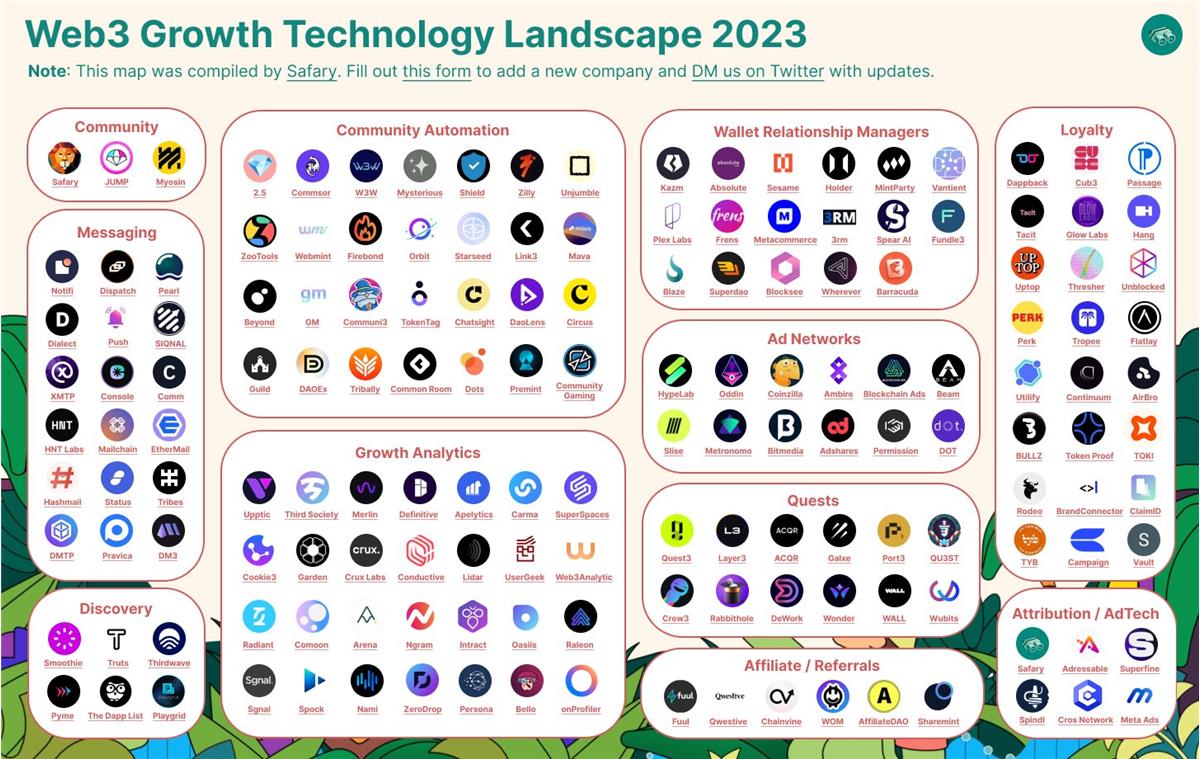
Attribution
In Web2, attribution generally involves understanding where users come from and where to invest for better acquisition. This includes identifying users across online/offline channels and multiple devices. In Web3, attribution poses new challenges. As noted earlier, the definition of a consumer has fundamentally changed throughout the typical user journey. With touchpoints split across Web2 and Web3, no dominant Web3-native social network, and communities like Discord and DAOs playing pivotal roles, plus users owning multiple wallets, Web3 attribution faces significant hurdles. However, a foundational solution willing to tackle this complexity could become immensely powerful in the coming years. Until the 2023 bear market, startups enjoyed a funding honeymoon with minimal focus on target audiences. Many built on principles contradicting core entrepreneurial values by ignoring data. But with capital drying up, basic issues like audience identification have returned to center stage—making Web3 attribution essential.
Safary aims to build marketing attribution for Web3, empowering the Web3 growth ecosystem via its SaaS interface/API. With just one line of code, Safary offers detailed attribution analytics through a no-code dashboard. Currently, Web3 projects can only track top-of-funnel metrics (like Web2 social media) and bottom-of-funnel on-chain wallet purchases. Safary bridges this gap by analyzing the full journey from Web2 channels to Web3 outcomes.
Ad Networks
Crypto companies currently face two major challenges in reaching their target audiences. First, crypto ads simply don’t work well on traditional Web2 platforms like Google and Facebook. You may have seen L1 blockchains advertising there, but that involves battling regulators and convincing stakeholders they’re tech infrastructure firms, not financial products.
Second, Web3 user acquisition relies heavily on one-off token airdrops—rewarding activity with promised or free protocol tokens. Yet airdrops are fundamentally flawed: costs often exceed customer lifetime value (LTV), and they prove unsustainable. Dune Analytics conducted a deep dive into Uniswap’s late-2020 airdrop, revealing troubling stats:
-
Only 7% of claimants still hold UNI tokens;
-
Over 75% sold their tokens within the first 7 days;
-
Only 5% of recipients remain active Uniswap users today;
-
50% of claiming wallets haven’t interacted on Ethereum in the past 610 days.
Clearly, Web3 advertising needs optimization to achieve its ultimate goal: acquiring valuable long-term users for new crypto projects. Projects must refine targeting—explaining why tactics like airdrops rarely succeed for new ventures.
HypeLab and Slise are startups tackling Web3 user acquisition. HypeLab offers personalized services connecting advertisers seeking new customers with publishers wanting to monetize their audience. Beyond analytics, HypeLab provides creative design services for image/video assets and UI tools to upload campaigns. Publishers get an SDK to seamlessly integrate ads and track real-time revenue and metrics. Slise offers similar capabilities using blockchain indexing, user analytics, segmentation, and real-time bidding to bridge publisher-advertiser gaps. Both extend into Web2.5 platforms—Web3 dApps, crypto media, price trackers—and general Web2 publishers, bridging the Web2/Web3 divide.
With emerging players like HypeLab and Slise, we can envision a future Web3 advertising landscape enabling early-stage projects to effectively reach qualified leads—beyond hoping Twitter influencers' followers match their ideal customers.
Growth Analytics
Though growth analytics overlaps with attribution, it focuses more on collecting, analyzing, and interpreting data to understand how users engage with campaigns. This data optimizes performance—improving click-through rates (CTR), conversion rates, and revenue.
One of the best ways to grasp Web3 AdTech is to examine a market leader: Cookie3. Beyond basic attribution, Cookie3 offers off-chain-to-on-chain conversion tracking, Discord server insights, wallet CRM, user segmentation analysis, and Twitter ad strategy recommendations based on on-chain transactions. With a massive dataset—including 200M wallets, 500K Twitter accounts, 8B transactions, and 4.5M tokens—Cookie3 hosts one of the strongest algorithms in Web3 growth analytics.
Another fast-growing area is game analytics. Helika provides end-to-end solutions to optimize user acquisition and player engagement in Web3 games through real-time operations and A/B testing. Using in-game analytics and player segmentation into gamer archetypes, Helika helps studios understand their communities and boost revenue. Its competitive intelligence tracks users’ NFT and ERC-20 portfolios to identify which other games they play—enabling targeted outreach. By integrating Web2 social insights (Twitter, Discord) into its core offering, Helika gives game studios a solid blueprint for user acquisition and engagement.
Wallet Relationship Management (WRMs)
WRMs are essentially CRMs where customers are represented by wallets. Projects like Absolute Labs offer end-to-end “wallet” management solutions—understanding wallet clusters, designing segments, and launching Web2/Web3 marketing campaigns (airdrops, wallet messages, emails, SMS)—to build Web3 user profiles. A key challenge today is that many Web3 startups lack marketing teams experienced in segmenting and navigating the Web3 marketing tech stack. WRMs solve this by bundling analytics, segmentation, campaign design, and execution into a seamless suite for deeper customer engagement.
The Future of Web3 AdTech
From our discussion, one thing is clear: Web3 needs its own native social analytics domain. Web2 platforms like Twitter serve only as discussion forums for crypto. Web3 AdTech promises a future where customers actively participate in advertising processes—an impossibility under Web2’s restrictive architecture and ideology.
Web3 ad networks will also spawn new “ad formats.” Each generation of social and media platforms introduced novel content distribution forms (TikTok, Instagram Reels). New cultural content becomes a medium for innovative ad formats and engagement tools. Web3 opens a fresh playground for marketers and growth hackers to experiment and connect with audiences.
Yet we must recognize that Web3 AdTech is still in its infancy. Yes, the idea that Web3 ad algorithms can thrive without personal data may seem too utopian today. Despite all data being on-chain, on-chain data is inherently limited and insufficient for robust predictive modeling. To compensate, AdTech projects currently rely on linking wallets to Web2 identities—a fragmented workaround that undermines privacy arguments. However, frameworks using zero-knowledge proofs, on-device data storage, and decentralized identity (essentially a Web3 passport) could allow users to privately share data in exchange for financial rewards.
Projects like Safary, HypeLab, Cookie3, and Helika offer excellent launchpads for mainstream Web3 social applications. Beyond these, we hope to see more transformative advances focused on Web3—through decentralized identity (DID), expanded data types, enhanced wallet functionality, merging physical and digital realms via metaverse, native Web3 social apps, Web3 job platforms, or blockchains with built-in identity layers.
Above all, Web3 AdTech empowers you to control and profit from your data—this is its true distinction from Web2 and the key driver for a mass shift from oppressive Web2 to fairer Web3 social systems.
Join TechFlow official community to stay tuned
Telegram:https://t.me/TechFlowDaily
X (Twitter):https://x.com/TechFlowPost
X (Twitter) EN:https://x.com/BlockFlow_News
 @BigBrainVC











