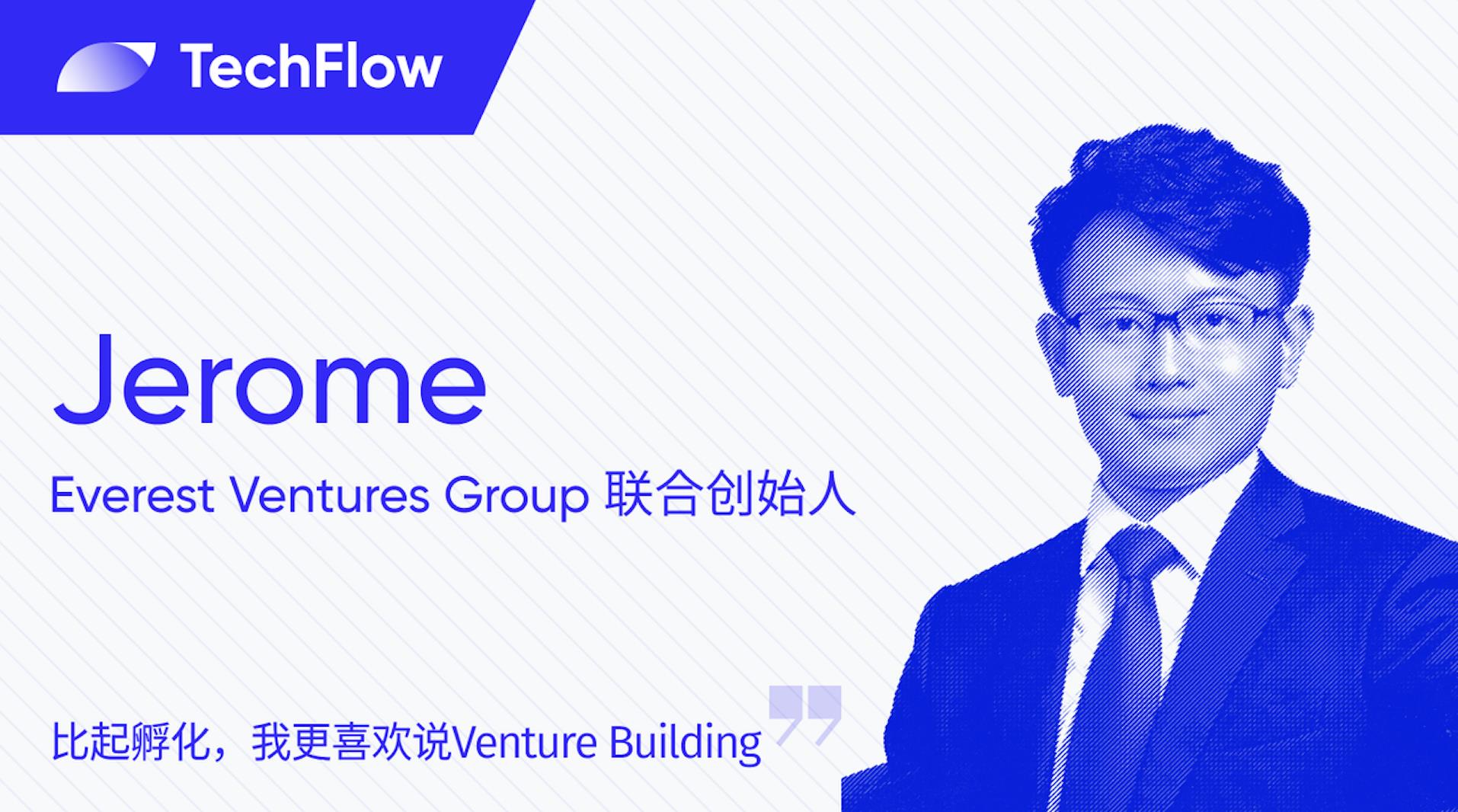
Interview with EVG Co-founder Jerome: How Was Hong Kong's Leading Crypto Incubation Group Built?
TechFlow Selected TechFlow Selected
Interview with EVG Co-founder Jerome: How Was Hong Kong's Leading Crypto Incubation Group Built?
Why are crypto institutions moving into incubation? What does genuine cryptocurrency incubation look like?
 Navigating Web3 tides with focused insights
Incubation—an overused term in the crypto industry.
Almost everyone boasts to you, "I incubated XXX," when in reality they might have just created a few WeChat groups or facilitated external partnerships.
With SEC regulations looming and AI capturing attention... summer 2023 is approaching, yet the crypto primary market seems to be entering a winter—while investment firms are increasingly turning toward "incubation."
Why are so many crypto institutions shifting toward incubation? What does real cryptocurrency incubation look like?
TechFlow sat down with Jerome Wong, Co-Founder of Hong Kong-based Everest Ventures Group (EVG), to explore how one of Asia’s leading crypto groups approaches Web3 incubation.
TechFlow: Welcome, Jerome. Could you introduce yourself and share what drew you into the Web3 rabbit hole?
Jerome: I’m Jerome Wong, from Hong Kong, graduated from Peking University’s School of International Studies. After graduation, I worked at an investment bank in Hong Kong for over a year. In 2018, I co-founded EVG with my co-founders.
Part of my entry into the crypto space came from exposure—many seniors from Peking University were already involved, and friends would talk to me about Bitcoin and blockchain. Back in 2017, ICOs were booming. I reviewed projects and participated in some ICOs with alumni. Although all those early investments ultimately lost money, what fascinated me was that ICOs had introduced an entirely new form of fundraising.
Reflecting on my prior work in traditional finance—mainly helping listed companies raise capital through non-dilutive financing, M&A, etc.—capital raising has always been a core product in investment banking. I began wondering whether ICOs and blockchain development could eventually make bankers obsolete. That curiosity kept me engaged. Despite the bear market in 2018, I decided to launch EVG.
TechFlow: EVG seems like a unique crypto investment firm. How has EVG evolved and expanded across the crypto landscape?
Jerome: EVG is based in Hong Kong but operates globally. It’s not a fund—we set out to become a venture-building and incubation firm within the Web3 ecosystem.
Think of traditional tech giants like ByteDance, which incubates multiple products—TikTok, Douyin, Lark—forming a product matrix. EVG adopted a similar “central platform” model. Since 2018, our goal has been to build a multi-product company, acting as founders rather than passive investors. In short, we’re both entrepreneurs and investors.
We don’t have LPs—we have shareholders. Most of the capital from our shareholders goes toward launching new companies. A smaller portion is used to invest in external projects our team believes in. Today, we have around 200 people, operating under a centralized platform model focused on technology and product development. My day-to-day involves managing teams, analyzing data, driving growth, and business development.
We aren’t particularly mysterious—we’re just doing something novel. Few funds are pursuing the same path. Some teams claim to do incubation, but it often amounts to little more than advisory. Between 2018 and 2020, we actively supported Animoca and The Sandbox—the latter’s expansion into Asia was led by EVG, including securing funding from Korea and Japan and facilitating key partnerships.
That’s why they built strong communities in Japan and Korea—we provided light-touch incubation, guidance, and support. To us, this is venture incubation.
Our projects start from our own ideas, then we assemble teams to execute them, decide go-to-market strategies, iterate internally, seek market validation, and eventually raise capital.
TechFlow: From early-stage VC and FA work to a stronger focus on crypto incubation—what drove EVG’s strategic shift?
Jerome: This has been our vision since day one, though initially it wasn’t fully formed.
In 2018, we invested in Animoca, and Yat (Animoca’s founder) invested in us. We also lightly participated in several of Animoca’s projects. Through these experiences—connecting people, running processes—we accumulated significant resources. By 2020, as the market warmed up and after reviewing many projects, we decided to transform into a “studio” model—with our own tech and product teams, backed by a central platform.
Our first product was Kikitrade, a social trading platform, targeting Hong Kong and Taiwan. It resembles Futu NiuNiu in structure. Given the importance of social dynamics in crypto, we believed social features could drive user acquisition into trading. In 2020, most exchanges offered only basic trade matching, lacking social elements. For retail and new users, getting started was intimidating. We wanted Kikitrade to guide newcomers, teaching them how to trade—essentially a learning companion for entering crypto.
Aspen Digital is a wealth management platform. In favorable market conditions, family offices express interest in allocating capital to Web3 but don’t know where to start—not just buying tokens, but also investing in early-stage projects or funds. When principals want action, their teams scan the market. To serve this need, we launched Aspen Digital, primarily targeting high-net-worth individuals and family offices in Hong Kong, with plans to expand internationally. Kikitrade and Aspen Digital represent EVG’s first two moves in fintech—one for retail, one for institutional/HNW clients.
In Africa, we launched two projects: Cassava, focusing on wallets and reward systems; and Vibra, providing payment services. Our model draws inspiration from Asian task platforms—offering tasks and rewards to incentivize product adoption. Despite economic challenges, Africa has high mobile penetration and abundant youth time, making this model promising.
In metaverse, NFTs, and culture, we built Mugen Interactive—distinct because we develop games ourselves, ensuring higher quality control.
Animoca’s approach is largely acquisition-driven. We instead seek compelling narratives and co-develop blockchain games from scratch. For example, we’re developing a card game and planning a strategy game—areas where we have expertise.
In the GameFi space, GameFi 1.0—like Axie Infinity—wasn’t necessarily fun; people cared more about the “Fi” than the “Game.” In GameFi 2.0, the goal is to bring Web2 players into Web3. These users will judge Web3 games by Web2 standards—they won’t tolerate lower gameplay quality just because it’s blockchain-based.
To attract Web2 players, game quality must improve. Additionally, popular Web2 genres—especially strategy games, which dominate in Web2—have been underrepresented in Web3.
So, strategy games could be GameFi 2.0’s next growth frontier. In Web2, Tencent acts as a publisher—developing games and distributing third-party titles. But in Web3, no major publishing platform exists yet, even though many gaming guilds have pivoted.
We believe there’s huge potential for a Web3 platform like Netflix—a home for premium content. Our strategy is to first create strong original content—that’s why we’re building games. If two of our games become hits, we’ll gradually evolve into a platform.
TechFlow: People often compare EVG with Animoca. What’s the actual relationship between the two?
Jerome: We became shareholders in each other back in 2018—deeply aligned from the start. When Animoca was still low-valued, we invested around a few hundred thousand dollars, and later helped them secure additional funding—effectively serving as their financial advisor (FA) during that period.
Overall, our journey began in 2018. Today, Animoca is among the largest shareholders in both Kikitrade and EVG. We’ve consistently supported each other.
TechFlow: Lately, many have jumped into incubation—especially in 2022. There’s a sense that there are more VCs than projects, more incubators than VCs, and incubation itself is becoming increasingly competitive. How do you view Web3 incubation, and what’s behind this trend?
Jerome: The term “incubation” itself is vague—because it’s unclear how much effort or value was actually contributed. Anything from giving advice to writing code can be labeled as incubation—light or heavy.
If you just give suggestions, you can still call yourself an incubator. But if you’re hiring the team, paying salaries, and acting as a co-founder—that’s “heavy incubation,” with deeper operational involvement.
Why are so many moving into incubation now? Primarily because investing in Web3 is highly uncertain. After experiencing multiple cycles and chasing various narratives, you realize Web3 is a story-driven industry with extremely fast rotation.
As one of dozens of investors, you have little control post-investment. With unstable startup cycles, the risk feels too high—so minimizing risk via incubation becomes attractive.
As investors gain experience, they better understand what makes projects succeed—launching on exchanges, gaining traction, etc. Eventually, they realize they know the playbook—why not build their own projects? So, they shift toward becoming builders.
As mentioned, incubation ranges from light to heavy. Light incubation is relatively easy—especially if the project team lacks technical or operational expertise and you can fill the gap. But we focus mainly on building our own products—prioritizing heavy incubation.
The word “incubation” isn’t quite accurate—I prefer “Venture Building.” Successful examples include Germany’s Rocket Internet, which built Lazada (sold to Alibaba), Jumia (Africa’s e-commerce listing), and delivery platforms. Their model closely resembles ours. Our structure is also similar to Animoca’s.
TechFlow: What do you see as the core competitive advantage in joint incubation or Venture Building?
Jerome: Let’s return to the “central platform” model. If you’re only building one project, dedicated focus suffices. But if you’re running multiple ventures simultaneously, a shared platform becomes essential.
Take Binance—it has thousands of employees, and each sub-product (staking, asset management, NFT marketplace) functions like an internal startup. All fall under one umbrella company, with deep integration across units.
The strength of a central platform lies in reusable modules—common components like trading infrastructure, lessons learned from past failures—which help avoid repeating mistakes.
By using this model, we consolidate all experience, learnings, and knowledge into a shared platform, steepening our collective learning curve.
Additionally, our business development team attends global events, builds relationships with funds and projects, gathers resources, and feeds them back into current and future ventures. These connections also fuel user growth—via partnerships, campaigns, events—maximizing resource reuse, cutting costs, and boosting efficiency.
Moreover, our research team analyzes market trends and shares insights with product teams—discussing what models work, what gaps exist. For example, while building a SocialFi project, we ask: What strengths can we highlight? What do competitors lack? What differentiates us? These insights emerge from cross-department collaboration, giving us a competitive edge through the central platform.
TechFlow: The market now appears to be entering a primary market winter—fundraising for crypto funds and projects is increasingly difficult, while secondary markets grow more popular. When do you think this primary market freeze might ease? And what advice would you give to projects still seeking funding today?
Jerome: I believe the primary market is tightening because the main driver is liquidity. After the Fed began hiking rates, we entered a prolonged monetary tightening cycle. In this macro environment, capital is scarce. Founders and funds are less aggressive in deploying capital, waiting for better opportunities. Founders must also cut costs and extend runway.
Meanwhile, secondary markets offer faster liquidity. In the primary market, you invest, wait for listings, endure lockups before exiting. After multiple cycles, investors realize primary success rates aren’t as high as before. With lower win rates, why not seek opportunities in secondaries—like Arbitrum—where returns may exceed holding illiquid primary assets for years?
After comparison, many find it smarter to focus on liquid, fast-moving secondary markets with immediate exit options, rather than waiting months or years for primary exits. Right now, investors prioritize certainty—so capital flows to secondaries.
For founders, the priority should be product—not BD. A strong product will eventually attract capital. Without a solid product, no amount of business development will save you. Second, optimize your revenue and business model. You must clearly understand your revenue streams and how to generate sustainable cash flow.
TechFlow: As a Hong Kong-native crypto group, from your perspective, what opportunities stand out following Hong Kong’s new policies?
Jerome: Hong Kong regulators have laid out clear frameworks. Institutional and retail adoption is now possible. Large institutions can begin allocating to crypto and Web3. As a financial hub, Hong Kong naturally attracts such demand.
On the institutional side, banks can now open accounts for crypto firms—something previously impossible. Several banks have already started offering these services, a crucial step forward.
For retail, broader crypto adoption is needed. On June 1st this year, retail trading opened—though only for top-tier cryptocurrencies. Still, it’s a solid start. Banks will progressively join, offering crypto trading to customers. For instance, ZA Bank has announced such plans.
Soon, traditional financial institutions will offer crypto services. The entry of big brands will accelerate mainstream acceptance. So, from a regulatory standpoint, both institutional and retail adoption are advancing in parallel.
TechFlow: Compared to Singapore, what are Hong Kong’s strengths and weaknesses in crypto?
Jerome: I see Hong Kong as a “front shop, back factory”—a premium market facing global clients, backed by manufacturing and service capabilities nearby. Compared to Singapore, Hong Kong offers easier access to talent—across tech, product, development, and operations. Proximity to mainland China means top-tier graduates are increasingly relocating to Hong Kong under new policies.
Another factor is capital. As a financial center, Hong Kong holds an edge over Singapore. While Singapore excels in commodity trading, in traditional equities and securities, Hong Kong remains Asia’s trading hub. Retail participation in IPOs is common here—this capital depth gives Hong Kong a structural advantage in crypto.
Singapore tends to be more conservative—both government and investors are less aggressive. The FTX collapse hit hard—Temasek and retail investors suffered losses, making the government more cautious in blockchain. In contrast, Hong Kong actively promotes crypto innovation, releasing supportive regulations and incentives. This stark difference highlights Hong Kong’s growing advantage. I believe capital will gradually shift toward Hong Kong.
TechFlow: What do you believe will drive the next bull market?
Jerome: The next major catalyst will likely involve supply reduction, alongside new narratives shaping outcomes. The 2019 DeFi Summer was essentially a mini-bull run, even though Bitcoin later dropped below $3,000.
Under current macro conditions, liquidity is tightening, making fundraising harder. I’m unsure if we’ll enter an era where startups require less capital—but our team is closely watching this.
Ideally, we’d see a killer app that showcases Web3’s true potential. Right now, Web3 and crypto remain niche—nothing like ChatGPT’s breakout moment for AI. We hope such a moment arrives. We can only wait.
The biggest difference between AI and blockchain is openness. Blockchain is an open ecosystem—developers, foundations, validators—all contribute and share value fairly. AI, by contrast, is largely controlled by closed corporations. Data contributors provide value but see little economic return.
I believe the future lies in merging Web3 with AI. If we can apply blockchain’s open, transparent principles to distribute AI-generated value more fairly, that would be transformative. Otherwise, everything remains monopolized.
Join TechFlow official community to stay tuned
Telegram:https://t.me/TechFlowDaily
X (Twitter):https://x.com/TechFlowPost
X (Twitter) EN:https://x.com/BlockFlow_News
 深潮TechFlow