









Vitalik: Is there freedom of speech in the cryptocurrency community?
TechFlow Selected TechFlow Selected
Vitalik: Is there freedom of speech in the cryptocurrency community?
A statement may be true, or it may be dangerous. The previous sentence is such a statement.
 Navigating Web3 tides with focused insights
Author: Vitalik Buterin
Translation: Chain Financial

“Statements can be true or dangerous. The previous sentence is such a statement.” — David Friedman
Free speech has been a topic many internet communities have grappled with over the past two decades. Cryptocurrency and blockchain communities, whose very existence hinges significantly on censorship resistance, place particularly high value on free expression. However, in recent years, the rapid growth and financial acceleration of these communities have repeatedly tested the applicability and limits of this principle.
In this article, I aim to clarify some contradictions and illuminate what the norm of “free speech” truly represents.
“Free Speech Law” vs. “Free Speech”
A common and frustrating argument I often hear is that “free speech” is solely a legal limitation on government actions, offering no guidance regarding the conduct of private entities such as corporations, private platforms, internet forums, or conferences.
One of the larger examples of “private censorship” within the cryptocurrency community was when Themos, the moderator of the /r/bitcoin subreddit, decided to begin strict moderation of the forum, banning discussions advocating for increasing Bitcoin’s transaction capacity via hard forks.
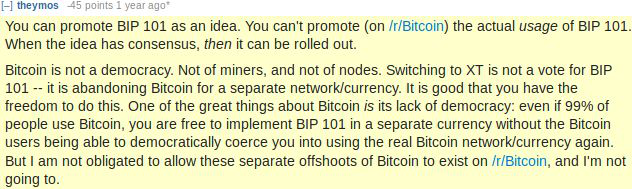
Below is John Blocke’s timeline of censorship:
https://medium.com/johnblocke/a-brief-and-incomplete-history-of-censorship-in-r-bitcoin-c85a290fe43
Below is Theymos’s post defending his policies:
https://www.reddit.com/r/Bitcoin/comments/3h9cq4/its_time_for_a_break_about_the_recent_mess/, which includes the now infamous line: “If 90% of /r/Bitcoin users find these policies intolerable, then I hope that 90% of /r/Bitcoin users leave.”
A common defense strategy used by supporters of Theymos’s censorship is that strict moderation is acceptable because /r/Bitcoin is a “private forum” owned by Theymos, and thus he has the right to do whatever he wants inside it; those who dislike it should simply move to another forum:
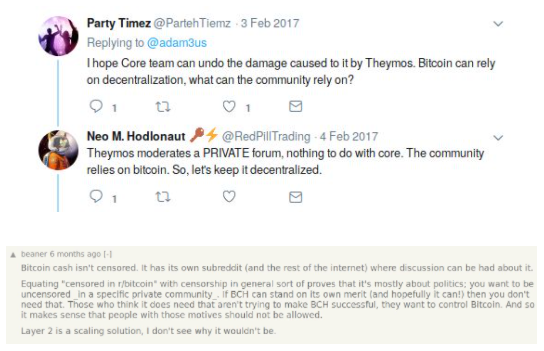
Indeed, hosting the forum in this way does not violate any laws, but for most people, it remains clear that some kind of violation of free speech principles has still occurred. What exactly is it? First, it's crucial to recognize that free speech is not merely a legal doctrine in certain countries—it is also a social principle.
Moreover, the fundamental goal of this social principle is the same as that of the legal doctrine: to create an environment where good ideas win—not just ideas favored by those in power. Governmental power is not the only form of power we need to guard against; corporations hold the power to fire individuals, forum moderators can delete nearly any post in discussion threads, and there are many other forms of hard and soft power.
So what is the core social principle here? As Eliezer Yudkowsky puts it:
In the art of human rationality, few injunctions lack "ifs", "ands", "buts", or "disclaimers". This is one of them. A wrong argument merits refutation. A true one does not need anything. But never—never ever ever—should you respond to an argument by making it harder to speak.
Slatestarcodex elaborates:
What exactly does the above-quoted “bullet” refer to? Does it cover other projectiles? Arrows? Giant boulders launched from catapults? What about melee weapons like swords or maces? Where do we draw the line between bad responses to arguments and good ones?
A good response to an idea addresses the idea itself. A bad response silences it. If you try to advance an idea, your success depends on how good the idea is; if you try to suppress it, your success depends on how powerful you are and how many pitchforks and torches you can muster quickly. Firing bullets is a great way to silence an idea rather than address it. Launching rocks from catapults, cutting people down with swords, or gathering a mob waving torches achieves the same end. So too does trying to get someone fired for holding an idea.
That said, sometimes “safe spaces” make sense—places where, for whatever reason, people simply don’t want to engage with certain types of arguments, and where such arguments will indeed be suppressed. Perhaps the most harmless example is a space like ethresear.ch. Posts there may be removed for being “off-topic” to keep discussions focused. But the concept of “safe spaces” also has a dark side; as Ken White wrote:
This might surprise you, but I am a supporter of “safe spaces”. I support safe spaces because I support free speech. Safe spaces, when designed on principled grounds, are simply an application of liberty—but not everyone envisions such “safe spaces”. Some treat the concept of “safe space” as a weapon to take over public spaces and demand that people within those spaces adhere to their private norms. That is not free speech.
Thus, creating your own safe space in a corner is perfectly fine, but there also exists the concept of “public space”, and attempting to turn public space into a safe space serving special interests is wrong. What then constitutes a “public space”? Clearly, public space is not merely “space owned or operated by the government”; the concept of privately-owned public space is well-established.
This holds even informally. It is a shared moral intuition, for instance, that it is worse for a private individual to commit acts of racial or gender discrimination than for a shopping mall to do so. In such cases—or regardless, in the case of the /r/bitcoin subreddit—no matter who technically holds the highest moderator position, the subreddit largely functions as a public space. Several arguments stand out particularly:
- It occupies prime real estate—specifically, the term “bitcoin”—leading people to assume it is the default venue for discussing Bitcoin.
- The value of this space was not created solely by Theymos, but by thousands of people who came to the subreddit to discuss Bitcoin, implicitly expecting it to function as a public forum for such discussion.
- Theymos’s policy shift surprised many and was unpredictable.
Conversely, if Theymos had created a subreddit called /r/bitcoinsmallblockers and clearly stated it was a curated space for a minority faction where controversial hard fork advocacy was unwelcome, few would see an issue with that.
People might disagree with his views, but few (at least within the blockchain community) would claim it inappropriate for someone to maintain an internal discussion space aligned with their ideology. But in reality, Theymos attempted to “take over a public space and demand that people within it conform to his private norms,” leading to the Bitcoin community’s block size split, intense ideological conflict, contentious forks, and ultimately a cold peace between Bitcoin and Bitcoin Cash.
Deplatforming
About a year ago, I publicly called out Craig Wright—the fraudster claiming to be Satoshi—at Deconomy, ending my tolerance for his nonsensical explanations and asking: “Why is this kind of fraud allowed to speak at this conference?”
Naturally, Craig Wright’s supporters responded with accusations of censorship:
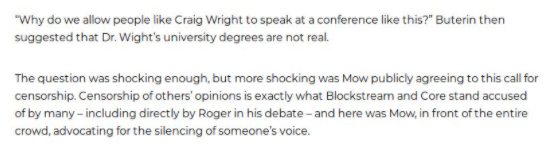
Did I attempt to “silence” Craig Wright? I would argue, no. One could say this is because “Deconomy is not a public space,” but I think a better argument is that conferences are fundamentally different from internet forums.
Internet forums can genuinely attempt to serve as completely neutral mediums for discussing anything; conferences, on the other hand, are inherently curated lists of speakers, allocating a limited number of speaking slots and actively directing significant attention toward those given the opportunity to speak. A conference is an editorial act by its organizers saying: “Here are some ideas and perspectives we believe people should genuinely encounter and hear.”
Every conference “censors” nearly all viewpoints due to limited space—this is inherent to the format; thus, objecting to a conference’s selection choices is entirely legitimate.
This extends to other types of selective platforms. Online platforms like Facebook, Twitter, and YouTube already actively make choices through algorithms that influence which content gets recommended. Usually, they do so for selfish reasons, tuning their algorithms to maximize “engagement” on their platforms, often producing unintended side effects—such as promoting flat-Earth conspiracy theories.
Therefore, given that these platforms are already making (automated) selective presentations, it seems highly reasonable to criticize them for not using these levers toward more pro-social goals—or at least goals that all major rational political groups would agree are pro-social (e.g., high-quality intellectual discourse).
Furthermore, “censorship” does not seriously hinder anyone from learning Craig Wright’s story; you can visit his website at: https://coingeek.com/. If someone is already operating a platform capable of making editorial decisions, it seems entirely reasonable to ask them to make equally significant decisions that align better with societal standards.
A recent example is the DelistBSV campaign, where several cryptocurrency exchanges—including notably Binance—dropped support for trading BSV (a Bitcoin fork promoted by Craig Wright). Again, many people—even rational ones—accused the movement of being a censorship effort, drawing parallels to credit card companies blocking WikiLeaks:
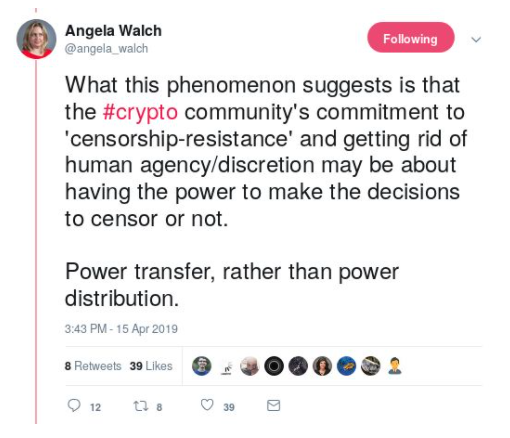
Personally, I’ve long criticized the power held by centralized exchanges. Should I oppose DelistBSV on free speech grounds? I would say no—supporting it is acceptable, though it’s certainly a closer call.
Many participants in DelistBSV, such as Kraken, are far from being “everything goes” platforms; they’ve already made numerous editorial decisions about which currencies to accept or reject. Kraken accepts only about 12 currencies, thus passively “censoring” nearly all others. Shapeshift supports more currencies but doesn’t list SPANK or even KNC. So in both cases, delisting BSV resembles reallocating scarce resources (attention/legitimacy) more than outright censorship.
Binance is different; it does accept a large number of cryptocurrencies, adopting a philosophy closer to “anything goes,” and holds a unique position as a market leader with substantial liquidity.
That said, arguments can be made from both sides regarding Binance. First, the delisting was retaliation against genuinely malicious behavior by core members of the BSV community—such as sending legal threats to critics like Peter McCormack. In “anarchic” environments where norms are deeply contested, “eye for an eye” retaliation serves as a decent social norm, ensuring people only face punishments they themselves have signaled they consider legitimate through their own actions.
Generally, opposing the existence of concentrated power may be entirely justified, but as long as such concentration exists, supporting its use for purposes one believes socially beneficial is reasonable; see Bryan Caplan’s explanation of coordinated support for open borders and anti-Ebola travel restrictions as another example in a different domain.
Opposing concentrated power only requires believing such concentrations are generally harmful and prone to abuse; it does not imply one must oppose everything these concentrations do.
If someone successfully builds a fully permissionless cross-chain decentralized exchange enabling easy trading between any asset and any other, then “listing” on that exchange would cease to send a social signal—because everyone would be listed. I support the existence of such an exchange, even if it enables BSV trading. What I support is removing BSV from existing exclusive positions that confer a higher level of legitimacy beyond mere existence.
So the conclusion is: censorship in public spaces—even non-governmental ones—is bad; censorship in genuinely private spaces (especially those not the “default setting” for a broader community) is acceptable; excluding projects by denying them access to their purpose and intended outcomes is wrong; excluding projects to deny them rare legitimacy, as both goal and effect, is acceptable.
Join TechFlow official community to stay tuned
Telegram:https://t.me/TechFlowDaily
X (Twitter):https://x.com/TechFlowPost
X (Twitter) EN:https://x.com/BlockFlow_News
 @VitalikButerin








