Endless Imagination on the Possibilities of AI and Web3 Integration
TechFlow Selected TechFlow Selected
Endless Imagination on the Possibilities of AI and Web3 Integration
This article comprehensively reviews the emerging fields resulting from the integration of AI and Web3, starting from the adaptation and complementarity of underlying technologies. It summarizes and analyzes the practical demands, development bottlenecks, and future prospects across various directions within these fields.
 Navigating Web3 tides with focused insights
Written by: michaeljin&Yetta
As Web3 practitioners swept up in the massive wave of AI, after experiencing months of information overload across both industries, we’ve compiled some reflections and research to share with fellow Web3 builders:
AI and Web3—one breaks our imagination of productivity limits, the other reshapes our understanding of economic models. As two frontier technologies representing the future, their convergence feels natural and sparks endless possibilities. Yet when we turn to reality, truly integrated projects remain rare. The collision of these two fields has created new narratives but also inflated bubbles and hype. Many theoretically complementary visions lack real-world demand, while projects addressing actual needs often struggle with cost or technical bottlenecks.
I believe the notion that Web3 and AI are inversely correlated is directly proportional to the number of AI-heavy Web3 projects seen in the primary market and the rise of unnecessary Web3-ification of AI projects. Native AI founders or teams typically don’t consider how to "Web3-ify" their products—such as tokenizing data ownership, designing economic models, or redistributing production relationships—because bottom-up large AI models have high resource demands, making AI inherently centralized from training to operations. I remain highly skeptical about the practical feasibility of so-called Web3 projects claiming to improve AI’s production framework.
The Web3 market faces significant bottlenecks both macro-policy-wise and innovation-wise. Setting aside new regulatory pressures, from an innovation perspective, when AI rapidly enhances productivity and substitutes human cognitive capabilities—capturing the attention of most users, builders, and investors—the stagnation within Web3 becomes even more apparent. It's been a long time since Web3 has seen innovation at AI's scale. Frankly, most recent projects drawing attention involve only minor tweaks to past technologies or products—better staking mechanisms, multi-chain wallets with improved UX, meme coins with novel mechanics, or DEXs on new chains offering better liquidity. Do these so-called “innovations” genuinely help onboard more users or increase blockchain adoption? Are they what the industry truly needs?
We need new domains that bring AI into Web3 and allow Web3 to reach beyond its current boundaries. Real-world applications of blockchain’s foundational principles—(1) content creation rights, (2) identity verification, (3) financial system innovation, and (4) trustless finality—are key to the next paradigm shift for the entire industry. With the goal of identifying organic integration, this article reviews emerging areas at the intersection of AI and Web3, analyzing actual demand, development bottlenecks, and future outlook across various directions, starting from technological compatibility and complementarity.
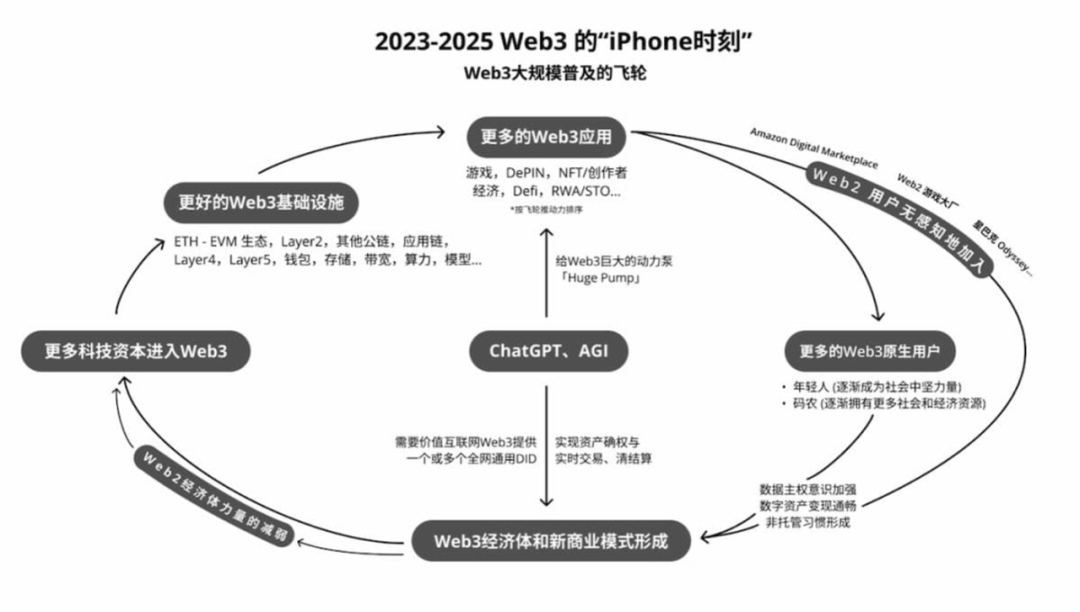
Image credit: KK from Hash Global
TL;DR
-
AI and Web3 have fundamental conflicts at the architectural level. Large AI models require vast resources, leading to highly centralized training and operations, whereas Web3 built on blockchain prioritizes decentralization and transparency. This makes deep integration difficult, and questions remain about whether the business logic holds or if real demand exists.
-
Yet it is precisely this contradiction that enables mutual supplementation—not as core narratives for each other, but as solutions to each other’s pain points, driving co-development. These technologies can generate new narratives and open vast imaginative space. Web3’s economic design can help AI projects improve capital efficiency, user acquisition, and engagement, while blockchain’s strengths—lowering infrastructure costs, verifying identity, injecting democracy and transparency into AI’s data black box, and incentivizing data contribution—can inspire fresh product designs for AI teams.
-
At the infrastructure layer, Web3’s decentralized mechanisms can address critical risks in today’s AI landscape—privacy protection and data misuse.
-
Decentralized markets for essential AI inputs like computing power and data maximize underutilized resources, optimize allocation, and accelerate the development and application of large AI models.
-
Web3’s decentralization can democratize AI at the foundational level. By deploying, training, and using AI in a decentralized manner, user data privacy improves, and individuals gain opportunities to earn rewards by sharing data.
-
Blockchain can record and monitor AI behavior, enhancing safety and enabling broader deployment of autonomous AI agents across use cases.
-
-
At the application layer, AI can drive Web3 adoption and growth.
-
As a productivity tool, AI can drastically speed up Web3 app development; as a knowledge engine, it lowers interaction and learning barriers between users and dApps, helping more people enter Web3.
-
AI significantly reduces the technical barriers to building dApps and launching projects, shifting competitive focus toward innovation and operations. In this direction, generative AI introduces new narratives to Web3 applications—embedding virtual humans, character AIs, and other cutting-edge elements into ecosystems like gaming and social platforms—to unlock entirely new experiences.
-
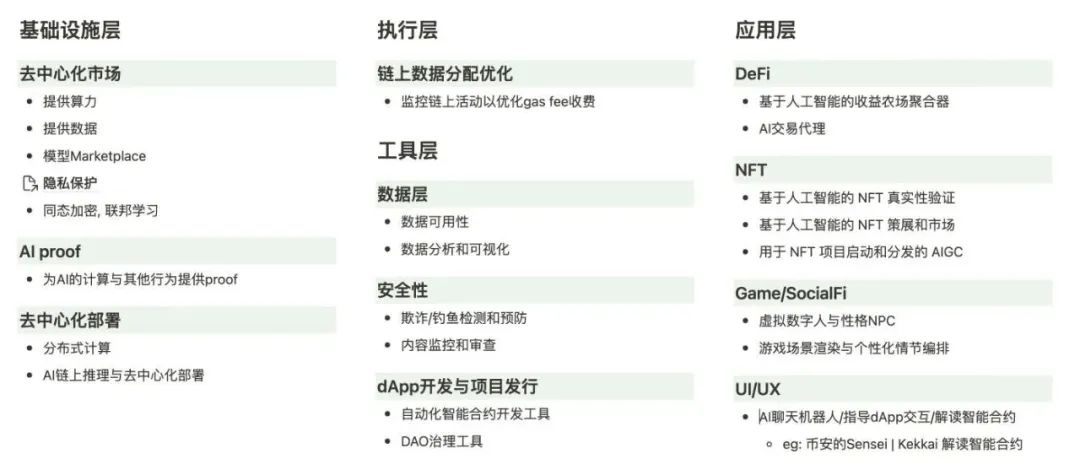
Infrastructure Layer
Token Incentives & Governance: Decentralized Markets Empowering AI Infrastructure
In the era of large AI models, every component supporting AI infrastructure becomes critically important.
A key challenge in building and scaling AI infrastructure lies in effectively incentivizing and coordinating participants to jointly advance system development and operation. Decentralized markets combined with token incentive mechanisms offer a novel and powerful solution. In such markets, tokens act as digital assets and value carriers, facilitating secure, transparent, and automated transactions via smart contracts.
For AI infrastructure, token incentives serve multiple functions. First, tokens can reward contributors who provide computing resources, datasets, algorithmic models, or processing power. Take MyShell, a popular AI voice chatbot creation platform—by combining chatbot workshops with data analytics, it achieves a data flywheel effect. Users customize their chatbots’ voices, features, and knowledge bases, then interact with them. The resulting interaction data improves bot performance and personalization, attracting more users, increasing data volume and value, creating a virtuous cycle of growth.
By rewarding participation with tokens, Web3’s economic model attracts more contributors to AI infrastructure, fostering resource sharing and collaboration. Tokens also enable value exchange within decentralized markets—participants can buy and sell resources, services, and models using tokens, enabling flexible and efficient cooperation. This value-flow mechanism supports more agile and scalable infrastructure development, allowing participants to better meet individual needs and interests.
Homomorphic Encryption & Federated Learning: Embedding Privacy Protection into AI Training
Balancing effective model training with personal privacy and data security remains a longstanding challenge. Homomorphic encryption offers a robust method for embedding privacy protection directly into AI’s foundational training processes, ensuring sensitive data stays secure.
Homomorphic encryption is a special cryptographic technique that allows computation on encrypted data without decryption. This means models can be trained and predictions made—all without exposing raw data. Applying homomorphic encryption to AI training enables privacy-preserving machine learning at scale.
Key steps and considerations when using homomorphic encryption for AI training:
-
Data Encryption: Input data used for AI training is encrypted using homomorphic algorithms, preserving privacy throughout training.
-
Encrypted Computation: Model training, optimization, and inference are performed directly on encrypted data, eliminating the need for decryption.
-
Secure Parameter Sharing: Training parties must securely exchange parameters required for encrypted computation and result decryption.
-
Handling Encrypted Results: After encrypted computation, results can be decrypted to obtain final model weights or predictions—but only through secure protocols preventing leaks or unauthorized access.
Homomorphic encryption brings several advantages and potential use cases:
a. Privacy Protection: Enables model training on sensitive data without accessing or exposing it, preserving individual privacy and data owner control.
b. Data Collaboration: Multiple data owners can jointly train models without sharing raw data, unlocking collaborative opportunities.
c. Regulatory Compliance: Offers a compliant path for training on legally restricted data (e.g., medical records, financial data).
Such privacy can also be achieved through decentralized compute platforms. For example, Fluence is a decentralized computing platform capable of running various programs including AI workloads, aiming to free digital innovation via peer-to-peer applications. It provides an open Web3 protocol, frameworks, and tools for developing and hosting apps, interfaces, and backends on permissionless P2P networks.
zkML & On-Chain AI Inference: Monitoring AI Agent Behavior and Enforcing Accountability
With rapid advancements and widespread adoption of artificial intelligence (AI), ensuring AI systems comply with ethical and legal standards has become crucial. Often viewed as autonomous agents, AI systems perform tasks and make decisions that may profoundly impact society. Thus, monitoring AI agent behavior and enforcing accountability is essential for safeguarding public and individual interests. zkML (zero-knowledge machine learning) emerges as an innovative approach, offering secure, verifiable, and transparent solutions. By combining zero-knowledge proofs with blockchain technology, zkML ensures compliance and trustworthiness while protecting privacy.
Take Modulus Labs as an example: the project uses zkML to ensure AI operations do not leak sensitive data. By applying zero-knowledge proofs during computation, it can prove to regulators or stakeholders that specific tasks were executed—without revealing underlying data or internal models. This protects personal privacy and trade secrets while enabling auditability and verification of AI behavior. zkML establishes a decentralized monitoring and enforcement framework capable of real-time oversight of AI decision-making pathways.
This decentralized monitoring ensures transparency and traceability, enabling timely detection and correction of violations or poor decisions. zkML also provides a mechanism for constraining AI agent responsibilities. By integrating smart contracts with AI execution and decision processes, predefined rules and conditions can limit AI behaviors, ensuring alignment with ethical guidelines and laws. Such accountability mechanisms make AI systems reliable tools—creating value without abusing power or harming human interests. This technology lays a vital foundation for sustainable, ethical, and responsible AI systems.
Execution Layer
Boosting Productivity: Accelerating Web3 Development
In Web3’s evolution, artificial intelligence (AI) plays a pivotal role across multiple domains, enhancing productivity and improving user experience. Key intersections include:
1. AI and On-Chain Data Collection & Analysis
AI is instrumental in collecting and analyzing on-chain data. Blockchain, as a distributed ledger, records vast amounts of transactional and behavioral data. Leveraging AI enables deeper insights and smarter utilization of this data.
For instance, Web3 Analytics is an AI-powered analytics platform using machine learning and data mining to collect, process, and analyze on-chain data. It helps users uncover transaction patterns, market trends, and user behaviors, providing accurate insights and decision support. Similarly, MinMax AI offers AI-driven on-chain analysis tools to identify market opportunities and trends.
2. AI and Automated dApp Development
AI significantly streamlines dApp development. Writing, testing, and deploying smart contracts and dApps traditionally requires extensive coding and manual effort. Integrating AI with development tools enables faster, smarter workflows. AI can automate code generation, verify and test smart contracts, and assist in deployment and maintenance—saving time, reducing errors, and boosting efficiency. Some AI-assisted tools use NLP and ML to help developers write contracts faster and automatically detect and fix bugs.
3. AI and On-Chain Transaction Security
Security is paramount in Web3. Despite blockchain’s openness and transparency, risks like malicious attacks, fraud, and data breaches persist. AI enhances on-chain security and privacy. For example, Web3 security platform SeQure uses AI to detect and prevent attacks, fraud, and leaks, offering real-time monitoring and alerts to ensure transaction integrity. Other tools like AI-powered Sentinel provide similar protections.
Optimizing Resource Allocation: Navigators for the Web3 World
In Web3, optimizing resource allocation is a major challenge. The fusion of blockchain and AI enables AI to act as a navigator for smarter resource distribution. Key applications include:
-
AI and On-Chain Activity Optimization: On-chain activities include transactions, contract executions, and data storage. Using AI’s analytical and predictive capabilities, we can better optimize these operations for higher efficiency and performance. AI analyzes data and trains models to identify transaction patterns, detect anomalies, and provide real-time recommendations to improve network resource allocation.
-
AI and On-Chain Advertising: Advertising represents another form of resource in Web3. AI plays a key role in on-chain ad systems by helping advertisers target audiences more precisely and deliver personalized content. By analyzing on-chain user data and behavior, AI enables more accurate ad targeting, improving click-through and conversion rates—thus optimizing resource use.
-
AI and DAO Governance: Decentralized Autonomous Organizations (DAOs) represent a new organizational model in Web3. AI can support DAO governance by aiding decision-making, voting mechanisms, and community management. Through data analysis and forecasting, AI helps members understand community sentiment and needs, offering actionable insights. With AI assistance, DAOs operate more efficiently, allocate resources wisely, and foster growth.
Application Layer
Lowering Barriers: Catalysts for Web3 Adoption
-
AI-Integrated User-Friendly Interfaces
For example, Web3 auditing platform Fuzzland uses AI to help auditors identify code vulnerabilities and provides natural language explanations to supplement technical expertise. Fuzzland leverages AI to generate plain-language interpretations of formal specifications and contract code, along with sample code, helping developers understand potential issues. By combining AI with auditing knowledge, Fuzzland enables Web3 developers to grasp and interpret code more easily, improving audit efficiency and accuracy.
-
AI-Powered Smart Contract Interpretation
-
AI-Assisted Smart Contract Writing
Lowering entry barriers is essential for Web3 mass adoption. To achieve this, integrating AI into user-friendly interfaces, smart contract interpretation, and code generation proves transformative. AI-enhanced UIs offer intuitive, seamless experiences. Traditional blockchain interaction often requires mastering complex commands and syntax. But with AI-driven UIs featuring natural language processing and graphical interfaces, users can interact effortlessly without deep technical knowledge.
AI also improves user comprehension of smart contracts. Through AI-powered parsing and visualization, contract logic and conditions become clear and accessible, increasing user trust and understanding.
Enriching Narratives and Gameplay: Creative Engine for the Web3 World
-
AI and Generative NFTs
-
AI Autonomous Trading Agents
-
Character AI and Game NPCs
-
AI and Metaverse Scene Auto-Rendering
The rise of generative AI unlocks unprecedented creative potential, bringing diverse and innovative experiences to Web3 and enabling users to engage in rich storylines and gameplay. During the last NFT bull run, AI supercharged generative NFTs with infinite creativity. Generative NFTs—algorithmically created digital artworks or assets—leverage AI to produce unique, varied pieces. These can serve as characters, items, or environments in games, virtual worlds, or the metaverse, offering users personalized, immersive experiences.
During the DeFi boom, AI-powered trading agents brought efficiency and convenience to economic flows within the creative ecosystem. In Web3, users earn by owning, trading, or participating in digital assets. AI trading bots use intelligent algorithms and machine learning to automate trades, identifying optimal opportunities and maximizing returns.
AIGC also introduces new dynamics to content platforms and UGC communities. Yodayo, for example, is an AI art platform where VTubers and anime fans create and share beloved content. By integrating AIGC engines, Yodayo simplifies content creation, empowering traditionally passive users to become creators and contributors—transforming consumers into active community members.
Merging character AI with game NPCs delivers more realistic, interactive storytelling. Equipping NPCs with AI enables intelligent behaviors, autonomous decisions, and emotional expression—enriching gameplay and allowing players to interact with lifelike AI entities, exploring worlds and overcoming challenges together. Combining AI with metaverse scene auto-rendering creates vivid, dynamic virtual environments. Inward AI systematically analyzes player behavior and preferences, tailoring quests and information from key in-game characters to craft personalized story arcs. Meanwhile, rctAI’s real-time combat AI learns from players’ strategies, improving skills and adapting tactics—making battles unpredictable and thrilling. Together, these integrations create immersive, interactive narratives and challenging combat scenarios, making virtual worlds more compelling than ever.
Conclusion
As Web3 practitioners caught in the sweeping tide of AI, having navigated months of intense developments in both fields, we now see the AI–Web3 convergence with greater clarity. While their foundational logics conflict—AI’s centralization versus Web3’s decentralization—it is precisely this tension that enables symbiosis. Each can solve the other’s pain points, driving mutual progress. Web3’s decentralized architecture can fundamentally address AI’s challenges around privacy and data misuse. Blockchain can also track and audit AI behavior, enhancing safety and enabling wider deployment of autonomous AI agents.
Despite structural incompatibilities, AI and Web3 open exciting possibilities at the application layer. AI can become a powerful catalyst for Web3—accelerating development, lowering user interaction and learning barriers, and onboarding more people. By reducing technical hurdles for dApp creation and project launches, AI shifts competition toward innovation and operations. Introducing virtual beings and character AIs into gaming and social ecosystems creates fresh narratives and experiences, further advancing Web3 adoption.
Although challenges and constraints remain, we believe only through genuine integration can AI and Web3 sustain the next-generation internet narrative and vision. We look forward to seeing more innovative projects that bring AI into Web3 and expand Web3 into broader realms—projects that help each technology overcome technical bottlenecks and cost barriers, jointly shaping a smarter, more open future.
Join TechFlow official community to stay tuned
Telegram:https://t.me/TechFlowDaily
X (Twitter):https://x.com/TechFlowPost
X (Twitter) EN:https://x.com/BlockFlow_News
 OP Crypto