What Does South Korea's Draft Digital Assets Basic Act Mean for Four Types of Market Players?
Author: Tiger Research
Compiled by: TechFlow
TechFlow Briefing: Following the implementation of the 2024 Virtual Asset User Protection Act, Korean regulators have initiated second-stage legislation: the draft Digital Assets Basic Law. This landmark bill codifies previously unwritten market conventions into law for the first time, establishing a clear four-pillar licensing framework for digital asset businesses and introducing groundbreaking institutional arrangements for KRW stablecoin issuance and domestic ICO rules.
The Tiger Research team provides an in-depth analysis of the profound impact of the bill on four core entities: centralized exchanges, traditional financial institutions, overseas stablecoin issuers, and Web3 foundations. It dissects the transformative pain points as the Korean crypto market enters a strict regulatory era, covering accountability for listing misrepresentations, the 20% shareholder cap for exchanges, bank-dominated stablecoin syndicates, and the trade-offs between offshore tax optimization.
Core Highlights (Key Takeaways)
- Broad Legislative Framework: The bill clearly defines four types of digital asset business models and establishes rigid compliance frameworks for KRW stablecoin issuance, domestic Initial Coin Offerings (ICOs), and centralized exchanges.
- Centralized Exchanges (CEX): Listing disclosure reports are formally elevated to statutory obligations. Exchanges will bear strict legal liability for compensation regarding material misrepresentations, while major shareholders' equity stakes are capped at 20%.
- Korean Local Financial Institutions: In the initial phase, KRW stablecoin issuance will only be open to syndicates where banks hold absolute majority control, but the segmented licensing model also opens up new markets for custody and brokerage services for securities firms and trust companies.
- Overseas Stablecoin Issuers: Foreign issuers already holding compliant licenses in their home jurisdictions must establish registered branches in Korea and meet a statutory minimum capital requirement of 5 billion KRW, alongside segregated reserve funds equal in value.
- Web3 Foundations & Projects: The ban on domestic ICOs in Korea has been substantively lifted. However, given the significant tax advantages offered by overseas crypto hubs like Singapore and Dubai, the likelihood of projects large-scale returning to Korea remains low, and they will face highly stringent disclosure requirements.
Elevating Market Conventions to National Legal Framework
About two years after the first phase, the Virtual Asset User Protection Act, officially took effect in July 2024, Kim Jae-seop, a lawmaker from the ruling People Power Party, formally introduced the draft Digital Assets Basic Law in February 2026 (marking the second phase of digital asset legislation). Before its formal passage in the National Assembly, the bill still requires extensive legislative debate and clause negotiations.
Even so, the core significance of this draft lies in elevating previously non-written conventions reliant on administrative guidance to national statutory provisions. It clearly delineates the legal boundaries for various market activities and fills long-standing legal gaps regarding stablecoin regulations and domestic issuance mechanisms.
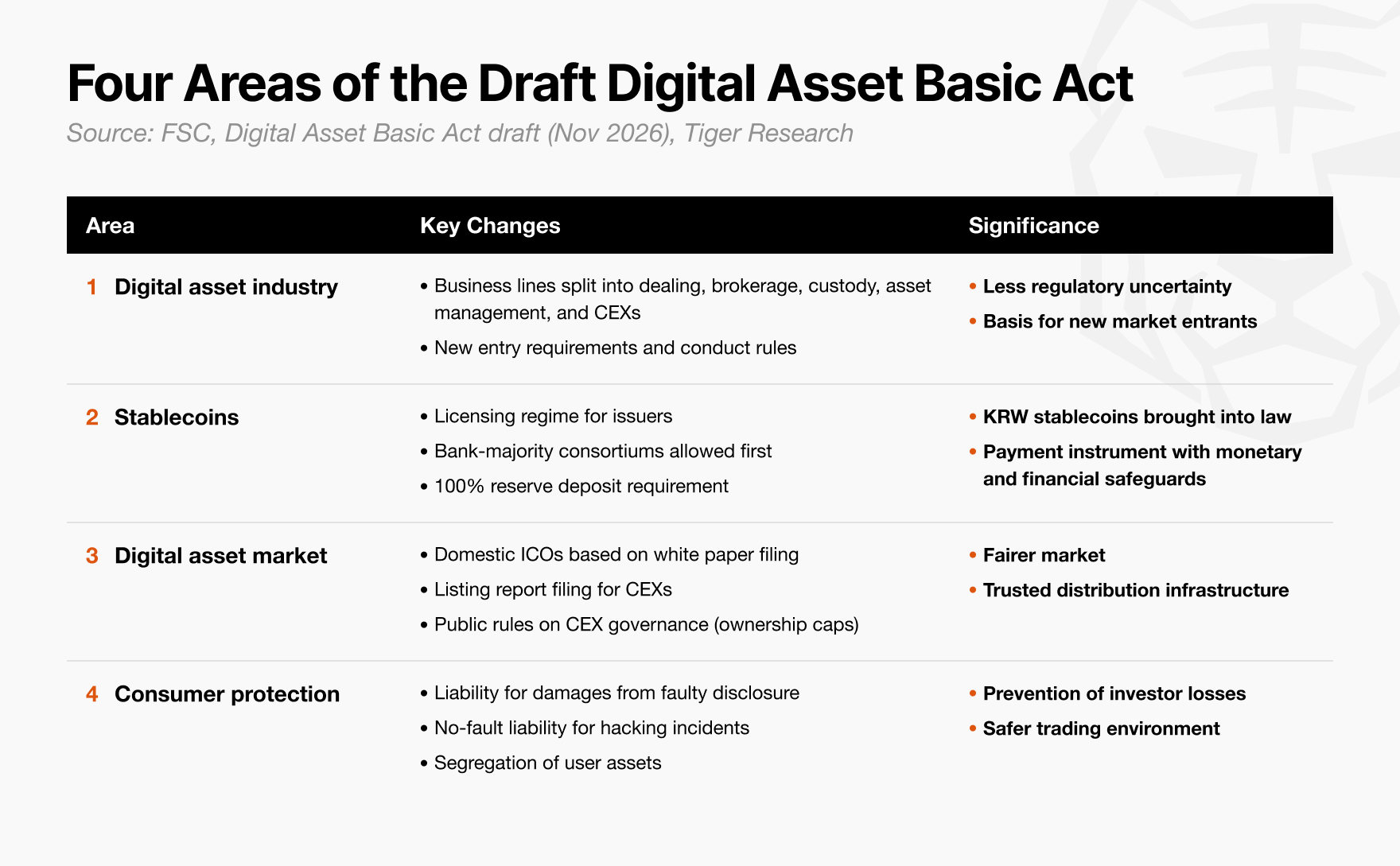
Impacted by this legislation, the four core participant groups in Korea's digital asset market must fundamentally restructure their long-term strategies: 1) Centralized Exchanges (CEX), 2) Local Financial Institutions, 3) Overseas Stablecoin Issuers, and 4) Web3 Foundations & Projects. This article aims to move beyond dry, line-by-line legal analysis to deeply explore the strategic maneuvers and industry reshaping of these four key players under the new regulatory landscape.
Centralized Exchanges (CEX): Codifying Listing Liability and the 20% Equity Ceiling
Under the new regulatory framework, centralized exchanges must not only submit official listing verification reports to the Financial Services Commission (FSC) for every listed token and mandate public disclosure, but also bear joint civil liability for compensation for any misrepresentations or material omissions in those reports. The sharp increase in legal risks associated with listing reviews has directly triggered a drastic tightening of exchange listing strategies.
The core reforms targeting CEXs in this bill focus on two dimensions: asset listing admission mechanisms and the exchanges' own equity governance structures. Of these two restructuring efforts, the listing verification rules will take effect immediately one year after the bill's promulgation, creating an urgent compliance deadline for exchanges. Conversely, the rectification regarding major shareholder equity caps provides designated exchanges with a three-year grace period starting from the date of designation.
1 Mandatory Disclosure of Listing Verification Reports
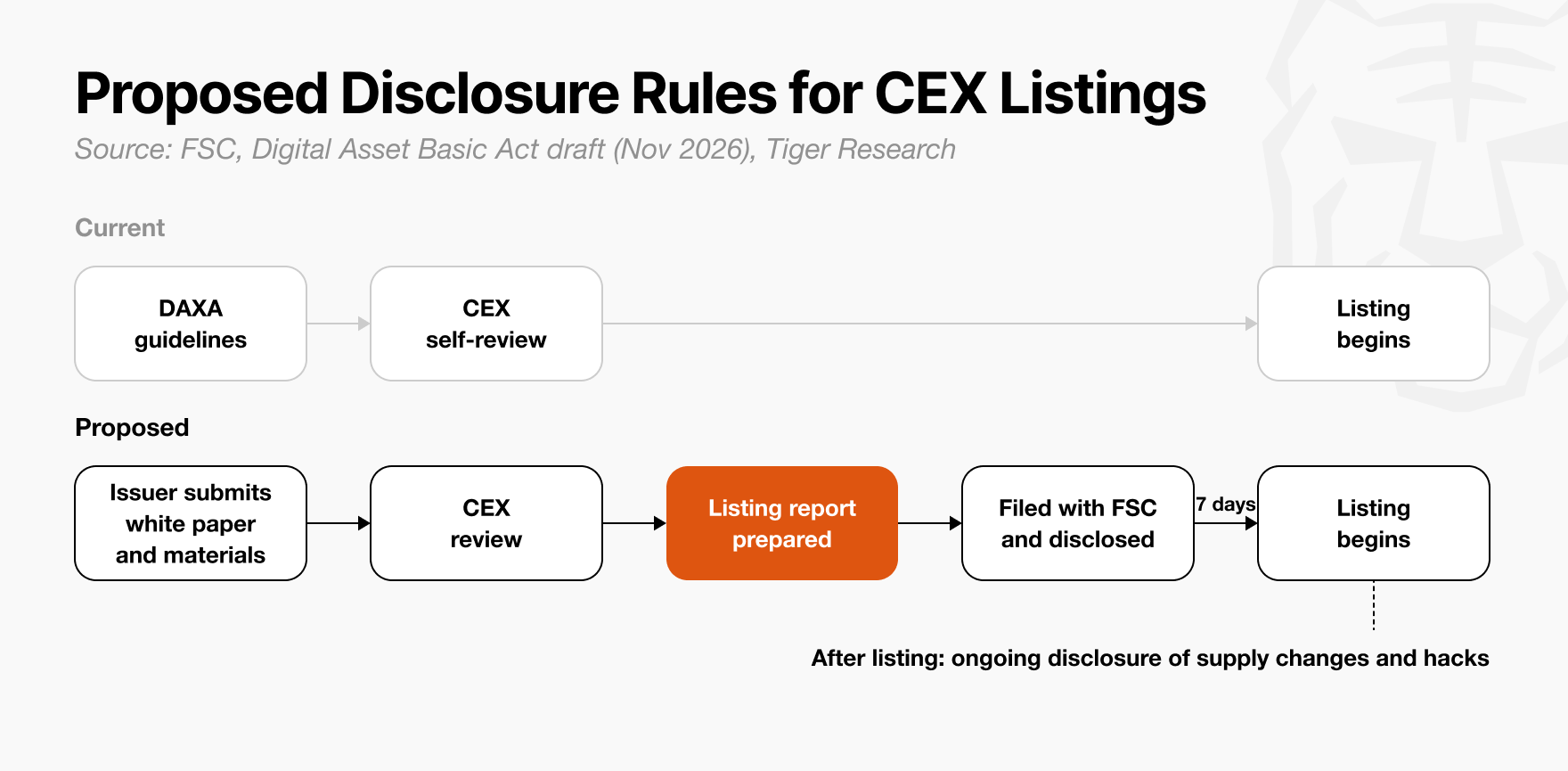
Article 11 of the draft explicitly stipulates that digital asset exchanges (i.e., entities defined under the bill as "digital asset trading intermediary business operators") must submit a listing review report to regulatory authorities upon deciding to list any asset. This report must cover the issuing entity, technical whitepaper, tokenomics distribution, and potential conflicts of interest, and be made publicly available.
More critically, Paragraph 1 of Article 15 establishes an extremely strict civil accountability mechanism: if a listing report contains false records, material misrepresentations, or omits material facts leading to economic losses for retail investors, the issuing exchange must bear civil liability for damages to the affected investors.
However, the development entities of most mainstream blockchain protocols are headquartered in overseas offshore jurisdictions. Korean domestic exchanges have severely limited cross-border due diligence capabilities regarding their off-chain finances and codebases. If overseas project teams engage in malicious fraud, Korean exchanges will directly become potential flashpoints for class-action lawsuits filed by victimized investors. Exchange legal and compliance departments will be forced to conduct protracted due diligence processes, compelling them to consolidate positions toward more robust, battle-tested mainstream assets.
2 Designated Exchange System and 20% Shareholding Cap
Paragraph 1 of Article 42 introduces the highly impactful "Designated Exchanges" system: for top-tier platforms whose trading volume and market influence reach specific thresholds, the Financial Supervisory Service (FSS) can directly designate them as systemically important exchanges and impose public governance requirements as stringent as those applied to traditional stock exchanges.
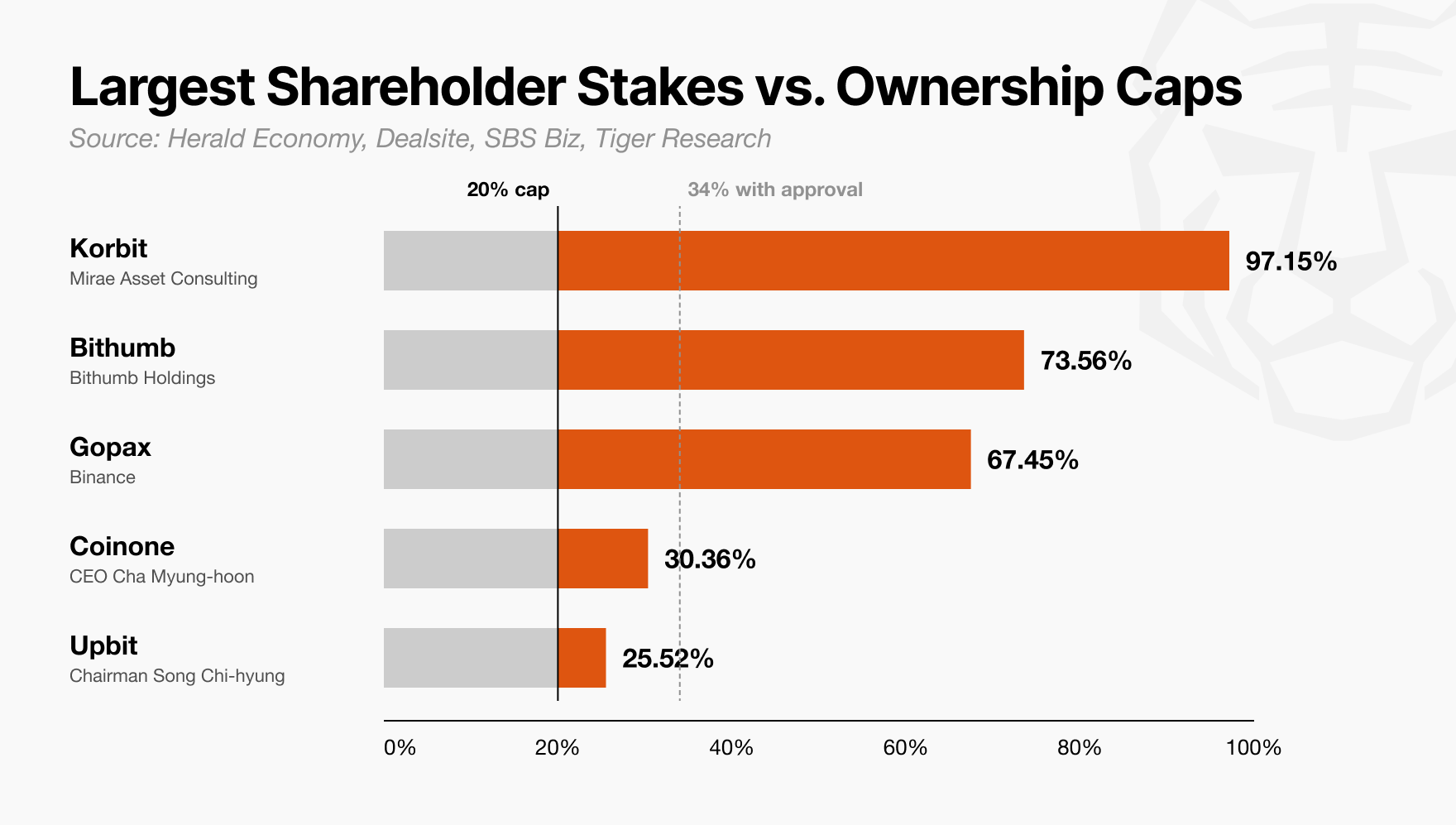
The most shocking provision to the industry comes from Paragraph 2 of Article 42: no single entity and its affiliates may directly or indirectly hold more than 20% of the shares in a designated systemically important exchange.
This clause directly targets South Korea's two exchange giants: Upbit (Dunamu) and Bithumb. Currently, founding core members including Song Ji-hyung tightly control over 20% of Dunamu's equity through concert parties; similarly, Lee Jeong-kun and his affiliates hold deep controlling stakes in Bithumb. If the bill takes effect, although existing designated exchanges enjoy a three-year rectification grace period, the three major controlling shareholders will be forced to list and sell massive excess equity in the secondary market or dilute holdings by introducing institutional syndicates. The entire ownership and capital landscape of Korean exchanges will face irreversible, historic consolidation.
Korean Local Financial Institutions: Diversified Expansion Blueprint Beyond Stablecoin Frameworks
Traditional commercial banks, securities brokers, and trust companies, long firmly barred from the doors of the digital asset sector, will witness a historic institutional breakthrough under this legislation.
1 KRW Stablecoins: Bank-Dominated Syndicates and FinTech Access
Paragraph 1 of Article 21 formally establishes the issuance license for fiat-collateralized stablecoins (particularly KRW stablecoins). To prevent systemic financial risks similar to the Terra-Luna algorithmic collapse, regulators have set nearly draconian capital and governance red lines:
The issuing entity must possess paid-in capital of at least 5 billion KRW (approximately $3.7 million) and fully segregate high-liquidity reserve assets equivalent to 100% of the stablecoin's circulating supply within secure institutions like banks. More substantively binding is the rigorous shareholder structure threshold set by the FSS: commercial banks must collectively hold no less than 60% of the issuing entity's shares (e.g., a syndicate formed by four major banks each holding 15%, a fintech company holding 30%, and other strategic partners holding 10%).
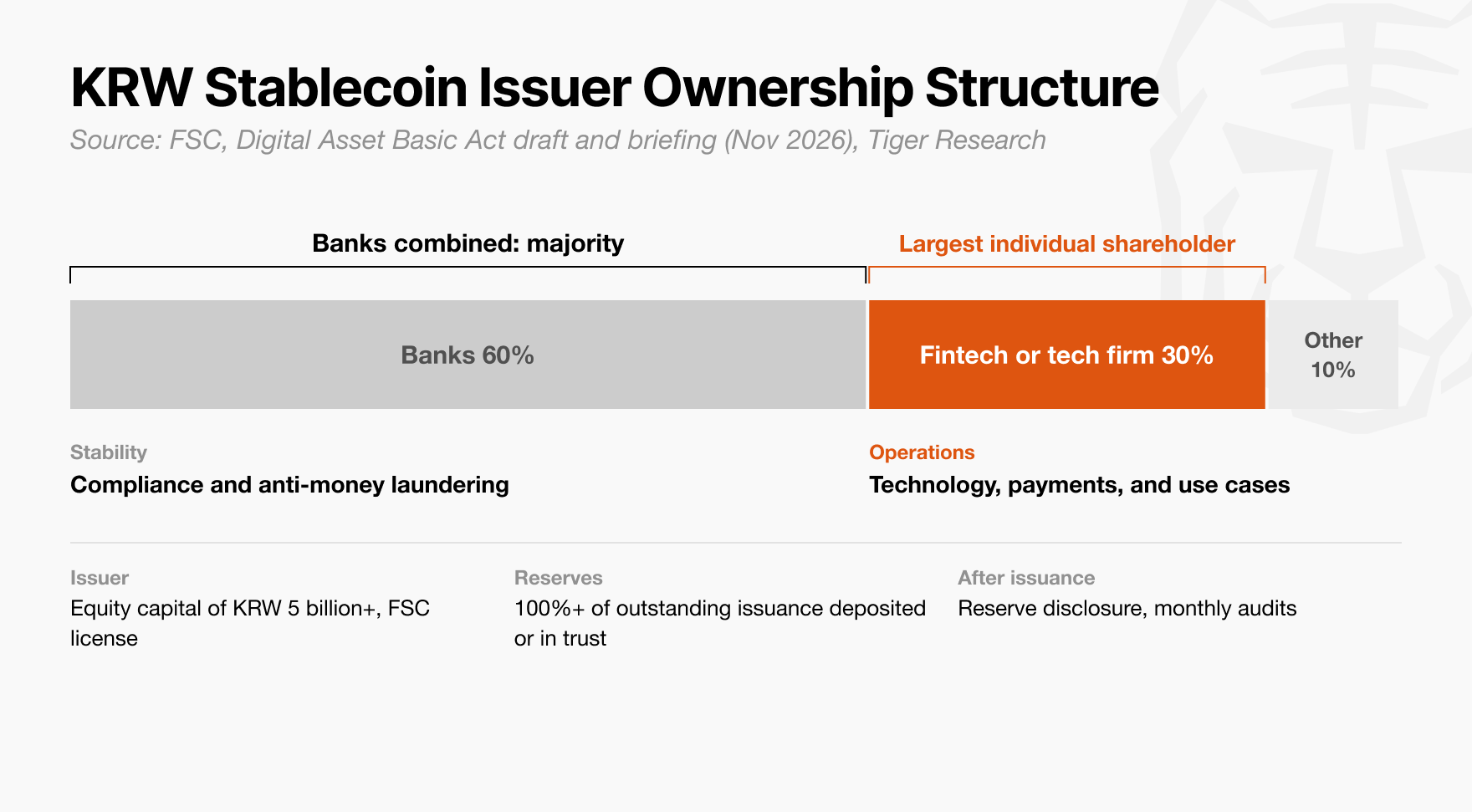
The 15% shareholder holding cap stipulated in the Banking Act is the key variable here. Under the current Banking Act, a single bank's stake in non-financial enterprises is capped at 15% in principle, providing the legal foundation for the FSS's policy discussions around "four major banks each holding 15% to reach 60% control." However, the draft does not explicitly exempt bank syndicate structures from current Banking Act restrictions. Lacking clear operational guidelines, any enterprise attempting to enter the KRW stablecoin space must first join forces with multiple mainstream banks to form a unified interest coalition.
This implies that pure fintech companies or Web3-native teams will hardly be able to independently monopolize KRW stablecoin issuance. The future landscape will inevitably evolve into a competitive cooperation norm characterized by "commercial banks holding control to provide licenses and reserve credit + fintech giants holding minority stakes to deliver front-end scenarios and circulation networks."
2 Diverse New Tracks Spawned by Segmented Business Licenses
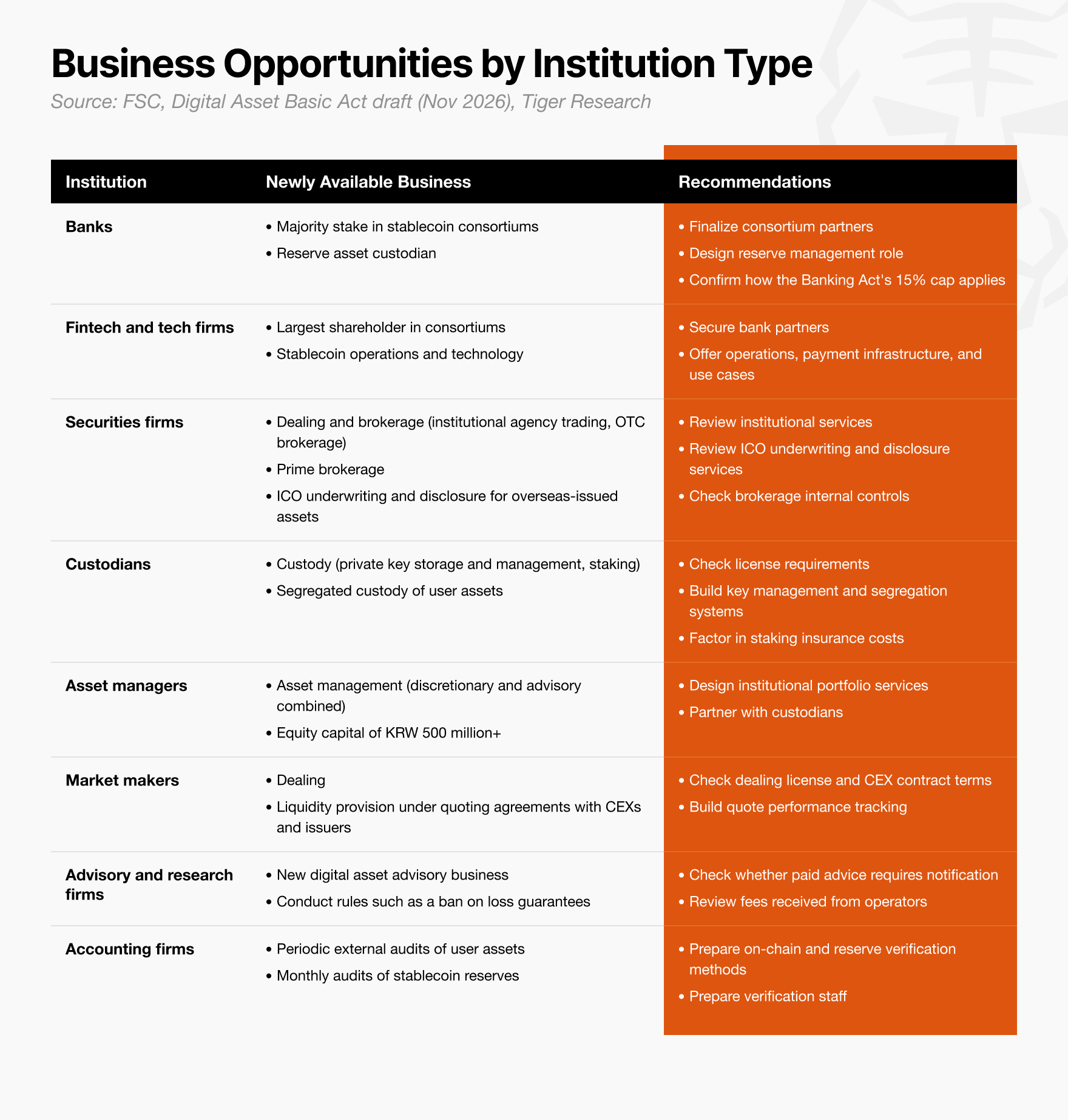
The draft completely abandons the previously broad single concept of "Virtual Asset Service Providers (VASPs)," instead drawing inspiration from traditional capital market laws to meticulously divide the digital asset industry into four independent licensed business categories:
- Digital Asset Trading Intermediary Business: Responsible for matching orders (i.e., pure order book exchanges);
- Digital Asset Custody Business: Independently and securely safeguard client assets;
- Digital Asset Brokerage Business: Execute trading instructions on behalf of clients;
- Digital Asset Advisory Business: Provide investment analysis and asset allocation advice.
This refined segmentation of licenses allows traditional securities firms to integrate crypto trading modules directly into their existing securities apps by applying for standalone brokerage and advisory licenses, without the need to invest heavily in building proprietary exchanges. Meanwhile, large trust companies and commercial banks can leverage their strong sovereign credit backing to rapidly seize custody hegemony for institutional-grade capital within the independent custody license track.
3 Unresolved Legacy Issues in the Draft
Although the framework has taken initial shape, the bill leaves significant gaps in many critical operational details: Are commercial banks permitted to allocate spot digital assets directly on their balance sheets using proprietary capital? Can traditional financial institutions directly use KRW stablecoins for cross-border payments and clearing/settlement? These unresolved red lines will require final determination by subsequent Enforcement Decrees issued by the FSS.
Overseas Stablecoin Issuers: Applicability of Korea's Localization Admission and Registration Procedures
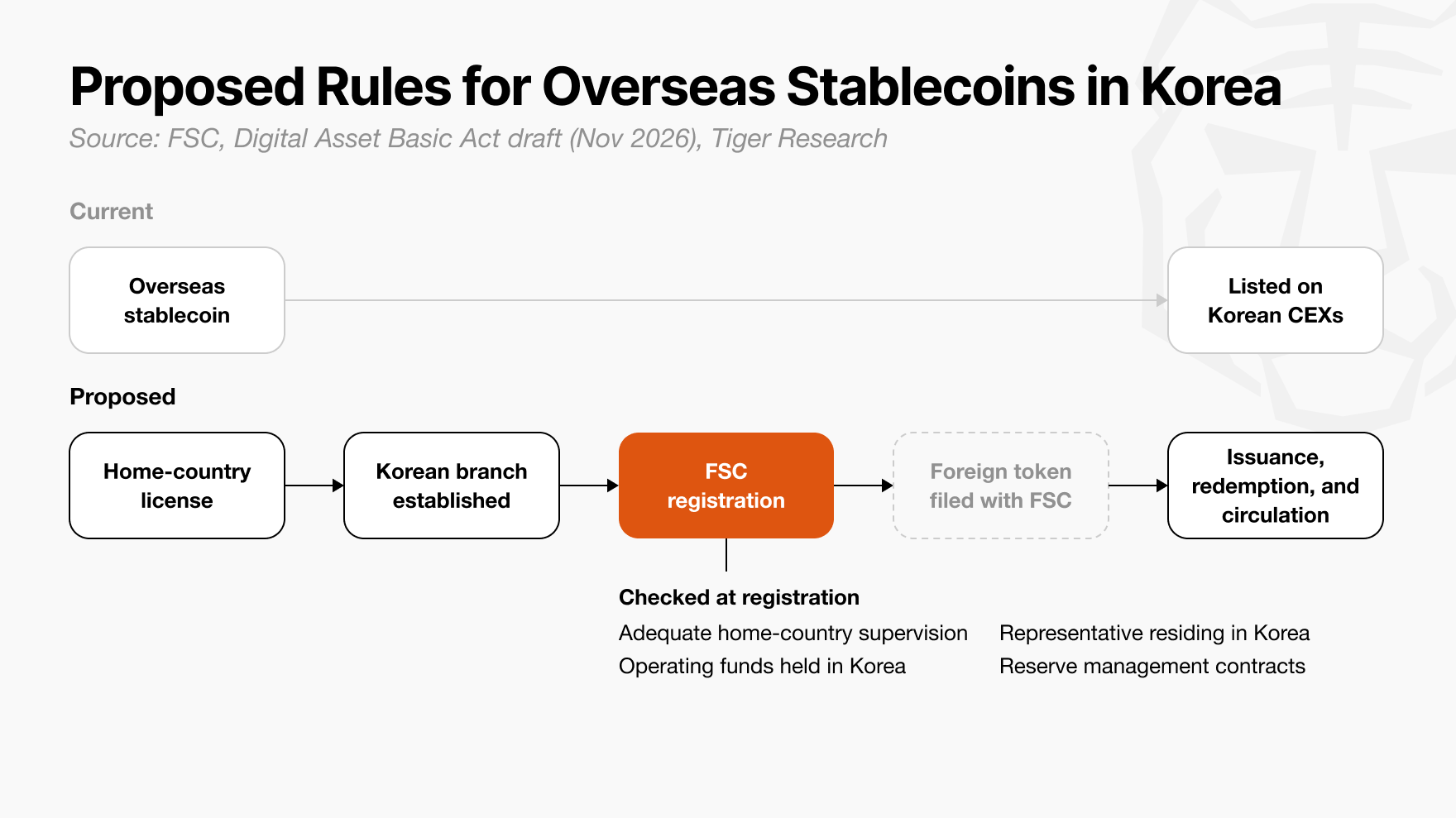
Aiming at foreign dollar-pegged stablecoins (such as Tether's USDT and Circle's USDC) that currently dominate the Korean trading market, Article 28 of the draft establishes a highly targeted cross-border regulatory extraterritorial jurisdiction mechanism:
For overseas issuing institutions to maintain compliant trading of their stablecoins on major Korean CEXs and ensure legal circulation among Korean residents, they must establish formal registered branches in Korea or designate statutory local agents. Additionally, issuers must already hold equivalent compliance licenses in their home jurisdictions and regularly report reserve adequacy ratios and audit reports to the Financial Supervisory Service (FSS).
The introduction of this regulation means overseas giants must accelerate the establishment of localized corporate entities in Seoul and integration with banking settlement networks. If certain unregulated offshore stablecoins refuse to meet these localization compliance requirements, Korean regulators will have the authority to directly order major exchanges to enforce mandatory delisting and isolation.
Web3 Foundations & Projects: Domestic ICO Ban Lifted, but Tax Havens Remain Hard to Displace
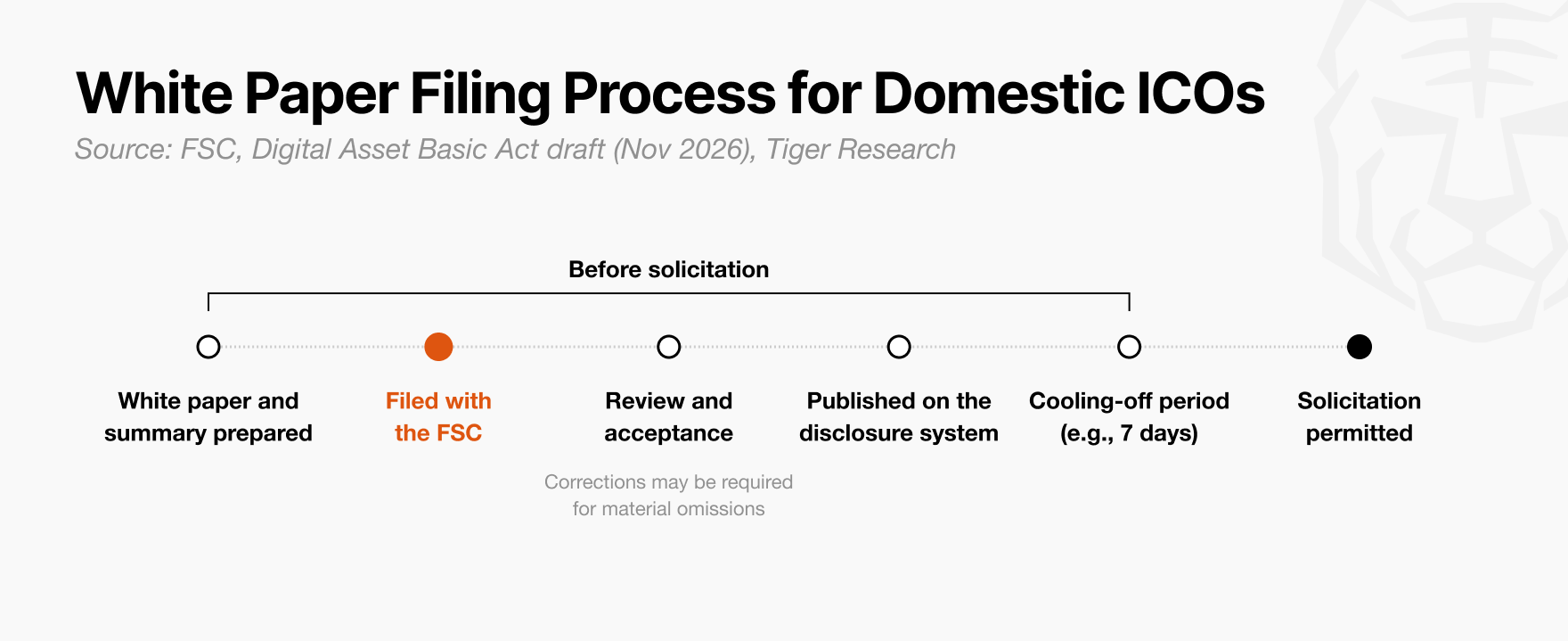
Since the FSS issued a comprehensive ban on domestic ICOs in September 2017, nearly a decade has passed during which the vast majority of outstanding Korean startup teams were forced to operate overseas, establishing offshore foundations in Singapore, Switzerland, the UAE (Dubai/Abu Dhabi), or the Cayman Islands to launch tokens indirectly. Article 7 of the draft finally lifts this legal seal on domestic compliant ICOs.
However, Tiger Research survey indicates that this policy easing is unlikely to trigger a large-scale wave of overseas foundation repatriation in the short term. The core constraints lie in heavy tax burdens and stringent disclosure responsibilities:
- Significant Tax Haven Gap: Foundations in Dubai, UAE, or the Cayman Islands can enjoy near-zero offshore tax rates. However, relocating a token issuance entity back to Seoul, South Korea would immediately subject it to Korea's standard corporate income tax regime at up to 24%.
- Onerous Statutory Whitepaper Disclosure Burden: The draft requires domestic issuing entities to submit detailed technical code audits, token unlock schedules, treasury fund flows, and executive holdings to regulators, bearing comprehensive joint legal liability for the authenticity of disclosures.
Therefore, for the vast majority of top-tier Web3 teams with a global outlook, maintaining a dual-track architecture of "offshore foundation issuance + local Korean technology subsidiary R&D" remains the most rational and pragmatic optimal solution today.
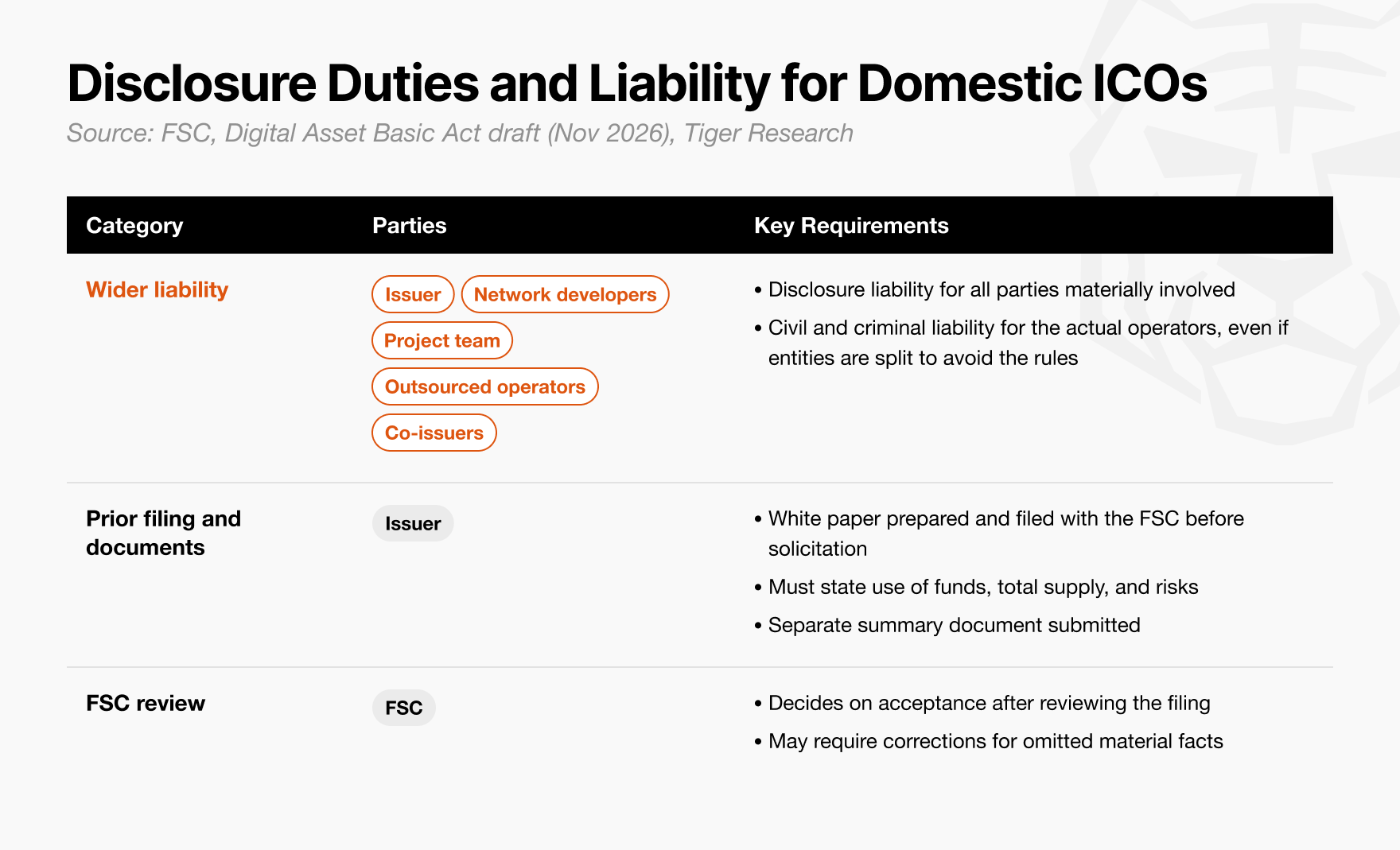
The bill further expands the scope of joint liability for information disclosure from mere issuing entities to underlying network developers, core project teams, and token sales/promotion agencies. Any natural person involved in drafting whitepapers or promoting/selling tokens could potentially be drawn into civil compensation lawsuits if the project makes misrepresentations. To navigate this high-risk environment, overseas foundations will likely need to establish permanent compliance liaison offices in Korea or hire domestic professional law firms to act as statutory disclosure agents.
Digital Assets: A Critical Step Toward Integration with the Compliant Traditional Financial System
The proposal of the Digital Assets Basic Law draft marks South Korea's crypto market finally bidding farewell to years of unguided expansion and gray-area maneuvering, formally entering a modern rule-of-law era rigorously aligned with traditional capital markets. Despite fierce debates anticipated in the National Assembly over property rights disputes regarding the 20% equity cap, the monopoly tendencies toward bank-controlled KRW stablecoins, and the crowding-out effects of high taxes on domestic innovation, the irreversible macro-trend toward institutionalization, transparency, and compliance for the entire industry has been firmly established.
Disclaimer: The content in this article is solely for frontier industry research and compliance policy analysis purposes and does not constitute any investment advice, legal opinion, or commercial endorsement.
Join TechFlow official community to stay tuned
Telegram:https://t.me/TechFlowDaily
X (Twitter):https://x.com/TechFlowPost
X (Twitter) EN:https://x.com/BlockFlow_News
 @tiger_research