A Decade as a Crypto Market-Neutral Strategy Manager: Alpha Generation and Zero Blowup Record Under the Sword of Damocles
Author: Santisa, Head of Risk and Market Neutral Strategies at Spark
Compiled by: TechFlow
TechFlow Guide: Amidst the towering waves of crypto assets, market neutral strategies are often packaged by outsiders as "risk-free money-printing machines that guarantee profits." However, their true underlying logic is an extreme asymmetric bet with a very low probability of default, but where a default results in nearly 100% loss. The fastest runners survive, while the slow-reacting only become bag holders for the project teams' empty promises.
The author, Santisa, spent nearly a decade navigating the razor's edge of DeFi as a hedge fund trader. Throughout the crypto industry's calamities—including the collapse of FTX, the flash crash and reset of Terra/Luna, and countless hacker drains—his fund achieved an astonishing "zero monthly drawdown, zero principal bad debt," serving as a textbook example of on-chain risk management.
As institutional forces flooded in, compressing arbitrage spreads, and risk-free interest rates climbed above 5%, the author ultimately chose to transition from solo operations to joining Spark, which manages $3.3 billion in assets. Drawing from a deeply sincere and sharp insider perspective, this article comprehensively reviews the ten-year evolution of on-chain liquidity, uncovering the fears, greed, and fundamental survival rules behind it.
The Sword of Damocles Hanging Overhead
For most of the past decade, I have devoted my full energy to the niche field of crypto market-neutral strategies. Vocalizing this might seem inconceivable to some, yet it has genuinely captivated all my intellect and nerves.
Historically, crypto market-neutral strategies have often been highly concentrated in extreme trades characterized by a low probability of default, but a near-100% loss rate upon default.
Every participant within it must maintain the highest level of vigilance at all times. Everyone knows instinctively that when the final gong sounds, the first to hit the withdrawal button will survive the ordeal. Most intriguingly, unplugging and escaping on-chain ahead of time usually costs almost nothing; those who hesitate even slightly will be left spending the rest of their lives relying on the project team's hollow and powerless bailout promises.
This is undoubtedly an incredibly suffocating, high-pressure lifestyle. Yet the charm of the crypto world lies in its genuine potential to generate massive risk premiums, premiums that are often several times higher than the actual risks assumed at the base level.
No one can deny that the up to 70% Bitcoin cash-futures basis arbitrage seen at Binance in 2021, or the leveraged fixed-income trades yielding nearly 100% annualized returns for certain tokenized hedge funds in 2024, contain extremely rich, pure Alpha.
However, a trade possessing positive Alpha does not mean it suits every portfolio. The DeFi market is intensely predatory and aggressive; a Sword of Damocles could drop on any position at any moment.
This means you must stare unblinkingly at the thin thread holding the sword, setting up monitoring alerts that may wake you and your family in the dead of night due to false alarms. The moment an alert rings, you must verify if the thread is snapping, and before the blast radius reaches you, pull your neck back as quickly as possible.
The Windfall and Wild Growth of Early DeFi
In the early stages of DeFi's rise, market premiums were unbelievably high. Partly because initial risks were indeed extremely high, but more fundamentally because traditional large asset management firms simply could not obtain regulatory authorization to allocate capital into such assets.
These early opportunities came with massive reputational risk, which traditional institutions barely understood. Consequently, there was a stark divide: on one side, project teams with ample funding backing from top-tier VCs but desperately craving liquidity deposits; on the other, native whales who struck on-chain fortunes and retreated their assets into stablecoins.
This peculiar and distorted market structure gave anyone with basic risk management capabilities the opportunity to dive into some of the most lucrative arbitrage strategies in global financial markets over the past two decades.
I was fortunate not only to personally participate in these historical opportunities but also to build my own business entity around them. Economies of scale tend to be more efficient; having more professional eyes and abundant resources watch the thread together is always better than fighting alone.
Back then, I keenly realized that the demand for stablecoins on-chain was immense, while the supply side possessing compliant capital was scarce. As long as you understood basic financial concepts and underlying technical logic, you could secure exceptionally high returns.
This was not a minor market pricing anomaly, but a deep structural gap separating serious asset management firms from DeFi, which was then viewed as "toxic assets."
In those early days, I was just a shut-in keyboard geek, spending all day delving into DeFi mechanics and blockchain code. Later, I met a partner who fully persuaded me to package this capability into standardized asset management products.
He painted a picture of strong real-world demand in the market, asserting that as long as we transparently and clearly disclosed all risks to clients, his channel network would make it a profitable business. He turned out to be right.
After clearly informing our Limited Partners (LPs) of the risk that principal could go to 100% under extreme pressure, we brought in a batch of courageous capital. Subsequently, we entered a hellish mode of sacrificed sleep and透支ed physical and mental health, diving headlong into what now seems like a fever-dream-inducing "food mining frenzy."
During the magnificent and ferocious bull market run from 2020 to 2021, our business progressed incredibly smoothly. We compared protocol fork code line by line to prevent backdoors, executed seemingly absurd same-stablecoin leverage arbitrage across multiple protocols to farm governance tokens, monitored countless on-chain wallet addresses to capture stress and anomalies, and forged a bloody path through the extremely rudimentary foundational tools available at the time.
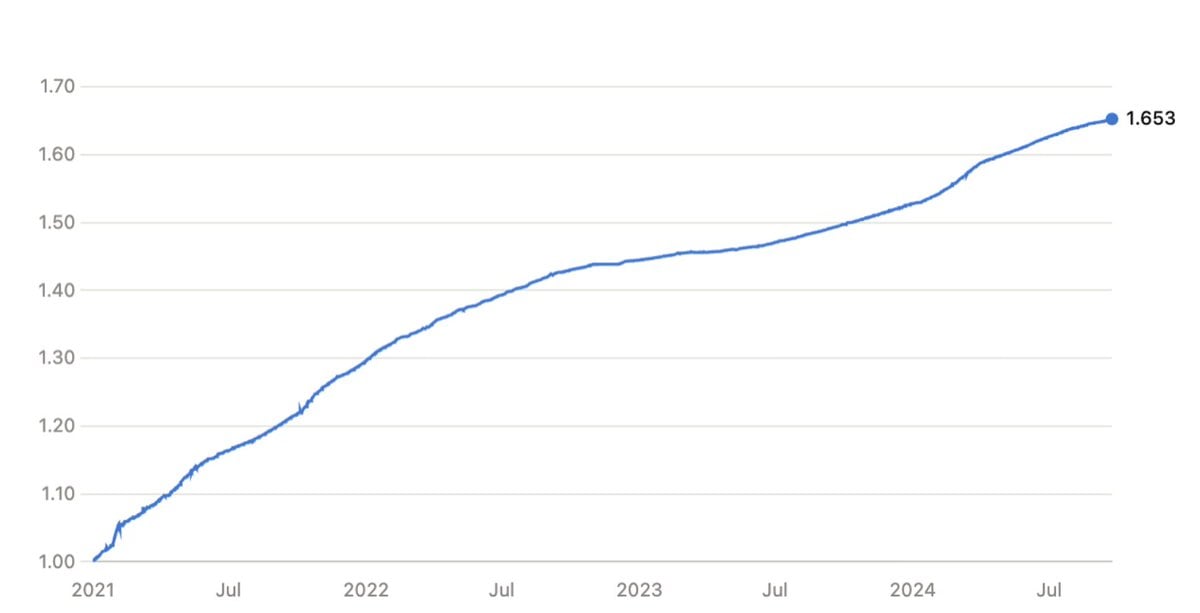
Figure: Return Curve of Market Neutral Funds from 2021 to Mid-2024
The Cost of Zero Drawdown: Countless Micro Heart Attacks
Some might feel that during that crazy bull market cycle, the returns shown in the chart above don't seem particularly sexy or eye-catching. But carefully read the true meaning behind this graph: throughout the entire duration, we achieved zero monthly drawdown.
We completely avoided the catastrophic collapses of FTX, BlockFi, Celsius, and Terra/Luna, as well as the USDC peg crisis in March 2022.
More crucially, across dozens of hacker drains and protocol resets involving Nomad, Multichain, Cream, Badger, Harmony, Mirror, Fei, BzX, we remained completely unscathed.
We incurred absolutely no operational losses and wrote down zero principal assets. The Sword of Damocles truly hung over our heads for years, but delivering such steady returns without losing a single dime amid such a harsh and dangerous industry environment remains my greatest professional pride.
Over the years, the price paid for these returns was enduring countless near-cardiac-arrest moments: transactions inexplicably stuck in cross-chain bridges, disappearing for hours before returning; frequent sightings of USDT depegging; USDC plunging deep to $0.88.
We also witnessed firsthand billions worth of UST collapsing to zero in an instant, and countless previously interacted-with protocols being wiped out due to contract vulnerabilities or private key leaks.
Our true operational Alpha was actually quite simple: First, a deep understanding of underlying financial mechanics; Second, adequate comprehension of technical architecture and smart contracts; Third, never blindly following the crowd to gamble in a casino designed for gamblers, but rather becoming the lender charging them interest.
This profession is far too demanding for the weak. But when paper profits justified the health toll, participating in those highly leveraged trades was entirely rational at the time. It was a rare generational opportunity, and I remain forever grateful to the partner who pushed me forward and shared the scaled risks with me.
The Brutal Bear Market and Compressed Risk Premiums
In the following years, market excess returns began to narrow significantly. We had to pivot to allocating capital into short-term U.S. Treasuries and wait idly, watching helplessly as the company continuously bled out due to daily operational costs.
With no attractive yield spaces remaining in the market and our investment discipline being extremely strict—we never acted blindly if assessed risk outweighed potential return—we struggled to maintain objective and honest analysis amidst fierce partner arguments, deep contemplation, and redemptions from some LPs.
At that time, the comprehensive risk of every position often nested up to seven layers: financial risk, custody risk, governance negligence, regulatory compliance, operational errors, black-box opacity, and contract vulnerabilities. Confronted with these overlapping hazards, we simply could not justify allocating capital into instruments yielding significantly below SOFR (Secured Overnight Financing Rate).
Yet on-chain at that time, vast amounts of dormant capital remained trapped and unable to exit DeFi. For them, even the slightest yield was preferable to idle capital.
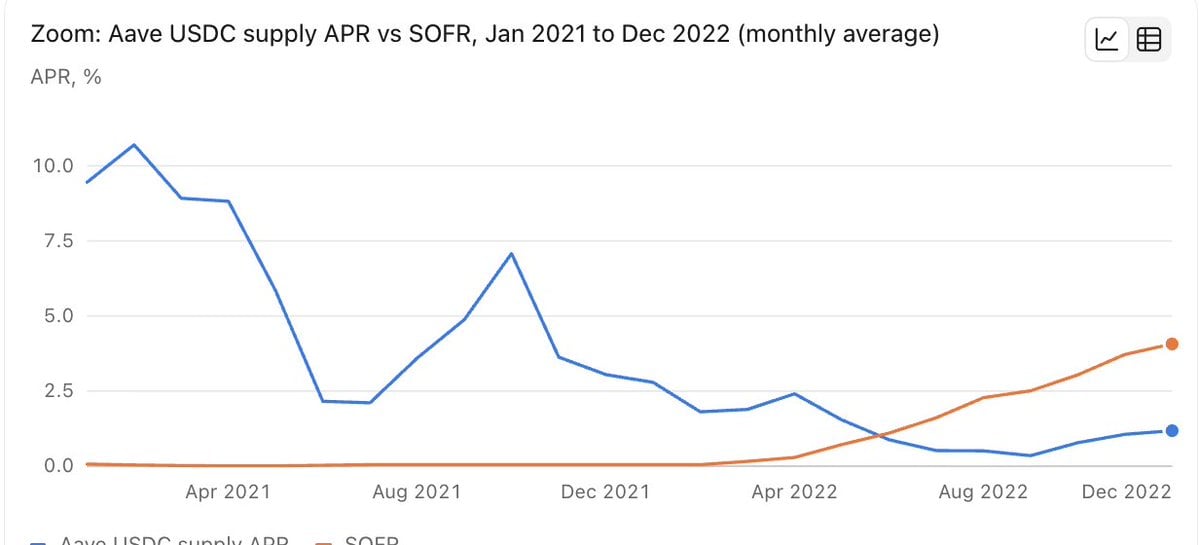
Figure: Comparison of Aave USDC Lending Rates and SOFR Risk-Free Rates
When the bull market staggeringly recovered in 2023, the entire industry landscape had undergone earth-shattering changes. A new wave of well-capitalized, highly mature professional players emerged in the market, comprehensively surpassing us in allocation capabilities across DeFi lending, liquidity mining, cross-market arbitrage, and holistic market-neutral positions.
Although we could still find small entry opportunities in certain niche gaps, the overall risk-adjusted returns were severely compressed. For me, bearing fiduciary responsibility toward external LPs brought immense psychological weight.
No matter how detailed and transparent your risk guidelines are written, if LPs choose to blind-trust you completely, you realize you carry a heavy fiduciary burden. When yields can no longer justify this exhausting sense of pressure, traditional fund management models become unsustainable.
Paradigm Shift and New Home Under Institutional Arms Races
Thus, in 2024, I pivoted to providing non-custodial yield strategy services for family offices and crypto exchanges, as these institutions possess profound professional understanding of strategy risks.
However, this operating model relied heavily on manual labor. Constant communication friction between custodians and strategy operators meant that after deducting management fees, the net excess returns reaching our hands became extremely meager. At this point, I completely grasped the new paradigm of crypto market-neutral management.
A new generation of leading institutions threw themselves into managing their own balance sheets. They employed round-the-clock teams working across time zones, deployed extraordinarily expensive risk monitoring systems, and utilized highly advanced multi-sig and custody infrastructure—all merely to extract maximum yields and control extreme risks.
I found myself in an awkward squeeze at the time: hungry to push Alpha to its limits, yet lacking the infrastructure and massive budget required to sustain such operations. Only two paths lay before me:
First, raise management partner capital again for a neutral hedge fund, then spend the globe chasing LPs, and fall back into the cyclical traditional grind;
Second, join top-tier institutional carriers that have already built massive frameworks and ample security budgets, capable of efficiently monetizing on-chain risk premiums.
At heart, I have always been a fund manager. I only took on managerial roles focused on fundraising and staff administration in the past purely because the industry lacked reliable, mature platforms to choose from at the time.
But the crypto world in 2025 is completely different. I am lucky to have crossed paths with a group of brilliantly talented elite professionals, who happen to be injecting billions in real capital into on-chain ecosystems.
My journey at Spark officially began in July 2025. To date, Spark has deployed approximately $3.3 billion in on-chain assets, primarily allocated to overcollateralized blue-chip lending. This encompasses Spark’s own on-chain lending market and credit backed by BTC held at regulated custodians. Spark also serves as the industry's largest stablecoin market maker and operates the most efficient USDT asset-side yield platform in the market.
"Becoming the market itself" and "running ragged within the market" are entirely separate dimensions. These deep strategies and mechanisms, I can only publicly deconstruct once future alpha leakage risks are eliminated.
Over the past decade, I have mastered the art of watching the thin thread, and this is precisely the foundation of my life. With the Sword of Damocles still hanging by my side, I will continue to hold my breath and watch that thread unblinkingly. Only on the day the blade is finally moved away will I lower my guard and sleep peacefully.
Join TechFlow official community to stay tuned
Telegram:https://t.me/TechFlowDaily
X (Twitter):https://x.com/TechFlowPost
X (Twitter) EN:https://x.com/BlockFlow_News
 @Tiza4ThePeople