The crypto world no longer exists.
Author: Liu Honglin, Manqun Blockchain Legal Services
In Liu Cixin's novel The Three-Body Problem, Wang Miao, a researcher in nanomaterials, becomes entangled in a series of scientist suicides.
One of those scientists was named Yang Dong, a theoretical physicist and Ding Yi's girlfriend. Wanting to understand how she reached this point, Wang Miao went to find Ding Yi.
Ding Yi brought him to a pool table, asked him to sink the black ball into a pocket, and then shifted the table before playing again. He tried several times in a row, and every shot went in. Ding Yi then asked: What if you strike the cue ball the exact same way, but the object ball suddenly flies toward the ceiling, bouncing chaotically around the room?
He used the pool table to illustrate particle collision experiments. Scientists had hoped to verify physical theories with more powerful accelerators, only to discover that under identical conditions, the experimental results changed every single time. Yang Dong had originally planned to test her theories through experiments, but now she could no longer find a single consistent law to repeatedly verify.
In her suicide note, this despair crystallized into a single sentence: "Physics has never existed."
She had always believed the universe operated according to immutable laws, which humans could comprehend through experimentation. Her education, her research pursuits, and the planning for her entire career were all built upon this foundational conviction.
What is being shaken now is the entire epistemological framework she once relied upon to understand the world. The profound sense of disorientation felt by some veteran players in the crypto community today instantly brings this scene to mind.
The set of market principles they had trusted for years also began to fail: Bitcoin rallied, while the altcoins in their portfolios remained stagnant; Wall Street institutions formally entered the space, yet financing for crypto projects and exit liquidity for investors did not become any easier.
This goes far beyond simply failing to make money from holdings. More painful than financial losses is watching an entire belief system, which previously helped them generate profits and achieve a sense of accomplishment, being dismantled by reality.
Acknowledging that these outdated playbooks may no longer work is often harder than admitting a single bad purchase. But if newly deployed capital has never intended to buy your tokens in the first place, waiting another full cycle won't guarantee a return to past gains.
After reading an interview with Fu Peng yesterday, he stated that Bitcoin's historical four-year cycle has concluded and crypto assets will gradually be integrated into traditional asset allocation frameworks. I firmly agree with his assessment of industry evolution.
Fund managers buying spot Bitcoin ETFs based on macroeconomic data, and retail traders rushing onto-chain to speculate on Meme coins, operate on entirely different logical paradigms. For these two phenomena to coexist within a single industry is already surreal.
I shared a comment stating: The crypto community in its traditional sense has essentially ceased to exist.
What Powered the Old Crypto Community
There was once a reliably profitable formula for wealth accumulation in this space.
By the "old crypto community," I refer to the ecosystem that relied on issuing tokens for fundraising, cashing out upon exchange listings, and then depending on the next wave of retail newcomers to keep the economic chain running. It handed out massive opportunities to many, but also fostered widespread manipulation, fraud, and conflict-of-interest schemes.
By 2026, continuing to bet the industry's long-term viability on this exact playbook is simply no longer viable.
Before products were even developed, grand narratives and whitepapers were published first, with capital raising entirely dependent on token sales. Early investors waited to exit post-listing, while users conducted testnet activities and claimed airdrops, eagerly anticipating selling their allocated tokens at premium valuations. Teams operated under foundation structures, projecting an ethos of decentralization externally while suffering from a severe lack of internal governance and oversight.
This model successfully funded early-stage teams and fueled the growth of wallets, exchanges, and developer tooling. However, for projects that relied on continuous token emissions to sustain user engagement, the moment the price crashed and emission incentives halted, airdrop farmers abandoned ship, leaving behind hollow, inactive protocol shells.
Early blockchain ventures also clung to another premise: users distrusted traditional banks and mega-corps, refused to let centralized platforms hoard their data, and desperately needed a decentralized alternative. But in regions where traditional banking and payment infrastructures are already highly refined, most consumers harbor relatively little resentment toward the established order.
Even Bitcoin, the community's ultimate totem, sees a growing number of buyers opting to hold through traditional custodians. These investors want exposure to Bitcoin but are unwilling to manage private keys or absorb catastrophic losses from irreversible transactions sent to incorrect addresses. Purchasing BTC-linked ETFs through familiar brokerage accounts remains a vastly more hassle-free solution for them.
Our repeatedly emphasized mantra of "self-custody of assets" simply does not prioritize convenience as highly for these institutional clients.
Crypto Is Becoming Financial Backends
On July 18, 2025, Donald Trump signed the GENIUS Act in the East Room of the White House, establishing a dedicated federal regulatory framework for payment stablecoins. Issuers must maintain fully qualified collateral reserves, disclose asset composition on a monthly basis, and implement robust anti-money laundering and sanctions compliance programs.
Many in the crypto space initially celebrated this as a monumental victory: after years of regulatory headwinds, it had finally gained mainstream acceptance.
Yet, the sentiment ultimately proved misplaced.
The White House prioritized stablecoins specifically because they sought to reinforce the dollar's international reserve status, drive demand for U.S. Treasuries, and tightly regulate issuance and capital flows around these instruments. The crypto industry delivered a highly functional tool, the U.S. government appropriately leveraged it, but the regulatory rules will undeniably be dictated by Washington.
The original ideological blueprint of the crypto community was never the driving force behind this policy design.
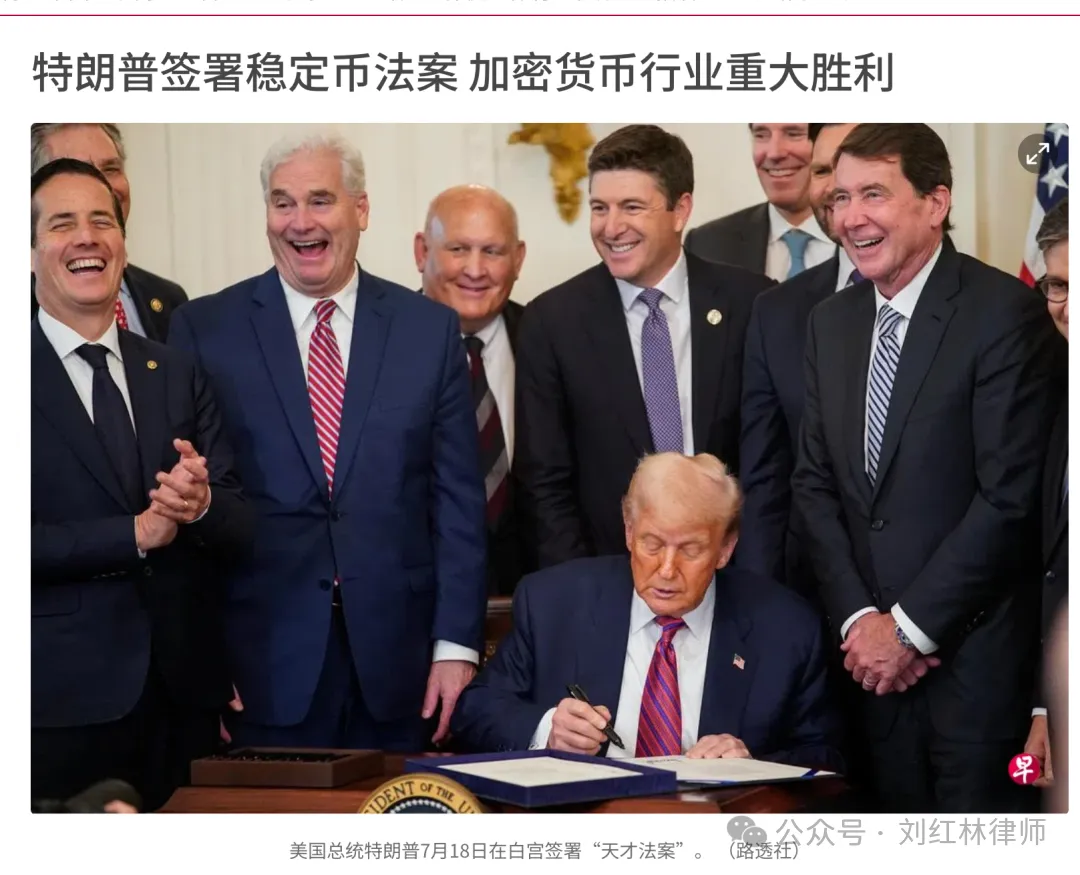
Source: Lianhe Zaobao reporting on Trump signing the GENIUS Act
The regulatory intent is straightforward: permit stablecoins to facilitate payments, conditional upon strict alignment with conventional financial system standards.
Commercial enterprises rapidly adapted accordingly. In October 2024, cross-border payments giant Stripe announced a $1.1 billion acquisition of stablecoin infrastructure provider Bridge.
Stripe aims to resolve the friction of fragmented global payment rails, sluggish settlement windows, and exorbitant fees. Leveraging Bridge, merchants can natively accept and circulate stablecoins within their existing merchant systems, all while preserving the familiar fiat-based consumer experience.

Source: Cross-border payment platform Stripe acquiring stablecoin infrastructure Bridge
Through this strategic acquisition, blockchain technology functions exclusively as an invisible conduit for cross-currency and cross-border settlement. It operates entirely behind the payment gateway, to the extent that end-users need never realize they are interacting with crypto assets.
On capital markets, traditional financial institutions are accelerating their integration of cryptographic technology.
By late 2025, the Depository Trust & Clearing Corporation (DTC) officially launched tokenized securities services, with twenty participating financial institutions signing contracts, including JPMorgan Chase and Citigroup. The DTC manages the custody of underlying traditional securities, issues digital settlement receipts on distributed ledger technology, and enables round-the-clock trading alongside near real-time settlement.
It provides an enhanced utility layer for existing securities, entirely bypassing the need to launch project-specific utility tokens purely for capital formation.
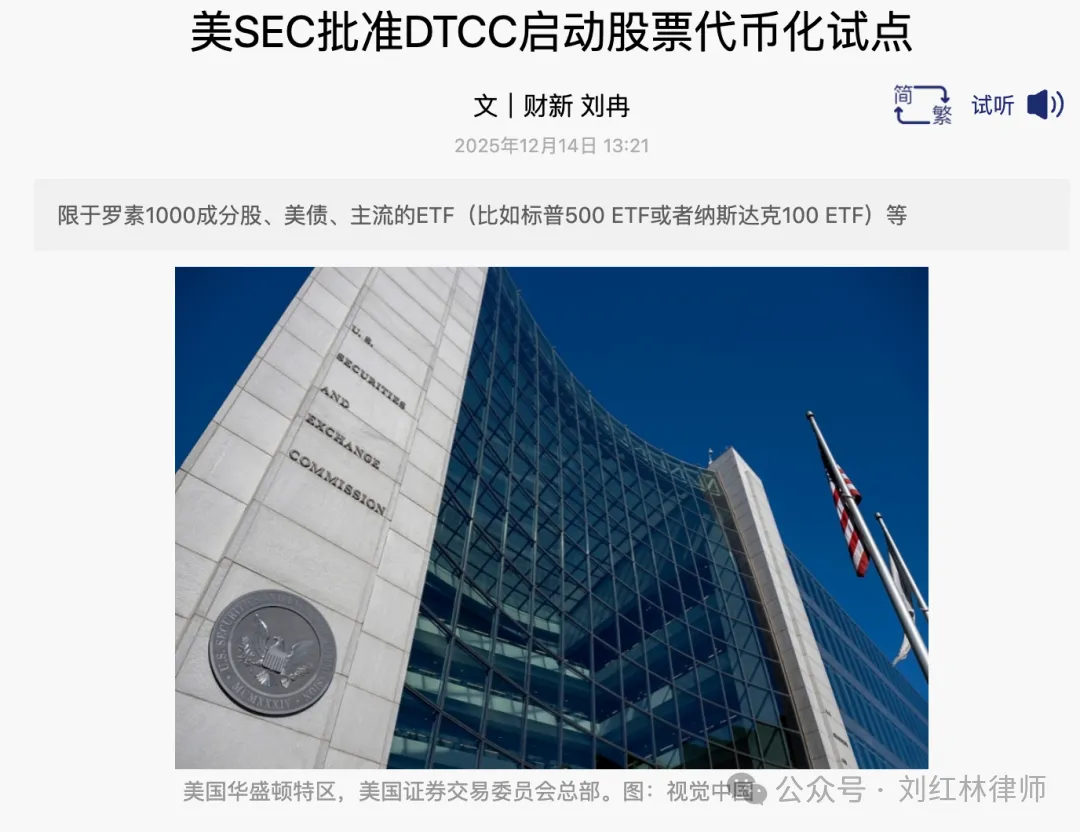
Source: Caixin's coverage of DTCC's tokenized securities pilot
Institutions are primarily interested in whether legacy securities can circulate more efficiently and serve as higher-yielding collateral, thereby reducing idle balance sheets. They value the underlying distributed ledger technology, but the open-source public chains readily available in the crypto space are rarely trusted enough to handle institutional-grade capital flows.
As noted, the DTC immediately deployed its proprietary private network alongside the Canton Network upon service rollout. Tokens only circulate between wallets registered directly with the DTC, featuring embedded compliance gatekeeping. The core operational objectives remain unchanged; the infrastructure simply switched to a significantly faster accounting engine.
These institutional actors have entered with their own rigorous compliance frameworks, prompting top-tier venues like Binance and OKX to proactively pivot and adapt.
Within the old crypto hierarchy, exchanges occupied the apex of the food chain, monopolizing user traffic and transaction flow, which generated countless overnight wealth legends. However, the volume of assets institutional clients commit to trading hinges entirely on whether exchanges can seamlessly integrate with their rigid treasury management protocols.
For example, Binance's third-party banking arrangement permits eligible institutional clients to retain collateral within regulated corporate banking accounts while actively trading on-platform. Similarly, OKX's institutional partnership with Standard Chartered Bank outsources collateral custody to independent third parties outside the exchange ecosystem, effectively neutralizing counterparty default risk.
This represents a fundamental departure from prior crypto operational norms.
Early-stage projects once survived on token crowdfunding, promising a permissionless internet where users retained sovereign control over data and capital, with participants speculating solely on token appreciation. The commercial models emerging today can achieve product-market fit without leaning on this speculative narrative.
With core technology actively solving financial plumbing issues, the outdated business model reliant on initial token distributions, exchange listings, and perpetual speculation on the next retail wave cannot reasonably claim to represent the industry's future.
I prefer to classify this evolution as "New Crypto Finance": traditional financial incumbents leveraging cryptographic rails to optimize payments, clearing, and asset mobility, while adaptable crypto-native firms restructure to service these institutional demands. This trajectory is profoundly centralizing.
I Still Remain Bullish on This Industry
Prior to drafting this article, I produced a short-form video elaborating on these exact perspectives.
Unexpectedly, numerous commenters misinterpreted the content as standard bear-market doomposting. After all, assertions that the crypto supercycle is collapsing routinely circulate during every cyclical downturn.
I comprehend this defensive reflex, but these viewers fundamentally missed my core thesis.
My position has always been unequivocal: I maintain a persistent long bias on Bitcoin (BTC) and remain highly optimistic regarding blockchain technology's pivotal role in architecting the next-generation internet.
What I am critically bearish on is normalizing get-rich-quick speculation as the sector's sustainable pathway, or naively assuming that dogmatically enforcing absolute decentralization will automatically capture mass-market adoption.
Short-term thinking inevitably breeds immediate operational fragility. Recording that video and publishing this article is meant to foster dialogue and strategic alignment with industry veterans committed to multi-cycle execution.
In the past, projects could securitize future value through token sales, heavily subsidize user acquisition, and passively rely on market valuation surges to underwrite burn rates; what does the future demand? Professionals intending to build in this sector must now actively identify and secure customers prepared to pay for sustainable utility over the long term.
Over recent months, my partners at Manqun and I have extensively debated similar structural shifts. For years, Manqun has maintained deep vertical penetration within the blockchain sector.
From Decentralized Finance (DeFi), GameFi, and SocialFi to full-scale tokenization, Bitcoin Layer 2 scaling solutions, and the architectural convergence of Artificial Intelligence (AI) with Web3, we have guided numerous initiatives through complete lifecycle transitions from seed stage to liquidity exits, providing critical counsel on regulatory structuring, civil litigation, and complex criminal defense matters.
This hands-on practice has exposed us to the industry's cyclical volatility, enabling us to deeply recognize and validate operators dedicated to long-haul value creation. As we analyze New Crypto Finance today, I aim to transplant the technological proficiency, operational wisdom, and relational trust cultivated over the years into our upcoming advisory engagements.
In managing prior mandates, we have observed unambiguously that Web3 user bases and commercial markets are intrinsically borderless. A single project's founding team, active user cohorts, and capital pools frequently span disparate jurisdictions, meaning legal and compliance architectures inevitably require multi-lateral coordination.
Consequently, we finalized a "deep domestic expertise, broad global footprint" expansion strategy, systematically positioning advisory desks across Shanghai, Shenzhen, Hong Kong, and Silicon Valley to execute this vision.
We deeply comprehend the operational realities navigating Chinese founders, and routinely provide localized regulatory navigation when executing cross-border expansions. Despite shifting geopolitical and regulatory headwinds, the relentless work ethic, operational resilience, and acute commercial instinct of Chinese entrepreneurs will permanently remain the sector's most catalytic force.
Continually clinging to the insular mentality of the legacy trading pit, anxiously waiting for incoming retail liquidity to convert the market into a zero-sum speculative game, fundamentally underestimates the sector's maturation curve.
We are exceptionally encouraged to witness stablecoins being functionally deployed for real-world payments across expanding jurisdictional boundaries, observe asset tokenization actively integrating into institutional treasury operations, and watch on-chain financial primitives resurge following massive institutional capital deployment. To us, this does not signal the death of the industry; rather, it marks a strategic pivot toward a far more pragmatic, real-economy-integrated operating model, steadily advancing toward its next evolutionary phase.
Join TechFlow official community to stay tuned
Telegram:https://t.me/TechFlowDaily
X (Twitter):https://x.com/TechFlowPost
X (Twitter) EN:https://x.com/BlockFlow_News