Variational Drops 32% Genesis Airdrop: Hyperliquid’s Heightened Token Distribution Generosity Also Fuels a New Paper Illusion?
Author: Gemini, TechFlow
The information most likely to deliver a significant airdrop today comes from Variational publishing a post on social media detailing its tokenomics:
It plans to conduct its TGE in Q4 2026, with 32% of tokens allocated as a Genesis airdrop that will fully unlock on day one, alongside a plan to dedicate 100% of treasury revenue toward buying back and burning $VAR.
This proposal has sparked heated discussion across Crypto Twitter. Some KOLs estimate a per-point value of up to $100 based on a $3 billion FDV assumption for early interaction farming.
Beyond the point valuation alone, unlocking over 30% of the total supply as an airdrop appears quite generous on paper compared to some stingy projects from the last cycle.

I believe this shift also stems from broader industry changes, particularly how Hyperliquid's airdrop, buyback, and tokenomic design have set a new benchmark for upcoming projects, pushing competitors to elevate their token distribution strategies to unprecedented heights.
The old stingy low-float, high-FDV model is completely obsolete. An airdrop exceeding 30% may now be the mandatory entry ticket for derivatives projects aiming to capture user attention.
However, when evaluating the 32% airdrop ratio and the 100% buyback clause alongside multi-dimensional market data and the protocol's underlying design, we can see there is a noticeable gap between public expectations on paper and actual operational reality.
So How Much Is a Point Actually Worth?
Currently, there are multiple valuation frameworks to answer the question, “How much is a point actually worth?”
The foundational metric is farming cost. According to actual calculations by community trader @LiuSaxon, the current slippage/cost to farm points on Variational ranges from approximately $6 to $7. This represents the real expense borne by participants.
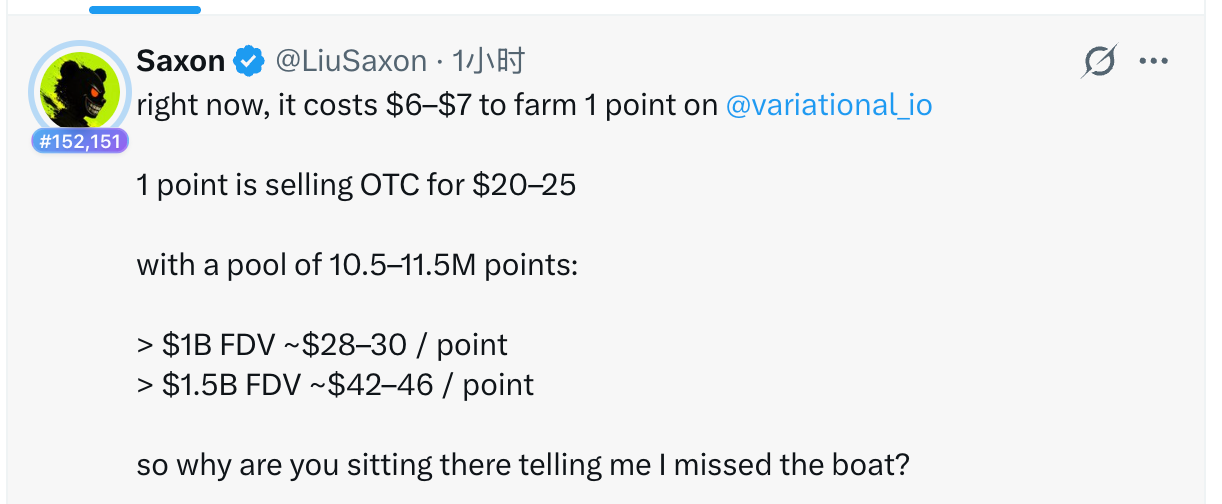
One level above is the only price tier with genuine liquidity: the over-the-counter (OTC) market.
On September 10 and 13, Points OTC facilitated two consecutive large block trades worth ~$100,000 each, with execution prices hitting exactly $20. Throughout August and September, OTC bid prices essentially oscillated within the $20–$26 range.
This indicates that capital willing to commit real funds reasonably values the Q4 airdrop option at slightly above $20.
The third layer relies on projections based on actual market expectations.
Referencing Polymarket's probability distribution for its post-listing FDV, the median valuation sits at $1.53 billion. Coupled with an expected total points supply of 10 to 11 million at TGE, the objective implied value per point falls between $45 and $60.
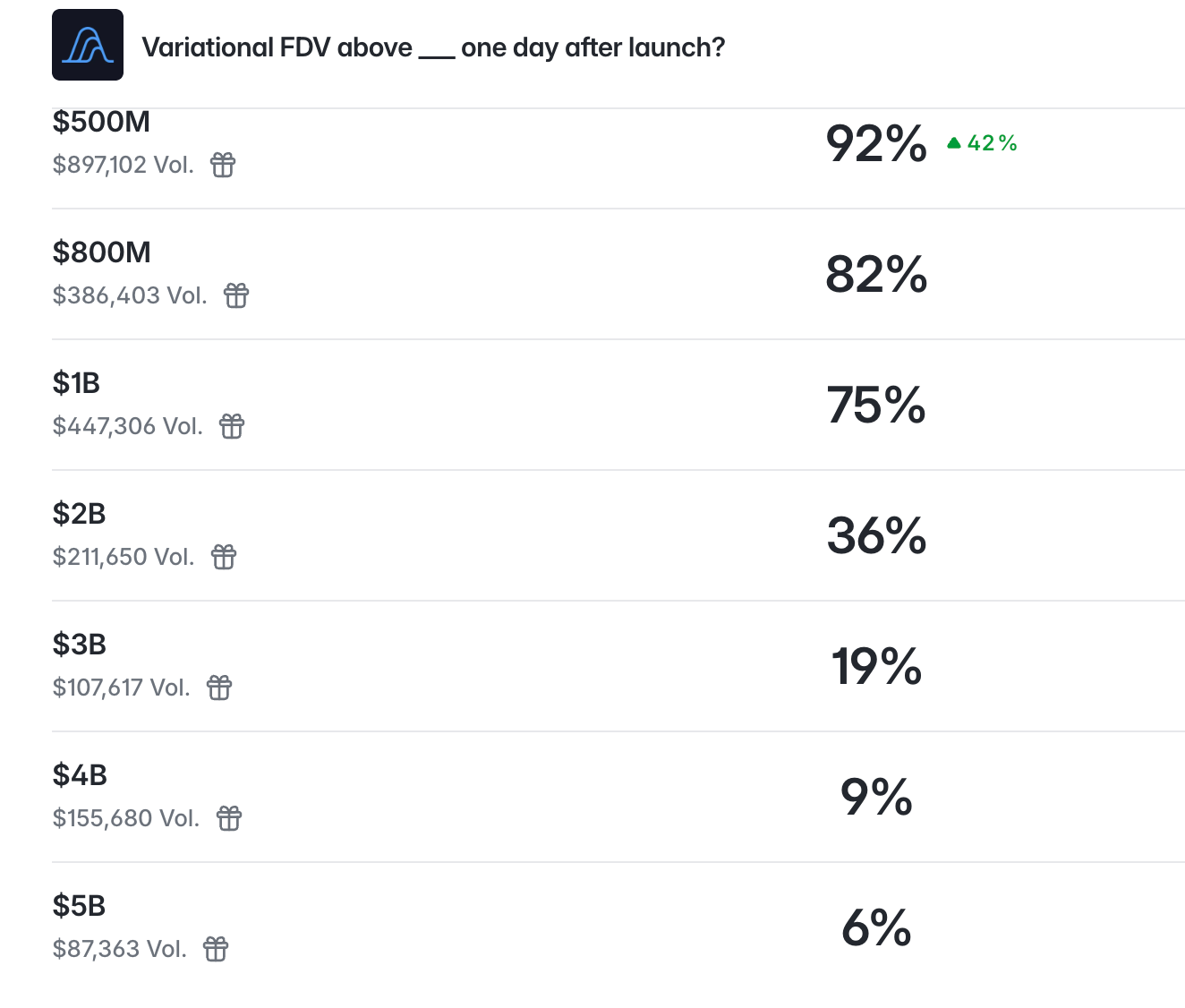
Under an optimistic scenario where FDV reaches $3 billion to $4 billion, the theoretical per-point value would indeed hit $100, which fuels the pervasive community sentiment of “making a fortune through farming.”
Framing a $100 opening price while holding points farmed at $6 or currently valued at $20 OTC would certainly yield massive returns. While the 32% airdrop ratio amplifies this speculative upside, imagination cannot directly convert into liquidity.
Differences from Hyperliquid’s “Fee-Based Buyback”
Variational’s 32% allocation clearly mirrors Hyperliquid’s 31% Genesis airdrop as a precise benchmark. However, the market seems to have misunderstood the latter’s true moat.
Hyperliquid’s ability to reshape industry valuations relies not merely on generosity at issuance, but on its transparent, cash-flow-driven buyback engine.
The vast majority of its trading fees (tracked at 97% to 99%) flow directly into the Assistance Fund for open-market purchases. The subsequently launched AQAv2 further channeled 90% of the yield generated from the platform’s billions in USDC reserves directly into buy-side pressure.
This represents genuine purchasing power on the scale of billions. When newer entrants attempt to replicate this model, they often only copy the slogans of “large airdrop ratios” and “buy-and-burn,” while deliberately overlooking the massive cash-flow foundation required to sustain the mechanism.
Without real profit generation from cash flow, a 100% buyback promise is merely marketing fluff.
Following this cash-flow logic, let’s examine Variational’s most eye-catching clause: 100% of treasury revenue will be used to buy back and burn $VAR.
Note the phrasing here specifies “treasury revenue,” not users’ “total transaction costs.”
Omni, under Variational, operates as a zero-fee platform. Its revenue comes from the bid-ask spreads earned by OLPs (Omni Liquidity Providers) acting as counterparties.
This model’s ledger differs significantly from Hyperliquid’s. DefiLlama Research sampled and broke down Variational’s financial data across four weeks in a deep-dive report:
The protocol generated $3.25 million in gross revenue during this period, but a staggering 61% ($1.98 million) was directly consumed by hedging and market-making costs. After deducting various frictions, the net profit flowing directly to the protocol treasury was only $650,000, accounting for roughly 20% of gross revenue.
This is the fold between surface-level tokenomics and actual business fundamentals.
Variational’s promised 100% buyback is essentially “20% of top-line revenue.” Before achieving absolute economies of scale, relying on compressing OLP net spreads to fund the buyback machine differs fundamentally from Hyperliquid’s approach of directly taking fee cuts and stacking massive interest-bearing reserves for buy-side momentum.
$VAR Holder Distribution and Time Dilution
Beyond protocol revenues, the $VAR holder distribution also signals harsh post-launch trading dynamics.
While retail investors secured a highly favorable full unlock of 32% at TGE, the team and investors still tightly control half of the total supply.
With insider allocations locked for 12 months, this means nearly all free-floating supply in the market during the first year post-launch will consist solely of airdropped tokens. With no buffer whatsoever, selling pressure and panic dumping in the early launch phase will be entirely absorbed by retail holders.
Meanwhile, prolonged delays are continuously diluting value. Pushing the TGE to Q4 means continued weekly inflows of 150,000 points will keep expanding the denominator. Under a constant $1.5 billion FDV assumption, inflating the total points supply from 9 million to 11 million causes pure mathematical depreciation in unit price.
The longer the delay, the less favorable the environment becomes for latecomers attempting to farm points.
Nevertheless, it’s undeniable that Variational’s 32% Genesis airdrop demonstrates a complete grasp of current market sentiment.
Through action, it declared the end of the “stingy era,” aligning with the higher token issuance bar raised by Hyperliquid. Yet beyond this threshold, 32% merely secures the right to sit at the table. What will ultimately determine whether $VAR achieves a hundredfold myth remains how much hard cash can actually be extracted from subsequent trading volume and profits.
Join TechFlow official community to stay tuned
Telegram:https://t.me/TechFlowDaily
X (Twitter):https://x.com/TechFlowPost
X (Twitter) EN:https://x.com/BlockFlow_News
 深潮TechFlow