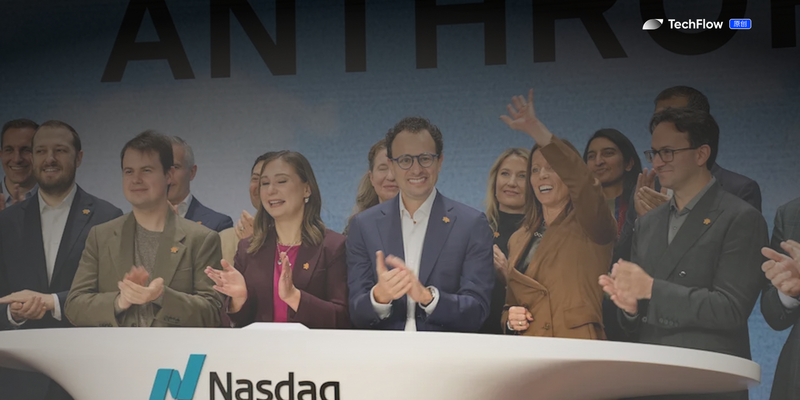
Anthropic Sprinting Towards $2 Trillion IPO? Investors Bet on October Listing, Valuation May Surpass SpaceX
Source: Jin10 Data
According to the UK "Financial Times", some Anthropic investors expect the company could go public as early as October this year, with a valuation reaching $2 trillion or even higher. This figure doubles the previous preliminary target of about $1 trillion, but Anthropic has not yet finalized the IPO valuation.
If this expectation materializes, Anthropic's valuation at listing will exceed SpaceX's IPO valuation of about $1.77 trillion, becoming the largest IPO globally. Previously, foreign media reported that Anthropic secretly submitted a U.S. IPO application in June, but the offering size and specific terms have not been disclosed.
The most direct basis for investors daring to double the valuation expectation is revenue. Anthropic's revenue in the second quarter this year was reported to be close to $11 billion, more than double the $4.8 billion in the first quarter.
When completing $65 billion in financing at the end of May, Anthropic's post-money valuation had already reached $965 billion, surpassing OpenAI. At that time, the company disclosed that May annualized revenue had already exceeded $47 billion.
Currently, investors' expectations are more aggressive: by the end of 2026, Anthropic's annualized revenue could reach $100 billion to $120 billion, growing more than 10 times compared to the beginning of this year. This means that from May to the end of the year, the company's annualized revenue still needs to increase by more than double.
The $2 Trillion Bet Is on Continued High Revenue Growth
Calculated based on $100 billion to $120 billion in annualized revenue, a $2 trillion valuation corresponds to approximately 17 to 20 times revenue multiple. To support this valuation, Anthropic cannot rely solely on an increase in Claude users; more importantly, it depends on whether enterprise customers continue to expand AI spending.
Anthropic has not disclosed the official user scale of Claude. Statista estimates that as of June this year, Claude's global monthly users were about 245 million, while OpenAI's ChatGPT users had surpassed 1 billion during the same period.
Despite the obvious gap in user numbers, Anthropic's valuation once exceeded OpenAI's this year. One important reason behind this is that Anthropic is gaining more customers in the enterprise market, and enterprise customers usually bring higher revenue per customer.
This advantage also faces increasingly direct cost competition. Reuters reported that some models launched by Chinese manufacturers are continuously approaching the capabilities of top U.S. closed-source models in tasks such as coding, while usage costs are significantly lower, causing enterprises to begin re-evaluating whether they must pay higher fees for the most cutting-edge models.
Marc Bhargava, Managing Director at General Catalyst, pointed out that many basic operational tasks do not require the most advanced models, and enterprises will ultimately return to the issue of return on investment. However, in high-difficulty tasks such as coding, he expects Anthropic and OpenAI to still maintain an advantage.
Anthropic has recently begun intensive communication with potential investors. According to "The Wall Street Journal", the company is responding to issues such as low-cost model competition, friction with the U.S. government, and data center construction costs.
Government relations have already actually affected Anthropic's business. Earlier this year, the U.S. government temporarily prohibited Anthropic from exporting two high-performance cybersecurity models due to security concerns; the restriction was lifted after lasting slightly more than two weeks.
Citing investors, the "Financial Times" stated that this restriction once dragged down Anthropic's June revenue, but after the ban was lifted, the company's revenue recovered at an "exceptionally rapid" pace. Meanwhile, Anthropic still has ongoing legal disputes with the U.S. government regarding whether its products can be officially used by U.S. government departments.
Nearly $100 Billion in Capital Inflows This Year, Compute Power Becomes Another Arena of Competition
The other side of rapid revenue growth is that Anthropic needs to continuously increase compute power investment. The company previously limited some services during peak demand periods due to insufficient capacity; infrastructure supply has begun to directly affect how much new demand Claude can accommodate.
Since the beginning of this year, capital from venture capital firms, technology companies, and institutional investors has invested nearly $100 billion into Anthropic. In addition to expanding model training and inference infrastructure, the company also plans to develop its own AI chips to alleviate long-term compute supply pressure.
In July, AMD committed to investing $5 billion in Anthropic. The cooperation between the two parties will enable Anthropic to obtain 2GW of compute power supported by AMD's latest generation of chips.
Amazon announced in April that it would further invest $25 billion in Anthropic. As part of the cooperation, Anthropic will continue to use Amazon cloud computing infrastructure on a large scale, with relevant cloud service investment exceeding $100 billion.
Anthropic was also reported to be negotiating the acquisition of Nvidia-backed AI infrastructure company Decart AI, with a potential transaction size of about $6 billion. Decart mainly develops AI infrastructure and inference optimization technology; if the transaction is completed, its team is expected to enter Anthropic's department responsible for inference and performance.
These moves mean that the competition Anthropic faces before listing is no longer limited to who can train more capable models. Inference costs, chip supply, data center capacity, and the ability to continuously obtain capital will all affect whether it can truly convert model demand into revenue.
For investors, the most important data in the coming months remains revenue. Anthropic's second-quarter revenue has increased from $4.8 billion in the first quarter to close to $11 billion, but the year-end target of $100 billion to $120 billion in annualized revenue means growth absolutely cannot slow down significantly.
If Anthropic can proceed with the IPO in October as planned, the formally disclosed prospectus will for the first time allow public market investors to see the actual revenue growth rate, enterprise customer structure, infrastructure expenditure, and capital consumption of this AI company founded about five years ago.
At that time, the market will also be able to judge more directly: whether the $2 trillion is built on growth rates that can be realized, or whether investors have paid extremely high revenue multiples in advance for AI demand over the next few years.