
Tether's Bitcoin Treasury Company CEO Resigns, Walks Away with $1.6 Million in Cash
TechFlow Selected TechFlow Selected
Tether's Bitcoin Treasury Company CEO Resigns, Walks Away with $1.6 Million in Cash
During Jack Mallers' tenure at Twenty One, multiple business goals were all missed, but he received a total compensation of over $2.2 million.
 Navigating Web3 tides with focused insights
Written by: Protos
Compiled by: Chopper, Foresight News
Jack Mallers claimed he voluntarily resigned as CEO of Twenty One and received no severance pay. However, data shows he received a lump sum of approximately $1.6 million in cash upon departure, with total compensation exceeding $2.2 million. He also claimed to have voluntarily forfeited stock options.
Hours after resigning as CEO of the Tether-controlled public company primarily engaged in Bitcoin reserve assets, Mallers issued a public statement emphasizing that his departure was voluntary. He repeatedly mentioned receiving no severance and forfeiting options, attempting to summarize the entire incident this way.
However, he deliberately avoided a key piece of information in his social media posts: a lucrative departure agreement worth seven figures, and cashing out millions personally while ordinary shareholders' assets shrunk significantly.
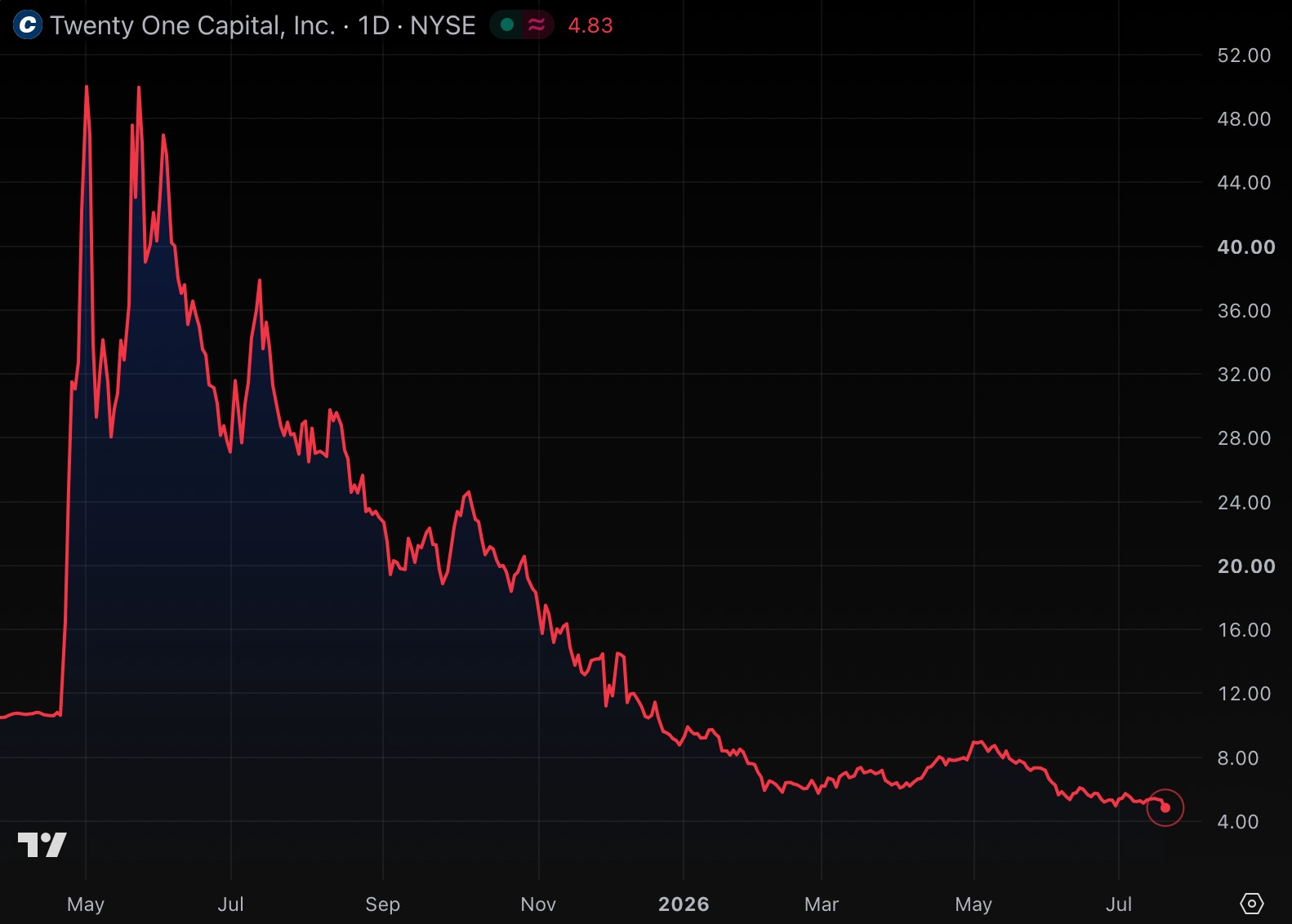
The following will outline how multiple business goals during Mallers' tenure at Twenty One failed completely. First, we need to clarify the details of his high compensation, which is the part he deliberately omitted in his social media posts.
Jack Mallers Received Over $2.2 Million in Total Compensation from Twenty One
According to the departure agreement, Twenty One paid Mallers a final salary installment of $50,000, which is obviously "too little" to qualify as severance pay.
The company additionally paid $420,455 to settle his vested restricted shares; meanwhile, it spent $1,151,046 in cash to repurchase 226,860 of his shares at a price of $5.23 per share.
For Mallers, this cash sum exceeding $1.6 million was enough to make him "voluntarily" resign, yet he claimed he received no severance pay and forfeited options.
The company also paid him stock proceeds higher than the current market price, while these stocks are currently trading at less than $5.
The term "severance pay" does not appear anywhere in the agreement text, which is the basis for Mallers' claim externally that he received no compensation.
Although he did not mention receiving this seven-figure cash gain on his social media account, he did forfeit certain rights:
The company cancelled his unvested options and restricted stock; however, he retained 1,522,407 vested options with an exercise price of $14.43. With the current Twenty One stock price below $5, these options are out-of-the-money.
This is the part he described as "worthless." In fact, long before he claimed to "forfeit" them, these options had already lost their exercise value.
Profit Goals Completely Missed
Twenty One went public via SPAC merger in 2025, with the transaction target being Cantor Equity Partners, a blank-check company under Cantor Fitzgerald associated with the sons of U.S. Secretary of Commerce Howard Lutnick.
Tether and Bitfinex provided Bitcoin assets and hold voting control; Jack Mallers served as the public-facing brand ambassador.
By virtue of his public influence and so-called "leadership," he received generous compensation.
In 2025, his total compensation exceeded $667,898, and he was granted 12 million options. As the stock price fell below the $14.43 exercise price, the vast majority of options ultimately became worthless.
Even so, in 2025 he still recorded $667,898 in income, including a $236,250 bonus and $431,648 in consulting fees, with funds distributed through entities under Twenty One. The company even spent $165,000 to cover legal fees for his personal employment contract negotiations.
Mallers planned multiple business lines for Twenty One, but almost all were declared failures or never officially launched.
In numerous interviews in 2025, many of the business blueprints he outlined remained at the conceptual stage.
When asked about substantive achievements at Twenty One, he could only list fundraising, completing the IPO, and obtaining a high valuation, without mentioning any profit-generating business throughout.
Goal to Benchmark Against Coinbase Came to Nothing
At the Bitcoin conference in April 2026, Mallers outlined a blueprint externally: Twenty One would build stable cash flow and achieve profitable operations.
He set a goal for Twenty One to match Coinbase in revenue scale, user volume, and operating profit. He repeatedly refused to simply define the company as a reserve enterprise passively holding Bitcoin.
But reality proved that Mallers' expectations were seriously detached from actuality. Twenty One failed to generate expected cash flow and did not launch profitable business. Ultimately, the company still became what he vehemently denied: a public company with almost no net earnings, simply holding Bitcoin assets.
Protos previously reported that Mallers quietly stopped disclosing the "Bitcoin per share" metric externally, which was originally the core standard he required shareholders to use to judge his performance. The reason is simple: the Bitcoin holdings per share did not achieve growth.
Return to Strike, Three-Party Merger Plan Collapsed
Originally, the company planned to link three parties to create revenue: Twenty One, Mallers' payment enterprise Strike, and Bitcoin mining company Elektron.
On July 21, it was officially confirmed that Strike would remain independently operated and would no longer proceed with the merger plan with Twenty One.
The M&A plan originally hoped to create operating income collapsed before terms were formally finalized.
The termination of the M&A means Mallers did not sell his held equity in Strike to Twenty One. No matter how high the book valuation of this private enterprise, he failed to cash out gains from it.
The board transferred company management control to Tether faction executive Raphael Zagury. Zagury operates Elektron and has served as a Twenty One director since last December.
The company simultaneously adjusted to a new strategy, focusing on "cash flow creation," implicitly admitting that during Mallers' tenure, significant cash flow was never formed.
Regulatory disclosure document 8-K shows Mallers' departure was "without any disagreement with the company."
He once promised to lead Twenty One to achieve user scale and operating profit comparable to Coinbase, but left ingloriously after about one year in office: all goals missed, personal total compensation received exceeded $2.2 million, and the previous business narrative completely collapsed.
As of press time, Twenty One's stock price has retraced 84% from its high, and plummeted 91% from its 2025 peak.
More noteworthy is that on the day Mallers joined, the stock price high was $17.83; now the stock price has fallen by two-thirds compared to that point.
Join TechFlow official community to stay tuned
Telegram:https://t.me/TechFlowDaily
X (Twitter):https://x.com/TechFlowPost
X (Twitter) EN:https://x.com/BlockFlow_News
 @Protos