








Meta Joins the Prediction Market Bandwagon—Can It Avoid the Metaverse’s Pitfalls?
TechFlow Selected TechFlow Selected
Meta Joins the Prediction Market Bandwagon—Can It Avoid the Metaverse’s Pitfalls?
Holding 3.5 billion units of traffic, yet trust crises and regulatory oversight remain the biggest obstacles.
 Navigating Web3 tides with focused insights
By: Gino Matos
Translated by: Luffy, Foresight News
TL;DR
- According to The New York Times, Meta has assembled a small internal team to develop Arena—a points-based prediction application with an internal codename—allowing users to place predictions on political outcomes, sports results, and global current events.
- Prediction markets have already demonstrated genuine demand. With 3.56 billion daily active users, Meta is uniquely positioned to bring this niche sector to the mainstream.
- However, Meta’s trust deficit—compounded by election-related scrutiny and misinformation oversight—may render Arena a regulatory target before it achieves scale.
On June 23, The New York Times reported that Mark Zuckerberg spearheaded the formation of a dedicated team to develop Arena, a prediction market application. Users will place predictions on political elections, sporting events, and international developments using platform-issued points.
This company—renamed from Facebook to Meta in 2021 amid its metaverse pivot, and whose Reality Labs division has accumulated nearly $90 billion in losses—has now shifted focus to prediction markets. While this sector exhibits robust real-world demand and an established user base, its regulatory landscape remains highly complex. This strategic pivot could represent Meta’s most astute move yet—or another costly misstep echoing its past multibillion-dollar failures.
The Metaverse’s Massive Bill
In October 2021, Facebook officially rebranded as Meta. In his announcement, Zuckerberg declared the company’s core mission to be “building the metaverse,” forecasting that it would reach one billion users within a decade.
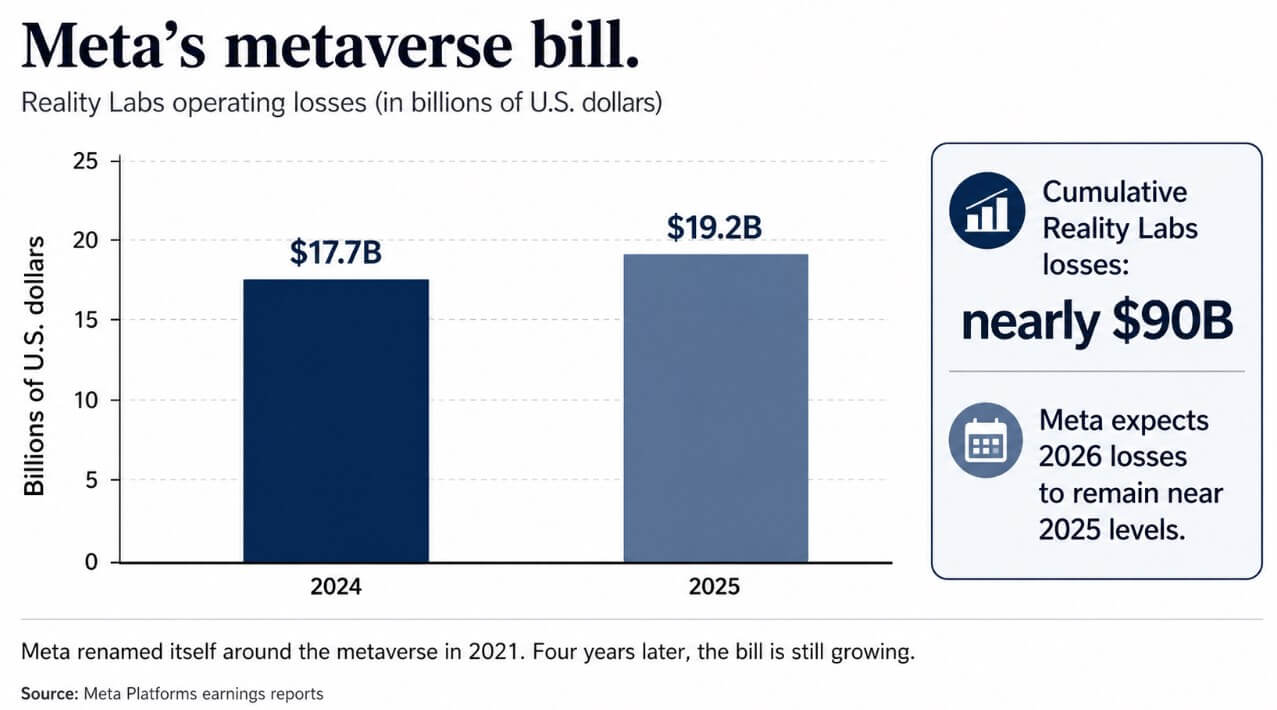
Reality Labs—the division entrusted with realizing that vision—has seen its operating losses mount steadily: $17.7 billion in 2024, $19.2 billion in 2025, bringing cumulative losses close to $90 billion. Meta has informed investors that losses in this segment may remain flat in 2026 relative to 2025.
Its flagship social VR platform, Horizon Worlds, saw monthly active users fall below 200,000 in 2022—far short of its original 500,000 target. Meta subsequently lowered expectations further and plans to gradually wind down the VR version’s operations by 2026.
Why Prediction Markets Are a Fundamentally Different Arena
In 2026, Kalshi and Polymarket—the two leading platforms—generated a combined monthly trading volume of approximately $24 billion. Industry analysts project that the sector’s total annual trading volume will exceed $130 billion.
Robinhood launched a dedicated prediction market section in 2025; Interactive Brokers integrated event contracts into its trading platform; even the Golden Globe Awards introduced interactive prediction market features. A Bernstein research report published in April forecasts that the sector’s annual trading volume could reach $1 trillion by 2030.
Meta has long excelled at replicating popular products and leveraging its massive traffic to achieve rapid dominance: after Snapchat launched Stories, Instagram followed suit; after Twitter dominated social text-and-image feeds for a decade, Meta launched Threads; after TikTok surged in short-form video, Meta rolled out Reels. As of April, Meta’s entire product suite boasted 3.56 billion daily active users—its traffic scale dwarfs all existing prediction market platforms combined.
Arena adopts a points-based model, continuing Meta’s longstanding strategy: identify users’ preexisting behavioral needs, embed them into Meta’s traffic ecosystem, and rely on massive distribution to offset limited product originality.
Building a prediction market requires only software, news feeds, account systems, content moderation, and compliance infrastructure—some use cases can even integrate licensed third-party partners. By contrast, the metaverse demands custom hardware, immersive content, avatars, dedicated runtime environments, and years of effort to cultivate user habits. Reality Labs’ staggering losses underscore how prohibitively expensive it is to invent an entirely new category from scratch.
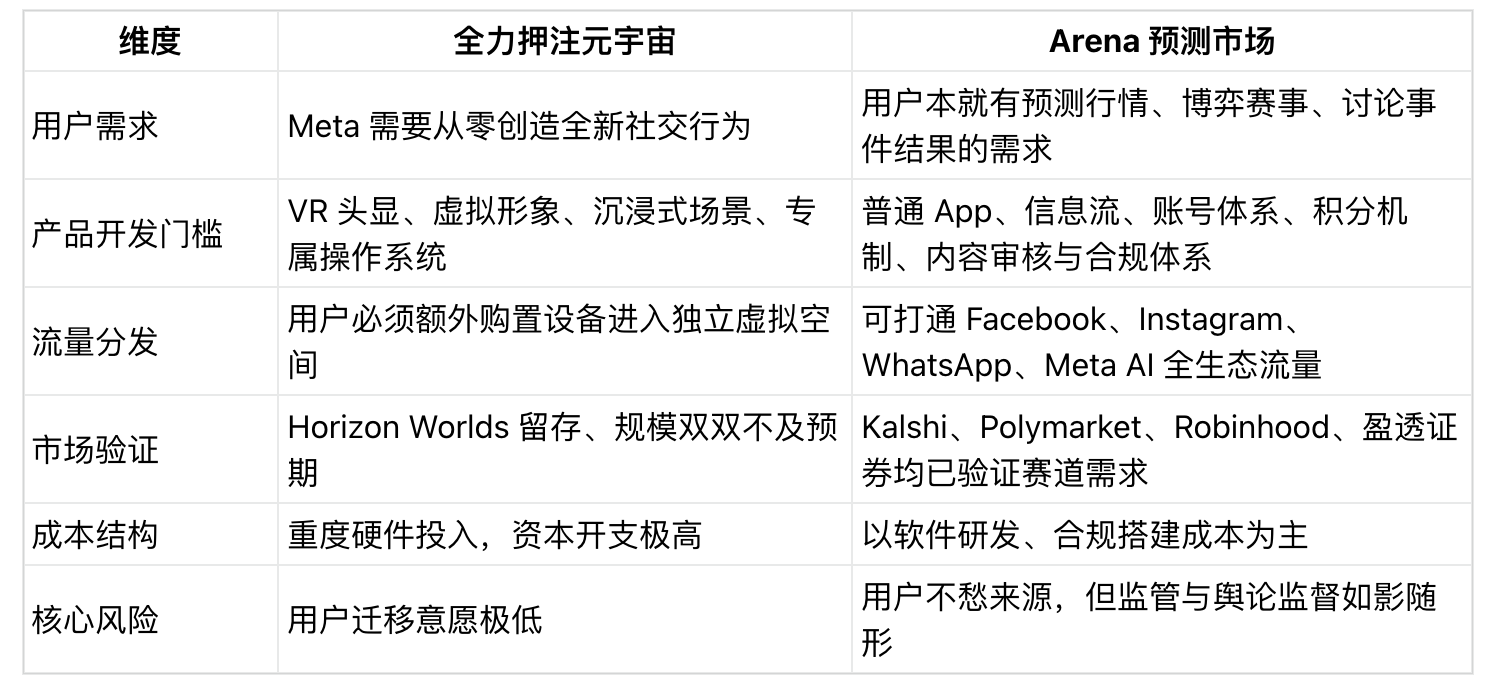
Core Dimension Comparison: Metaverse vs. Prediction Market Arena
Arena Is Not Meta’s First Foray Into Prediction Markets—Its Predecessor Was Shut Down
As early as the pandemic’s onset in 2020, Meta launched Forecast—a points-based mass prediction app focused on forecasting current events—but shut it down in 2022. At that time, Polymarket had not yet surged in popularity ahead of the 2024 U.S. presidential election, and Kalshi had not yet prevailed in its federal lawsuit against the Commodity Futures Trading Commission (CFTC) over election-related contracts. The sector’s annual trading volume had yet to surpass $50 billion.
The sector Meta is poised to enter is rife with regulatory enforcement actions:
- In 2022, the CFTC found Polymarket guilty of conducting unregistered over-the-counter event derivatives trading and imposed a $1.4 million fine;
- Kalshi spent years litigating in federal court to secure authorization to offer election-related contracts. In September 2024, a district court issued a favorable ruling; in May 2025, the CFTC dropped its appeal, opening up regulatory space for election-event contracts—though debates over political trading and market fairness persist;
- In April 2026, the CFTC filed its first-ever insider trading lawsuit targeting a prediction market, accusing an active-duty U.S. military officer of profiting on Polymarket by trading on classified intelligence regarding U.S. operations in Venezuela.
Meta’s prior financial product initiatives have already placed regulators on high alert regarding its financial ambitions. Facebook’s Diem (formerly Libra) digital stablecoin project was ultimately sold at a steep discount to Silvergate Bank in 2022, after regulators concluded that Meta’s control over a payments network serving billions of users would concentrate excessive financial and societal power. During the Libra congressional hearings, Meta’s combination of social identity infrastructure, political content curation, financial incentives, and market data access drew fierce regulatory opposition.
Precisely because points-based prediction games avoid stringent initial financial regulation, Meta has opted for this model as Arena’s entry point.
What Massive Traffic Can Deliver
Arena’s most viable initial form is a mass-prediction feature built atop Meta’s social scale: Instagram creators launching award-ceremony prediction markets; Facebook groups debating sports odds; WhatsApp communities sharing collective forecasts; Meta AI aggregating dominant public expectations across the network.
This version deliberately avoids cash-based event contracts—the very instruments that previously triggered regulatory penalties—and instead operates solely on Meta’s 3.56 billion daily active users and their social graph.
Yet the core logic of prediction markets relies on real-money stakes to constrain prediction behavior and generate fair market prices. Once replaced with points-based engagement incentives, the product prioritizes virality and user time-on-platform—not prediction accuracy.
Meta’s poor historical record in handling political content and combating misinformation means regulators and media will inevitably scrutinize every controversy Arena sparks.
Meta’s traffic advantage alone is sufficient to scale the sector. The success formula behind Stories and Reels is identical: identify users’ preexisting preferences and amplify them via a billion-user platform. If Arena delivers lightweight social prediction features while keeping financial barriers low—enabling ordinary Facebook users to easily engage with prediction markets—while platforms like Kalshi retain their professional trading positioning, Meta could expand the overall market size, benefiting existing industry leaders.
Crypto-native users with financial literacy have sustained a multi-billion-dollar prediction market sector. Meta’s 3.56 billion daily active users, however, represent a vast population of mainstream users the industry has never reached—this is the greatest opportunity in Meta’s entry.
Yet just two months before Meta’s Arena announcement, the CFTC initiated its first-ever insider trading lawsuit targeting a prediction market—an unmistakable signal of tightening regulatory scrutiny. Meta’s platforms cover election-related, sports, and public-figure prediction markets, making them highly susceptible to regulatory intervention. Combined with Meta’s negative track record managing sensitive political content, its entry carries an inherent credibility deficit—where its massive traffic could ironically magnify any controversy.
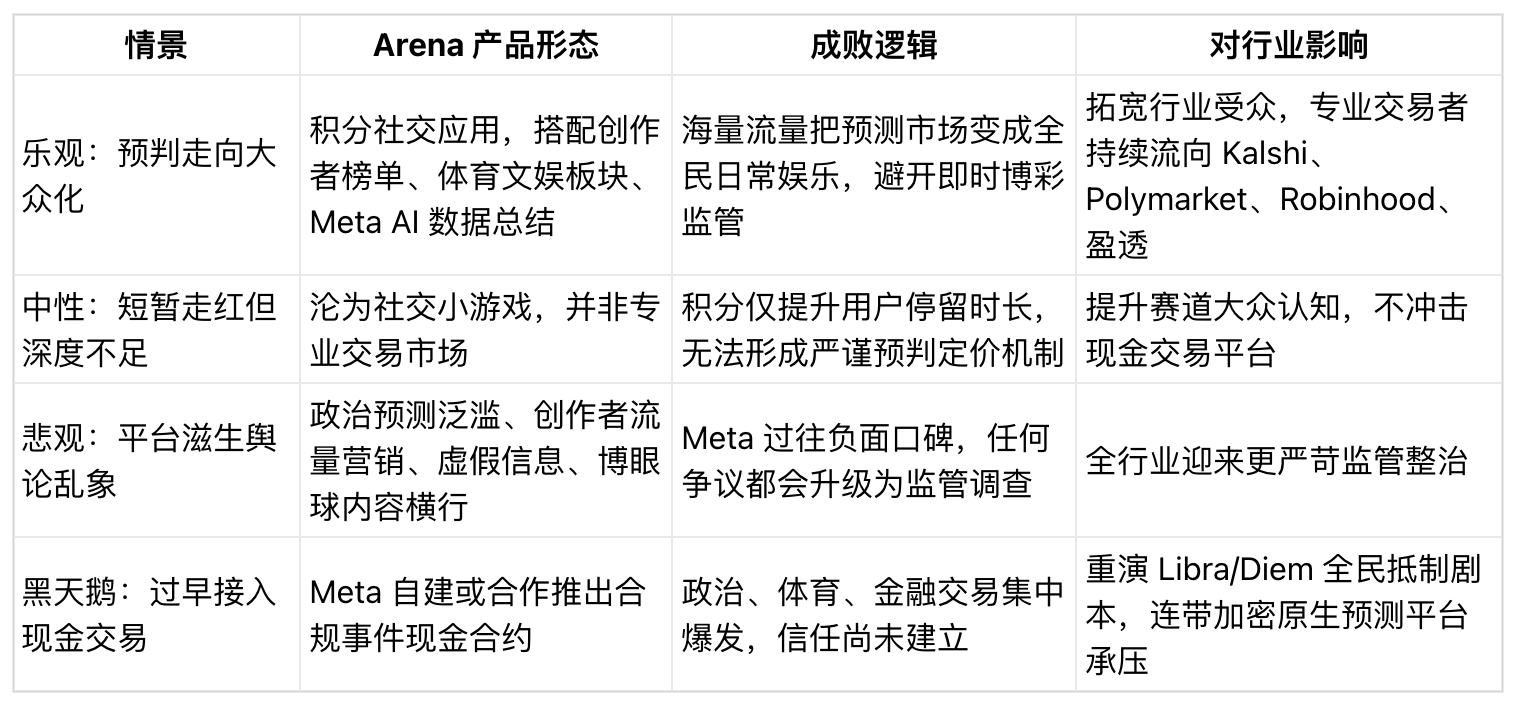
Four Potential Development Scenarios for Arena
Several of Meta’s prior financial products failed outright due to regulators’ determination that underlying trust issues were unsolvable.
Arena does possess inherent advantages: the prediction market sector is already mature, and a real, established user base exists. Yet Meta—the platform operator—carries the same negative reputation that doomed Libra. Once election-related or monetary transactions are involved, trust becomes a core asset Meta must earn through sustained, long-term effort; raw traffic scale cannot compensate for a credibility deficit.
Join TechFlow official community to stay tuned
Telegram:https://t.me/TechFlowDaily
X (Twitter):https://x.com/TechFlowPost
X (Twitter) EN:https://x.com/BlockFlow_News
 @CryptoSlate


