A Brief Analysis of the Ammo Whitepaper: From Vector Primitives to a Multimodal Agent Ecosystem
TechFlow Selected TechFlow Selected
A Brief Analysis of the Ammo Whitepaper: From Vector Primitives to a Multimodal Agent Ecosystem
The market is waiting for the emergence of an innovative "singularity."
 Navigating Web3 tides with focused insights
Spent some time carefully going through Ammo's newly released whitepaper—had quite a few reflections. Below are several insights I'd like to share:
1) The market’s pursuit of AI Agents fundamentally stems from dissatisfaction with AI merely functioning as a Copilot-style query tool, where it only responds to user prompts. Instead, people desire a Buddy-model companion that grows alongside them—one capable of understanding, thinking, proactively creating value, and pushing meaningful outputs to users. This shift is precisely what elevates AI Agents into a compelling narrative;
2) Traditional Web2 AI monolithic models started with a focus on "utilitarian instrumentalism," but often create data silos in multimodal collaboration, making true intelligent breakthroughs difficult. While Web3 has proposed the ideology of individual autonomy for AI Agents, we’re still far from realizing this vision—AI autonomous decision-making is far more complex than imagined. A “symbiotic model,” where AI assists in automated learning and path recommendations while humans enhance AI’s autonomous learning through feedback, will truly become the dominant direction for future AI Agents;
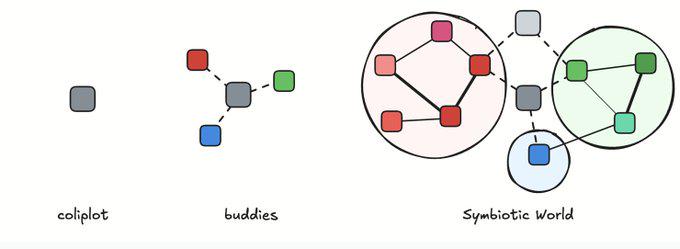
3) AMMO defines an abstract space called MetaSpace, where all data surrounding AI Agents can be dynamically orchestrated in the form of vectors—similar to how blockchain initially defined Hash, enabling all subsequent on-chain protocols and application forms. This vector-first paradigm can not only serve Web3, but also function as a framework standard applicable to Web2 multimodal systems. Combined with its upper-layer MAS (Multimodal Agent System), it can shift today’s academic-oriented “think tank” approach to AI toward practical, real-world applications in work, gaming, education, and beyond;
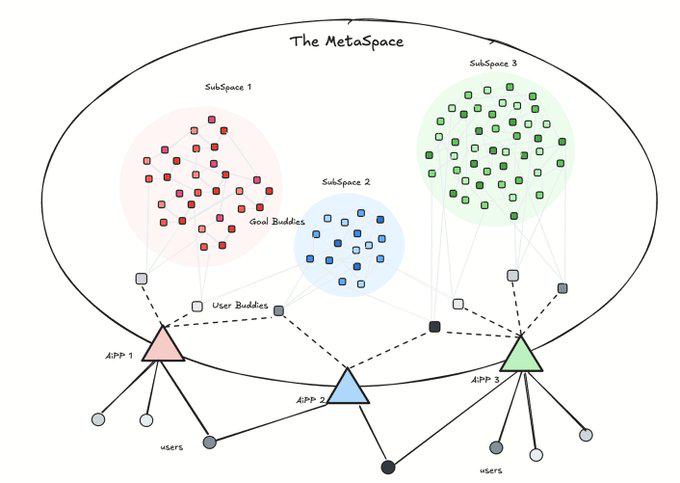
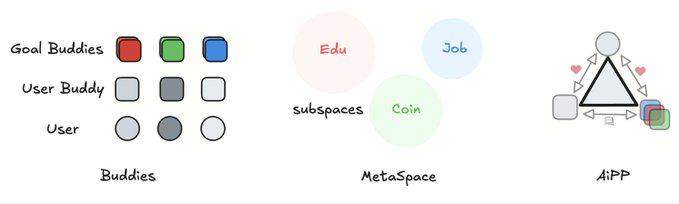
4) How can we understand this intuitively? Think of MetaSpace as a large shopping mall, where each functional floor represents a SubSpace, and each zone contains different knowledge bases. The Buddies system acts as an intelligent concierge: Goal Buddies function like expert sales associates, curating high-quality recommendations; User Buddies resemble personal assistants who provide customized solutions based on your spending habits and budget; AiPP works like a front desk service counter, collecting feedback to continuously improve service quality;
Overall, by integrating essential components such as MetaSpace, Buddies, and the AiPP human-AI feedback loop, AI Agents can operate effectively—accelerating their mass production and practical deployment;
5) The whitepaper primarily presents an off-chain multimodal collaboration framework and engineering implementation思路 (approach). Certain standardized definitions that integrate with blockchain—such as ID identity systems, Memory systems, Character trait systems, Context management, and Oracle systems—still require further exploration and refinement (the so-called “chainification” general standard framework I’ve often mentioned);
That’s all.
Frankly, this is one of the most coherent, pragmatic projects I've seen recently in terms of macro architecture, application deployment, and engineering design. Yet, after reading the above, many might still feel somewhat abstracted and confused. Indeed, the path to widespread adoption and application of AI Agents is longer than expected. However, an increasing number of outstanding teams are entering the space, innovative solutions are brewing, and the market is now waiting for the emergence of an innovation "singularity."
Join TechFlow official community to stay tuned
Telegram:https://t.me/TechFlowDaily
X (Twitter):https://x.com/TechFlowPost
X (Twitter) EN:https://x.com/BlockFlow_News
 Haotian | CryptoInsight