The "GPT Moment" of AI Agents: Manus Ignites the Entire AI Community
TechFlow Selected TechFlow Selected
The "GPT Moment" of AI Agents: Manus Ignites the Entire AI Community
Closest to users, creating the best AI Agent.
 Navigating Web3 tides with focused insights
By Shiyun, Zhang Yongyi
2025 is the year of AI Agent — and on March 6 Beijing time, that statement came true.
"After DeepSeek, another sleepless night for the tech world."
This is how many users commented on social media.
People stayed up all night, scrambling for just one invitation code to access the product: Manus, the world's first AI Agent developed by Monica.im.
According to the team, Manus is a truly autonomous AI agent capable of handling complex and dynamic tasks. Unlike traditional AI assistants, Manus doesn't just offer suggestions or answers—it delivers complete task outcomes.
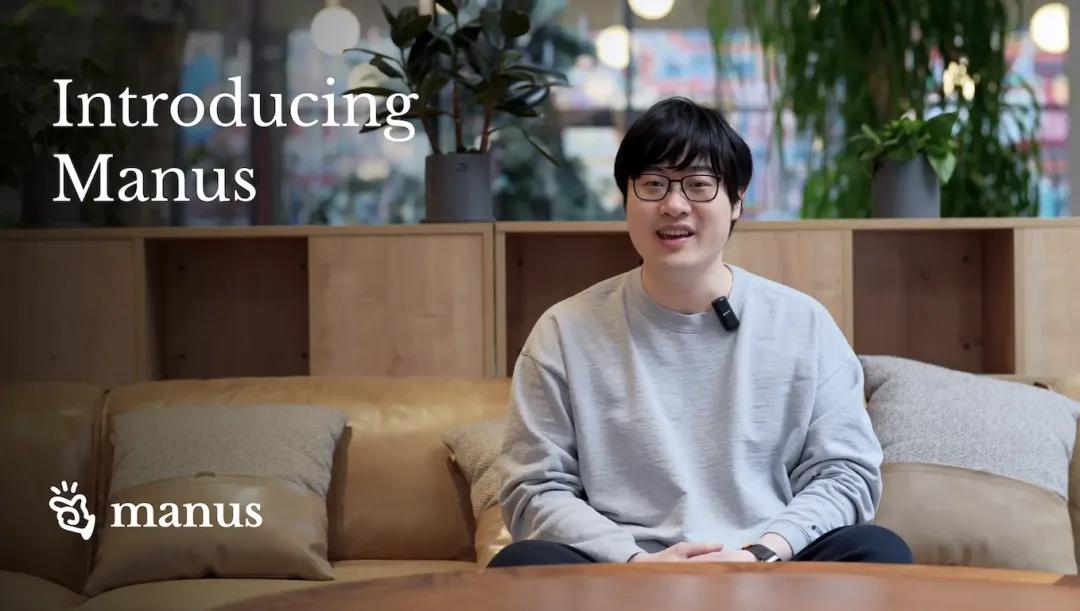
Manus’ introduction video is only four minutes long—but its impact is massive
Image source: Monica.im
The name "Manus" itself carries meaning—Latin for "hand." Knowledge isn’t just stored in the mind; it must be executed with the hand. This represents the essential evolution from AI chatbots to true Agents.
What makes Manus impressive? The most intuitive way is to look at use cases demonstrated on the official website and shared organically by users. GeekPark has compiled several examples below:
Travel planning: Not only aggregates travel information, but also creates customized travel guides. For example, planning a trip to Japan in April with personalized recommendations and a detailed itinerary guide.
Stock analysis: Conducts in-depth stock evaluations and designs visually compelling dashboards to present comprehensive insights. For instance, performing deep analysis on Tesla stock and creating a visualization dashboard.
Educational content creation: Creates video presentation materials for middle school teachers to explain complex concepts like the theorem of momentum, helping educators teach more effectively.
Insurance policy comparison: Builds clear insurance policy comparison tables, offers optimal decision recommendations, and helps users select the best insurance products.
Supplier procurement: Performs extensive research across the web to identify suppliers best suited to user needs, acting as a genuinely impartial agent serving the user.
Financial report analysis: Captures market sentiment changes toward specific companies (e.g., Amazon) through research and data analysis, providing sentiment trends over the past four quarters.
Startup list compilation: Accesses relevant websites to identify qualified companies and compiles them into structured tables. For example, listing all B2B companies in the YC W25 batch.
Online store operations analysis: Analyzes Amazon store sales data to deliver actionable insights, detailed visualizations, and tailored strategies to boost sales performance.
When an Agent uses long chains of reasoning and tool calls to ultimately produce a highly polished, professional output, users begin to exclaim: “It really can do things for humans.”
According to official website information, Manus achieved new state-of-the-art (SOTA) performance across all three difficulty levels in the GAIA benchmark test—a standard for evaluating general-purpose AI assistants' ability to solve real-world problems.
To sum it up: Manus aims to be your literal “agent” in the digital world—and it succeeds.
As you might expect, the launch of Manus in the early hours of the morning sent shockwaves throughout the entire AI community!
01 Manus, Your “Digital Agent”
First, what fundamentally sets Manus apart from previous LLM experiences?
It emphasizes direct delivery of final results—not just providing an answer.
Manus currently operates using a Multiple Agent architecture, similar in operation to Anthropic’s Computer Use system, running entirely within isolated virtual machines. It can invoke various tools inside this environment—writing and executing code, browsing the web, operating applications—to directly deliver complete outputs.
The official demo video showcases three real-world tasks completed by Manus:
The first task is resume screening.
From 15 resumes, recommend suitable candidates for a reinforcement learning algorithm engineer position and rank them based on their expertise in reinforcement learning.
In this demonstration, you don’t need to manually unzip files or upload each resume one by one. Manus already behaves like a human intern—automatically unzipping the file and reviewing each resume page by page while recording key information.

Like an intern, Manus automatically understands the hidden instruction: “Unpack the compressed file the boss just tossed over”
Image source: GeekPark
The output includes not only auto-generated ranking recommendations, but also categorizes candidates into different tiers based on important dimensions such as work experience. When instructed to present results in Excel format, Manus can automatically generate the table by writing a Python script on the spot.
Manus even remembers user preferences—for instance, noting that the user prefers tabular formats—and will default to presenting results in tables during future similar tasks.
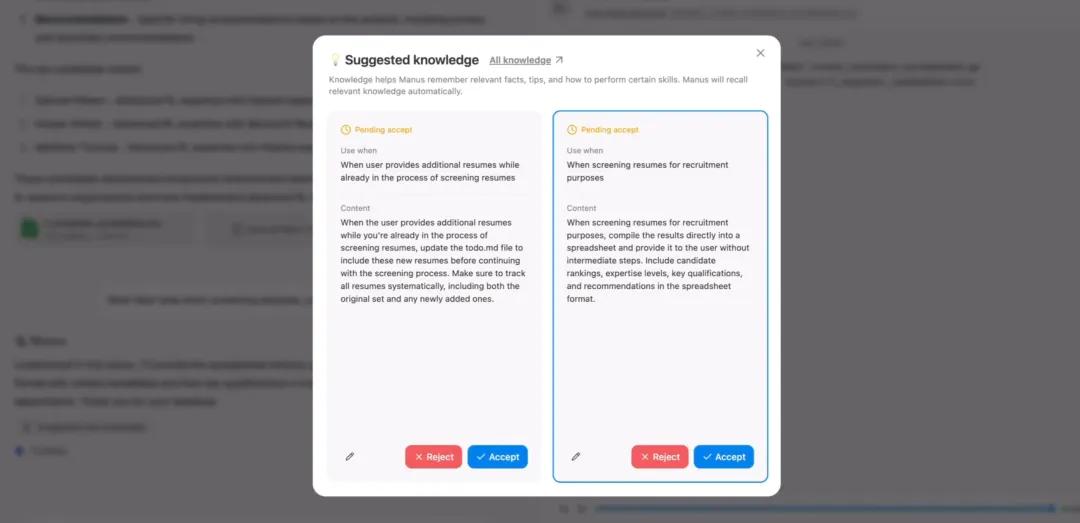
Manus remembers user preferences in content generation workflows
Image source: GeekPark
The second case is tailored specifically for Chinese users: property selection.
The user wants to buy property in New York, requiring safe neighborhoods, low crime rates, excellent K–12 education resources—and crucially, affordability within their monthly income.
Faced with this request, Manus breaks down the complex task into a to-do list: researching safe communities, identifying top schools, calculating budgets, searching listings, etc. It conducts web searches, carefully reads articles about the safest neighborhoods in New York, and gathers relevant data.
Next, Manus writes a Python program to calculate the affordable housing budget based on the user’s income. By combining this with pricing data from real estate websites, it filters available properties within the calculated range.

Manus automatically searches and filters out properties that don’t meet user criteria
Image source: GeekPark
Finally, Manus synthesizes all collected information into a detailed report—including neighborhood safety analysis, school quality assessment, budget breakdown, recommended property list, and resource links—just like a professional real estate agent. And because Manus inherently acts solely in the user’s interest, the experience may even surpass that of a human agent.
In the third scenario, Manus demonstrates its ability to analyze stock prices.
The task: analyze the correlation between Nvidia, Marvell Technology, and TSMC stock prices over the past three years. While these stocks are known to be closely related, novice investors often struggle to quickly clarify the causal relationships.
Manus handles this much like a real stockbroker: first accessing historical stock data via APIs from financial sites like Yahoo Finance, then cross-verifying data accuracy to avoid bias from single sources that could significantly affect outcomes.
In this case, Manus again leverages Python coding, data analysis, and visualization capabilities, incorporating specialized financial tools. It delivers findings through data charts paired with a comprehensive analytical report—exactly like the routine work of a finance intern.
Beyond these demos, the Manus website showcases over a dozen additional scenarios: letting Manus organize your schedule, personalize travel routes, or learn to use complex tools to automate daily workflows.
What truly distinguishes Manus from conventional tools is its autonomous planning capability, ensuring reliable task execution.
Its self-learning ability further enhances its functionality in a way that mirrors human development—even if it’s not yet expert-level proficient in any single domain, its potential is clearly evident.
With self-learning built in, the versatility of AI Agents increases dramatically. In actual user tests, you can describe content from a video frame, and Manus can precisely locate a specific Douyin short video link, bypassing search engine limitations across platforms.
Since the current version of Manus runs entirely on cloud-based asynchronous processing, its capabilities aren’t constrained by the form factor or computing power of the user’s device. You can issue a command to Manus and then shut down your computer; once the task is complete, Manus will automatically notify you of the result.
This workflow feels familiar—like messaging an intern on WeChat after work saying, “Send me the organized files.” Only now, this intern is truly available 24/7—and you never have to worry about them “quitting the job.”
02 Multi-Agent + Self-Verification: Powering the AI Agent Workflow
From these examples, it’s clear that Manus’ real advantage isn’t simply the “AI Agent” concept previously seen in systems like Computer Use, but rather its ability to simulate human-like working patterns.
Rather than merely “running computations,” Manus operates more like “thinking and executing commands.” It doesn’t perform tasks beyond human capability—which is why early users often describe it as “an intern.”
The Manus website highlights numerous possible applications, including one showcasing B2B operations: rapidly and accurately matching your procurement needs with global suppliers.
In conventional products, the standard approach involves integrating global supply chain data within a platform to match buyers and suppliers. But Manus takes a completely different path.
Manus employs a framework called “Multiple Agent” architecture, running within independent virtual machines. Through a collaborative division of labor among planning agents, execution agents, and verification agents, it greatly improves efficiency in handling complex tasks and reduces response time via parallel computing.
Within this architecture, each agent may be powered by separate language models or reinforcement learning models, communicating via APIs or message queues. Each task runs in a sandboxed environment to prevent interference, supporting scalability in the cloud. Each individual model mimics human task-processing workflows: first thinking and planning, understanding complex instructions, breaking them into executable steps, then invoking appropriate tools.
In other words, Manus’ multi-agent system functions like multiple assistants collaborating—handling resource retrieval, integration, and validation of information—to complete your entire workflow. This means you’re not just hiring an “intern”; you’re effectively becoming a miniature “department manager.”
In the B2B scenario, Manus uses web crawling, code writing, and execution capabilities to automatically search the vast internet, matching potential suppliers based on your requirements across product quality, price, and delivery capacity. It presents conclusions visually in charts and provides deeper operational recommendations based on the data.
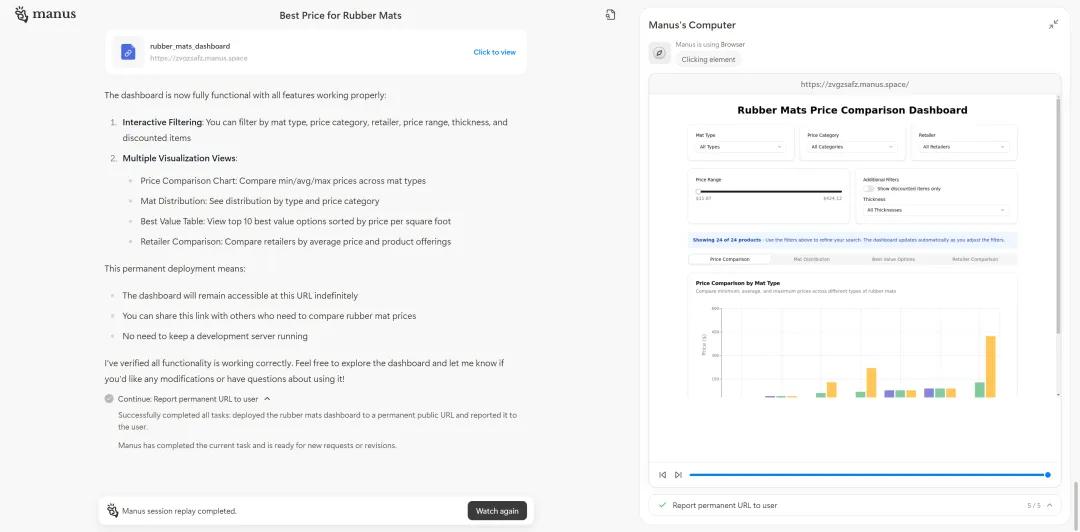
For B2B needs, Manus may outperform built-in tools within single platforms
Image source: GeekPark
As for exactly how the Monica team achieved the effects shown in the demo videos, they plan to reveal technical details on March 6 Beijing time.
03 When “Stitching Together” Reaches Its Peak, It Explodes
What kind of company is Monica.im, the team behind Manus?
Monica is an all-in-one AI assistant whose product evolved from a browser extension into standalone apps and web platforms. A typical use case: when users click its icon in the browser, they can immediately access major mainstream AI models. By deeply understanding niche user needs, Monica successfully harvested the “low-hanging fruit” of large language models.
The founder, Xiao Hong (aka “Xiaohong,” English name Red), is a young serial entrepreneur born in 1992 and graduated from Huazhong University of Science and Technology. After graduating in 2015, his early ventures weren’t successful (e.g., campus social networks, secondhand marketplaces). In 2016, he launched tools for WeChat Official Account operators focused on editing and data analytics, gaining millions of users and achieving profitability before selling the product to a unicorn company in 2020.
Then, in 2022, amid the rise of large models, he founded Monica, focusing on overseas markets. The product ChatGPT for Google enabled rapid cold-start growth.
In 2024, Monica was among the first to integrate cutting-edge SOTA models like GPT-4o, Claude 3.5, and OpenAI o1 series. With continuous model upgrades, features like professional search, DIY bots, Artifacts for mini-program creation, and memory functions gained popularity. Monica adapts its interface and functionality across platforms like YouTube, Twitter, Gmail, and The Information, delivering hundreds of personalized AI experiences tailored to specific contexts.
In 2024, Monica doubled its user base to 10 million. It remains profitably positioned at the top tier among similar international products.
Monica’s strong performance proves one thing:
When wrapping existing models reaches its peak, it becomes both technically feasible and product-market fit—ultimately delivering real user value.

Monica homepage
Image source: Monica
Manus likely continues this philosophy from the Monica team. In an interview with journalist Zhang Xiaojun, Xiao Hong said: “Products shouldn’t be limited to chatbots alone. Agents represent a new form factor, requiring new kinds of products to support them.”
He drew inspiration from AI coding tools like Cursor and Devin. According to GeekPark, the former follows a copilot model, while the latter adopts an autopilot mode—closer to actual user needs. Agents should follow Devin’s lead: designed for mass audiences, with AI taking full control of execution. The problem until now? Models weren’t smart enough.
Yet leveraging existing model capabilities to build encapsulated services may be precisely where the Monica team excels. Xiao Hong noted that few teams are building Agent products today, as it requires diverse expertise: experience with chatbots, AI coding, browser-based technologies (since everything runs in browsers), and a sharp sense of model boundaries—understanding current capabilities and anticipating future developments.
“Not many companies possess all these skills. And those that do might already be busy with other concrete projects. Fortunately, we had teammates who happened to have the bandwidth to make this happen,” he said.
Why did Monica succeed? He summarized: “First, I think we were lucky. Second, perhaps if everyone else is focused on reasoning now, maybe there’s more room left for startups? How far can this overflow of model capability go?”
He believes Agents are still in early stages: first, they’re still confined to planning, not physical-world execution; second, large model capabilities continue to evolve—everything remains unpredictable.
“I definitely didn’t know Agents could be built this way. It was something unknown,” he said.
Ironic, then, that Monica—a team that admitted they didn’t know how to build an Agent—has now created a product that shocks the entire AI industry.
Manus may not be the final form of AI Agents, but following DeepSeek’s breakout success, it has once again elevated expectations for AI to a whole new level.
Join TechFlow official community to stay tuned
Telegram:https://t.me/TechFlowDaily
X (Twitter):https://x.com/TechFlowPost
X (Twitter) EN:https://x.com/BlockFlow_News
 极客公园
极客公园