
Interest wanes, ETP outflows: BTC may test $92K support level
TechFlow Selected TechFlow Selected
Interest wanes, ETP outflows: BTC may test $92K support level
Last week, digital asset investment products saw significant outflows totaling $415 million, marking the end of a 19-week streak of cumulative inflows amounting to $29.4 billion.
 Navigating Web3 tides with focused insights
Author: Mary Liu, Bitpush News
Amid growing inflation concerns, crypto exchange-traded products (ETPs) saw their first net outflows in 19 weeks, as the cryptocurrency market continues to decline.
Data from Bitpush shows that within the past 24 hours, Bitcoin briefly touched a low of $93,388.83 before rebounding above $95,000 at the time of writing. Ethereum dropped 3% to $2,600, while Solana (SOL) declined nearly 5%, falling as low as $163.
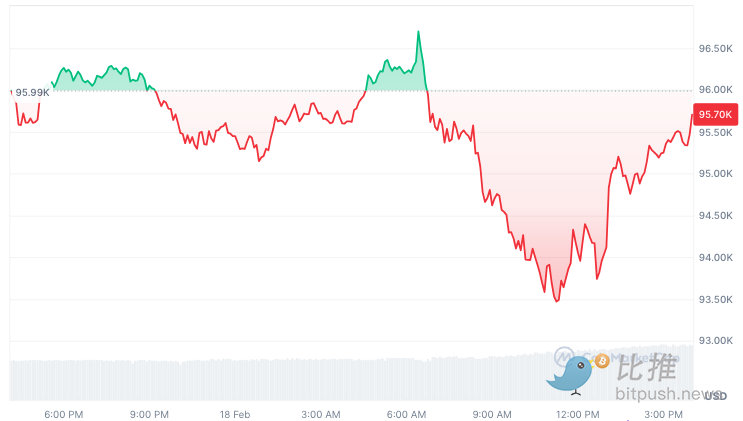
Sid Powell, CEO of Maple Finance, said: "A 3% drop in the crypto market today isn't particularly surprising—it appears to be primarily driven by macro factors. Recent inflation reports suggest inflation will persist, making rate cuts less likely in the near term."
Crypto fund outflows
This pullback coincides with the first net outflow in digital asset exchange-traded products (ETPs) in 19 weeks.
According to CoinShares' latest weekly report on digital asset fund flows, last week saw significant outflows from digital asset investment products totaling $415 million. This marks the end of a 19-week streak of cumulative inflows amounting to $29.4 billion.
The report stated: "ETFs ended 19 consecutive weeks of inflows and recorded their first net outflow amid investor efforts to reduce risk exposure, contributing to selling pressure." CoinShares attributed these outflows to recent hawkish signals from Federal Reserve Chair Jerome Powell and higher-than-expected U.S. inflation data.
The report noted that BTC was particularly affected, seeing outflows of $430 million, reflecting its sensitivity to interest rate expectations. Interestingly, short Bitcoin products also recorded $9.6 million in outflows.
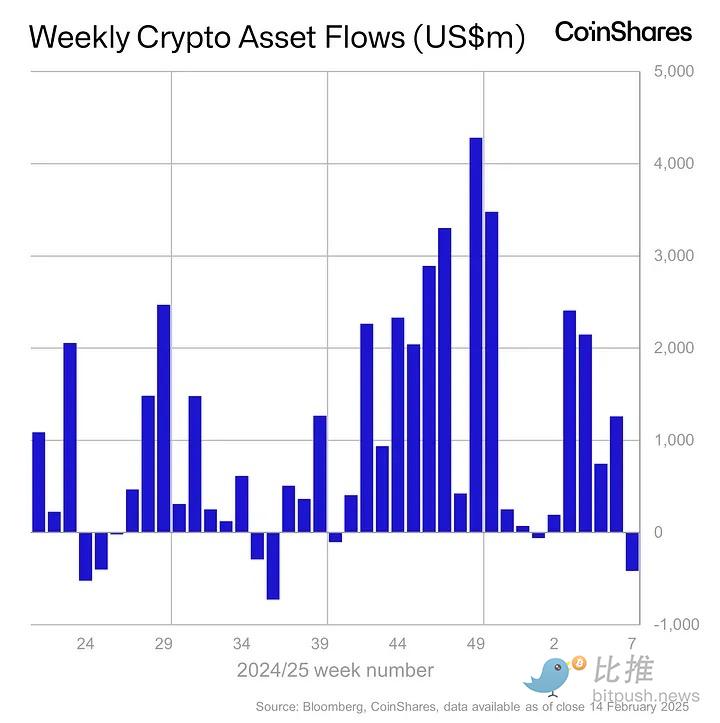
In contrast, Solana led with $8.9 million in inflows, followed by XRP and Sui with $8.5 million and $6 million respectively. Crypto-related equities attracted $20.8 million in inflows, bringing their year-to-date total to $220 million.
Technical indicators suggest potential retest of $92,000 support
Analysis shared by Material Indicators on February 17 suggests Bitcoin could fall further due to a "death cross" forming on the daily chart. A death cross occurs when the short-term moving average falls below the long-term moving average, typically signaling weakening price momentum. However, the analysis also notes buying liquidity around $95,000 and a secondary support level at $92,000, which may help stabilize prices.
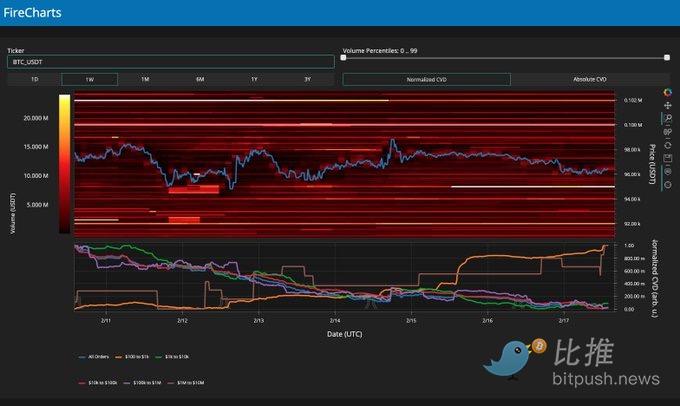
Analysis of Binance order book data further supports the view of an impending test. Technical charts shared by Material Indicators show significant buy-side interest near $95,000, while all order categories except retail traders have reduced risk exposure. The $92,000 support level indicates that further downside could confirm a key support zone, setting the foundation for future price movements.
Traders remain cautious, with many closely watching technical signals. The emergence of a death cross suggests a potentially prolonged downtrend, but some investors see current conditions as an opportunity to accumulate more Bitcoin. Material Indicators emphasized the importance of strategic planning under such market conditions, advising traders to stay patient and stick to their goals.
Standard Chartered reaffirms $500,000 Bitcoin price target
Standard Chartered maintains its $500,000 Bitcoin price target, citing a shifting investor landscape including institutions, banks, and sovereign buyers. The bank expects Bitcoin to reach this level before the end of former U.S. President Trump's term, driven by increased access and reduced volatility.
According to Standard Chartered, spot Bitcoin ETFs purchased 499,000 BTC in 2024, while Strategy bought 257,000 BTC. The bank anticipates institutional inflows will grow further in 2025 but stresses the need for new buyers to sustain momentum.
Analysts wrote: "To achieve this, we need new buyers; bank purchases have been substantial, and now sovereign nations are joining in."
A key factor supporting this outlook is data from SEC 13F filings, which show increased Bitcoin positions among banks and hedge funds during the fourth quarter.
Standard Chartered noted: "The type of buyer will gradually evolve—from retail dominance pre-ETF, to hedge funds during early ETF adoption, and ultimately to sovereign investors." Looking ahead, the bank expects pension funds and central banks to enter the market as long-term institutional investors.
Join TechFlow official community to stay tuned
Telegram:https://t.me/TechFlowDaily
X (Twitter):https://x.com/TechFlowPost
X (Twitter) EN:https://x.com/BlockFlow_News
 比推 BitpushNews