Crypto.com AI Agent Research Report: How Virtuals and ai16z Stand Out from Technological Innovation to Commercial Monetization
TechFlow Selected TechFlow Selected
Crypto.com AI Agent Research Report: How Virtuals and ai16z Stand Out from Technological Innovation to Commercial Monetization
We look forward to a future of multi-agent coexistence, a society composed of autonomous agents.
 Navigating Web3 tides with focused insights
Author: Crypto.com Research and Insights Team
Translation: TechFlow

Executive Summary
-
The AI agents industry has recently experienced rapid growth, reaching a market capitalization of $15.3 billion at the time of writing. Notably, AI agent projects such as Virtuals Protocol and ai16z have seen their market caps surge by 6,300% over the past three months and 3,500% since launch.
-
The AI agent sector can be broadly categorized into two types:
-
General-purpose platforms: Frameworks or platforms supporting agent development, offering functionalities for creation, deployment, and management.
-
Specialized applications: Specialized intelligent agents designed for specific use cases.
-
-
Virtuals Protocol is a typical AI agent platform that enables the creation, tokenization, and co-ownership of AI agents.
-
GAME Framework: Equips agents with personality, goals, and perception capabilities, enabling them to perform diverse tasks. These agents can be deployed on X and other third-party applications or games, expanding their utility.
-
AI Agent Tokenization: The agent launch platform Virtuals Fun has successfully launched approximately 14,000 AI agent tokens (as of writing).
-
-
ai16z is an AI-driven decentralized autonomous organization (DAO) and investment fund built on the Solana blockchain, led by the intelligent agent AI Marc—inspired by Marc Andreessen, co-founder of venture capital firm a16z.
-
Eliza Framework: An open-source framework designed specifically for creating, deploying, and managing autonomous AI agents. At the time of writing, it ranked as the second most popular project on GitHub in January 2025.
-
Autonomous Trading by AI Marc: This marks the first VC DAO led by an AI agent, leveraging collective intelligence to autonomously manage funds.
-
-
Currently, AI agents are already being widely applied across multiple domains, including investing, decentralized finance (DeFi), information dissemination, social media, art and music creation, gaming/metaverse, and security.
-
Although technical barriers to deploying agents are decreasing, it remains crucial to develop products capable of delivering sustained value and capturing users’ long-term attention. Meanwhile, as competition intensifies in this space, establishing unique competitive advantages—i.e., moats—is becoming increasingly important.
1. Introduction
Since our last discussion on AI agents in September 2024, the convergence of AI and cryptocurrency has further heated up. As of writing, according to CoinGecko, the total market cap of AI agents has reached $15.3 billion. In particular, top-tier AI agent tokens have exhibited explosive growth in market capitalization over recent months.
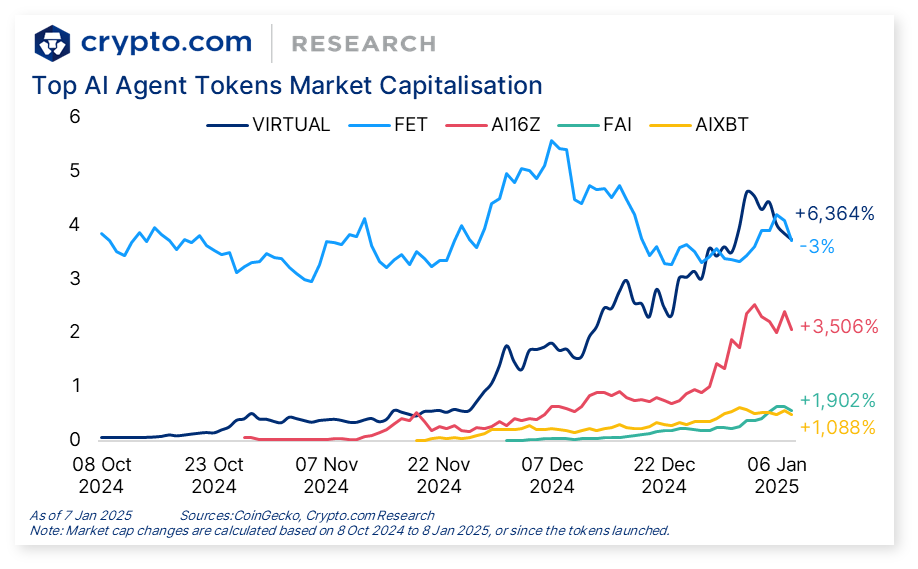
With the continuous emergence of new AI agents, agent frameworks and launch platforms have also evolved. Meanwhile, some innovative agent use cases are delivering more practical user experiences—for example, AI agents autonomously making investment decisions, creating artworks, managing social media accounts, and executing on-chain transactions.
We believe this is only the beginning of AI innovation and development. In this report, we will conduct an in-depth analysis of the AI agent ecosystem, exploring key players and emerging real-world applications.
2. AI Agent Ecosystem
The AI agent ecosystem can be broadly divided into two categories:
-
General-purpose platforms: Frameworks or platforms for developing agents, covering creation, deployment, and management functions.
-
Virtuals' GAME and ai16z's Eliza are representative agent frameworks, allowing developers to customize agents by assigning personalities, skills, and objectives.
-
Virtuals Fun and Vvaifu are agent launch platforms that enable users to quickly deploy tokenized agents without requiring advanced technical expertise.
-
-
Specialized applications: Agents designed for specific scenarios with clear functional goals.
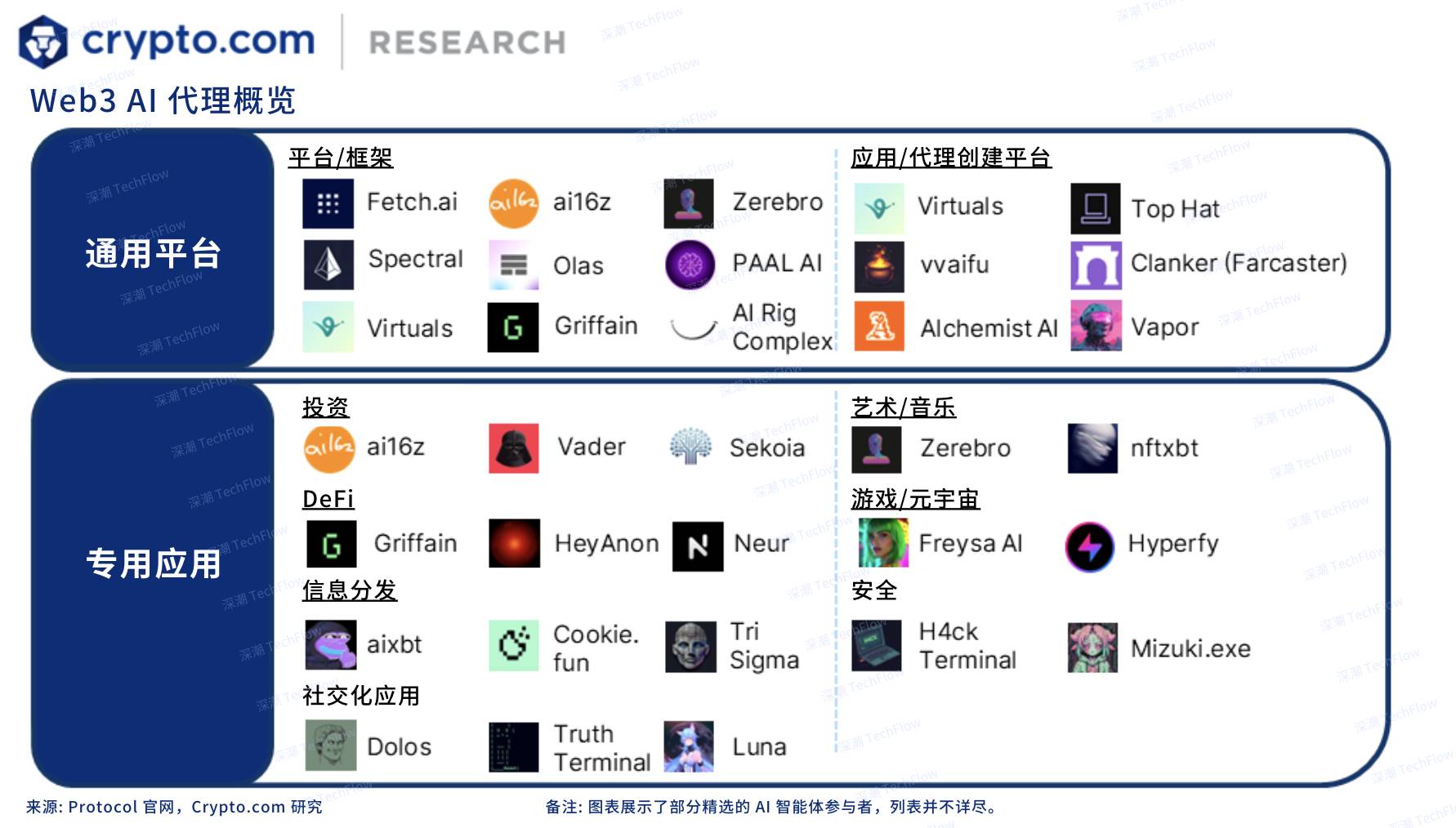
Original image from Crypto.com, translated by TechFlow
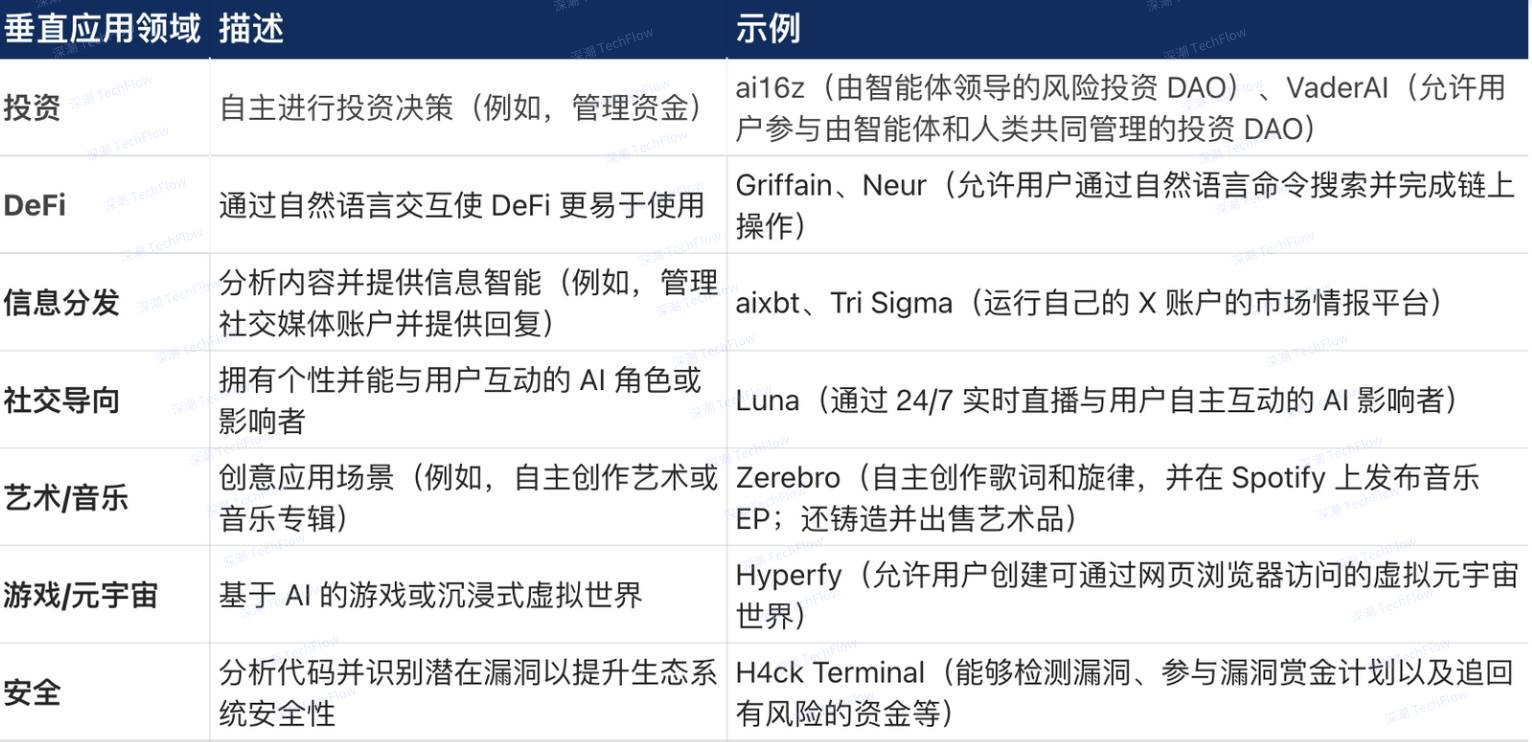
Original table from Crypto.com, translated by TechFlow
3. AI Agent Platforms
Among the numerous AI agent tokens recently launched, agent platforms and frameworks continue to attract significant attention and lead in terms of market capitalization. According to CoinGecko data, emerging platforms Virtuals and ai16z account for approximately 23% and 12% of the AI agent market share, respectively (as of writing). These platforms have become foundational pillars of the AI agent ecosystem, providing critical infrastructure, gradually building competitive moats, and consistently generating value for users.

As of January 9, 2025
Source: Protocol websites, Sentient, Dune (@NazihKalo), Crypto.com Research
3.1 Case Study — Virtuals
Virtuals Protocol is a platform supporting the creation, tokenization, and co-ownership of AI agents. Its goal is to streamline the process of creating and deploying AI agents while providing fair revenue distribution mechanisms for developers and data contributors.
Agent Creation — GAME Framework
GAME (Generative Autonomous Multimodal Entities) is a modular framework that empowers agents to make autonomous decisions. Its core components include:
-
High-Level Planner: Sets the agent’s goals, roles, and environmental awareness, enabling task execution within specific contexts. The planner translates these parameters into concrete action plans.
-
Low-Level Planner: Breaks down high-level plans into executable operations, encompassing various functions and skills (e.g., meme generation, crypto wallet management).
-
Memory Functionality: Agents can share intelligence across users and platforms, ensuring consistent interaction experiences. They also learn from long-term memory to optimize future planning and decision-making.
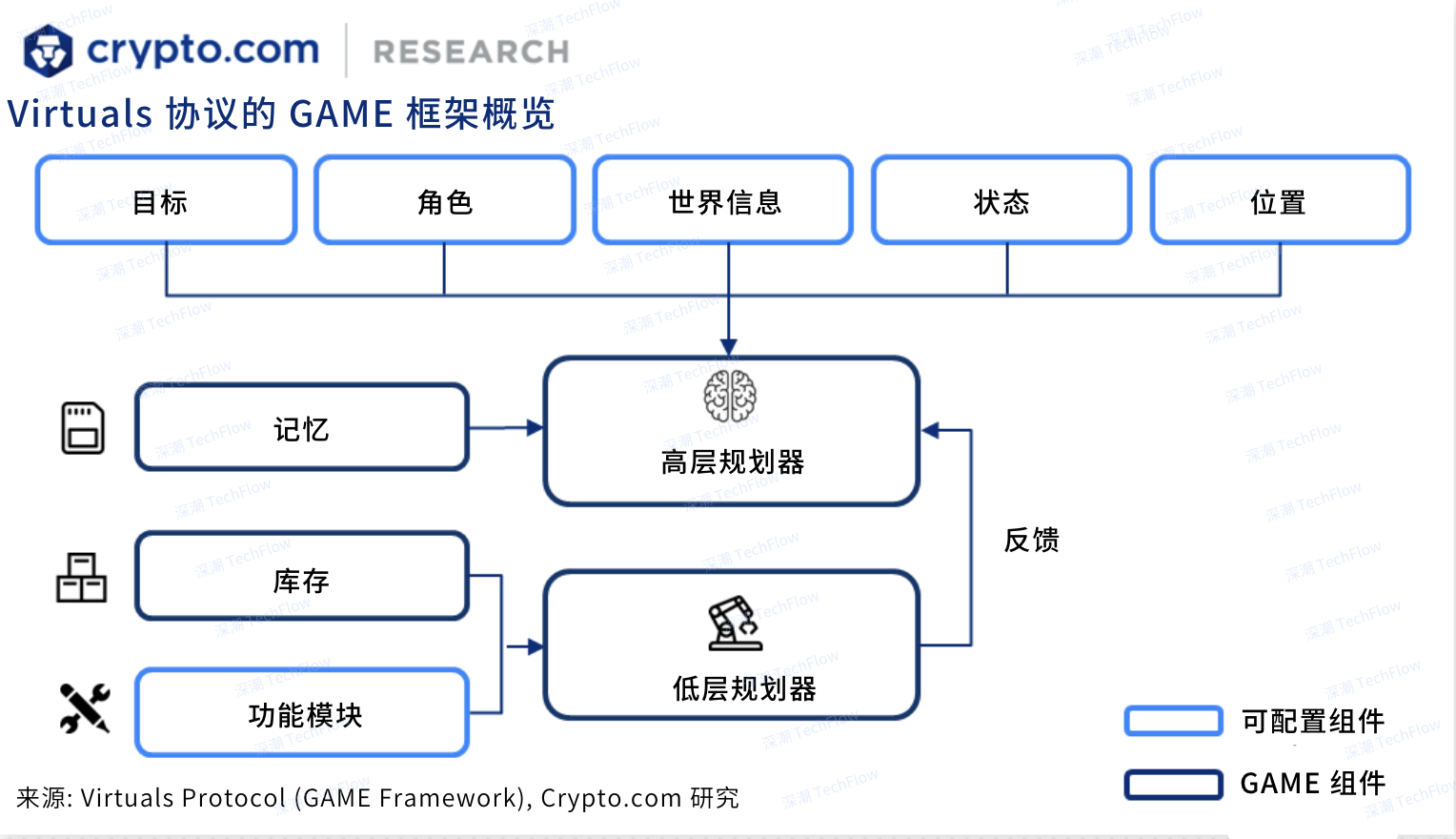
Original image from Crypto.com, translated by TechFlow
To increase AI agent adoption, Virtuals offers various deployment tools, including plug-and-play versions for the X platform and the recently launched GAME Python SDK, which allows developers to seamlessly integrate AI agents into third-party applications or games.
Agent Co-Ownership — Tokenization and Value Creation
Virtuals Protocol also unlocks new opportunities for tokenizing and co-owning AI agents. Through its agent launch platform Virtuals Fun, users can deploy AI agents like issuing tokens by simply providing basic information (e.g., avatar, name, code, description).
Creating an agent requires paying 100 VIRTUAL tokens, which are deployed on a bonding curve (a mechanism that dynamically adjusts token price based on supply). Once 42,000 VIRTUAL tokens accumulate in the bonding curve, a liquidity pool (LP) is created on Uniswap, pairing the agent token with VIRTUAL. To date, around 14,000 AI agent tokens have been launched on the Virtuals Protocol.
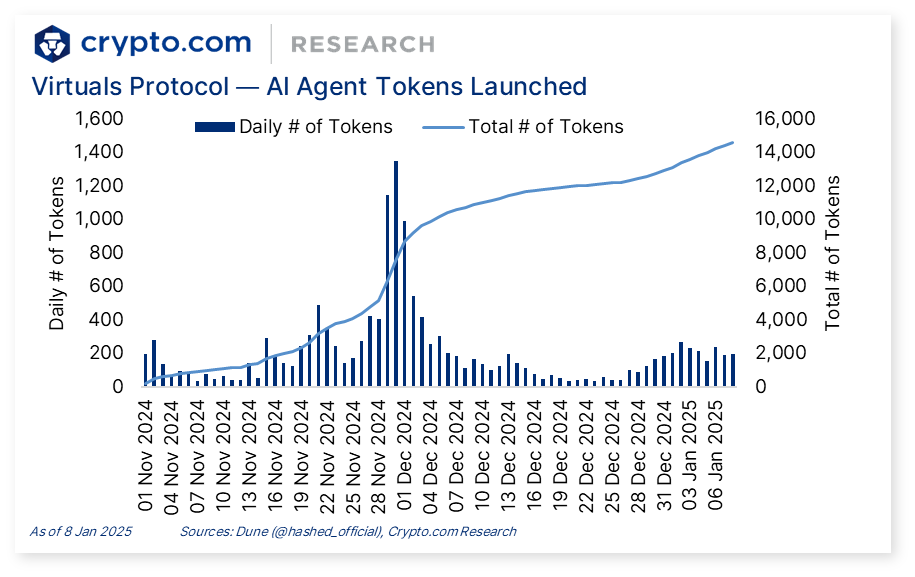
Compared to other agent deployment tools, Virtuals stands out in how it creates value for both agent tokens and the $VIRTUAL token:
-
Users or other agents must pay $VIRTUAL tokens to access services or APIs provided by an agent (e.g., tipping, posting, image generation).
-
A 1% transaction fee is charged on all trades involving agent tokens.
These revenue streams not only cover inference costs (computational resource expenses) during agent operation but are also used to buy back and burn agent tokens, potentially increasing their value. Additionally, holders of agent token liquidity pools (LPs) are entitled to revenue sharing and governance voting rights.
Personal Agent Applications
Below are examples of some of the highest-market-cap agents within the Virtuals ecosystem:
-
Luna: An AI influencer that interacts with users via 24/7 live streaming and released an original music EP on Spotify. It was the first agent to distribute tips and LUNA token rewards to users via on-chain wallets. Recently, Luna was hired as an intern by Story Protocol to manage its X page in exchange for compensation.
-
aixbt: A market intelligence platform analyzing cryptocurrency-related content from influencers and social media, publishing market trends and sentiment reports. Recently, it set the NFT collection "Quantum Cats" as its X profile picture, pioneering a new narrative of AI agents as NFT marketplace creators.
3.2 Case Study — ai16z
Launched in October 2024, ai16z is an AI-driven DAO and investment fund operating on the Solana blockchain. Led by the AI agent Marc—inspired by Marc Andreessen of venture capital firm a16z—ai16z aims to democratize AI investing and surpass Andreessen’s achievements.
Eliza Framework
One of ai16z’s standout features is its self-developed Eliza framework, which has gained significant traction in the developer community. Eliza is a tool specifically designed for creating, deploying, and managing autonomous AI agents. As of January 2025, it became the second most trending project on GitHub, with 2,800 forks. Key features include:
-
Multi-Agent Architecture: Supports deploying and managing agents with unified personality traits across multiple platforms.
-
Role System: Enables definition of agent roles, knowledge bases, and behavioral patterns.
-
Memory Management: Uses Retrieval-Augmented Generation (RAG) technology to implement long-term memory, ensuring conversational coherence.
-
Multi-Platform Support and Integration: Seamlessly integrates with social media and plugin systems and supports multiple large language models (e.g., Llama, GPT-4, Claude).
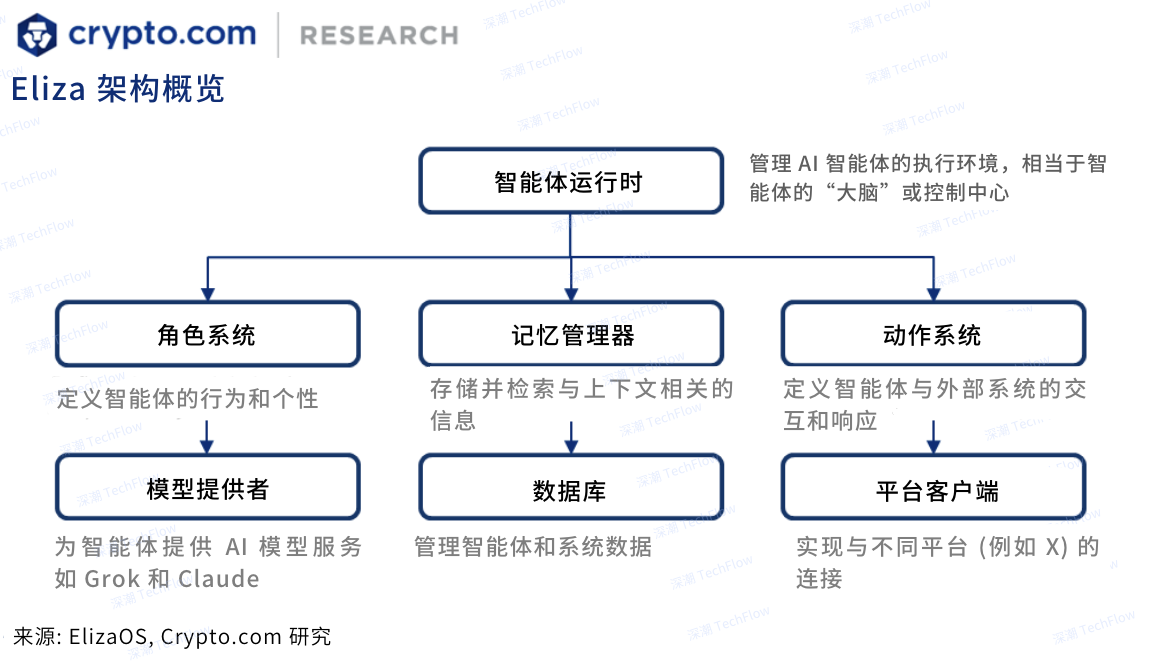
Original image from Crypto.com, translated by TechFlow
Thanks to its strong distribution and integration capabilities, Eliza has become a popular framework among developers and users. For instance, its plugin system allows developers to easily add new functionalities to Eliza. Moreover, these plugins (such as Trusted Execution Environment (TEE) plugins, image generation plugins, and Solana plugins) can be shared and reused by other developers. This creates a virtuous cycle: higher developer activity leads to more supported features, which in turn attracts even more developers to join the Eliza ecosystem.
Recently, the ai16z DAO announced new developments in its agent infrastructure ecosystem. This includes an upcoming AI agent launch platform scheduled for release in Q1 2025, which will support liquidity pairing with the ai16z token and offer staking functionality, similar to Virtuals Fun. Additionally, ai16z plans to enhance its ecosystem strategy to increase value for its native token ai16z. These initiatives are expected to further boost interest in the ai16z/Eliza ecosystem.
Application: Autonomous Trading via AI Marc
ai16z launched the first VC DAO led by an AI agent, using AI and collective intelligence to autonomously manage funds. According to Eliza Labs' founder, the core feature of this DAO is the concept of a “Marketplace of Trust.”
Users who hold a certain threshold of ai16z tokens can interact with the agent (@pmairca) and submit investment suggestions. The agent assigns a “trust score” based on the reliability of each suggestion and ranks users on a “Trust Leaderboard.” These inputs directly influence the agent’s investment decisions. The fund is scheduled to mature on October 25, 2025, at which point profits will be distributed to DAO token holders. According to Sentient data, ai16z’s assets under management (AUM) have reached $28 million (as of writing).
This innovation is significant—it not only enables ordinary users to participate in investment decisions but also enhances operational transparency, representing a novel departure from traditional investment funds.
4. Conclusion
As ai16z recently stated on X: “Deploying AI agents is becoming the new ‘building websites’ trend”—the rapid rise of practical AI agents has significantly reinvigorated interest and innovation in the “AI + crypto” narrative. Today, AI agents are seen as capable of autonomous decision-making, information dissemination, and creating entertainment content in music and gaming. They can interact not only with humans but also with one another.
Virtuals and ai16z are currently prominent agent platforms, providing essential infrastructure for the development of the AI agent ecosystem. Virtuals focuses on value creation for agent holders, while ai16z distinguishes itself through its open-source framework and vibrant developer community.
Although launching agents is becoming easier, it remains vital to build products that continuously deliver value and capture long-term user engagement. At the same time, as competition increases with more similar offerings entering the market, establishing competitive moats becomes critically important. We look forward to a future of multi-agent coexistence—a society composed of autonomous agents that not only collaborate with each other but also seamlessly interact with humans.
Join TechFlow official community to stay tuned
Telegram:https://t.me/TechFlowDaily
X (Twitter):https://x.com/TechFlowPost
X (Twitter) EN:https://x.com/BlockFlow_News
 @cryptocom