When the AI gold rush meets Crypto, AI agents make crypto products easier to "fly into ordinary households"
TechFlow Selected TechFlow Selected
When the AI gold rush meets Crypto, AI agents make crypto products easier to "fly into ordinary households"
AI agents will completely reorganize the current trajectory of global cryptocurrency adoption and span all application verticals.
 Navigating Web3 tides with focused insights
Author: Derek Edws, Managing Partner at Collab+Currency
Translation: Zen, PANews
I’m no longer confident that our traditional strategic frameworks can meet the new realities of the future—especially in light of the astonishing acceleration of artificial intelligence and its disruptive potential for the American workforce.
America must begin moving toward a new framework to adapt to this emerging labor reality. This starts with understanding the two most disruptive technological innovations of the past two decades: AI and crypto.
Artificial Intelligence
Thirty years ago, internet search engines first emerged. Their value seemed simple: retrieving global data. Twenty-five years later, OpenAI’s ChatGPT became the fastest-growing consumer application in history. The product now has 300 million weekly active users and over 10 million monthly paying subscribers. In less than two years, it generates approximately $3 billion in annual revenue.
What is the value of these AI systems? Combining “retrieval” with “completion.” Simply put:
-
Request any task using natural language;
-
Delegate the completion of that task to computer intelligence.
In just the past three months, we’ve clearly seen these products rapidly improve in their ability to fulfill work requests across an expanding range of domains—text, math, audio, video, geometry, programming, and more.
So far, the scaling assumptions behind AI systems continue to hold: more data, more compute power, better models. Additionally, new dimensions of scaling are being explored, such as innovations like test-time compute. Last month, OpenAI’s latest reasoning model scored 25% on a frontier math benchmark—problems solvable only by deeply specialized mathematicians.

These next-generation reasoning models are adapting to new tasks and producing observable results. Meanwhile, advances in robotics are enabling machines to perform increasingly complex physical tasks. Intelligent, human-like hardware will never tire, never take vacations, and never go on strike.
This release of technological productivity is not unprecedented—the Industrial Revolution of the 18th century and the Digital Revolution of the 20th century dramatically reduced costs, improved efficiency, and transformed labor markets and economic structures.
But AI appears to be a different kind of technological revolution. These systems can create value in unprecedented ways, transcending traditional cost structures. Dario Amodei, CEO of Anthropic, believes AI could deliver the equivalent of 50 to 100 years of biological progress within the next 5 to 10 years—by shifting much of our human labor structure onto AI systems.
As the infrastructure supporting these systems continues to grow, I believe the global population will witness two trend lines emerge:
-
The cost of all cognitive labor will trend toward the cost of running AI systems;
-
The cost of all physical labor will trend toward the mechanical parts cost of robots.
The promise of this technology is clear:
-
Unlimited output;
-
Dramatically lower prices;
-
Across every value category.

For the purposes of this article, let us assume these trends hold true. As someone deeply committed to ensuring the next generation of Americans enjoys the same opportunities as previous generations, two questions linger: First, how can America win the AI revolution with advantage? Second, how can individual Americans participate in the benefits of future AI systems, while recognizing their disruptive potential for human labor?
Cryptocurrency
In 2008, Satoshi Nakamoto released the Bitcoin whitepaper. It proposed a novel, game-theoretic accounting system where globally distributed computers could work together to achieve shared digital consensus on the Bitcoin ledger.
Today, Bitcoin has become the world’s most powerful supercomputer. Its network scale far exceeds the combined infrastructures of companies like Amazon, Google, and Microsoft. Yet after fifteen years of development, blockchain still feels clunky:
-
Poorly written code may contain vulnerabilities leading to theft or zeroed account balances;
-
User errors in managing private keys were the leading cause of cryptocurrency theft last year;
-
Decentralized applications remain harder to use than traditional web apps, resulting in extremely high user dropout rates.
Despite these limitations, engagement with cryptocurrency has reached record highs. One study estimates that 40% of the U.S. population now owns crypto, up from 30% in 2023. Globally, around 24,000 developers actively contribute to blockchain and blockchain-based applications each month—far exceeding the 1,000 per month a decade ago.
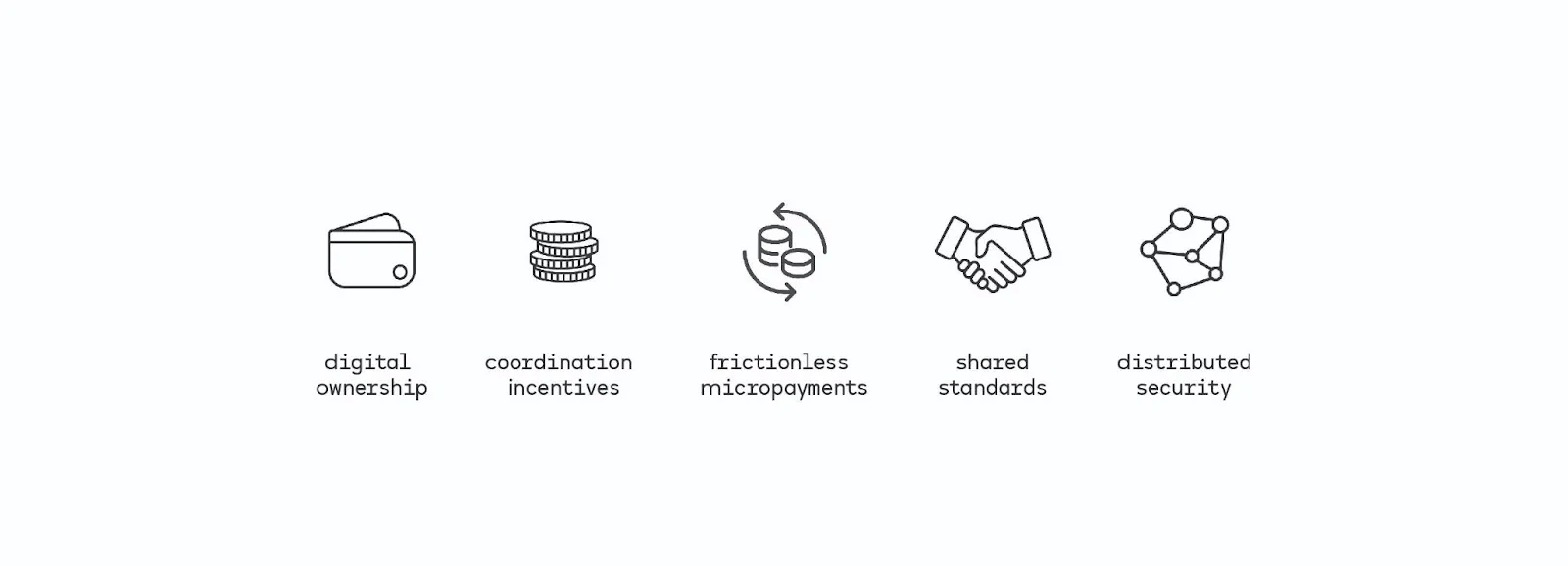
Given all these constraints, why is crypto still growing? I believe it's precisely because cryptocurrency possesses five unique characteristics—working together in ways no other database architecture can replicate:
-
Digital ownership: Blockchain databases are global, fully auditable, community-owned, tamper-proof, and operate 24/7. For the first time, individuals can own any digital object on the internet, establishing a global system of digital property rights.
-
Coordinated incentives: Through self-executing smart contracts, blockchain protocols can use programmable incentives to coordinate new forms of digital labor across networks. These incentives can reward those who use products or services, provide economic security, contribute core code, supply market demand or liquidity, or refer others to adopt a product.
-
Frictionless micropayments: Today, most internet companies rely on subscriptions, bundling, or ad-supported models due to high transaction costs. This constraint limits business model innovation and prevents consumer-friendly alternatives. Blockchain enables low-cost, frictionless digital payments globally—bypassing inefficiencies of traditional payment systems without chargeback risks. Moreover, any crypto asset can be divided into arbitrarily small units.
-
Shared standards: By leveraging shared settlement standards on blockchains, protocol tokens, stablecoins, apps, games, and financial services can seamlessly interoperate—like Lego bricks snapping together effortlessly.
-
Distributed security: Blockchain networks are typically spread across numerous nodes worldwide, eliminating single points of failure. This decentralized architecture makes it harder for malicious actors to attack the system, as they would need to simultaneously compromise most nodes.
Today, the crypto economy has a market capitalization of about $3.6 trillion, spanning multiple emerging sectors.
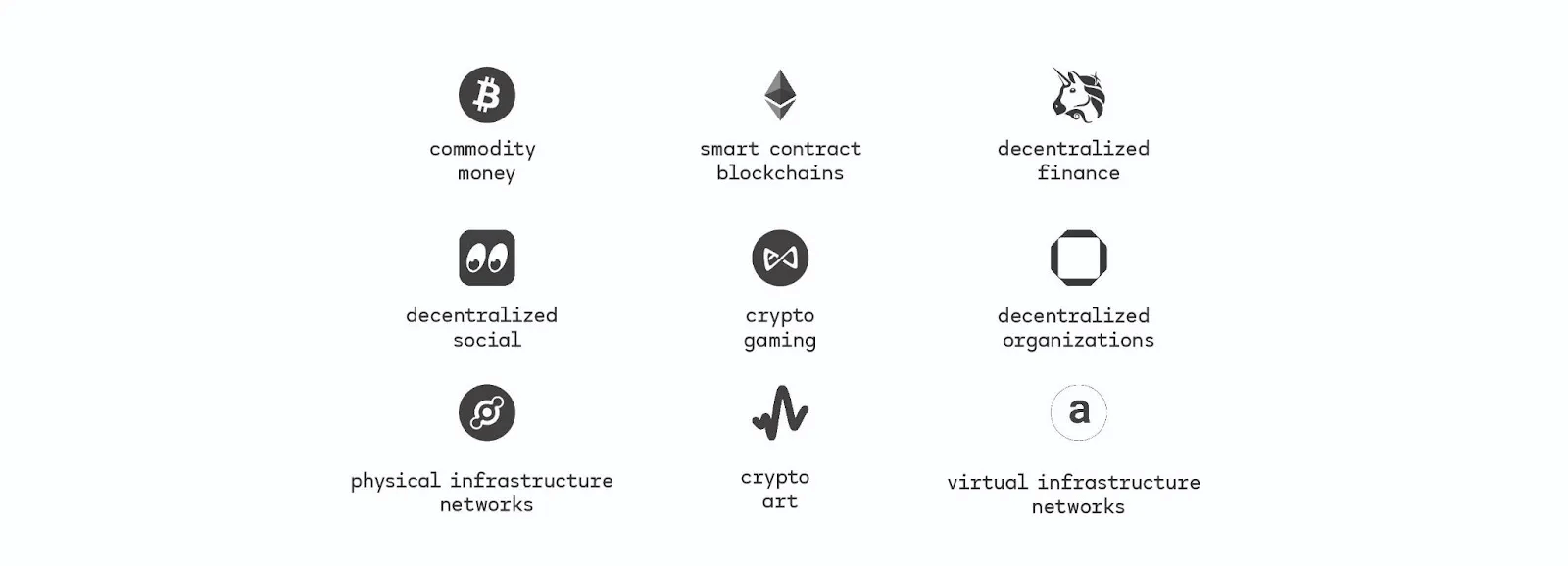
In the next decade, I believe the crypto economy will be significantly repriced upward—driven primarily by two converging trends at the intersection of AI and crypto: (1) AI and crypto infrastructure; (2) AI and crypto applications.
AI and Crypto Infrastructure
To understand the current landscape of AI infrastructure, it helps to look back at historical parallels.
In 1849, the California Gold Rush quickly attracted massive investment. Hundreds of new roads were built for rapid transport. San Francisco’s port became one of the busiest in the world, shipping prospectors, goods, and tools globally. Powerful banks and financial systems emerged to support nascent global enterprises. Infrastructure investments then laid the foundation for the region to become an economic powerhouse.
175 years later, the world is witnessing a similar gold rush—this time aimed at creating Artificial General Intelligence (AGI). However, unlike before, the supporting infrastructure isn’t confined to one geographic region. Networks involving data, computing power, and electricity are now being built globally by competing players.
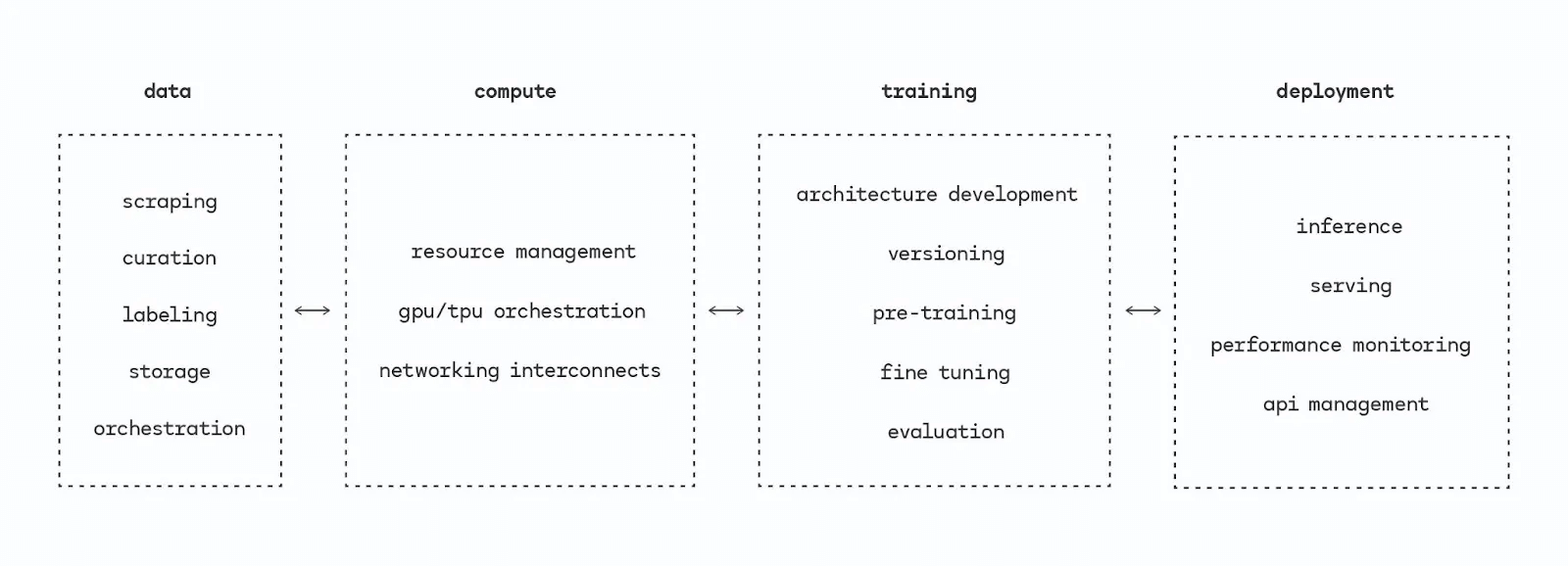
Unsurprisingly, the capital and computational resources required to train, optimize, and deploy AI infrastructure are extremely expensive—affordable only to a few companies. Conservative estimates suggest training GPT-3 once cost over $4 million, while GPT-4 cost over $60 million.
More capital, more compute, better performance.
While I am proud of and supportive of America’s contributions to AI through traditional corporate structures, I also recognize inherent structural limitations:
-
Value capture: Although centralized firms leverage venture capital to drive key AI innovations, the economic benefits are limited to a small group of shareholders, restricting broader societal impact.
-
Proprietary knowledge: Progress in technical frameworks often remains internal to centralized firms, limiting access to critical breakthroughs—even as information flows at internet speed around the globe.
-
Opaque systems: Concentrating AI within opaque, closed, centralized systems makes it difficult for independent auditors to verify practices around data collection, security, and accountability.
-
Closed competition: The enormous computational resources needed to develop advanced AI create high barriers to entry, allowing only a few well-funded companies to continuously push technological boundaries.
By integrating America’s AI infrastructure with the five unique features of crypto—digital ownership, coordinated incentives, frictionless micropayments, shared standards, and distributed security—I believe we can mitigate the negative effects of centralized AI and restore the competitive spirit long embedded in American capital markets. Furthermore, combining U.S. AI infrastructure with crypto will lead to higher-performing AI systems: (a) greater transparency, and (b) fairer ownership among millions of future American participants.
(a) Better Performance
To understand what breakthroughs AI can achieve without massive funding, consider the DeepSeek team. Two weeks ago, this China-based research group released DeepSeek-V3, a 670B parameter model performing comparably to many closed-source SOTA models including GPT-4o and Claude-Sonnet-3.5. To date, DeepSeek has received no venture capital investment.
As proven by open-source projects like Bitcoin and Ethereum, programmable incentives distributed across a global pool of contributors can significantly enhance both qualified labor and computing networks—creating forces stronger than any single lab or centralized system. From this perspective, building systems that reward AI labor and compute networks is not fundamentally different from those rewarding Bitcoin miners and validators.
Examples include:
-
Better training data: Crypto networks can reward humans for contributing high-quality labeled datasets—including private data, proprietary intelligence, or information not obtainable via traditional web scraping.
-
Stronger compute networks: Decentralized markets can incentivize individuals and organizations to contribute computing power—rapidly assembling a global machine network without requiring upfront capital investment.
-
More efficient model training: Open-source developers can earn rewards by providing custom contributions, improvements, and optimizations to existing models. When code and model weights are public, thousands of researchers and developers can simultaneously publish improvements, debug issues, fine-tune custom models and agents—all coordinated through network incentives.
Over time, I believe this collaborative model pioneered by decentralized projects like Nous Research, Prime Intellect, and Bittensor will surpass what even well-resourced private companies can achieve internally.
(b) Greater Transparency
Open-source AI models allow the research community full visibility into training processes, architectures, and behaviors—enabling scrutiny and improvement. This transparency helps identify risks or biases early, fostering more reliable and trustworthy systems. Leveraging blockchain throughout this process ensures that the creation, reward, and evolution of AI protocols remain transparent and auditable.
(c) Fairer Ownership
Crypto networks designed across verticals of the AI tech stack will establish ownership structures far more equitable than current centralized models. Through programmable incentives, all contributors and participants in a crypto protocol can be transparently compensated.
Moreover, complete markets forming around various types of work within the AI infrastructure stack will enable finer-grained competition across AI design domains. Categories such as data, compute, training, and deployment—and their subcategories—can independently compete and accumulate value.
Yet ultimately, the benefits extend beyond AI infrastructure. I believe AI agents will fundamentally reshape the trajectory of global crypto adoption—across all application verticals.
AI and Crypto Applications
For years, the complexity of crypto applications has been seen as a major barrier to widespread adoption. Over the past fifteen years, blockchains have required users to navigate complex approval flows, manage private keys, and understand intricate UI patterns—skills inaccessible to most internet users.
However, with the emergence of agent technology, these user patterns are rapidly changing. If you view AI models as responsive infrastructure reacting based on prior training data, then AI agents can be seen as proactive applications—integrating models into new architectures to accomplish narrow objectives.
In short, AI agents use foundational models to autonomously think, plan, and execute actions. Crucially, agents differ from the “bots” we’ve known before. Unlike bots, AI agents can reason on demand. They analyze their own performance, adjust strategies, and solve complex tasks that sometimes require hundreds—or eventually thousands—of distinct steps.
In September 2024, I met with one of my portfolio founders building an AI agent protocol for blockchain navigation. The protocol is called Wayfinder. Using just a few simple natural language prompts on his phone, I deployed a frontend and token contract replicating Bitcoin’s monetary policy on the BASE blockchain, funded by ETH bridged from the Ethereum mainnet. The entire process took fewer than four prompts and less than five minutes.
Startups like Wayfinder illustrate an important trend: AI agents will mediate the longstanding technical friction of crypto. Within the next 12 months, agents will transform blockchain’s complex structures into seamless natural language interactions—increasing protocol accessibility, protecting users from their own mistakes, helping developers deploy safer code, and drastically reducing consumer drop-off rates in complex decentralized products and services.
More importantly, key management networks will extend these agent capabilities, enabling agents to seamlessly execute cross-chain tasks without human intervention. Global namespace networks will allow each agent’s actions to span all blockchains and link to a single human identity.
In short:
Crypto agents make building or using any crypto product easier—regardless of the underlying blockchain.
-
In decentralized finance, agents will compress crypto’s financial friction into personalized risk profiles via simple natural language instructions.
-
In crypto gaming, agent workflows will support personalized, owned generative content, more sophisticated NPCs, and customized on-chain experiences tailored to individual players.
-
In decentralized organizations, humans will define high-level policy goals and constraints, then delegate execution across operational, protocol, or administrative functions to agents.
These guiding roles and advantages bring revolutionary breakthroughs—from zero to one—for all crypto applications. Millions of new users will enter this way, and no domain will remain untouched.
AI, Crypto, and Ownership
When grasping the magnitude of the trends ahead, it’s vital to reflect on lessons from history. For most of human history, the ability to secure and defend resources meant survival itself. Modern property rights evolved from millions of years of this evolutionary pressure. The concept is so central to human experience that it was enshrined in the U.S. Constitution (Fifth Amendment). America’s Founding Fathers viewed property rights as foundational to our governance and way of life.
Economists have long argued that strong property rights are essential for economic growth. They are crucial for individuals to securely generate income, store wealth, and leverage assets for credit and investment over time.
Research supports this view. A study of over 100 countries between 1990 and 2002 found that nations with stronger property rights grew faster than those with weaker protections—partly because they better enabled technological advancement and improved resource allocation.
From the lens of property rights, blockchain is a core enabling technology. It provides the strongest technical foundation for global digital information—offering immutable recordkeeping, cryptographically secured ownership, distributed security, and programmable enforcement of rights via smart contracts.
As America enters the era of digital intelligence, blockchain can serve as the standard environment for all AI infrastructure and applications—ensuring U.S. AI systems benefit structurally from crypto’s five unique features. Historically, America has created unprecedented opportunity—for individuals and the nation alike—from breaking free of colonial rule, to constitutional promises of personal liberty, to fighting segregation, fierce market competition, and entrepreneurial spirit.
Today, standing at the threshold of AGI, I believe America has a pivotal opportunity to further solidify its leadership along these very dimensions. Aligning U.S. AI policy goals with crypto will unlock unprecedented individual participation in open-source networks, driving incentive-aligned contributions across all layers of the AI stack. Broad participation in our AI ecosystem will stimulate competition, encourage new forms of bottom-up mobilization, and yield wider social impact.
Join TechFlow official community to stay tuned
Telegram:https://t.me/TechFlowDaily
X (Twitter):https://x.com/TechFlowPost
X (Twitter) EN:https://x.com/BlockFlow_News
 @Collab_Currency