OKG Research: The Widespread Adoption of AI and Web3 Both Rely on This "Invisible" Technology
TechFlow Selected TechFlow Selected
OKG Research: The Widespread Adoption of AI and Web3 Both Rely on This "Invisible" Technology
APIs, along with the development and maturation of these applications, will make on-chain data ubiquitous in the Web3 world.
 Navigating Web3 tides with focused insights
In the early days of computer science over 40 years ago, the first APIs (Application Programming Interfaces) emerged to enable data sharing and exchange between different applications. With the rise of the internet and cloud computing, APIs have gradually become ubiquitous.
Today in the Web3 space, as most projects and institutions focus on data and application innovation, APIs are growing increasingly important. In a conversation with Victor, Product Manager at OKLink by OKG Technology, he emphasized that "whether it's blockchain explorers or on-chain data service providers, APIs are indispensable."
1. Why Are APIs "Indispensable"?
More and more people are integrating AI products like ChatGPT into their daily workflows—using them for brainstorming, summarizing texts, retrieving translations, drafting emails, and more. All of these use cases rely heavily on APIs. Like an "amplifier for AI technology," APIs allow complex AI capabilities to be rapidly integrated by developers and organizations into their own applications, enabling users to access and use AI more easily, thus accelerating widespread adoption and explosive growth.
From this perspective, many of today’s AI applications are essentially reinventions built upon APIs. Not every organization has the resources to develop AI from scratch, but with APIs, everyone gains the opportunity to explore and experiment with advanced AI applications.
Global tech giants such as OpenAI, Microsoft, Google, Amazon, and Baidu now offer rich artificial intelligence API suites and are fiercely competing around them. Because behind every API lies an ecosystem: the more organizations and developers adopt your API, the greater advantage you hold in future competition.
In the Web3 world, APIs are equally critical—especially in the domain of Web3 data. Although on-chain data is theoretically public, transparent, and accessible to all, it is often difficult to retrieve directly. This challenge intensifies when wallets or NFT applications require data from multiple blockchain networks, as these networks differ in data structure and output formats, requiring repeated calls under various API specifications—an effort-intensive and complex process.
Yet for most Dapp and crypto application developers, frequently accessing on-chain data is essential when building front-ends and delivering services. From setting up nodes and filtering data to successfully retrieving required information, each step consumes significant time and resources. Having reliable APIs that solve these problems would undoubtedly free both users and developers from the overwhelming burden of raw on-chain data, addressing key data challenges faced by enterprises and brands entering the Web3 market. APIs can be seen as the enabling technology operating beneath the surface of blockchain, truly empowering Web3 ecosystem development.
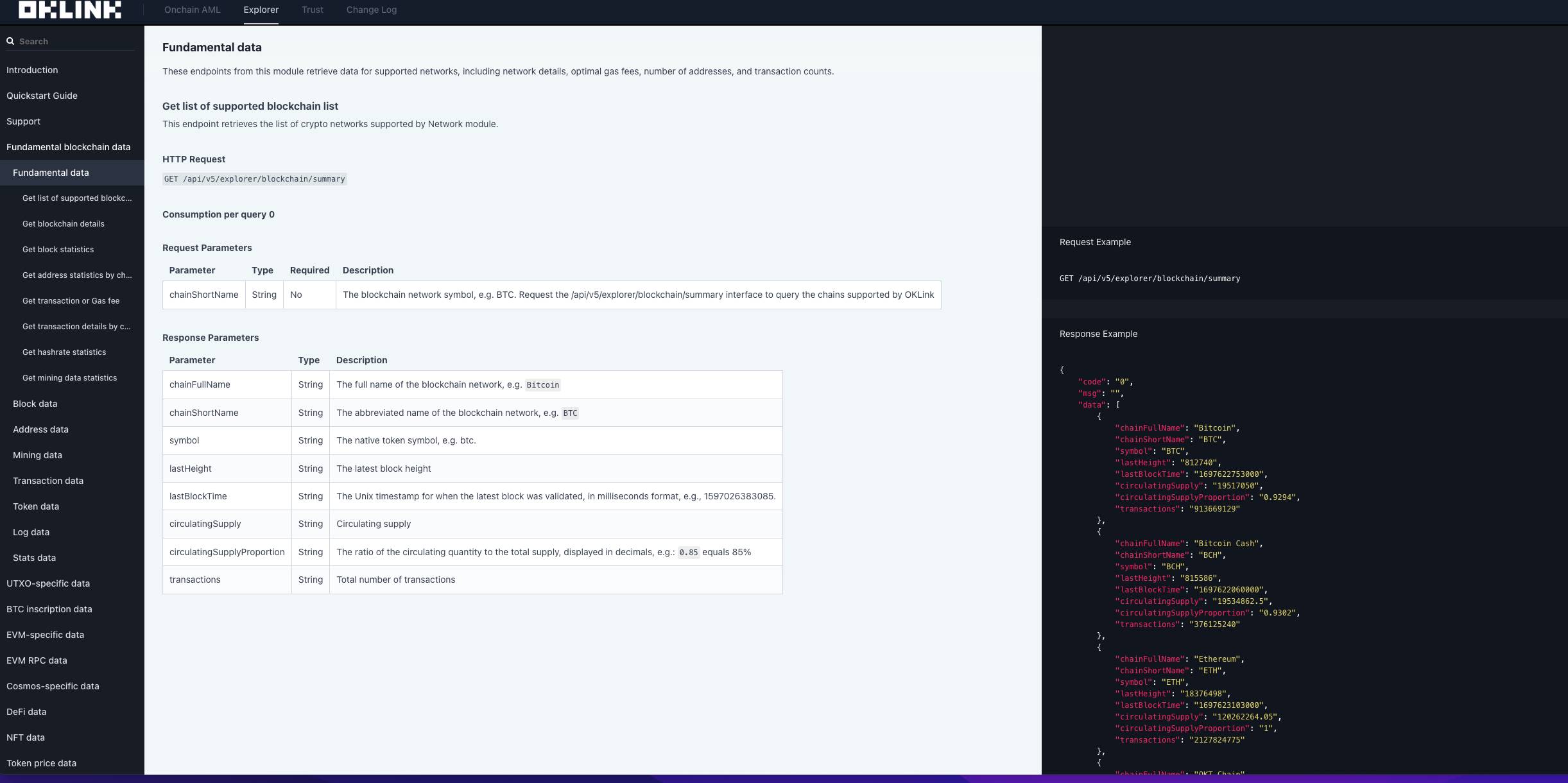
Today, numerous organizations in the Web3 space are emerging as blockchain data API providers, primarily blockchain explorers and on-chain data service platforms. Take OKLink's OpenAPI as an example—it already supports block data across 40+ major public chains and provides token price data from over 200 blockchain networks, covering more than 7 million tokens and NFTs, including comprehensive data on popular protocols such as runes, BRC20, and ARC20. "More importantly, we’ve adopted a unified API interface design. Users only need one single API to access all data across 40+ chains," said Victor.
2. What Exactly Can Data APIs Do in Web3?
Once we obtain on-chain data via APIs, what can we actually do with it? Many people aren't clear on this. In reality, this data plays vital roles across public chains, wallets, Dapps, and security-focused Web3 projects and platforms.
Recently, meme coin narratives have gained popularity, and Sui, as one of the hottest Layer 1 blockchains, has drawn widespread attention. Suppose a wallet wants to integrate Sui into its product and support querying and retrieving data on trending meme coins—how should it proceed?
The most straightforward approach would be setting up a node to fetch Sui chain data, but this incurs substantial costs related to node deployment, block synchronization, data storage, and ongoing maintenance. In contrast, leveraging API services provided by OKLink offers a lighter and more efficient solution. Developers can quickly retrieve multi-dimensional data—including transactions, addresses, and tokens—through simple API calls, and even track and visualize transaction activity for specific wallet addresses to meet market demands.
Media outlets or on-chain analysts can also use APIs to extract data and conduct targeted analysis along specific dimensions, gaining more accurate and trustworthy insights for professional reporting and investment decisions. Meanwhile, many Web3 platforms leverage blockchain data APIs to fetch and update on-chain information in real time, presenting it through intuitive visualizations on their front ends. Therefore, although we may not always be aware of the presence of on-chain data APIs, we've likely already used or encountered products and services powered by them.
In the future, more and more brands and enterprises will attempt to build Web3 applications or platforms—either from scratch or by upgrading existing systems—and using blockchain data APIs will make these efforts significantly easier. As these applications evolve and mature, APIs will ensure that on-chain data becomes truly omnipresent throughout the Web3 world.
Join TechFlow official community to stay tuned
Telegram:https://t.me/TechFlowDaily
X (Twitter):https://x.com/TechFlowPost
X (Twitter) EN:https://x.com/BlockFlow_News
 @OKGResearch