The Crypto Elite's $200 Million Gamble: How Cryptocurrency Giants Are Hijacking the U.S. Election?
TechFlow Selected TechFlow Selected
The Crypto Elite's $200 Million Gamble: How Cryptocurrency Giants Are Hijacking the U.S. Election?
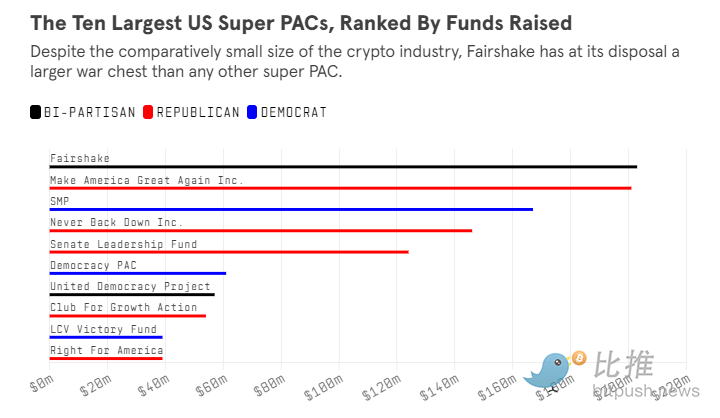
Among all super PACs, Fairshake raised the most funds, exceeding $200 million.
 Navigating Web3 tides with focused insights
By: Joel Khalili
Translation: Yanan, BitpushNews
Despite its relatively small size and lack of clear mainstream utility, the cryptocurrency industry has poured more money into the U.S. election than any other sector.
This week at the Democratic National Convention in Chicago, Jonathan Padilla—a self-described "crypto expert"—moved through the venue adorned with American flags and blue signage.
Wearing a baseball cap and a striking pineapple-print shirt, Padilla roamed the convention floor, discussing crypto policy with anyone willing to listen. He posted a selfie on Facebook hugging Senator Chris Coons of Delaware, captioning it: "Senator Coons now knows about crypto."
Padilla is delighted to have earned the new title of "crypto expert" at the Democratic National Convention, seeing it as proof that crypto has finally entered the political agenda. "Four years ago, crypto was a non-issue—almost no one talked about it," Padilla said. "Now you see Trump mentioning it at major events, and top Democrats talking about it too."
Padilla is the founder of Snickerdoodle Labs, a crypto marketing firm, and previously served as PayPal’s resident blockchain advisor. He is also a co-founder of Crypto4Harris, a coalition of pro-Democrat members from the crypto industry. The group aims to encourage Kamala Harris to support crypto-related legislation and demonstrate that the crypto industry "is not uniformly Republican."
On August 14, Crypto4Harris hosted a virtual town hall featuring several prominent Democrats, including Senate Majority Leader Chuck Schumer, who declared: "I believe in the future of crypto." Padilla said the group has also made progress within Harris’s campaign, engaging with both financial and policy staff.
The organization's outreach to Harris’s team reflects a dramatic shift in how U.S. politicians view cryptocurrency. Lawmakers now seem to accept that there exists a bloc of voters who will cast their ballots based entirely on which candidate can make their investments soar (never mind immigration or healthcare). Not to mention, crypto firms are spending lavishly through major donations.
An analysis by nonprofit consumer advocacy group Public Citizen shows that following the 2024 surge in crypto prices, crypto companies have invested an “unprecedented” amount to influence this year’s U.S. election. Despite being relatively small in revenue terms and still lacking clear use cases beyond financial speculation, crypto firms accounted for 48% of all corporate donations during this election cycle.
The crypto industry spent some money during the 2020 election, but its efforts in 2024 feel far more urgent and aggressive. Veronica McGregor, chief legal officer at crypto wallet company Exodus, speaking as an industry veteran, said: "The crypto industry sees this election as existential. Whoever wins the White House, changes are needed so our industry can thrive."
Crypto political donations are primarily funneled through three interconnected super political action committees (PACs): Fairshake, Protect Progress, and Defend American Jobs. These groups cannot donate directly to candidates, but they can spend freely to support candidates friendly to crypto.
During the Biden administration, crypto companies felt unfairly targeted by regulators. As a result, they’ve backed politicians via super PACs who are willing to establish dedicated regulations for crypto. Their goal is to clarify crypto’s legal status and regulatory framework, ending the current state of regulatory uncertainty.
Fairshake has raised the most funds among all such committees—over $200 million—surpassing not only other crypto-linked PACs but also every other industry’s affiliated organizations. Major donors include Coinbase and Ripple, crypto-friendly venture capital firm a16z, and an investment firm founded by Cameron and Tyler Winklevoss, founders of the Gemini exchange.
Coinbase, Fairshake’s largest donor, has contributed $45 million to the fund but is now facing a formal complaint from the Federal Election Commission. The complaint was filed jointly by Public Citizen and software developer Molly White, founder of the project “Follow the Crypto,” which tracks crypto industry donations. It alleges that Coinbase violated campaign finance laws by donating to Fairshake while negotiating to become a federal business contractor.
Coinbase declined interview requests but provided a public statement from its chief legal officer, Paul Grewal. Grewal rejected the notion that Coinbase qualifies as a federal contractor, arguing its services aren’t funded by taxpayer dollars. In response, White said: "We believe Coinbase is trying to exploit a loophole that doesn't actually exist."
She added: "The crypto industry has long tended to ignore laws it dislikes. It would be good if there were consequences for that behavior. I don’t want large corporations or ultra-wealthy executives spending money in ways ordinary voters simply can’t match. I just want this spending to be at least legal and compliant."
The FEC is currently deciding whether to penalize Coinbase. Meanwhile, these crypto super PACs are effectively using their war chests to target opponents of the industry. In California, Fairshake spent $10 million on ads attacking Democratic Senate candidate Katie Porter, contributing to her primary defeat. Similarly, Democratic Representatives Jamaal Bowman and Cori Bush each lost their primaries after Fairshake spent a combined $3.5 million running negative ads against them. Notably, none of these hostile ads mentioned cryptocurrency explicitly.
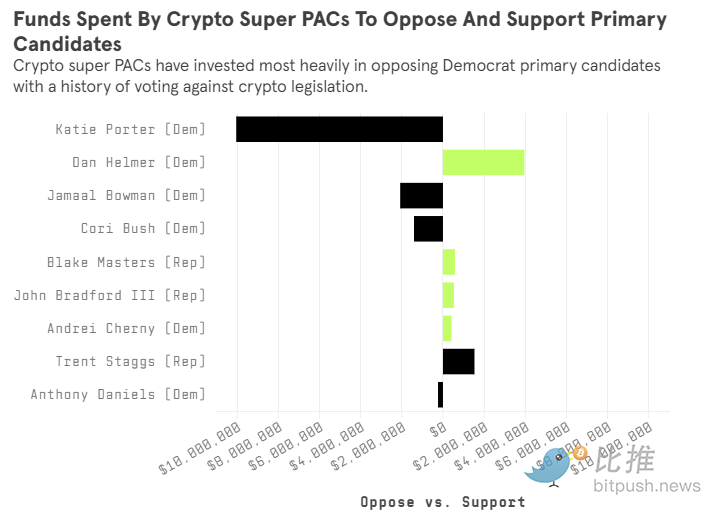
Fairshake declined to discuss its strategy publicly, but the candidates it opposes share a common trait: either they align with outspoken crypto critics like Massachusetts Senator Elizabeth Warren—one of the industry’s favorite “villains”—or they failed to vote for legislation popular within crypto circles.
In 2022, Porter joined Warren in launching an investigation into the impact of crypto mining on Texas’ power grid. This May, Porter, Bowman, and Bush all voted against a crypto bill aimed at clarifying the jurisdiction of the U.S. Securities and Exchange Commission (SEC). During the Biden administration, this financial regulator launched a series of lawsuits against multiple crypto firms, including Coinbase. (Nonetheless, the bill passed by a wide margin and is now awaiting Senate approval.)
To date, many industry leaders have aligned with Trump’s campaign: the Winklevoss brothers each donated $1 million to Trump, and Kraken co-founder Jesse Powell did the same. Marc Andreessen and Ben Horowitz, founders of a16z, have also publicly endorsed Trump.
Trump himself, despite once calling Bitcoin a "scam," has recently rebranded himself as the "crypto president." In July, at a conference in Nashville, Tennessee, he promised thousands of Bitcoin supporters that, if re-elected, he would make the U.S. the "global capital of crypto" and establish a national "Bitcoin reserve." That night, the loudest cheers erupted when Trump vowed to fire SEC Chair Gary Gensler.
"People in the industry are angry and frustrated because we often don’t know what to do," McGregor said. "We think we’re complying, yet the SEC or other agencies sue us anyway. We feel like we’re serving many different 'masters.' This isn’t how regulation should work."
Groups like Crypto4Harris are working to "reset" relations with the Harris campaign, aiming to break the perception that Trump is the only rational choice for crypto supporters. "People are angry and worried," Padilla said. "But I think if we can achieve a reset with the Harris campaign, we have a real chance to calm things down."
In stark contrast to her Republican opponent, Harris has remained largely silent on her crypto stance. The 2024 Democratic platform contains no mention of cryptocurrency. However, on Wednesday, one of Harris’s advisers hinted for the first time that the vice president might consider compromise. The adviser told Bloomberg: "She will support policies that ensure the continued growth of emerging technologies and related industries."
For different reasons, players across the crypto spectrum have reached the same conclusion: the 2024 election is about "survival." Pro-Trump factions argue that a Harris presidency would extend the difficult conditions of the Biden era, and that talk of a "reset" is misleading. Cameron Winklevoss wrote on X: "We won’t be fooled," tagging Harris directly in the post.
Meanwhile, pro-Democrat crypto advocates believe Trump’s embrace of the industry is purely electoral theater. "You have to ask yourself: Is Donald Trump really someone you can trust?" Padilla said. "Among all those running for president, the only one who ever called crypto a scam is Donald Trump."
Join TechFlow official community to stay tuned
Telegram:https://t.me/TechFlowDaily
X (Twitter):https://x.com/TechFlowPost
X (Twitter) EN:https://x.com/BlockFlow_News
 比推 BitpushNews