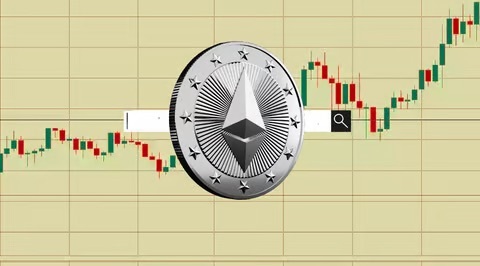
Who Is Behind the Ethereum Price Halving?
TechFlow Selected TechFlow Selected
Who Is Behind the Ethereum Price Halving?
The market maker has fled.
 Navigating Web3 tides with focused insights
Author: Mia, ChainCatcher
Editor: Marco, ChainCatcher
Amid global financial market panic and sharp declines, the cryptocurrency market has entered a new phase of turmoil.
Over the past 24 hours, the total market capitalization of cryptocurrencies has dropped by more than 10%. Major cryptocurrencies such as BTC and ETH have seen significant price declines. During U.S. trading hours on Sunday night, BTC plunged to its lowest level since March, while ETH has been cut in half from its March 12 high of $4,000. ETH fell over 20% in the past 24 hours and more than 30% for the week, completely erasing all gains made so far this year.
Under the crash, widespread distress prevails.
Why did ETH plummet?
Yen Appreciation, Global Payback
At the beginning of August, the Bank of Japan announced a 25 basis point interest rate hike. This tightening monetary policy triggered a surge in the yen and a sharp decline in Japan's Nikkei stock index. The volatility quickly spread to global markets, including U.S. equities and the crypto market. The Nasdaq Index dropped over 5% in the last two trading days, and on Sunday evening, Nasdaq futures fell another 2.5%.
In addition to the Bank of Japan’s hawkish stance, the U.S. Federal Reserve's (Fed) policy has further increased market uncertainty. Although the Fed kept rates unchanged, its ambiguous tone on a potential September rate cut surprised market participants. Almost everyone had assumed a rate cut was certain, but the Fed's vagueness forced investors to reassess its policy trajectory.
Market Makers Front-Running
Behind this wave of ETH’s plunge amid broader financial instability, large-scale token transfers by market makers have also fueled market panic.
Recently, Jump Crypto moved hundreds of millions of dollars worth of cryptocurrency into exchanges, sparking speculation that it may be preparing to sell off substantial assets.
Data from blockchain analytics platform Arkham shows that Jump Crypto’s addresses received approximately $300 million since August 3, mostly from exchange wallets. Meanwhile, the trading firm transferred about $80 million out during the same period, primarily to exchanges such as Coinbase, Gate.io, and Binance. These fund flows are ongoing, with most of the transferred funds in the form of ETH.
In fact, according to crypto investigator EmberCN, shortly after the launch of U.S. spot Ethereum ETFs around July 25, Jump began redeeming over $500 million worth of Lido’s wstETH for ETH. Jump still holds about $130 million in staked ETH, while nearly $200 million in unstaked ETH has already entered exchanges.
Moreover, Jump Crypto has also transferred USDC, USDT, UNI, and SHIB to cryptocurrency exchanges. As more funds flow into exchanges, crypto observers are now speculating whether Jump is preparing to liquidate hundreds of millions of dollars worth of digital assets. As a major market participant, Jump Crypto’s selling activity undoubtedly puts immense pressure on the market—especially during this sensitive post-ETF-launch period—further interpreted by the market as a lack of confidence in Ethereum’s future outlook.
Previously, reports indicated that the U.S. Commodity Futures Trading Commission (CFTC) is investigating Jump Crypto’s crypto investment activities, adding further uncertainty to its current actions.
Currently, Jump Crypto’s transfer activities continue.
According to Spot On Chain, within the past 24 hours, JumpTrading transferred another 17,576 ETH (worth $46.78 million) to centralized exchanges (CEX). Currently, JumpTrading still holds 37,600 wstETH (valued at $101 million) and 11,500 STETH (valued at $26.3 million). According to Scopescan, reviewing Jump Crypto’s Binance deposit address reveals that it has deposited $91 million worth of ETH since last Friday.
Additionally, other market makers and VCs are also moving ETH en masse.
According to The Data Nerd, Wintermute transferred 22,460 ETH (approximately $52 million) from its market-making and other exchange accounts to its Binance deposit address over the past 24 hours, which were subsequently moved to Binance’s hot wallet.
Within the past 16 hours, Symbolic Capital deposited 4,446 ETH (about $12.16 million) into Binance, later transferred to Binance’s hot wallet.
Leverage Liquidation Cascade
Besides these large-scale ETH transfers, as ETH sharply declined, massive loan liquidations occurred across the blockchain lending protocols.
According to Parsec data, DeFi liquidations exceeded $320 million in the past 24 hours—a yearly high. Among them, ETH collateral liquidations reached $187 million, wstETH $77.9 million, and wBTC $32.5 million.
As monitored by on-chain analyst Yujin, ETH’s sharp drop this morning led to leveraged ETH whales being liquidated, further pushing ETH’s price down by over 20%.
Indeed, even whales couldn’t escape unscathed. According to chain data published by Lookonchain on X, a whale address consistently accumulated ETH during the price drop and recently bought another 4,000 ETH (worth $12.58 million). Since May 29, this whale has acquired 17,012 ETH worth $61 million at an average price of $3,587 per ETH. With ETH now trading around $2,300, the position faces an unrealized loss of approximately $21.89 million.
Amid such turbulence in the crypto market, ordinary investors’ confidence has been severely shaken. Today’s Fear & Greed Index dropped to 34, shifting from “Greed” to “Fear” (yesterday’s reading was 37). A large number of investors are gripped by panic, and fear-driven selling is further exacerbating the downward trend, creating a vicious cycle.
ETF Bull Case Realized, Market Falls Instead
ETH’s plunge isn’t solely due to current market panic—it’s also closely tied to the realization of ETF-related bullish expectations.
Since the beginning of the year, the overall crypto market has rebounded, and ETH remained relatively stable, briefly rising above $4,000.
However, as the ETH ETF rollout accelerated, ETH’s rally began to lose momentum. The launch of ETH ETFs was widely seen as positive news. Yet, contrary to expectations, ETH’s downtrend didn’t ease after the official launch—in fact, it worsened. ETH ETFs recorded net outflows, with first-week outflows reaching $341 million.
Why didn’t ETH ETFs drive ETH prices higher as expected?
Overly High Expectations: The gap between market expectations and reality is a key factor. Before the ETF launch, the market held excessively high hopes, believing it would bring massive inflows and significant price appreciation. However, actual capital inflows failed to meet expectations—or worse, turned into outflows—leading to widespread disappointment.
Fund Flows: The real net buy volume for ETH ETFs was far below expectations. Despite strong derivatives trading volume on ETF front-ends, actual capital flowing into ETH remained limited, insufficient to support price increases. Conversely, because expectations were so high, any shortfall in inflows easily triggered sell-offs.
Investor Preference: ETH is largely viewed as a technological asset, primarily attracting venture capital firms, crypto funds, and tech experts. In contrast, BTC, as a macro asset, holds greater appeal for institutional investors such as macro funds and pension funds. Therefore, ETH may face greater challenges in attracting broad investor participation. If ETH ETFs fail to draw sufficient diversified investors, supply-demand imbalances can easily emerge.
Economic Fundamentals: While Ethereum is technologically innovative, its actual economic fundamentals do not justify its current high valuation. To date, Ethereum has yet to develop a compelling application that boosts its economic utility. Key metrics such as fee revenue and annualized income remain weak, leading analysts to believe its price appears “overvalued.” When the market realizes this, it triggers a reassessment of ETH’s true value, increasing sell-side pressure.
In fact, the launch of ETH ETFs marks, in some sense, a new phase for the market—one where investors begin re-evaluating the value and risks of cryptocurrencies. This adjustment could lead to capital reallocation and likely triggered certain technical sell orders. Some investors may have used ETFs as hedging tools, selling ETH to rebalance their portfolios.
Currently, under the dual pressures of underwhelming ETF performance and adverse macro-financial conditions, Ethereum will continue to face numerous market challenges in the short term.
Join TechFlow official community to stay tuned
Telegram:https://t.me/TechFlowDaily
X (Twitter):https://x.com/TechFlowPost
X (Twitter) EN:https://x.com/BlockFlow_News
 ChainCatcher 链捕手