Forbes: Why Are Argentinians Embracing Cryptocurrency?
TechFlow Selected TechFlow Selected
Forbes: Why Are Argentinians Embracing Cryptocurrency?
Argentina is an outlier market where many people simply buy USDT.
 Navigating Web3 tides with focused insights
By Javier Paz, Forbes
Translated by Luffy, Foreisght News
In recent years, Argentina has become synonymous with inflation, much like its world-famous grilled beef. Over the past 12 months, the country’s cumulative inflation rate has reached 276%. A telling sign of Argentina's soaring inflation is shifting dietary habits—residents are reducing their beef consumption and turning instead to cheaper protein sources such as pork and chicken. Some observers predict that beef prices in Argentina will rise by 600% this year, making steak no longer a daily staple for Argentinians.
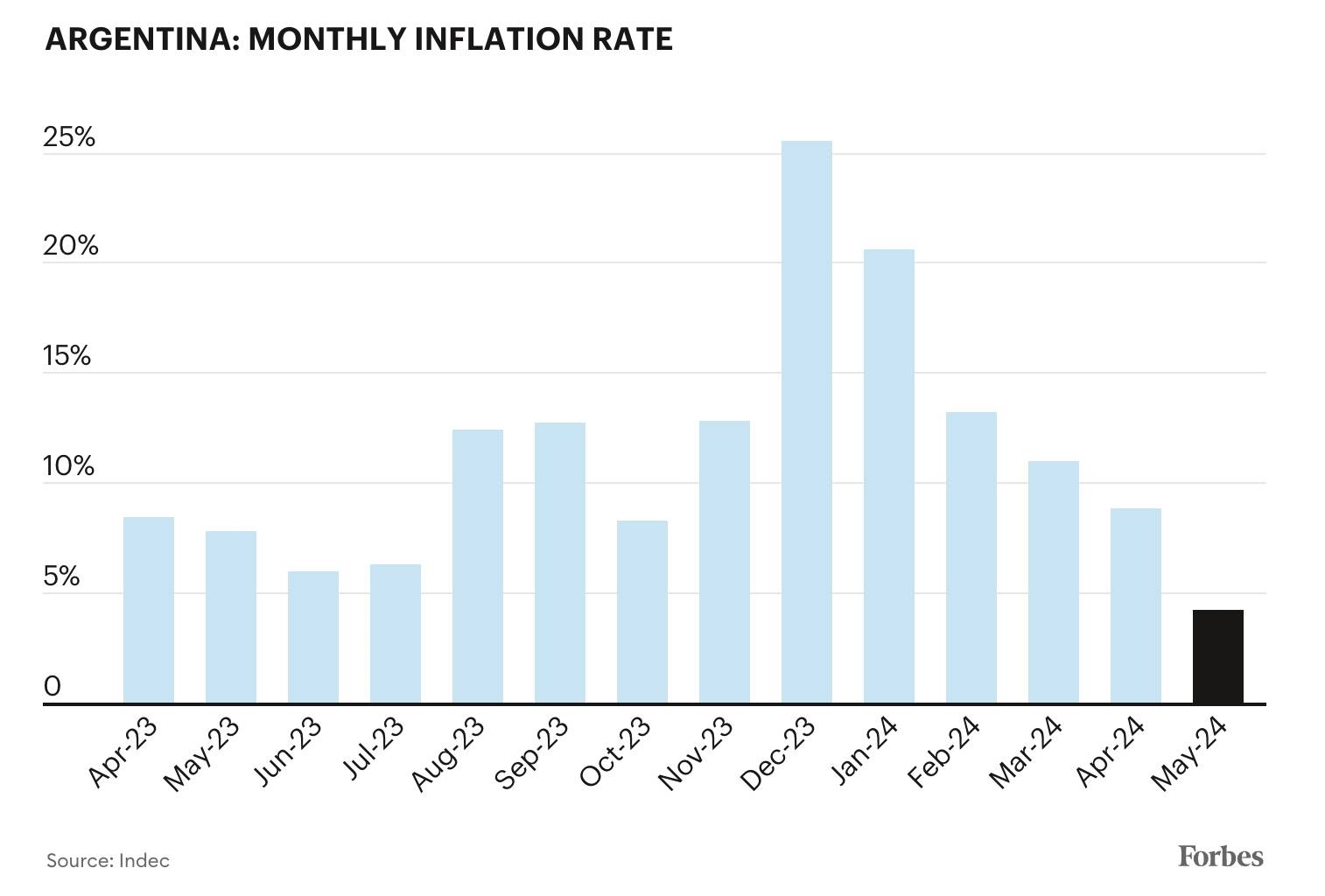
Argentina’s monthly inflation rate
Although Argentinians are only now beginning to seek alternatives to beef, they have been trying to escape the steadily depreciating peso for decades. In fact, for the past 50 years, Argentinians have turned to informal channels to purchase U.S. dollars. The most famous black-market operators once operated openly on Florida Avenue, a main thoroughfare in the capital city of Buenos Aires.
The black market is a last resort for many Argentinians—and one fraught with risks. At these unregulated and unsafe currency exchanges, Argentinians sometimes exchange pesos for dollars at rates double the official government rate. The current exchange rate exceeds the official rate of 954 pesos to 1 dollar by 41%. But that’s not the only risk. According to Argentina’s second-largest newspaper, La Nación, other major risks include robbery by counterparties or receiving counterfeit bills.
Now, however, a new way to access dollars has emerged: cryptocurrency. Indeed, Argentina has the highest cryptocurrency adoption rate (measured as crypto users per capita) in the Western Hemisphere. A study conducted by Forbes in collaboration with web analytics firm SimilarWeb found that out of 130 million visitors to the world’s 55 largest exchanges, 2.5 million were from Argentina.
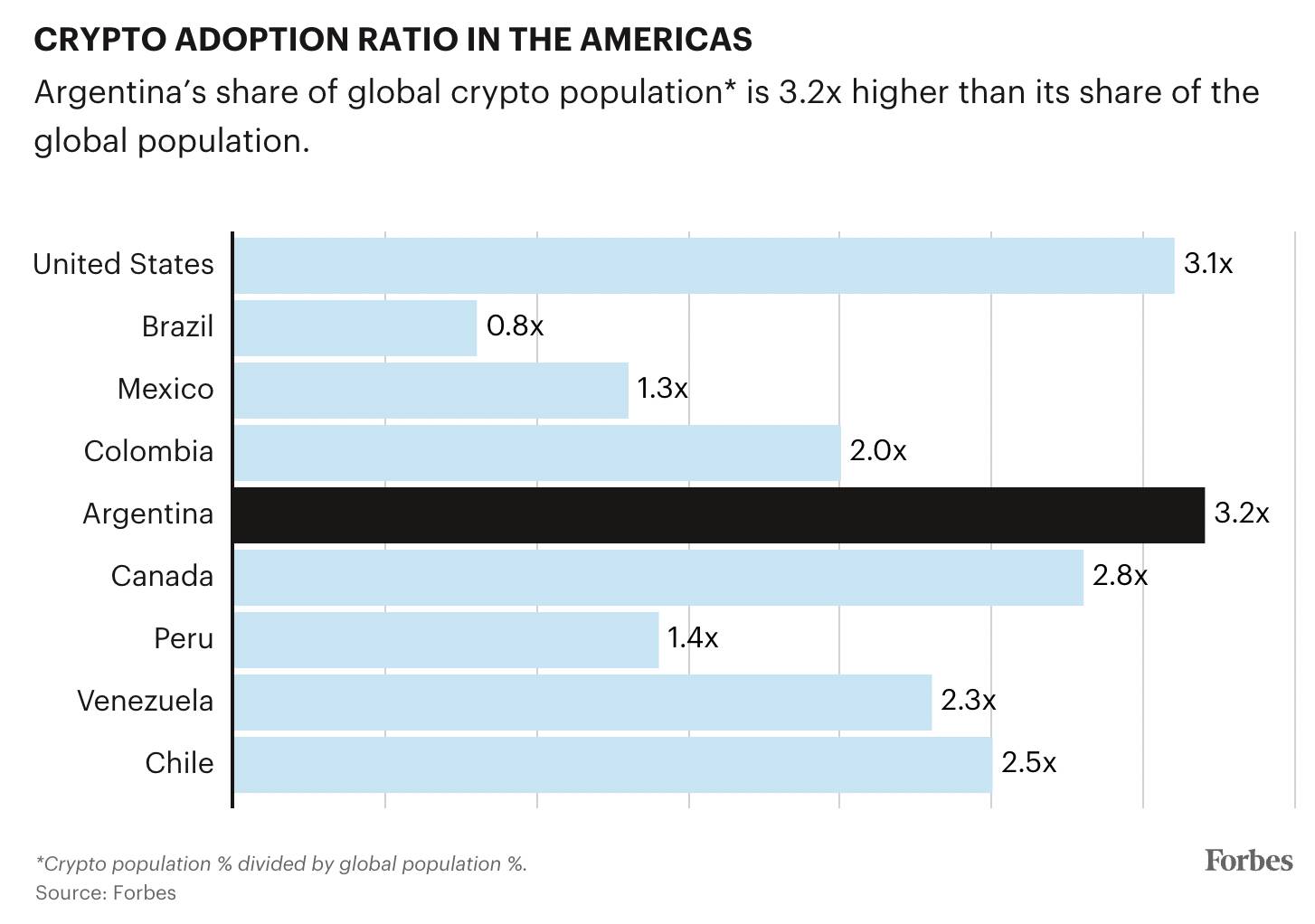
Cryptocurrency adoption rates across American nations
Argentinians aren’t dabbling in memecoins or chasing overnight riches through the next hot token. Instead, they typically buy and hold Tether (USDT), a synthetic dollar with an $112 billion market cap. “Argentina is an outlier market,” says Maximiliano Hinz, Bitget’s head of Latin America. “Many people just buy USDT. We don’t see this elsewhere. Argentinians buy spot USDT and then do nothing.”
While stablecoins like USDT may seem like a perfect escape from Argentina’s inflation crisis, they come with their own risks. The country has yet to establish regulations governing this fast-growing sector, and the world’s most trusted exchanges and marketplaces (as ranked by Forbes) are not among the most widely used platforms in Argentina.
Argentina’s new libertarian president, Javier Milei, has expressed openness to full dollarization. On May 17, during a business conference, he stated the country was moving toward a “competitive monetary system” where individuals could choose which currency to use for payments and transactions. He predicted this would lead Argentina to use the peso “less and less,” eventually transitioning to dollarization and eliminating the central bank so that corrupt politicians could no longer “steal wealth” through money printing.
Dollar-pegged stablecoins align well with the idea of dollarization, but buyers must find secure ways to purchase, hold, and use them. Currently, Argentina offers no reliable protections for cryptocurrency users.
Argentina leads the Western Hemisphere in cryptocurrency adoption. According to Forbes’ analysis of Similarweb data, 2.5 million of the 130 million visitors to the world’s 55 largest exchanges came from Argentina. Additionally, blockchain analytics firm Chainalysis reported in a late-year study that as of July 2023, Argentina “led Latin America in raw transaction volume, with an estimated transaction value of $85.4 billion.”
However, the stablecoin of choice in Argentina, USDT, carries a complicated history. Tether, headquartered in the British Virgin Islands, has remained secretive about its internal operations, never undergoing an audit and refusing to disclose which banks it uses. In 2021, both the CFTC and the New York Attorney General forced Tether to pay fines of $41 million and $18.5 million respectively, after falsely claiming that USDT was fully backed one-to-one by U.S. dollars. In a country still grappling with triple-digit inflation, these red flags appear to have little impact on user behavior.
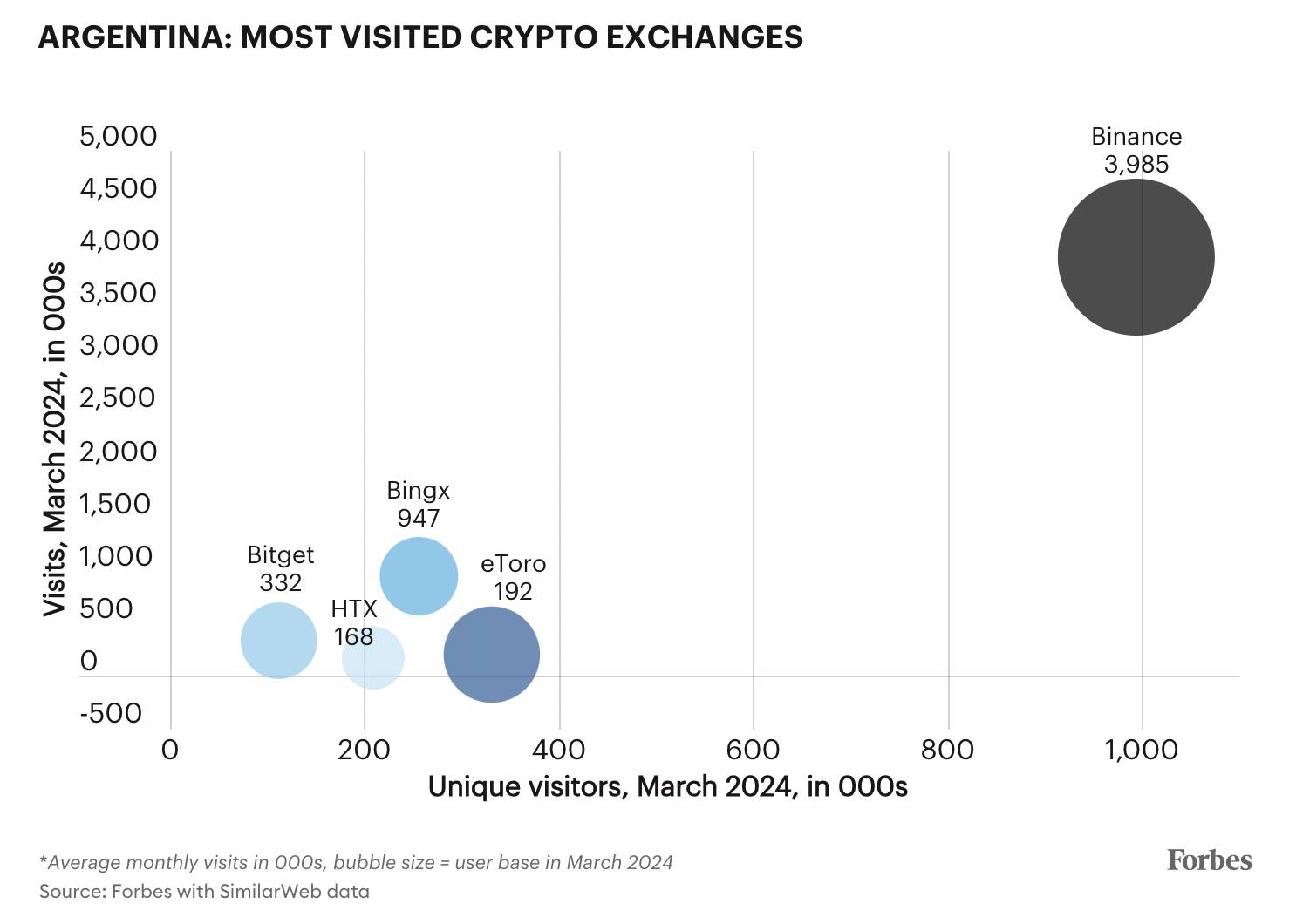
The risks extend beyond the stablecoins themselves to the exchanges and platforms serving Argentinians. None of Argentina’s top five crypto providers—Binance, eToro, BingX, HTX, and Bitget—made Forbes’ list of the world’s 20 most trustworthy crypto exchanges released in May, largely due to lack of domestic regulatory oversight. Binance, the most visited exchange website, draws more traffic from Argentina than any other country. Yet Binance operates without oversight from any national regulator, let alone a local one.
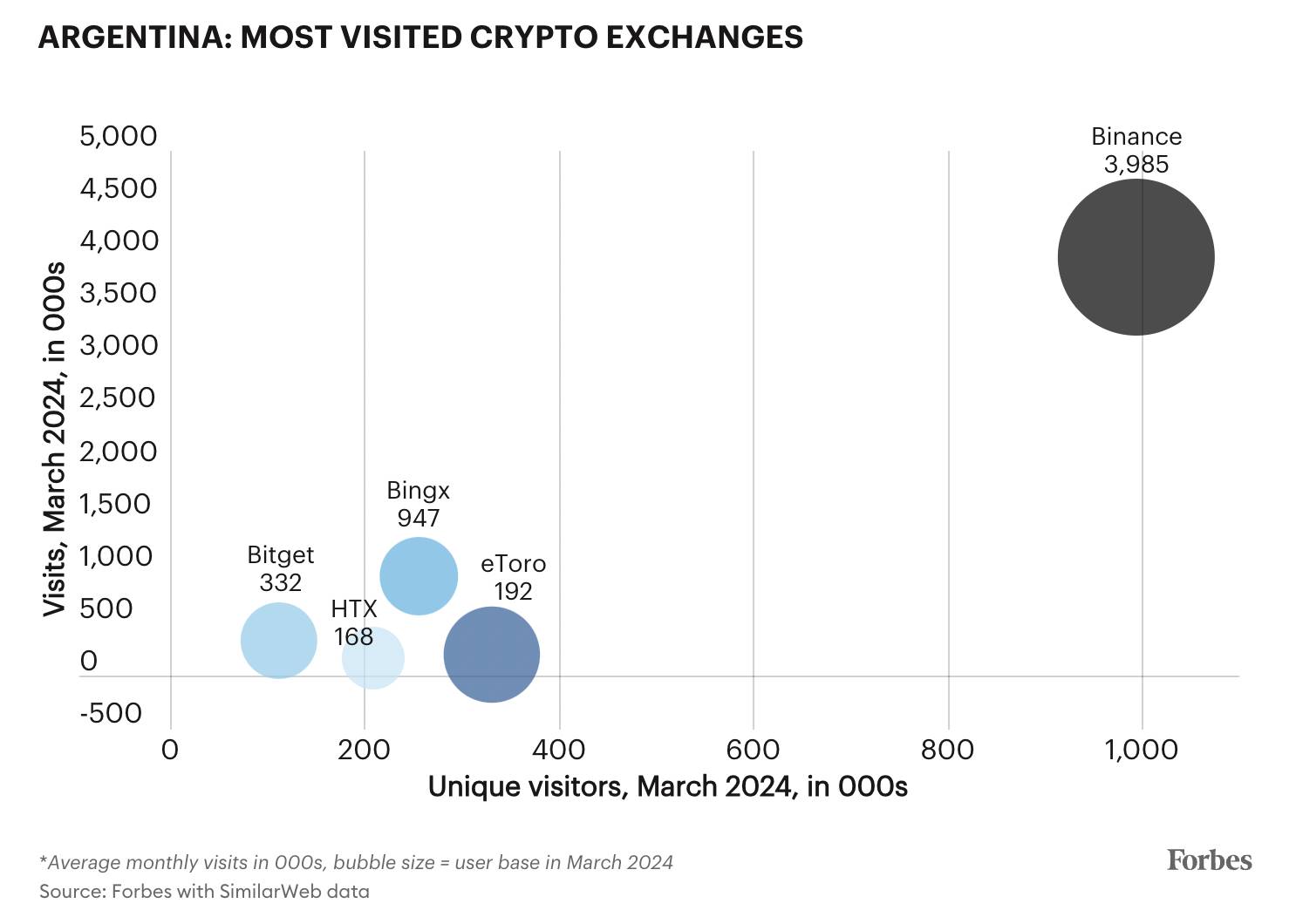
Top cryptocurrency exchanges visited by Argentinians
Visitor sources for Binance’s website
How risky is doing business with Binance? We know that Binance previously admitted to violating U.S. anti-money laundering laws, resulting in a $4.3 billion fine and ongoing monitoring by U.S. regulators to prevent future violations.
But that’s not all. Previous investigations by Forbes into Binance revealed that customers’ online account balances are unreliable because the final authority over held tokens lies within the company’s internal ledgers—information not made public. (Translator’s note: Binance has published its proof of reserves.) The company has also transferred funds outside the exchange to serve as collateral for issuing stablecoins. That said, to Binance’s credit, it has avoided bankruptcy, has generally processed customer withdrawals, and continues operating normally.
For ordinary Argentinians or novice investors, understanding and recognizing these risks is extremely difficult. Fernando Apud, a software engineer living in Tucumán province in northern Argentina, recently evaluated websites ranging from local firms like Cocos Capital to larger, more complex platforms like Binance. While these sites promote security and convenience as key selling points, he found that even large platforms like Binance are reluctant to disclose basic information—such as whether they are registered to operate in Argentina or who actually owns the company.
When Forbes asked Rose Zimler, part of Binance’s Spanish communications team, about the company’s status in Argentina, she said the firm “maintains close contact with authorities” but has not yet registered in the country. She did not explain why registration hasn’t occurred or whether there are plans to register. She noted that Binance holds 18 licenses globally.
Binance is not alone. None of Argentina’s top cryptocurrency exchanges are registered with the National Securities Commission (CNV), the country’s securities regulator. Typically, when approached by Forbes, these firms assert their trustworthiness based on a strong operational track record. Pablo Monti, brand ambassador for BingX, declined on behalf of the exchange’s communications team to discuss its regulatory compliance status in Latin America but told Forbes on May 20: “As we celebrate our sixth anniversary, BingX is expanding further into countries including Argentina, Turkey, and Vietnam.” An eToro spokesperson declined to comment on its unregistered status but stated: “As a company regulated by financial authorities in multiple jurisdictions worldwide, eToro is committed to complying with applicable rules and regulations in the jurisdictions where it operates.” Bitget, a crypto exchange whose brand ambassador is Argentine football legend Lionel Messi, saw Maximiliano Hinz say: “To my knowledge, there are no licensing requirements in the Latin American countries where Bitget operates.” Finally, HTX, an exchange linked to Justin Sun, did not respond to emails inquiring about its operations in Argentina.
Beyond international exchanges, Argentinians can also access cryptocurrency through domestic companies. These firms allow users to buy and spend crypto via prepaid cards, such as Lemon and Buenbit. However, these companies also suffer from regulatory gaps. In Chainalysis’ latest Latin America report, Alfonso Martel Seward, compliance officer at Lemon Cash, said his company serves around 2 million Argentinian users, while total crypto users in the country number approximately 5 million.
Argentinians have had enough of the peso. Since January 2002, when the country ended the peso’s one-to-one peg with the dollar, the peso’s depreciation has caused significant hardship. Years of excessive spending and repeated debt defaults have plagued the currency ever since. Within a decade of the peg breaking, the dollar rose to around four pesos; by early 2020, amid the Covid-19 pandemic, the exchange rate hit 64 pesos per dollar.
According to Bloomberg data, while peso depreciation initially boosted Argentina’s foreign trade in the early 2000s, those benefits faded after 2009. Over the past decade, real GDP has declined on average by 0.1% annually, growing in only four of those years.
Why has Argentina fallen into this困境? Beyond an oversized public sector employing 3.5 million people and a lack of commitment to fiscal discipline, external factors such as weather patterns (La Niña) have severely impacted grain exports—the country’s primary source of hard currency—over the past two years. Argentina experienced its worst drought in 60 years. “It’s unprecedented for soybeans, corn, and wheat to all fail simultaneously,” said Julio Calzada, head of economic research at the country’s main agricultural exchange. “We’re all waiting for rain.” Crop shortfalls mean reduced dollar earnings, pushing up food prices and increasing default risks and interest rates. On December 10, 2023, President Milei declared in his inauguration speech that he intended to end previous practices. “Today, we bury decades of failure and meaningless struggles,” he said. “There’s no turning back.” At the time, Argentina faced an annualized inflation rate of 143%, a $43 billion trade deficit, and a fiscal deficit equal to 3.5% of GDP. Six months into Milei’s presidency, inflation remains high, but the country has achieved six consecutive months of trade surpluses and a fiscal surplus of 1.1% of GDP.
Milei is striving to reverse Argentina’s economic decline. His measures include laying off tens of thousands of public-sector workers, suspending public works projects, eliminating energy subsidies, raising taxes, and cutting revenue-sharing between the federal government and provinces. These moves have sparked massive opposition and street protests, forcing Milei to scale back his austerity agenda, which enjoys limited support in Congress. In June, a watered-down version of his fiscal package narrowly passed the Senate and will now go to the House for debate.
Milei’s tough approach may be the bitter medicine Argentina needs to finally move forward—but a spoonful of sugar might make it easier to swallow.
Even if Argentina’s fortunes improve, decades of poor economic management mean people will continue flocking to the dollar—whether in paper form or digital. Yet the government has done little to protect its citizens.
What crypto regulations exist in Argentina? Over three months ago, CNV announced a registration requirement: “All entities using websites, social networks, or other means to advertise to individuals residing in Argentina” and “receiving user funds through any technological means” must register. There is no deadline for registration. CNV President Robert E Silva stated, “Unregistered entities will not be allowed to operate in the country.”
The registration process is neither complex nor burdensome. Nevertheless, many of the 55 crypto companies analyzed by Forbes operate in Argentina but none had registered within three months of the rule taking effect on March 25. As of June 20, the public registry listed 48 companies, most of which are relatively small local operators. Argentine officials did not respond to repeated requests for comment on the matter.
Registration is only a small step—and clearly insufficient for the world’s 22nd-largest economy, with a GDP of $633 billion. Bitcoin and digital currencies were born out of the Great Recession that struck the U.S. in 2008. But if Bitcoin had originated in this long-suffering Andean nation of chronic inflation and political turmoil, it would be just as fitting.
Join TechFlow official community to stay tuned
Telegram:https://t.me/TechFlowDaily
X (Twitter):https://x.com/TechFlowPost
X (Twitter) EN:https://x.com/BlockFlow_News
 Forbes