








Delphi Labs CEO: FDV is not a meme; high unlocks do not equal project zero
TechFlow Selected TechFlow Selected
Delphi Labs CEO: FDV is not a meme; high unlocks do not equal project zero
A higher proportion of venture investments ultimately achieve not only spot liquidity but even liquid derivatives markets.
 Navigating Web3 tides with focused insights
Author: José Maria Macedo
Translation: TechFlow
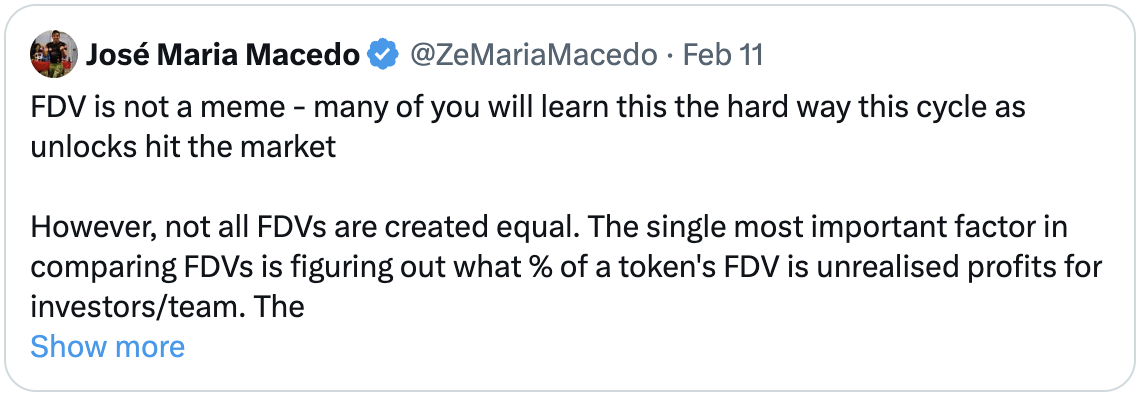
FDV really isn't a meme. Since this article was published, I've been speaking with OTC brokers to understand the secondary market structure for my shorted assets. The findings have been illuminating, so I’d like to share them.
In short, I don’t think these will be bullish unlocks.
Many of these assets have active sellers, but very few bids below 70% of market price (we're talking about standard SAFTs—Simple Agreements for Future Tokens—with a 1-year cliff and 2- or 3-year vesting).
In terms of volume, based on conversations with various brokers, I roughly estimate total SAFT trading volume at around $100 million. Considering that cumulative tens of billions in unrealized gains are set to unlock across these assets over the coming years, this is basically negligible.
Plainly put, “bullish unlocks” would ideally see as low a market cap-to-unrealized-gains ratio as possible, as explained in the linked article.
Most tokens carry massive unrealized gains from teams (0 cost basis) and early investors (you can calculate this yourself using tools like cryptorank.io).
Add to that extremely low float (typically 5–15%), and most projects trade at 4–8x their unrealized gain market cap—meaning the full circulating market cap sits atop 4–8x the amount of unrealized gains.
Assuming a 2-year period from cliff day, this means unlocking events every 3–6 months, each releasing assets worth the entire current market cap. This makes it hard to attract buyers, especially when their alternative beta exposure lies in memecoins and other assets without supply overhangs.
One way to mitigate this effect (besides increasing initial float) is high pre-launch secondary trading volume, ideally close to the current market price.
This helps reset the cost basis of unlocked tokens and effectively reduces the unrealized gain-to-market-cap ratio (e.g., the now-famous Multicoin SOL side deal ahead of the first unlock).
Unfortunately, I’m not seeing this in the OTC market.
Relatedly, I'm trying to make sense of the market structure. I don’t want to name specific assets, but there are many with the following traits:
-
Extremely high unrealized gain-to-market-cap ratios;
-
No secondary demand even at ~70% discounts to market price;
-
Consistently positive funding rates on Binance, with open interest reaching eight digits;
Who is eager to hold these on CEXs yet uninterested in buying them on the secondary market at over 70% discount?
My assumption is simply that both buyers and sellers face unique frictions.
I don’t know much about the buyers, but if they’re spending money going long on these, they’re likely retail gamblers who don’t understand vesting schedules or OTC platforms.
Sellers may include:
a) Founders/teams whose >90% holdings are locked up, leaving them without collateral or incentive to short;
b) VC fund investors who either cannot or haven’t set up short positions on CEXs;
This is why the opportunity to short these assets and profit remains viable.
By the way, contrary to what CT doomsayers tell you, this doesn’t mean all crypto is a scam, nor that all high unrealized gain assets will go to zero.
I’m very bullish on crypto and believe certain categories of winners will rise through their unlocks because they actually have real use cases.
However, there will also be long-tail assets that “go to zero.” That’s natural and expected in an asset class that provides liquidity for early-stage venture investments.
After all, most startups fail. In traditional venture capital, only a select few elite companies eventually IPO and become liquid, while long-tail ventures quietly fade away.
In crypto, a far higher proportion of venture projects end up not just with spot liquidity, but even with liquid derivatives markets. This is unheard of in traditional VC and is precisely what makes crypto venture a distinct asset class.
It also means the long-tail failures in crypto venture will be public and painful, where large sums of money are either made or lost—rather than quietly disappearing.
It also implies structural short opportunities in crypto will outnumber those in any other asset class. To some extent, you can essentially get paid to bet on the empirically indisputable fact that most startups fail.
Join the official TechFlow community
Telegram subscription group:
Official Twitter account:
English Twitter account:
Join TechFlow official community to stay tuned
Telegram:https://t.me/TechFlowDaily
X (Twitter):https://x.com/TechFlowPost
X (Twitter) EN:https://x.com/BlockFlow_News
 @delphi_labs


