








AO Tokenomics Model Released: How to Maximize Efficiency in Acquiring AO Tokens?
TechFlow Selected TechFlow Selected
AO Tokenomics Model Released: How to Maximize Efficiency in Acquiring AO Tokens?
AO allocation depends on the amount of funds and the types of token assets held. What we need to do is seek the most capital-efficient way to acquire AO tokens given limited funds.
 Navigating Web3 tides with focused insights
Author: Marshal Orange
Review: Kyle
The Arweave team officially released the AO tokenomics at 23:00 Beijing time on June 13. Based on currently available information, this article analyzes how to maximize efficiency in acquiring AO tokens. This article is for cryptocurrency economics analysis only and does not constitute any investment advice!
Understanding the AO Tokenomics Model
According to the AO tokenomics, AO is a 100% fair launch token following Bitcoin's economic model. Like Bitcoin, AO has a total supply of 21 million tokens, with a halving cycle roughly every four years. AO distributes tokens every five minutes, with monthly allocations equaling 1.425% of the remaining supply. However, unlike Bitcoin, AO does not experience sudden "halving events." As is well known, Bitcoin halves approximately every 210,000 blocks (averaging one block every 10 minutes), which occurs about every four years. In contrast, AO’s halving process is relatively smooth—the token issuance gradually decreases on a monthly basis. While this difference doesn’t drastically affect AO acquisition efficiency, early participation still yields significantly higher returns.
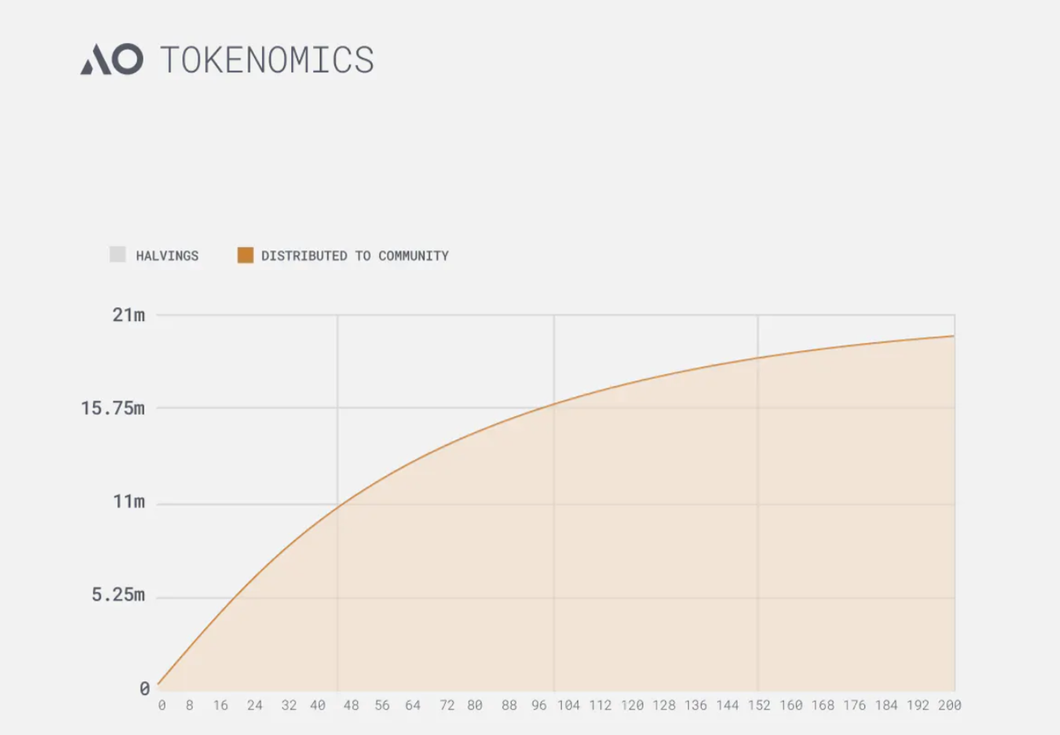
The official team consistently emphasizes that AO is a 100% fair launch token. Currently, the team defines "100% fair launch" as AO tokens being obtainable only by holding specific assets ($AR, $AOCRED, $stETH). Notably, no allocations have been reserved for the core team, investors, or ecosystem projects—highlighting the project’s high integrity compared to many other crypto projects. This also means AO acquisition depends entirely on capital size and the type of token assets held. Our goal is therefore to identify the most capital-efficient method of acquiring AO tokens within limited financial resources.
AO token acquisition currently consists of two phases: Phase One ends on June 18, followed immediately by the start of Phase Two. The mechanism for Phase One was only revealed when the tokenomics were announced on June 13, though it makes sense in hindsight—AO tokens minted from February 27, 2024 (the day the AO public testnet launched) up until June 18 are distributed 100% to $AR holders based on their balance snapshots taken every five minutes. As of June 13, 2024, each $AR holder can expect to receive approximately 0.016 AO tokens. In total, over one million AO tokens will be distributed during Phase One.
Strategies to Maximize AO Token Acquisition
Phase One accounts for only about 5% of total distribution; the main event is Phase Two. Our primary focus should therefore be on maximizing AO acquisition during Phase Two. Specifically, 33.3% of AO tokens will go to $AR holders, while 66.6% will be allocated to other assets staked into the AO network (currently only stETH). Additionally, AOCRED can be exchanged for AO at a ratio of 1000:1, with these AO tokens sourced from the AO rewards generated by AR holdings owned by Forward Research.
After Phase Two begins, each AR will earn approximately 0.016 AO in the first year. For other eligible cross-chain assets (non-AR assets), the amount of AO earned depends on the product of the asset's trading volume, its annual staking yield, and the ratio relative to the total value of all cross-chain assets. Currently, stETH is the only eligible cross-chain asset, meaning all 66.6% of AO designated for non-AR assets will flow into the stETH pool. Therefore, the exact number of AO tokens received through stETH staking depends solely on your proportion of the total stETH pool value.
For example, if you contribute 0.01% of the total pool value and stake for one year, you would receive 210 AO. The current pool size is over twenty million USD (viewable here). Suppose after Phase Two launches, the total value locked (TVL) reaches 1 billion USD and remains constant throughout the year—staking $1,000 worth of stETH would yield 2.1 AO after one year. Conversely, if AR’s market cap stays steady at $2 billion, holding $1,000 worth of AR would generate 0.485 AO annually. At first glance, staking stETH appears more profitable—which is currently true. However, both the stETH pool TVL and AR market cap are unlikely to remain static over a full year. It's essential to continuously monitor and calculate based on the ratio between the stETH pool TVL and AR market cap (in USD terms):
-
When Pool TVL / AR Market Cap ≈ 2, staking an equivalent value of another asset yields roughly the same AO as holding an equivalent value of AR;
-
When Pool TVL / AR Market Cap > 2, holding an equivalent value of AR yields more AO than staking an equivalent value of another asset;
-
When Pool TVL / AR Market Cap < 2, staking an equivalent value of another asset yields more AO than holding an equivalent value of AR;
Note that AO tokens minted during Phase Two will not be unlocked until February 8, 2025, at which point the circulation rate will reach 15%, with a total circulating supply of over 3 million AO.
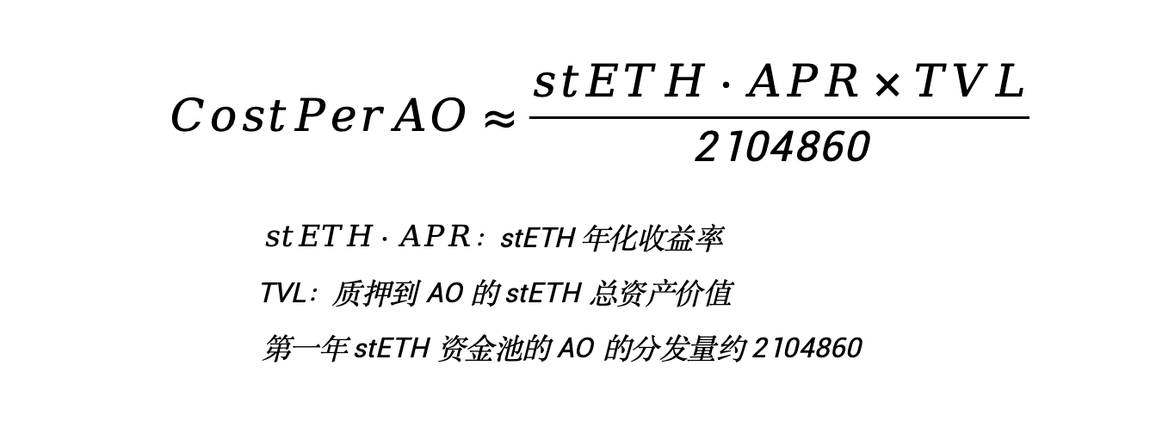
Additionally, we can evaluate the risks and costs associated with acquiring AO, which will significantly influence future AO pricing. AR holders need only hold their tokens passively, whereas stETH must be obtained by staking ETH via Lido. Currently, stETH offers an APR of 3.3%. By staking stETH into AO, users effectively forfeit this yield to the AO protocol—this foregone income represents the opportunity cost for stETH stakers. If the pool TVL reaches $1 billion, the cost per AO acquired through stETH staking would be approximately $15.70. However, this is a simplified calculation under controlled variables and assumes stETH remains the sole eligible cross-chain asset:
For short-term investors, both staking stETH and holding AR expose them to price volatility risk. Some centralized exchanges (CEXs) offer zero-leverage borrowing services, typically at interest rates below 1%. However, given the extended reward period for AO incentives, users should carefully weigh these trade-offs. Meanwhile, the current cost of converting AOCRED to AO is around $50–60 per AO (ensure conversion before June 27, 2024—expired after date). These tokens also unlock on February 8, 2025, so the price of 1000 AOCRED essentially reflects the AO futures price. Given that AO testnet deployment has already contributed substantial market cap growth to AR—far exceeding $1 billion—and considering the initial circulating supply will be only a few million AO, there is considerable upside potential for AO’s market price.
For long-term investors, time mitigates market volatility risks. They benefit not only from potential appreciation of their principal but also from continuous accrual of AO rewards (including future growth dividends).
Summary
To summarize, the key to maximizing AO acquisition lies in closely monitoring changes in the stETH pool TVL and AR market cap, dynamically adjusting strategies based on acquisition costs to achieve optimal capital efficiency. Beyond cost considerations, potential price volatility cannot be ignored. Tactics such as zero-leverage borrowing may help mitigate certain risks. The cost and unlock timing of AOCRED-to-AO conversions are also critical decision factors. Ultimately, long-term holders simply need to wait patiently for results.
Join TechFlow official community to stay tuned
Telegram:https://t.me/TechFlowDaily
X (Twitter):https://x.com/TechFlowPost
X (Twitter) EN:https://x.com/BlockFlow_News
 @perma_dao


