Will Blast airdrop face a network-wide backlash like zkSync did?
TechFlow Selected TechFlow Selected
Will Blast airdrop face a network-wide backlash like zkSync did?
Users with funds earn Blast Points, users with time earn Blast Gold, and those with both funds and time get both.
 Navigating Web3 tides with focused insights
Author: 0xlin
I believe the most critical judgment criterion is the "airdrop allocation ratio."
Yes, unlike zkSync, which faced backlash due to unfair distribution, whether Blast’s airdrop ratio meets user expectations will directly impact its overall public sentiment at TGE. (Of course, I think any FUD toward Blast at this stage is meaningless—and may even benefit users deeply engaged with Blast. But if, when Blast releases its tokenomics model, the S1 airdrop ratio turns out significantly lower than expected, I’ll be among the first to FUD and dump Blast tokens.)
Why do I believe the airdrop ratio directly determines whether Blast receives praise or criticism? Because the alignment between the airdrop ratio and Blast’s incentive mechanism reflects the project team’s true “vision.”
The core purpose of an incentive mechanism is to enable a “sustainable, growing, and positively cyclical ecosystem.” As illustrated in a diagram I shared earlier:
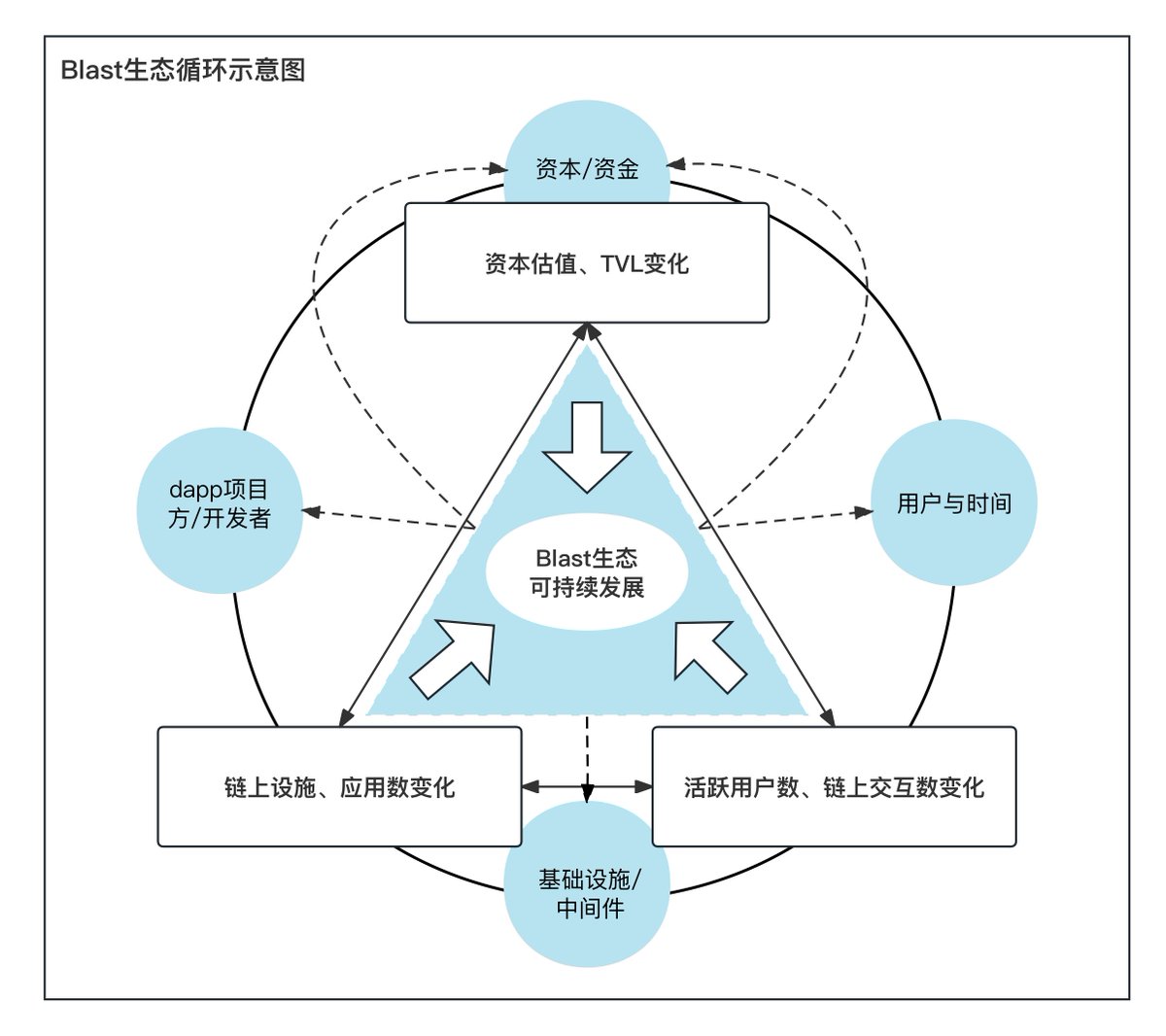
Regarding Blast’s incentive mechanism, let me first discuss the historical evolution of Web3 airdrop models.
When Uniswap distributed 400 $UNI tokens en masse, we generally consider it the pioneer of Web3 airdrops, indirectly sparking DeFi Summer—what I call Airdrop Model 0.1. (Note: I don’t count hardware-resource mining as a strict or narrow definition of airdrops.)
Afterward, we saw a diversification of airdrop models: testnet interaction airdrops, mainnet interaction airdrops, trading airdrops, staking airdrops, check-in task airdrops, etc. In particular, mainnet interactions—especially within the L1/L2 blockchain space—gained significant attention and became favorites among professional farming studios.
However, after traditional L2s like zkSync completed their airdrops, many believed the era of large-scale airdrops had ended. I strongly disagree—Web3 airdrop mechanics won’t disappear anytime soon; they simply need an upgrade. Yes, the old model of farming TXs, burning gas, and Sybil-resistant checks by projects should be phased out.
If we refer to traditional airdrop models from zkSync, Starknet, OP, Arb, etc., as Version 1.0, then Blast represents the upgraded Version 2.0. (Unfortunately, many users still operate under 1.0 thinking and end up FUDing Blast.)
Because Blast’s incentive mechanism is extremely transparent:
Users with capital earn Blast Points; users with time earn Blast Gold; those with both capital and time earn both.
On this point, Blast’s official website has long stated clearly: a 50% split between Blast Points (for stakers) and Blast Gold (for developer airdrops).
Therefore, if you view Blast purely as a staking project, you can ignore the Gold component entirely and simply complete basic transaction interactions (with double points). Alternatively, if you see Blast as a platform, you can ignore Blast Points and instead engage with DApps on the Blast platform to earn Gold. (Here I borrow a phrase I really like from @Greta0086: “Gold points belong to thinkers and doers.”)
Thus, capital staking and DApp interaction can be viewed independently, each contributing differently to the ecosystem.
Another key point: in the traditional L2 space, L2 teams typically incentivize DApps and developers through direct funding grants (Ecosystem Grants).
Blast, however, rewards DApps and developers via Gold (developer airdrops)—essentially providing them with “non-monetary operational/marketing funds” directly through the protocol, and even offering “cold-start funding” through early initiatives like the Big Bang Campaign.
In contrast, traditional 1.0 airdrop models either didn’t allocate any portion directly to users as Gold, or distributed value based on opaque DApp-specific marketing strategies. Blast leverages a well-designed底层 protocol (Points API) to make this transparent and fair.
With that understanding, we return to the crux: the “airdrop ratio.” What kind of allocation would trigger widespread FUD against Blast? — When Blast allocates only a single portion of tokens covering both Points and Gold combined.
That might sound abstract, so let’s use @MantaNetwork as an example. Their first phase allocated 5.6% of tokens via capital staking (similar to Blast’s Points portion). For comparison, if Blast’s S1 airdrop ratio were:
1) Blast Points + Gold = 5.6%, the airdrop ratio would severely mismatch Blast’s dual incentive structure—an act of conceptual deception toward users;
2) Blast Points and Gold each at 5.6%, totaling 11.2%, aligns with expectations—clearly representing “two distinct airdrop portions”;
3) Total airdrop exceeding 11.2%, e.g., 9% each for Points and Gold, totaling 18%—would exceed expectations.
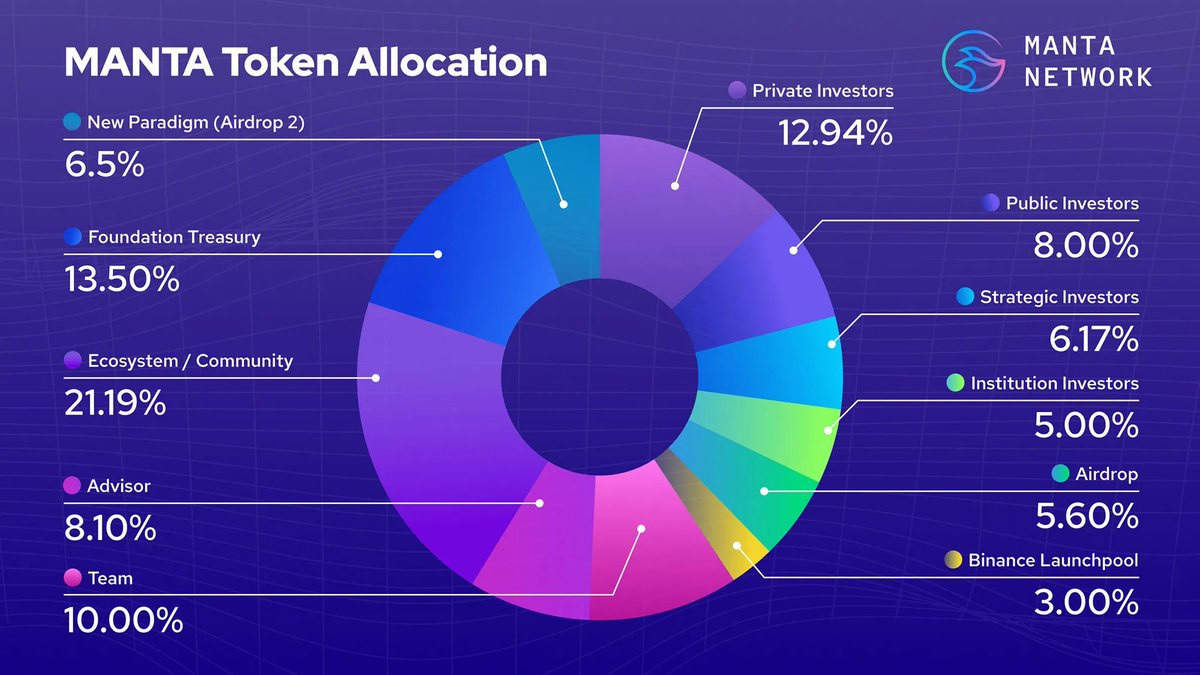
(Note: Since the staking periods differ between projects, airdrop ratios aren’t directly comparable. For instance, zkSync’s initial 17.5% airdrop sounds high but was spread over roughly four years.)
To summarize:
Requiring both TVL and user engagement (“capital and time”) is perfectly reasonable—and actually a smart strategy for sustainable ecosystem growth. However, the airdrop must offer users a corresponding or equivalent share in return.
Whether there will be FUD or not—let’s wait together for Blast’s tokenomics model to be revealed.
Join TechFlow official community to stay tuned
Telegram:https://t.me/TechFlowDaily
X (Twitter):https://x.com/TechFlowPost
X (Twitter) EN:https://x.com/BlockFlow_News
 @0xlaurence