New Bitcoin Whale: BlackRock
TechFlow Selected TechFlow Selected
New Bitcoin Whale: BlackRock
Financial giant BlackRock has replaced Grayscale's position.
 Navigating Web3 tides with focused insights
Author: Huohuo
On March 21, BlackRock announced the launch of BUIDL, its first tokenized fund on Ethereum, directly igniting a surge in interest in the RWA (Real World Assets—real-world assets tokenized via blockchain technology) sector.
However, this isn't the first time BlackRock has shaken up the crypto market. As early as January, BlackRock led the charge in launching the long-awaited spot Bitcoin ETF, sending shockwaves through the industry. Following this, the entire crypto market entered a new boom cycle, with Bitcoin—after more than a year of stagnation—breaking through the $40,000 mark.
Looking ahead, BlackRock is expected to dive deeper into the crypto industry, becoming a pivotal force. As the world's largest asset management firm, why is BlackRock interested in cryptocurrencies? And what implications does this have for the future development of the crypto industry? Let’s take a closer look at this newly emerged Bitcoin whale in the crypto space.
Who is BlackRock?
BlackRock, founded in 1988, is currently the world’s largest asset management, risk mitigation, and advisory firm.
Today, BlackRock operates 89 offices across 38 countries, employs over 16,000 people, and serves clients in more than 100 countries. It holds equity stakes in 4,973 companies, including Apple, Microsoft, NVIDIA, Amazon, Facebook, Tesla, and ExxonMobil.

Top equity holdings of BlackRock as of August 2023. Source: Startuptalky
In terms of revenue, BlackRock generated a total of $17.86 billion in 2023, with the largest portion ($14.4 billion) coming from investment advisory fees, management fees, and securities lending. The Americas contributed the most regionally, generating $11.9 billion in revenue in 2023. Overall, financial advisory and management fees constitute the bulk of the company’s income, primarily driven by U.S.-based firms.

Source: https://in.tradingview.com
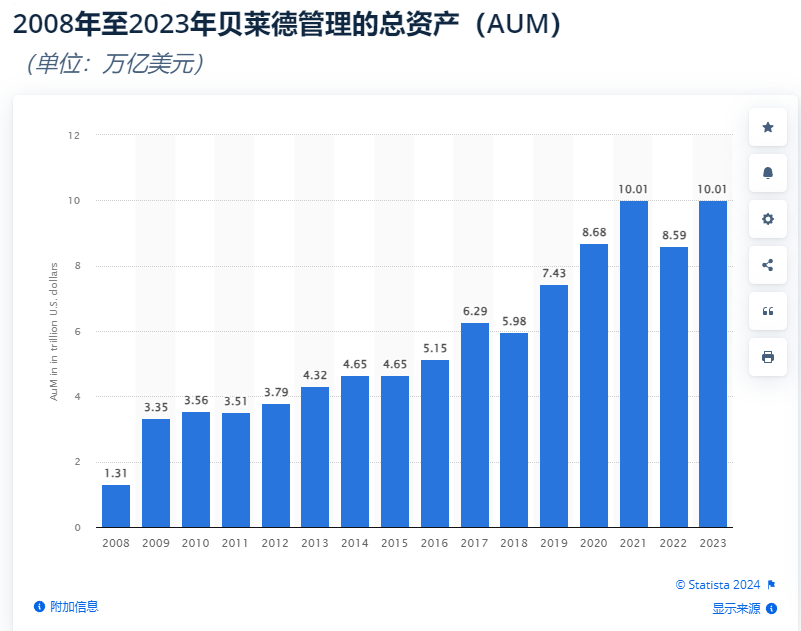
According to reports, in Q4 2023, BlackRock managed assets totaling an astounding $10 trillion. Even without launching a spot Bitcoin ETF, BlackRock stands unchallenged as the towering giant of global finance. So why is BlackRock now moving into the crypto industry? Is this a natural expansion of its business? Or has it recognized Bitcoin’s potential to hedge against traditional financial risks? Or does BlackRock view this as a valuable addition to its investment portfolio?
BlackRock’s Crypto Moves
In fact, BlackRock has shown interest in the crypto and blockchain space for several years, but faced significant challenges earlier on, including high market volatility, lack of clear regulation, immature market rules, and the SEC’s longstanding rejection of spot Bitcoin ETF applications due to concerns about market manipulation. Thus, it refrained from making bold moves.
However, on January 11, 2024, BlackRock led several institutions in launching the first spot Bitcoin ETFs in the U.S.—iShares Bitcoin Trust (IBIT)—marking a historic reversal after a decade of rejections and opening a new chapter in crypto development.
1) One of the Key Drivers Behind the Approval of the Spot Bitcoin ETF
BlackRock has a near-perfect track record with ETF approvals. According to foreign media, the company had 575 out of 576 applications approved by the SEC—close to 100% success rate. Only one ETF application was rejected, back in October 2014—a actively managed ETF jointly submitted with Precidian Investments, which the SEC deemed lacked transparency in profitability.
Yet when facing the SEC’s decade-long resistance to spot Bitcoin ETFs, BlackRock prepared thoroughly to increase approval chances. On June 15, 2023, when filing its spot Bitcoin ETF application, BlackRock proactively addressed key SEC concerns. For instance, to meet SEC requirements on preventing market manipulation, BlackRock proposed signing surveillance-sharing agreements with major platforms and named Coinbase as the custodian for the proposed ETF to ensure secure Bitcoin management.
Thanks to BlackRock’s involvement and reputation, numerous investment and asset management firms joined the race, including Fidelity, Invesco, VanEck, Cathie Wood’s Ark Investment Management, and WisdomTree. Most of them also listed Coinbase as their ETF custodian.
Unfortunately, on June 30, the SEC rejected the applications from BlackRock, Fidelity, and others, citing insufficient clarity and completeness. A few days later, BlackRock resubmitted its application. Typically, the SEC has up to 240 days to decide on a Bitcoin ETF application. While the process may involve lengthy discussions, the fact that the application wasn’t outright rejected signaled progress and raised hopes for eventual approval.
Based on the timeline of each ETF’s rule change publication in the Federal Register, TokenInsight predicted the following possible approval dates for eight institutions’ ETFs:
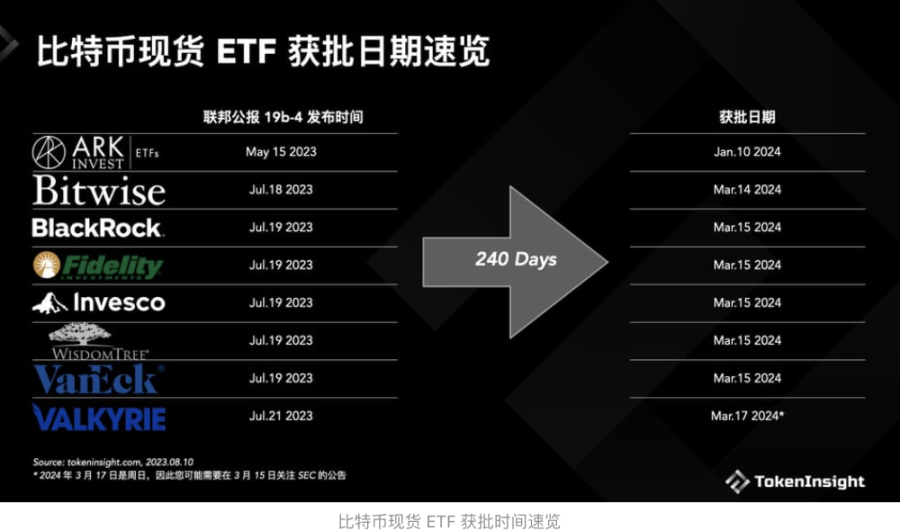
Indeed, as predicted, in the early hours of January 11, the SEC officially approved 11 spot Bitcoin ETFs, including BlackRock’s.
Following the announcement, Bitcoin briefly surged above $49,000. This marked the beginning of a spiraling upward trend—within less than three months, Bitcoin reached an all-time high of over $71,000.
In fact, since BlackRock first filed its spot Bitcoin ETF application, the market responded positively. Bitcoin broke through $30,000 and then $40,000 in October 2023, and climbed to $45,000 after the approval.
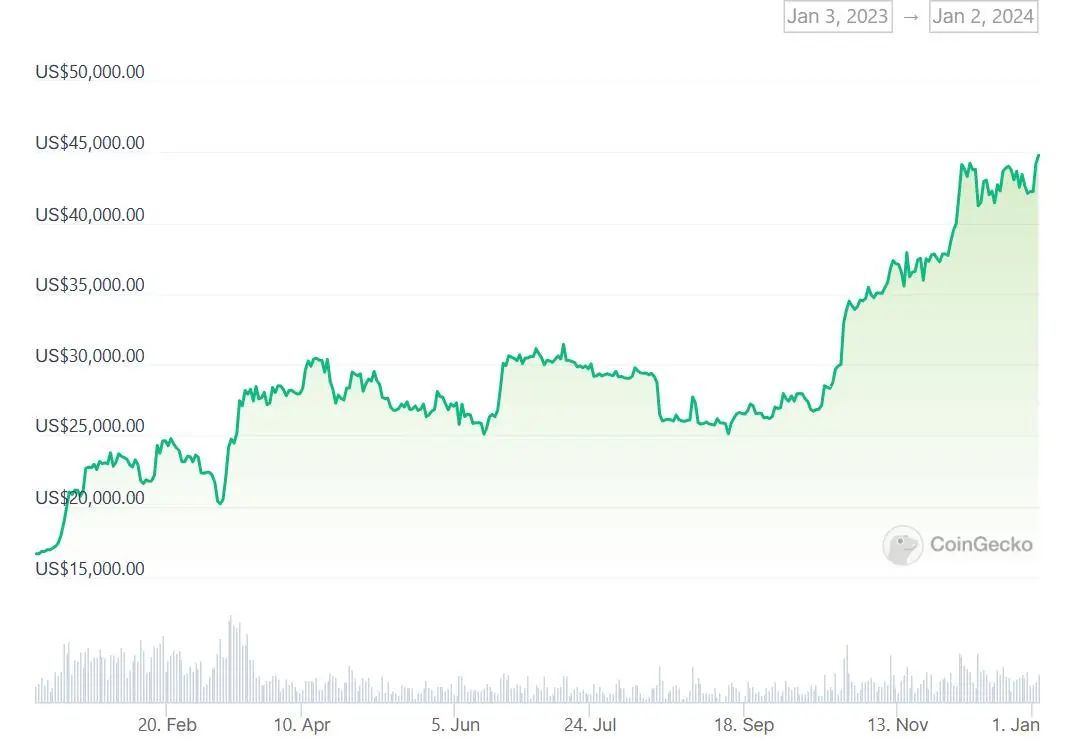
Bitcoin price performance over the past year
Moreover, five of the approved ETF issuers selected Coinbase as their custodian, driving Coinbase’s share price from around $70 in October 2023 to a peak of $187 in December.
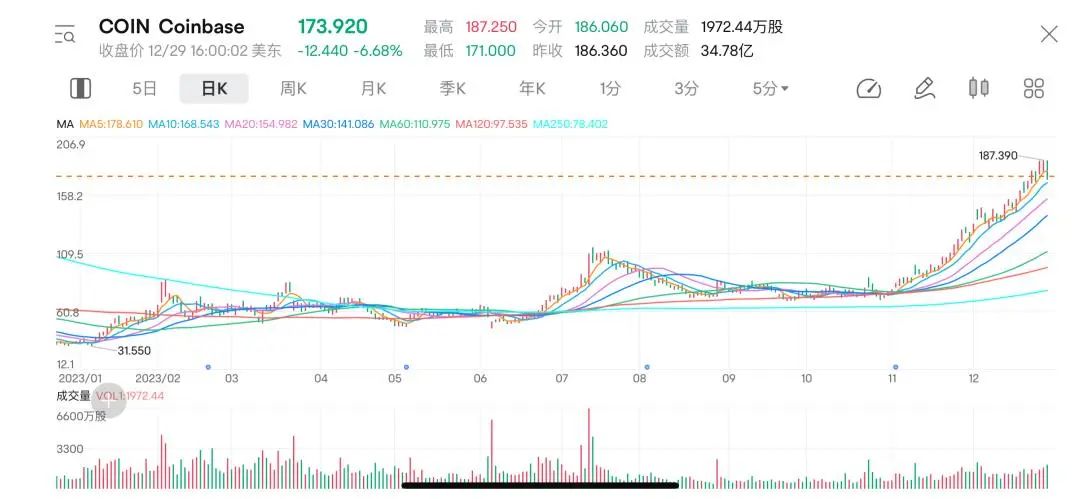
Coinbase token price trend in 2023
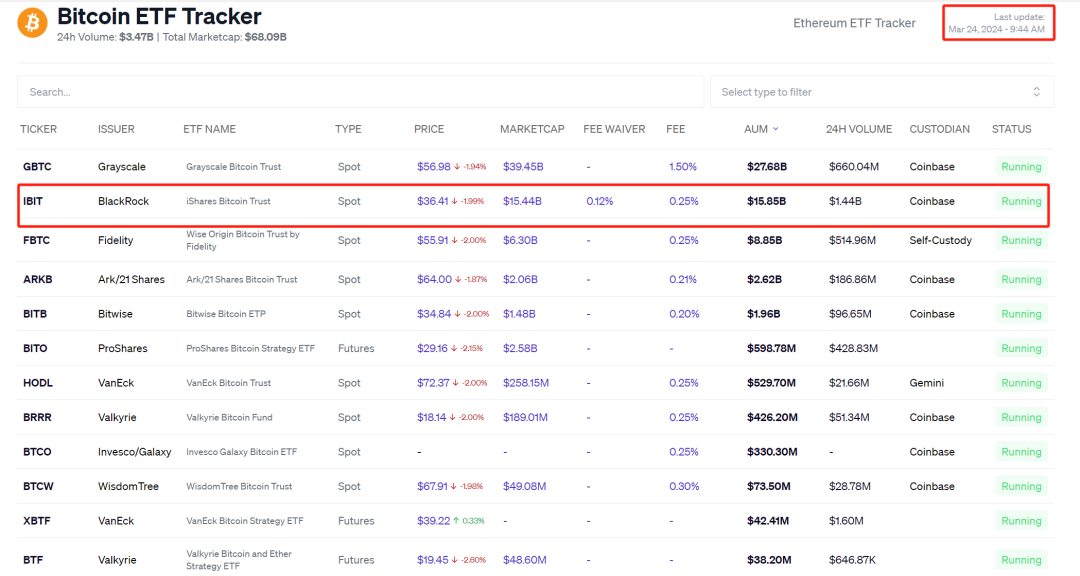
According to ChainCatcher on March 24, since their debut on January 11, 2024, the new spot Bitcoin ETFs (excluding GBTC) have significantly increased their Bitcoin holdings. Nine new spot Bitcoin ETFs (excluding Grayscale’s GBTC) now hold 474,363.55 BTC. Among them, BlackRock’s IBIT leads with 242,829.94 BTC, making it the dominant player in the group, accounting for 51.19% of the total held by these nine funds. Including GBTC, the total rises to 824,615.55 BTC—approximately 3.92% of Bitcoin’s maximum supply.
According to Cointelegraph on March 25, assuming current capital flows remain stable, the amount of Bitcoin held in BlackRock’s spot ETF could surpass Grayscale’s GBTC within the next three weeks.
Although short-term market analysis suggests the impact of ETF approval might not be immediately dramatic, in the long run, their presence will significantly enhance the compliance and investability of digital assets, improving market depth and liquidity, reducing volatility, and boosting investor confidence.
Overall, thanks to BlackRock’s global reputation, influence, and extensive expertise in launching and managing ETFs, both the SEC and the market have come to recognize the feasibility and value of Bitcoin ETFs. BlackRock has made a profound impact on the crypto world. Next, let’s review its multiple investments and preparations in the crypto space.
2) Major Shareholder in the Company Holding the Most Bitcoin
Within BlackRock’s cryptocurrency portfolio, it holds a 5.53% stake in MicroStrategy. As a business intelligence and software company, MicroStrategy is currently the largest corporate holder of Bitcoin. BlackRock acquired this stake through various funds and ETFs, such as iShares Core S&P 500 ETF, iShares ESG Aware US Aggregate Bond ETF, and iShares Russell 1000 Growth ETF.
MicroStrategy currently holds over 120,000 Bitcoins, worth more than $5 billion, and has issued over $2 billion in debt to fund additional Bitcoin purchases. According to a recent Forbes analysis, BlackRock’s stake in MicroStrategy equates to ownership of over 6,600 Bitcoins—worth more than $300 million. This makes BlackRock one of the largest institutional holders of Bitcoin, despite not holding any directly. BlackRock’s investment in MicroStrategy reflects its optimism and confidence in both the company and Bitcoin.
3) $384 Million Invested in Leading Bitcoin Mining Companies
In August 2023, BlackRock invested $384 million in Bitcoin mining companies as part of its strategy to explore the potential impact of digital currencies on the global economy.
The four recipients—Marathon Digital Holdings, Riot Blockchain, Bitfarms, and Hut 8 Mining—are among the largest and most established Bitcoin block producers today.
This investment in Bitcoin miners is a bold and innovative move. On one hand, it supports the growth and development of the Bitcoin network and ecosystem, enhancing its security, stability, and diversity, while encouraging technological innovation and adoption. On the other hand, it signals BlackRock’s growing interest and engagement in the crypto space, acknowledging the industry’s value and potential.
4) Close Collaboration with Crypto Industry Players
While ETF issuers have long navigated the SEC’s scrutiny, BlackRock has been actively advancing the process by collaborating and consulting with other key stakeholders and experts in the crypto industry—such as Coinbase, Fidelity, and VanEck—to address SEC concerns and requirements.
In 2022, BlackRock partnered with Coinbase, integrating its Aladdin operating platform with Coinbase’s leading crypto exchange to build a robust solution for the IBIT ETF.
Beyond Bitcoin ETFs, BlackRock has formed partnerships with several major crypto players. It holds a minority stake in stablecoin issuer Circle Internet Financial and manages over $25 billion in reserves for government money market funds supporting Circle’s USDC.
BlackRock also manages a private Bitcoin trust for institutional clients. According to sources, the trust’s assets exceeded $250 million, though most clients have since migrated their funds to the new ETF.
BlackRock CEO: Bitcoin is Irresistible
BlackRock’s embrace of Bitcoin has been gradual. During the pandemic, Rick Rieder, the firm’s Chief Investment Officer for Global Fixed Income, began allocating Bitcoin futures in his fund. Sources say Robbie Mitchnick, BlackRock’s Head of Digital Assets, also helped convert Larry Fink into a Bitcoin believer.
Speaking of Fink, who ranked on the Forbes Billionaires List in 2022, the 72-year-old is hailed as the “Godfather of Wall Street” and architect of a “financial empire,” playing an indispensable role in BlackRock’s rise. His investment acumen, leadership, and networking skills are unparalleled.
But Fink wasn’t always a Bitcoin supporter. In 2017, he called Bitcoin a “money laundering index” and repeatedly criticized cryptocurrencies as “something clients don’t actually want to invest in.”
It wasn’t until 2022 that Fink’s stance on digital assets visibly shifted. Sources indicate that Bitcoin’s resilience following the 2022 crypto crash was a key factor in changing BlackRock’s perspective.
During a conference call in April that year, Fink said the company was broadly researching the crypto space and observing rising client interest. That same month, BlackRock participated in Circle’s $400 million funding round. Later that summer, it quietly launched a spot Bitcoin product for U.S. institutional clients—its first private trust offering. BlackRock seeded the fund with its own capital and expanded it alongside external investors.
Also in 2022, BlackRock formed a partnership with Coinbase, enabling institutional clients holding Bitcoin on the exchange to use BlackRock’s Aladdin suite for portfolio management and risk analysis. Hence, Coinbase is now the custodian for its spot Bitcoin ETF.
Today, it’s fair to say Fink has become one of Bitcoin’s most prominent believers. His firm has legitimized Bitcoin, manages the fastest-growing Bitcoin fund, forged alliances with top digital asset players, and opened the door for mainstream investors to buy and sell Bitcoin as easily as stocks.
Now, BlackRock’s ambitions in crypto extend beyond Bitcoin. The asset manager has filed a pending application with the SEC to launch an ETF holding Ethereum, the second-largest cryptocurrency and native token of the Ethereum blockchain. The regulatory decision deadline is in May—definitely something to watch.
Conclusion
True to its motto—“Investing in a New World”—BlackRock believes cryptocurrencies and blockchain technology can transform finance, creating new opportunities for growth, efficiency, and inclusion.
Precisely because it recognizes the growing demand and adoption of cryptocurrencies by institutional investors, retail users, governments, and enterprises, BlackRock’s interest goes beyond chasing trends or speculative bets—it represents a strategic, long-term vision.
One thing is certain: BlackRock will continue to play a major role in the future of crypto.
Join TechFlow official community to stay tuned
Telegram:https://t.me/TechFlowDaily
X (Twitter):https://x.com/TechFlowPost
X (Twitter) EN:https://x.com/BlockFlow_News
 白话区块链
白话区块链