Bitcoin NFT sells for $254,000 at Sotheby's — but it's not the most expensive one yet
TechFlow Selected TechFlow Selected
Bitcoin NFT sells for $254,000 at Sotheby's — but it's not the most expensive one yet
Why Are NFTs Etched on the Bitcoin Network So Expensive?
 Navigating Web3 tides with focused insights
By Mu Mu
When digital artwork by crypto artist Beeple sold for $69.34 million at Christie's, NFTs suddenly became a global sensation overnight. This new medium for digital art broke out from Web3 and entered the mainstream art collecting market.
However, as the crypto market entered a bear phase, the non-fungible token (NFT) market also declined. Major auction houses like Christie’s and Sotheby’s saw sharp drops in digital art sales. Then Bitcoin NFTs emerged, offering a new "canvas" for digital art, revitalizing another segment of the NFT market.
As of January 23, 19 Bitcoin NFTs sold at Sotheby’s for a total of approximately $1.1 million. Among them, Genesis Cat—a digital artwork created on the Bitcoin blockchain by visual artist FAR (Francisco Alarcon)—sold for $254,000. But even that wasn't the highest price.
In December last year, Bitcoin-based NFT artworks made their debut at Sotheby’s, where three pixel-art Super Mario-themed digital pieces sold for around $450,000—about five times their top estimated value.
Compared to earlier Ethereum-based NFTs, Bitcoin NFTs use protocol tools to store data entirely on the Bitcoin network. In terms of crypto asset market capitalization, Bitcoin is the world’s largest blockchain network, currently valued at $784.66 billion.
Previously considered only capable of recording Bitcoin transactions, the blockchain has now gained new functionality. Taproot Wizards, the developer behind this innovation, enabled these new features—explaining why its Bitcoin NFTs command high prices. With this tool, more NFT creations are emerging within the Bitcoin ecosystem, and anyone can mint them.
Sold for $254,000—Over 12 Times Estimated Value
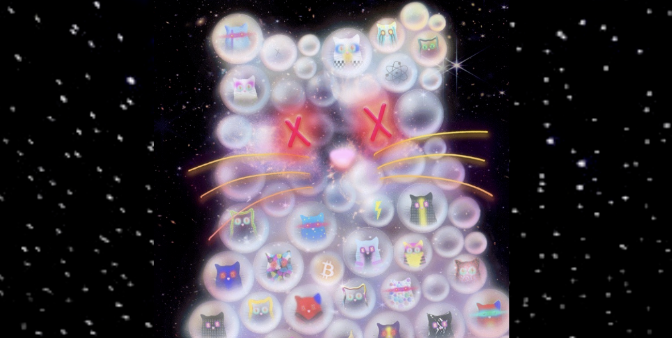
Following in the footsteps of Nyan Cat and CryptoKitties, another cat-themed NFT has taken off. On January 22, the NFT named Genesis Cat was auctioned at Sotheby’s—the world’s leading auction house for art and luxury goods—for $254,000, more than 12 times its pre-sale estimate of $15,000–$20,000.
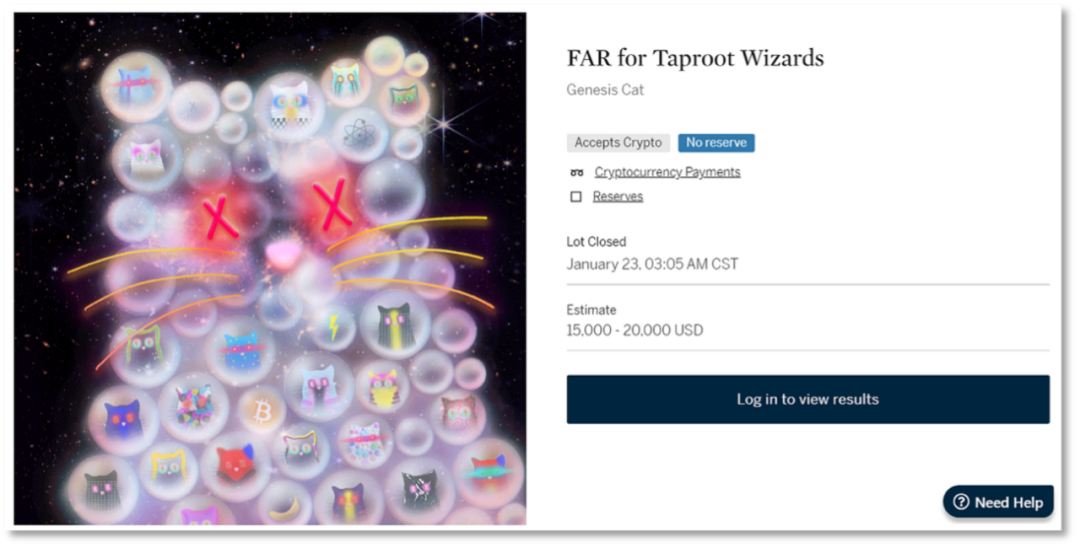 Genesis Cat listed on Sotheby’s auction platform
This high-value NFT artwork was created on the Bitcoin blockchain by FAR (Francisco Alarcon), a visual and technical artist/engineer. Genesis Cat is part of the Quantum Cat NFT series. The Quantum Cats will be the first NFT collection launched by Taproot Wizards, the development team behind the Bitcoin Ordinals protocol, consisting of 3,333 cat-themed Bitcoin NFTs.
Genesis Cat is not the most expensive Bitcoin NFT ever sold at Sotheby’s.
Back in December 2023, the historic auction house held its first sale of Bitcoin NFTs—pixel-art works inspired by Super Mario—that fetched about $450,000, roughly five times the highest estimate. As of January 23, Sotheby’s had sold 19 Bitcoin NFTs with a combined value of approximately $1.1 million.
 The Super Mario-themed Bitcoin NFT series sold for $450,000
Looking back at Sotheby’s NFT auction history, it's clear that none of these Bitcoin NFTs have reached astronomical prices.
The auction house first entered the NFT digital art space in 2021, setting several record-breaking sales—including CryptoPunk #7623, which sold for $11.75 million, and the Bored Ape Yacht Club (BAKC) Cube series, whose 23,598 NFTs generated $14 million in total sales.
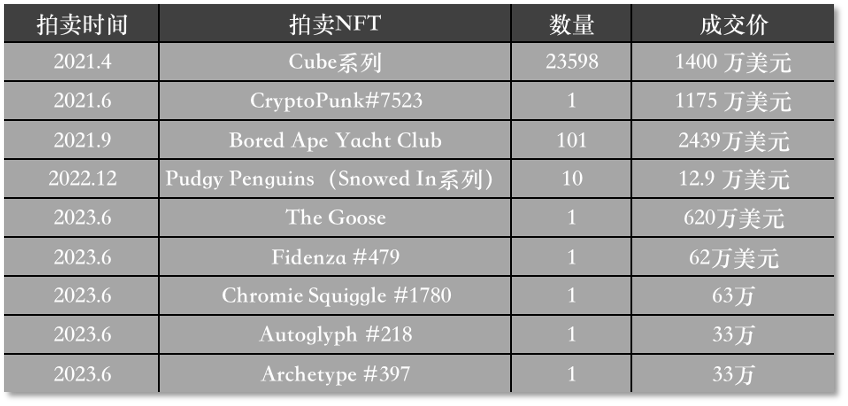 Partial statistics of NFTs auctioned by Sotheby’s
But over time, the sale prices of individual NFT artworks at Sotheby’s have steadily decreased. According to Sotheby’s 2021 annual report, the auction house achieved a total sales volume of $7.3 billion that year—the highest in its more than 200-year history—with NFT collectibles contributing $100 million. By contrast, digital art auctions generated only about $35 million in 2023.
This reflects the broader downturn in the NFT market, which was particularly bleak in 2023. Data from CryptoSlam shows that total NFT sales across all blockchains amounted to just $8.7 billion in 2023, far below the $23.734 billion recorded in 2022. However, transaction counts reached 90.6 million—1.65 times the 54.85 million transactions in 2022.
Amid this market slump, the emergence of Bitcoin NFTs is injecting fresh momentum.
1.14 Million Bitcoin NFTs Minted Within 200 Days
The uniqueness of the Genesis Cat NFT lies in the fact that it is a digital artwork inscribed onto the Bitcoin blockchain via the Ordinals protocol—a process known as “inscription,” and the resulting artifact is called an “ordinal” or “inscribed content.”
As Taproot Wizards’ digital artworks debut on Sotheby’s, Bitcoin inscriptions are being traded at an unprecedented pace in the market.
According to Cryptoslam, as of January 25, Bitcoin NFTs have generated $2.141 billion in sales across 1.874 million transactions. In comparison, Ethereum NFTs—the best-selling platform—have achieved $42.188 billion in sales with 45.497 million transactions. Although Bitcoin NFT sales represent only 5% of Ethereum’s total, this figure was achieved in just over 200 days since the market’s inception.
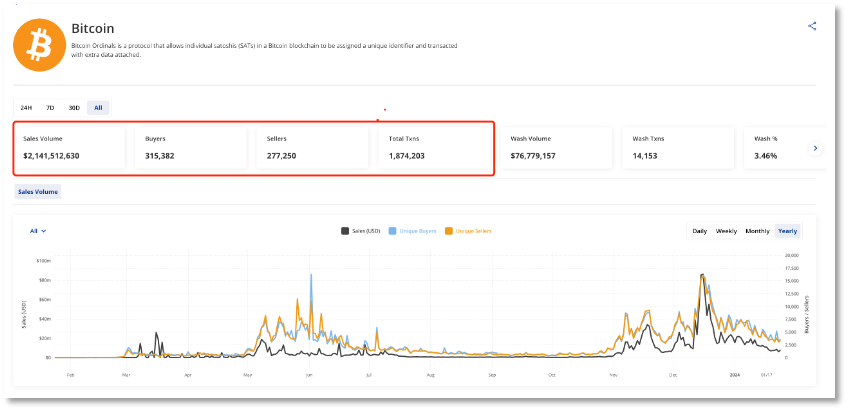 More buyers than sellers in Bitcoin NFT market over the past year
Since the launch of the Ordinals protocol in March 2023—which granted the Bitcoin blockchain the ability to create NFTs—1.14 million image inscriptions were created within 200 days. That rate far surpasses output from established NFT strongholds: the combined total of NFTs produced on Ethereum, Solana, and Polygon during their respective first 200 days.
Why has the Bitcoin NFT market grown so rapidly? It comes down to how the market perceives its value.
Unlike NFTs on other blockchains such as Ethereum, Bitcoin NFTs are created and stored directly on the Bitcoin blockchain. On other smart contract-enabled blockchains, while creation and transaction data are recorded on-chain, the actual images, text, or video files are typically stored off-chain.
The Ordinals protocol enables NFT minting on Bitcoin by assigning sequential numbers to the smallest unit of Bitcoin, the “sat” (or satoshi), and embedding text, images, or even videos within the network’s allowable storage limits. The result of this inscription process is known as a Bitcoin ordinal.
The “numbering” and “inscription” features of ordinals have given rise to various new crypto assets. If different annotations or content are inscribed into individual sats, they fulfill the criteria of non-fungible tokens (NFTs). If identical content is inscribed, they effectively become fungible tokens akin to BTC or ETH.
Historically, Bitcoin’s network has been limited to generating and recording Bitcoin transactions—data that is publicly verifiable and immutable. Given that each Bitcoin block has a maximum capacity of 1MB—capable of storing up to 4,096 transactions—it was long considered unsuitable for carrying additional information.
The Ordinals protocol proved that Bitcoin can indeed carry supplementary data. Numbered entries with unique significance gain commemorative value due to Bitcoin’s tamper-proof nature, leading some market participants to regard them as “digital artifacts.” Of course, inscribing data onto the Bitcoin network increases congestion, slowing transaction speeds and driving up fees.
Recently, some core developers of Bitcoin Core, the software underlying Bitcoin, criticized inscriptions as “valueless” amid growing network strain. Yet judging by the rising volume of Bitcoin NFTs and related tokens, market participants appear largely indifferent to the developers’ stance.
The successful auction of Genesis Cat and other Bitcoin NFTs at Sotheby’s demonstrates renewed investor interest in digital art. Galaxy Research and Mining forecasts that the market capitalization of the Ordinals inscription ecosystem could reach $5 billion by 2025.
Join TechFlow official community to stay tuned
Telegram:https://t.me/TechFlowDaily
X (Twitter):https://x.com/TechFlowPost
X (Twitter) EN:https://x.com/BlockFlow_News