Former Ethereum Foundation Member Accuses It of Staging The DAO Hack
TechFlow Selected TechFlow Selected
Former Ethereum Foundation Member Accuses It of Staging The DAO Hack
Ethereum, why do you only get attention because of old news?
 Navigating Web3 tides with focused insights
Author: 0xAyA, Odaily Planet Daily

Solana is charging forward aggressively, while ETH appears powerless to respond. Recently, Ethereum has once again found itself in the midst of an "accusation crisis."
Ethereum has faced many perilous moments in the past, with the most dramatic being the DAO incident—a hacker attack that nearly destroyed the entire community. Ultimately, after the fork, both sides—those supporting and opposing the rollback—ceased their debate, and everything seemed settled.
But recently, a former foundation member made explosive claims suggesting the DAO incident was orchestrated by members of the Ethereum Foundation. Are these allegations true or false?
Seven Years Ago: The Ethereum Story
Let’s briefly revisit history. DAO, or Decentralized Autonomous Organization, was originally a concept proposed by Vitalik Buterin. DAOs operate on blockchains via smart contracts without legal entities—we can think of them as "decentralized companies."
The DAO was a crowdfunding project initiated by blockchain company Slock.it.

Slock.it is a company combining blockchain with the Internet of Things. Initially, they aimed to use Ethereum to develop their "shared economy network." As development progressed, they realized decentralized sharing economies had great potential. They demonstrated this concept and vision at Devcon 1 in London, where it unexpectedly received enthusiastic responses—leading to the creation of The DAO project.
In The DAO project, token holders wielded significant power—the use of project funds required voting by token holders, with related proposals supported by smart contracts.
On April 30, 2016, The DAO began its crowdfunding campaign. The DAO token sale lasted 28 days and raised over 12 million ETH—nearly 14% of the total ETH supply at the time—worth more than $150 million.
On June 12 of the same year, Stephan Tual—one of The DAO's lead designers—claimed they discovered a "recursive call vulnerability" in the software.
However, perhaps the euphoria of successful fundraising overshadowed underlying risks. On June 17, hackers exploited a recursive bug in The DAO's code to repeatedly siphon assets from The DAO’s fund pool. Then, leveraging a second vulnerability, they prevented the separated assets from being destroyed, executing over 200 attacks and ultimately stealing 3.6 million ETH—more than one-third of the funds raised.
Under normal circumstances, assets split from The DAO would be destroyed. However, the hacker transferred the stolen DAO assets to another account before the function call ended, avoiding destruction. Fortunately, due to these very "flawed" codes, the hacker couldn’t immediately withdraw the ETH—code rules required a 28-day waiting period before withdrawal, giving the community enough time to devise countermeasures.
Ultimately, after extensive community discussion, it was decided to fork the ETH blockchain. This created two chains: the original chain, which retained the theft records, became ETC; the new chain, which erased the theft records, became the current ETH—each representing different community consensuses.
Accused Seven Years Later by a Former Insider
Steven Nerayoff—the former legal counsel and advisor to the Ethereum Foundation—recently claimed in a blog interview that Vitalik Buterin once lived with him in New York and worked out of his rented office. In the blog post, he alleged the DAO hack was an inside job. He stated that evidence uncovered by TruthLabs suggests the Ethereum Foundation and Slock.it were behind the infamous DAO hack, arguing that Ethereum has become a system influenced by a small group of developers, regulators, and investors—acting contrary to the community's original intent.
Additionally, Nerayoff named former SEC official Bill Hinman, pointing out potential conflicts of interest in Hinman’s personal finances affecting the SEC's lawsuit against Ripple.
Subsequently, an X user unearthed a GitHub post accusing Swiss SA Bity of possibly collaborating with groups operating under the names "White Hat Group" or "Robin Hood Group" to carry out the The DAO theft. These groups reportedly still hold around 7,000,000 ETH, with the "White Hat Group" allegedly organized by Alex Van de Sande from the Ethereum Foundation.
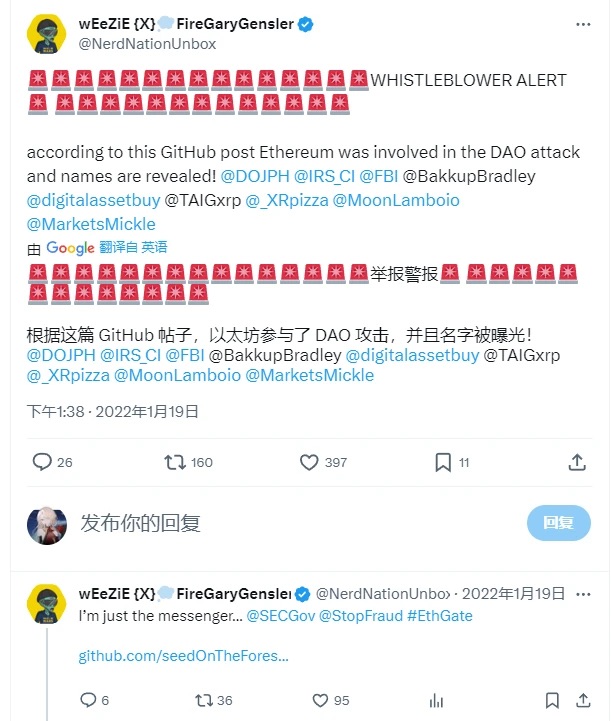
Interestingly, Steven Nerayoff was charged by the U.S. Department of Justice in 2019 with criminal extortion, damaging his personal credibility. However, in May 2023, a New York judge dismissed the charges and cleared his record.
Are Nerayoff’s allegations true? We don’t know yet—official responses are still pending. But at least, the accuser’s claims have brought a sliver of attention back to ETH during this bull market where it has otherwise been absent.
Join TechFlow official community to stay tuned
Telegram:https://t.me/TechFlowDaily
X (Twitter):https://x.com/TechFlowPost
X (Twitter) EN:https://x.com/BlockFlow_News
 Odaily