Facing the Chain Scams of Fake Crypto Trading Platforms: An Ounce of Prevention is Worth a Pound of Cure
TechFlow Selected TechFlow Selected
Facing the Chain Scams of Fake Crypto Trading Platforms: An Ounce of Prevention is Worth a Pound of Cure
Use blockchain analysis tools to mitigate risks before engaging in investments and transfers involving on-chain transactions—one ounce of prevention is worth a pound of cure; keep risks at bay.
 Navigating Web3 tides with focused insights
Author: Bi Lianghuan, OKLink Research Institute
The fallout from the JPEX case, involving as much as HK$1.6 billion, has yet to subside when another scam operating under the guise of an exchange has come to light. Last month, Hong Kong police reported on the fraudulent activities of HOUNAX, an unlicensed virtual asset exchange. According to the South China Morning Post, 158 Hong Kong residents have so far reported losses totaling approximately HK$155 million after being lured into investing through unlicensed platforms. The brazen HOUNAX orchestrated a layered scam that caused investors’ funds to “disappear upon deposit,” delivering yet another blow to Hong Kong’s crypto investors.
Both incidents are pyramid-style fraud schemes disguised under the banner of Web3 and virtual assets—a common financial scam tactic. They lure investors with promises of “high returns” and “quick wealth,” using funds from new investors to pay earlier participants, creating the illusion of profitability. Recent cases have all exploited the name of virtual assets to entice investors to deposit money directly into criminals’ pockets rather than onto legitimate trading platforms.
SFC Transition Period Challenges: New Technologies Become Scam Tools
One reason for the recent surge in such frauds is that financial criminals are exploiting the transitional window provided by the SFC for virtual asset trading platforms (VATPs). On June 1 this year, the Securities and Futures Commission (SFC) issued its “Guidelines for Virtual Asset Trading Platform Operators” (the “Guidelines”), stating that any VATP operating in Hong Kong must obtain a Virtual Asset Service Provider license by June 2024. This means the SFC has granted a one-year grace period for unlicensed but currently operating exchanges to develop and apply for licensing, rather than imposing an immediate ban—an approach reflecting support for Hong Kong’s Web3 development.
Another contributing factor is the appeal of new technology. Since the Hong Kong government announced its support last year, Web3 has become one of the city’s key technological priorities. Our analysis reveals a recurring pattern: criminals exploit virtual asset investors’ eagerness to invest, targeting them with carefully crafted misinformation. Additionally, virtual assets present a high operational barrier for new investors. In these scams, deception was deliberately built into processes like deposits and withdrawals.
The Web3 market remains immature. Compared to scams involving traditional financial instruments, we observe that Web3-related frauds escalate significantly faster. For example, the Madoff Ponzi scheme uncovered in 2008 lasted nearly a decade, whereas blockchain-based scams move rapidly due to techniques such as creating fake identities, anonymous wallets, and anonymous trading accounts. Some even exploit technical vulnerabilities in smart contracts, increasing the difficulty for law enforcement in investigation, evidence collection, and enforcement actions. Due to their rapid growth and high entry barriers, by the time these scams are discovered and reported, many users have already lost their assets, leaving no effective intermediate controls throughout the incident chain.
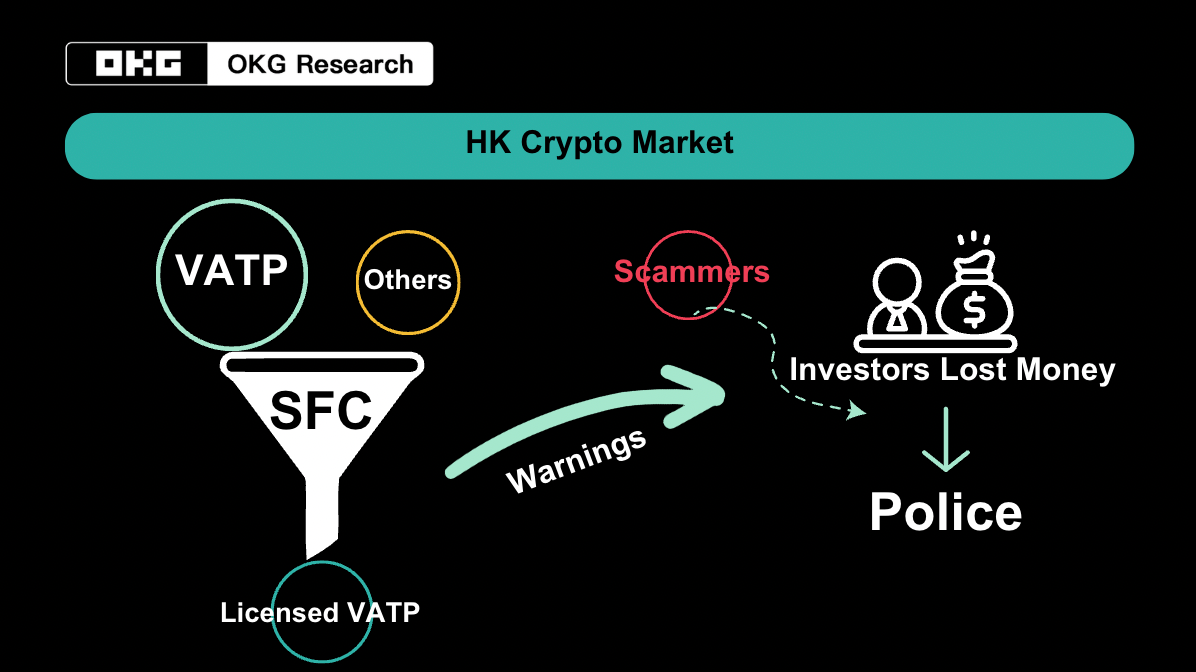
Figure: SFC's enforcement process during the transition period
Choosing Virtual Assets for Fraud May Be “Self-Imprisonment”
Based on case experience accumulated by OKLink, a compliance technology product under OKGroup, OKLink Research Institute compared these incidents with previous financial crimes and reached the following conclusion: after obtaining user funds, scammers typically transfer them via cryptocurrency addresses and anonymous wallets. However, this may be “self-imprisonment.”
We believe that if financial crime involves virtual assets, blockchain technology completely transforms traditional law enforcement methods. According to CBInsights, 90% of European Payments Council members believe that by 2025, blockchain technology will fundamentally change business operations in legal compliance. Once transactions are recorded on-chain, they are permanently stored on the blockchain, and anyone—whether institution or individual—can trace the entire transaction history using just a single wallet address. This overcomes longstanding challenges in financial crime investigations, including information asymmetry between financial institutions, difficulties in cross-border cooperation, and underutilization of unstructured data.
Precisely because of this transformative nature, without appropriate technological solutions, regulators and law enforcement agencies face cumbersome procedures when attempting to fully understand the complete flow of on-chain fund transfers. To meet such needs, regulatory and enforcement bodies can leverage effective blockchain analytics tools to more quickly track and analyze virtual asset transactions and ultimately obtain critical intelligence.
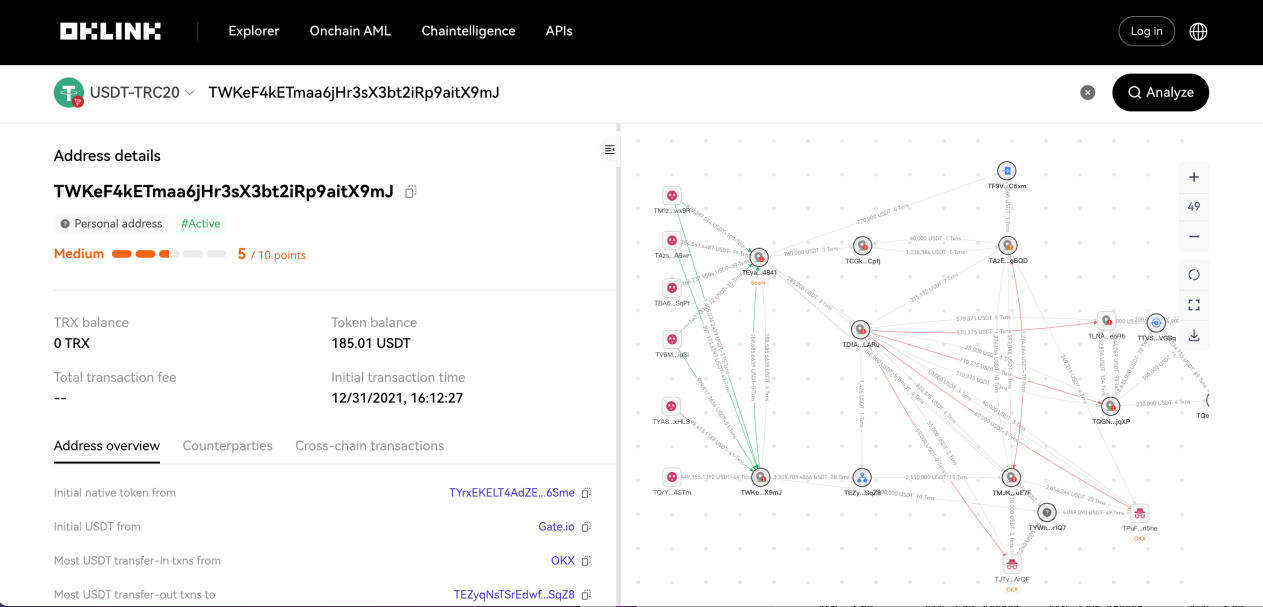
Figure: Blockchain analytics tool OKLink tracing fund flows
"An Ounce of Prevention Is Worth a Pound of Cure"
As Benjamin Franklin once said—this holds true for investor protection as well.
For virtual assets issued based on blockchain technology, blockchain analytics tools are not only efficiency enhancers for regulators and law enforcement but also essential compliance tools for virtual asset service providers, helping mitigate criminal risks including money laundering. Earlier this year, when the SFC consulted the public on VATP licensing requirements, OKLink Research Institute shared case experiences with the SFC using its product OKLink as an example to demonstrate how to trace on-chain assets and identify potentially suspicious transactions. In subsequent updated documents, the SFC explicitly highlighted the importance of blockchain data analysis tools and revised its "Anti-Money Laundering/Terrorist Financing Self-Assessment Checklist" on November 14, adding blockchain analytics tools as one of the assessment criteria. These publications indicate that the SFC prefers VATPs to proactively adopt technological solutions like blockchain analytics tools at the institutional level to help investors avoid risks before they occur.
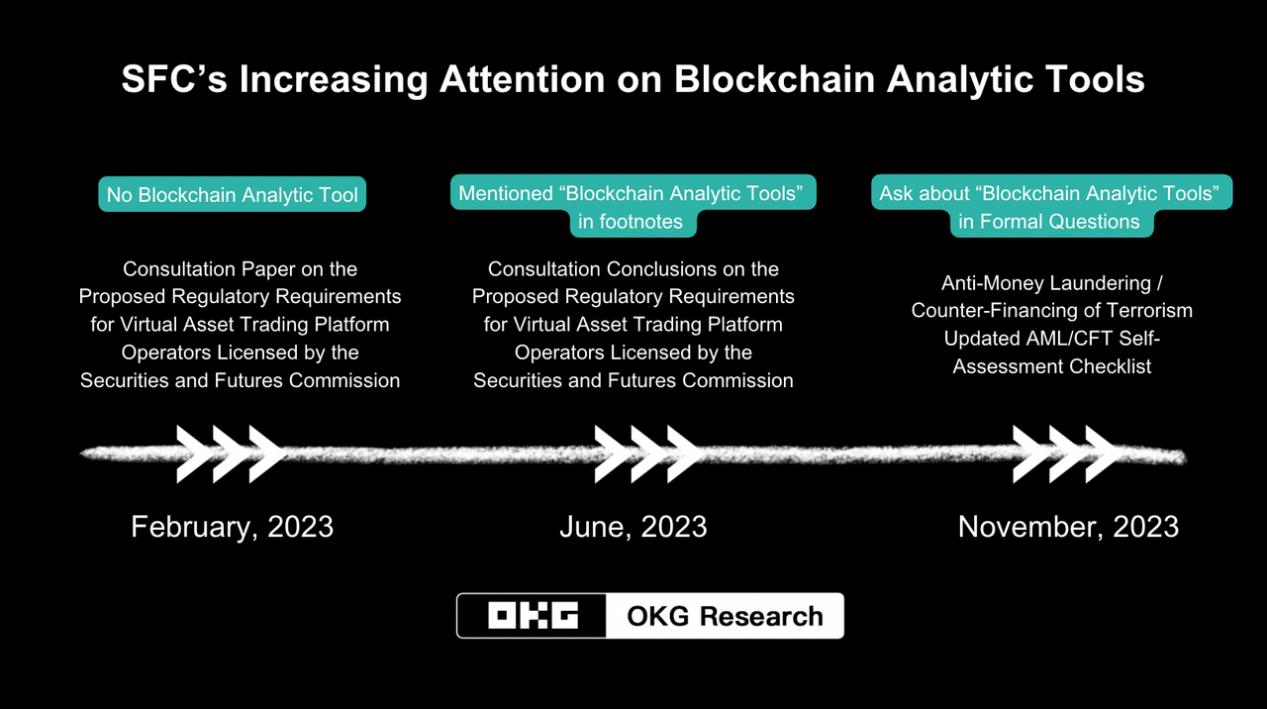
Figure: The path toward official recognition of blockchain analytics tools
It should be emphasized that the above measures and recommendations apply specifically to VATPs aiming for long-term, compliant, and lawful operation. Before making any investment, individual investors—regardless of the financial instrument involved—should conduct thorough due diligence or choose well-known, reputable trading platforms. Moreover, investors can reverse-check whether a platform partners with compliance tech tools such as Chainalysis or OKLink to assess whether it genuinely intends to operate compliantly and sustainably—thereby making informed decisions to prevent their investments from vanishing without a trace.
When your transactions move from off-chain to on-chain environments, individual investors can also use blockchain analytics tools themselves to mitigate risks—for instance, screening counterparties by checking risk scores associated with their wallet addresses. Ashurst LLP partner and representative lawyer for JPEX victims, Qian Jiang, noted that besides using blockchain analytics tools on-chain, investors should also preserve relevant off-chain evidence when using VATPs—such as signed agreements (if any), or promotional materials received via influencers (KOLs). In case of financial loss, such evidence could support applications to courts for bank disclosure orders, asset freezing injunctions, and other measures to identify and preserve assets.
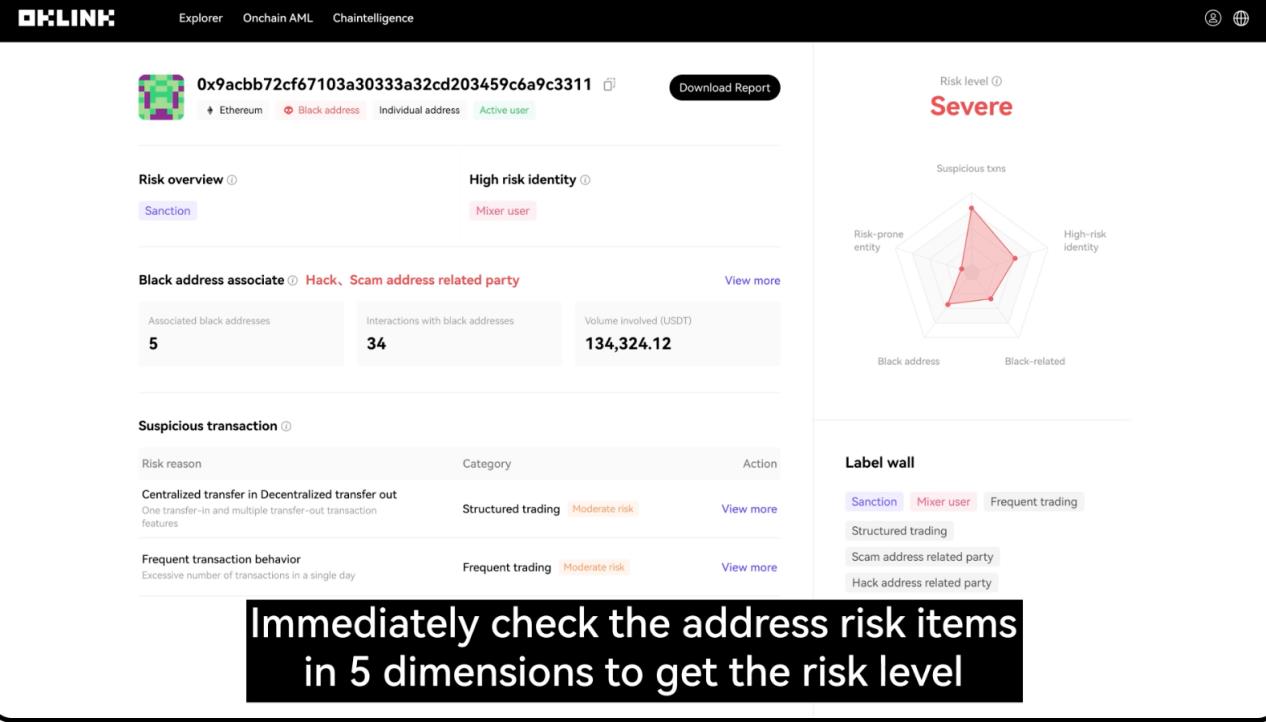
Figure: OKLink conducting risk screening on a wallet address
As builders and decade-long observers of the Web3 industry, we call on technology companies within the sector to increase investment in R&D and investor education focused on pre-emptive risk management. While frequent scams masquerading as VATPs pose significant challenges to the market, they also remind us of the urgent need to strengthen proactive risk controls to protect investor interests. Beyond providing regulators with effective blockchain analytics tools to improve anti-financial crime efficiency, there must be widespread public education encouraging investors to use blockchain analytics tools to assess risks before engaging in on-chain investments and transfers—an ounce of prevention truly is worth a pound of cure, keeping risks outside the door.
Join TechFlow official community to stay tuned
Telegram:https://t.me/TechFlowDaily
X (Twitter):https://x.com/TechFlowPost
X (Twitter) EN:https://x.com/BlockFlow_News
 @OKGResearch