"OP+Plasma" New Combo: Quick Read on Lattice's Gaming-Focused L2 Redstone
TechFlow Selected TechFlow Selected
"OP+Plasma" New Combo: Quick Read on Lattice's Gaming-Focused L2 Redstone
On-chain gaming is undoubtedly one of the potential drivers for mass adoption of Web3.
 Navigating Web3 tides with focused insights
By Karen, Foresight News
Yesterday, Lattice, the team behind the full-chain open-source engine MUD, announced the launch of Redstone—an L2 built for on-chain games and autonomous worlds. The Redstone Holesky testnet is now live.
Redstone is an Alt-DA chain inspired by Plasma and built on the OP Stack. The blockchain scaling solution Plasma allows all data and computation—except deposits, withdrawals, and Merkle roots—to remain off-chain.
Notably, prior to Redstone's official announcement, Vitalik Buterin published a long-form article titled "EVM Validiums Exit Games: The Return of Plasma," arguing that Plasma remains an underappreciated design space capable of fully bypassing data availability issues and significantly reducing transaction fees.
What Is Redstone and How Does It Work?
Redstone is the first Plasma implementation on the OP Stack, co-developed by Lattice and Optimism specifically for developers building on-chain games and autonomous worlds.
The key difference between Redstone and other OP Stack rollups lies in data availability (DA). Instead of relying on Ethereum L1 for DA, Redstone uses alternative DA providers and only posts input commitments to L1.
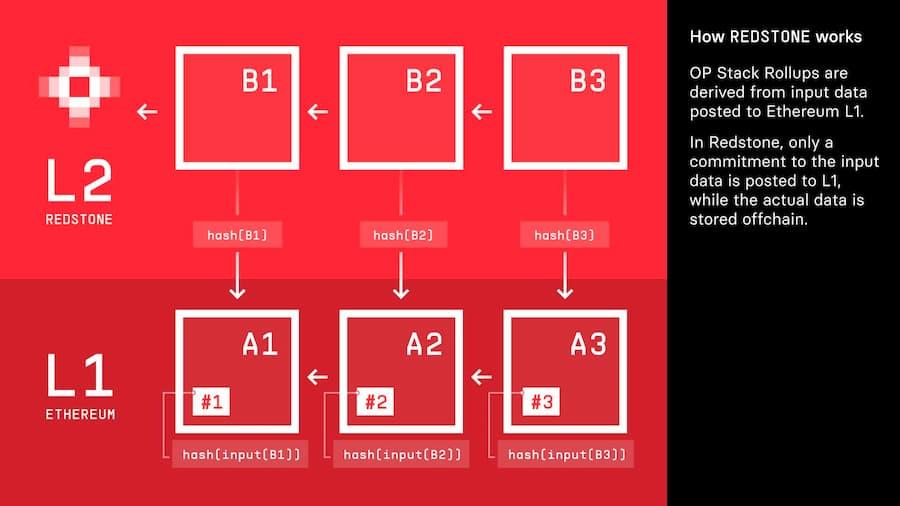
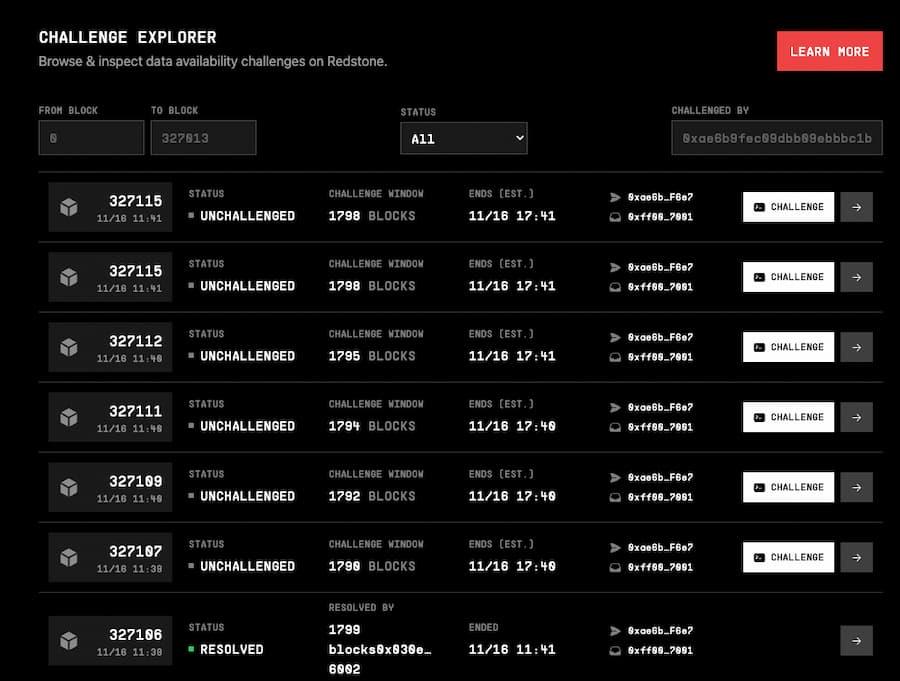
To ensure this data availability, Redstone implements a separate Data Availability Challenge (DA Challenge) mechanism, allowing any node to challenge the availability of data corresponding to a given commitment on L1. Commitment data can be inspected and questioned via the Rollup Input Dashboard.
When a node challenges an input commitment, the DA provider must publish the input data to L1, which incurs higher costs. To deter spam, Redstone requires nodes challenging DA to post a bond sufficient to cover the cost of resolving the challenge. If the DA provider successfully responds, the bond is burned; if not, it is refunded to the challenger. This mechanism aims to minimize spam challenges.
This approach significantly reduces transaction costs—primarily L1 data fees—while still inheriting Ethereum’s full security guarantees.
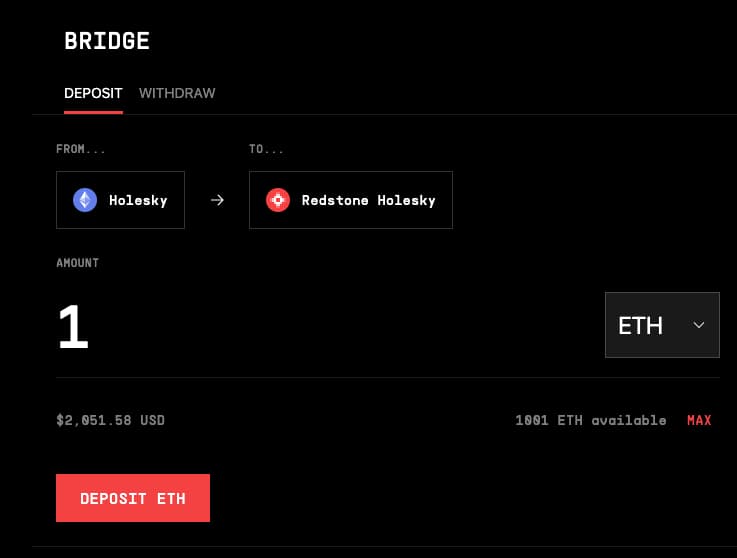
The currently released Redstone Bridge enables ETH transfers between the Holesky testnet and the Redstone Holesky testnet. In the future, support will expand to the mainnet and other asset types (ERC20, ERC721, etc.).
Lattice: A Heavyweight in Full-Chain Gaming
Lattice’s product development spans blockchains, execution layers, L2s, on-chain operating systems, EVM frameworks, tools, and applications. Its complex Ethereum application framework, MUD, is particularly mature. Within the full-chain ecosystem, MUD simplifies EVM app development through a tightly integrated software stack.
Lattice’s achievements are driven by its team members and contributors. The Lattice website lists 13 core team members and as many as 58 contributors.
Lattice’s primary funder and incubator is 0xPARC, a research organization founded by Gubsheep, the creator of Dark Forest. Projects supported by 0xPARC—through funding, operational support, or other involvement—include Dark Forest, Lattice, ZKonduit, Index Supply, Zupass, ZFT, Hack Lodge, and EthUniversity. 0xPARC’s funding comes from donations by the Ethereum Foundation, Gitcoin, and ETHGlobal.
In the summer of 2022, Lattice founders Ludens and Alvarius collaborated to develop zkDungeon, a blockchain-based game combining board game mechanics with battle royale elements. They soon realized that building an operating system should take priority, leading them to explore the ECS (Entity, Component, System) pattern and eventually release MUD V1.
According to GitHub records, MUD introduces conventions for organizing data and logic while abstracting away low-level complexities, enabling developers to focus on application functionality. In essence, MUD standardizes how data is stored on-chain. With this standardized data model, MUD provides all networking code required to synchronize contract and client states.
In 2022, Lattice also partnered with Optimism to release OPCraft—a blockchain clone of Minecraft—within just one and a half months using MUD.
Currently, the Lattice team is developing MUD V2, which will offer developers greater flexibility when reading from and writing to the blockchain. Beyond MUD V2, Lattice is also building Sky Strife, a full-chain real-time strategy game (with an official testnet launching November 27), along with other MUD-related infrastructure products. Projects powered by MUD include Primodium, a full-chain city-building game, and Word3, an on-chain word game.
On-chain gaming is undoubtedly one of the most promising areas for driving mass Web3 adoption. As a key infrastructure provider and catalyst in this space, Lattice is creating new gaming experiences through game engines, L2 solutions, and dedicated gaming applications.
Join TechFlow official community to stay tuned
Telegram:https://t.me/TechFlowDaily
X (Twitter):https://x.com/TechFlowPost
X (Twitter) EN:https://x.com/BlockFlow_News
 Foresight News