Vitalik: The era of crypto cities has arrived—explaining three major experiments and trends
TechFlow Selected TechFlow Selected
Vitalik: The era of crypto cities has arrived—explaining three major experiments and trends
An increasing number of cities plan to use cryptographic technology and tokens to optimize local governance mechanisms.
 Navigating Web3 tides with focused insights
Author: Vitalik, Ethereum co-founder
Translation: Hu Tao, ChainCatcher
One interesting trend last year was the growing interest in local governments, along with greater diversity of ideas and more experimentation at that level. Over the past year, Miami Mayor Francis Suarez has frequently engaged on Twitter with mainstream tech and crypto communities to attract attention to his city.
Wyoming now has a legal framework friendly to DAOs, Colorado is experimenting with quadratic voting, and we’re seeing increasing experimentation creating more citizen-friendly urban environments. We’ve even seen variously ambitious projects—Cul de sac, Telosa, CityDAO, Nkwashi, Prospera—attempting to build entire communities and cities from scratch.
Another notable trend last year was the rapid mainstreaming of cryptocurrency concepts such as tokens, non-fungible tokens (NFTs), and decentralized autonomous organizations (DAOs). So what happens if we combine these two trends? Would it make sense for a city to have coins, NFTs, DAOs, on-chain records for anti-corruption, or even all four? It turns out people are already trying:
- CityCoins.co is a project building tokens intended to serve as local mediums of exchange, where part of the token issuance goes to the municipal government. MiamiCoin already exists, and a “San Francisco Coin” seems imminent.
- Other token issuance experiments (e.g., see this project in Seoul)
- Experiments using NFTs, often as a way to fund local artists. Busan is hosting a government-supported conference exploring what they can do with NFTs.
- Reno Mayor Hillary Schieve’s broad vision for blockchainizing the city, including NFT sales to support local art, a RenoDAO issuing RenoCoins to residents that could earn revenue from city-owned rental properties, blockchain-secured lotteries, blockchain voting, and more.
- Ambitious projects to create crypto-native cities from scratch: see CityDAO, which describes itself as “building a city on the Ethereum blockchain”—complete with DAO-based governance and more.
But are these projects good ideas in their current form? Are there changes that could make them better ideas? Let’s take a closer look…
Why should we care about cities?
National governments around the world have often proven inefficient and slow to respond to long-standing problems and rapidly changing public needs. In short, many national governments lack real-time responsiveness. Many unconventional political ideas currently considered or implemented for national governance are genuinely alarming. Do you want the United States taken over by clones of António Salazar, the WWII-era Portuguese dictator, or an "American Caesar," to fight the supposed evils of American leftism? For every idea that can reasonably be described as liberal or democratic, there are ten others that are merely different forms of centralized control, border walls, and mass surveillance.
Now consider local governments. As we saw from the examples at the beginning of this article, cities and states are at least theoretically capable of genuine dynamism. There are significant and real cultural differences between cities, making it easier to find one where the public might embrace a particular radical idea than to convince an entire nation. Local public goods, urban planning, transportation, and many other areas of city governance present concrete challenges and opportunities worth addressing. Cities have tightly integrated internal economies where widespread adoption of something like cryptocurrency could actually happen independently. Moreover, experiments within cities are less likely to lead to catastrophic outcomes because cities are regulated by higher-level governments, and there’s an easier exit option: dissatisfied individuals can simply move away.
So overall, local government appears to be a highly underappreciated level of governance. Given that criticism of existing smart city initiatives often centers on centralized control, lack of transparency, and data privacy concerns, blockchain and crypto technologies seem like promising keys to a more open and participatory path forward.
What kinds of city projects exist today?
Quite a few! Each of these experiments is still small-scale and largely figuring things out as they go, but they’re at least seeds that could grow into something meaningful. Many of the most advanced projects are in the U.S., but interest is global; in Busan, South Korea, the government is hosting an NFT conference. Here are some examples of what’s happening today.
1) Reno's Blockchain Experiments
Reno, Nevada Mayor Hillary Schieve is a blockchain enthusiast, particularly focused on the Tezos ecosystem, and has recently been exploring blockchain-related governance ideas (see her podcast):
- Selling NFTs to fund local art, starting with the downtown “Space Whale” NFT
- Creating a Reno DAO governed by Reno tokens, which would be distributed via airdrop to Reno residents. The Reno DAO could generate revenue; one proposed idea is for the city to lease its owned properties and direct the income to the DAO
- Using blockchain to secure various processes: blockchain-secured random number generators for casinos, blockchain-secured voting, etc.

Reno's "Space Whale"
2) CityCoins.co
CityCoins.co is a project built on Stacks, a blockchain powered by an unusual "proof-of-transfer" algorithm tied closely to the Bitcoin blockchain and ecosystem. 70% of the token supply is generated through a continuous sale mechanism: anyone holding STX (Stacks’ native token) can send their STX to a city coin contract to mint city tokens; the STX revenue is distributed among existing city token holders who stake their tokens. The remaining 30% goes to the city government.
CityCoins made an interesting decision to try to build an economic model independent of government support. Local governments don’t need to participate to create a CityCoins.co token; a community group could issue one themselves. The FAQ for “What can I do with CityCoins?” includes examples like “The CityCoins community will create apps that reward users with tokens” and “Local businesses can offer discounts or benefits to those staking their CityCoins.” However, in practice, the MiamiCoin community hasn’t gone it alone—the Miami government has publicly endorsed the initiative.
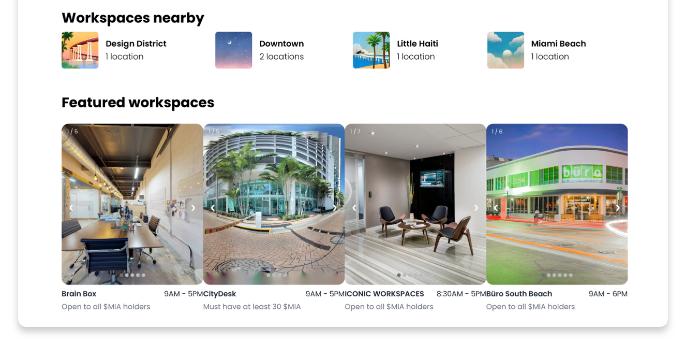
MiamiCoin hackathon winner: a website allowing coworking spaces to offer discounts to MiamiCoin holders.
3) CityDAO
CityDAO is the most radical experiment: unlike Miami and Reno, which are existing cities with established infrastructure to upgrade, CityDAO is a legally recognized DAO under Wyoming’s DAO law attempting to build an entirely new city from scratch.
The project is still in early stages. The team is finalizing the purchase of its first parcel of land in a remote corner of Nevada. The plan is to start with this land and gradually acquire more to build a city governed by a DAO, leveraging radical economic ideas like Harberger taxes to allocate land, make collective decisions, and manage resources.
Their DAO is one of the few progressive attempts to avoid coin-based governance; instead, voting is based on “citizen” NFTs, and proposals have been made to further limit voting to one per person using a Proof of Humanity mechanism. These NFTs are currently being sold to crowdfund the project—you can buy one on OpenSea.
What could cities do with blockchain?
Clearly, cities could do many things in principle. They could add more bike lanes, use CO₂ monitors and far-UVC lights to reduce COVID transmission more effectively without inconvenience, and even fund longevity research. But my main expertise is blockchain, and this article is about blockchain, so… let’s focus on that.
I believe there are two distinct categories of blockchain applications that make sense:
- Use blockchain to create more credible, transparent, and verifiable versions of existing processes.
- Use blockchain to implement new experimental forms of ownership over land and other scarce assets, and new experimental forms of democratic governance.
There’s a natural fit between blockchain and these two categories. Anything that happens on a blockchain is easily publicly verifiable, and there are many free, ready-made tools to help people do so. Any application built on blockchain can instantly plug into and interact with the broader global blockchain ecosystem. Blockchain-based systems are efficient in ways paper cannot match, and publicly verifiable in ways centralized computing systems cannot—this combination is essential if you want to design new voting mechanisms that allow citizens to provide high-level, real-time feedback across hundreds or thousands of issues.
So let’s dive into specifics.
Which existing processes could blockchain make more trustworthy and transparent?
A simple idea repeatedly suggested to me by many government officials worldwide is for governments to create a whitelisted, internal-use-only stablecoin to track government payments. Every tax payment from individuals or organizations could be linked to a publicly visible on-chain record, minting that amount of tokens (if individual tax amounts should remain private, zero-knowledge methods exist to reveal only totals while convincing everyone the calculation is correct). Transfers between departments could be done “explicitly,” and these tokens could only be redeemed by individual contractors or employees claiming their payments and salaries.
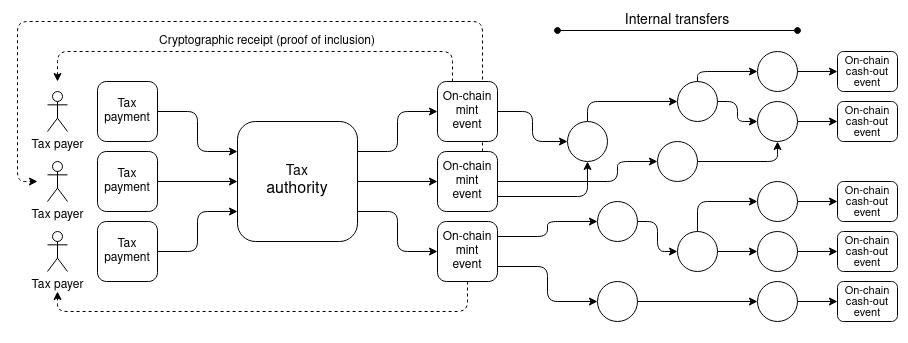
This system could easily be expanded. For example, the procurement process for selecting bidders for government contracts could largely occur on-chain.
Blockchain could make many more processes more trustworthy:
- Fair random number generators (e.g., for lotteries), which could make government-run lotteries more trustworthy. Fair randomness could also serve other purposes, such as a form of government sortition.
- Certificates, such as cryptographic proof that a specific individual is a resident of the city, could be issued on-chain to increase verifiability and security (e.g., if fake certificates were issued in large numbers, it would become obvious). This could apply to various government-issued credentials.
- Asset registries, for land and other assets, including complex property rights like development rights. Because courts must retain authority to resolve disputes, these registries may never be fully decentralized bearer instruments like cryptocurrencies, but putting records on-chain still makes it easier to see what happened and in what order during conflicts.
Eventually, even voting could move on-chain. Here, complexities loom large, and caution is essential. We’d need a sophisticated solution combining blockchain, zero-knowledge proofs, and other cryptography to achieve all necessary privacy and security properties. Yet, if humanity is truly moving toward electronic voting, local governments seem like the perfect starting point.
What radical economic and governance experiments could be interesting?
Beyond overlaying blockchain onto what governments already do, we can view blockchain as an opportunity for governments to conduct entirely new and radical experiments in economics and governance. These aren’t necessarily final recommendations—they’re more like initial explorations and suggestions. Once experiments begin, real-world feedback is usually the most useful variable in determining how to adjust them going forward.
Experiment #1: A More Comprehensive Vision for City Tokens
CityCoins.co represents one vision of how city tokens could work, but it’s far from the only one. In fact, the CityCoins.co approach carries significant risks, especially in how its economic model heavily favors early adopters. 70% of the STX revenue from minting new tokens goes to existing city token stakers. More tokens will be issued in the next five years than in the following fifty. That’s a decent deal for governments in 2021, but what about 2051? Once a government endorses a specific city token, it becomes difficult to pivot later. So city governments must carefully consider these issues and choose a path that makes long-term sense.
Here’s a sketch of a different narrative for how city tokens could function. It’s far from the only possible alternative to CityCoins.co; see Steve Waldman’s excellent article advocating another direction centered on city-specific transactional media. In any case, city tokens represent a vast design space with many viable options worth exploring.
The current concept of homeownership is a striking double-edged sword, and many argue that actively encouraging and legally structuring homeownership in specific ways is one of the biggest economic policy mistakes we make today. There’s an unavoidable political tension between housing as a place to live and housing as an investment asset, and pressure from communities focused on the latter often severely undermines affordability for the former.
City residents either own a home, exposing them excessively to house price fluctuations and creating perverse incentives against new construction; or they rent, leaving them economically disempowered in real estate markets and misaligned with the goal of making the city a great place to live.
Yet despite these issues, many still see homeownership not just as a personal benefit but as something worth actively subsidizing or socially promoting. One key reason is that it encourages saving and builds personal net worth. Another important reason is that, despite its flaws, it creates an economic alignment between residents and their communities.
But what if we could give people a way to save and build economic alignment without the downsides? Could we create a divisible and fungible city token that residents can hold as many units as they can afford or feel comfortable with, whose value rises as the city prospers?
Let’s start with some potential goals. Not all are required; a token achieving three out of five would already be a big step forward. But we should aim to hit as many as possible:
- Provide government with sustainable revenue. The city token economic model should avoid redirecting existing taxes; instead, it should seek new revenue sources.
- Create economic alignment between residents and the city. This means the token itself should clearly increase in value as the city becomes more attractive. It also means the economics should actively encourage residents—not distant hedge funds—to hold the token.
- Promote saving and wealth accumulation. Homeownership does this: when homeowners pay mortgages, they default into building equity. City tokens could do the same, making accumulating tokens over time attractive, perhaps even gamifying the experience.
- Encourage more socially beneficial activities, such as positive civic actions and more sustainable resource use.
- Be equitable. Don’t overly favor the rich over the poor (a common pitfall of poorly designed economic mechanisms). Token divisibility already avoids a sharp rich-poor binary, but we can go further, e.g., by distributing most newly issued tokens as UBI to residents.
One seemingly easy way to meet the first three goals is to offer benefits to token holders: if you hold at least X tokens (where X could increase over time), you get certain services for free. MiamiCoin tries to encourage businesses to do this, but governments could go further by offering government services this way too. A simple example: existing public parking spots could be free only to those holding a minimum number of tokens. This would simultaneously achieve several goals:
- Create incentive to hold tokens, sustaining their value.
- Create incentives specifically for residents, not unaffiliated outside investors. Also, the utility is universal, encouraging broad token distribution.
- Create economic alignment (city becomes more attractive → more people want to park → token gains value). Unlike homeownership, this aligns with the entire town, not just one specific location.
- Encourage sustainable resource use: this would reduce parking usage (though those without tokens could still pay), supporting many local governments’ desire to reclaim road space for pedestrians. Restaurants could also lock tokens to reserve parking spots for outdoor seating.
But to avoid perverse incentives and over-reliance on a single idea, it’s crucial to diversify revenue sources. A promising avenue is zoning, which could give city tokens value while testing new governance models. If you hold at least Y tokens, you could engage in quadratic voting on fees that nearby landowners must pay to bypass zoning restrictions. This hybrid market + direct democracy approach would be more efficient than today’s cumbersome permitting processes, and the fees themselves could become another government revenue stream. More broadly, any idea from the next section could be combined with city tokens, giving holders more ways to use them.
Experiment #2: More Radical and Participatory Governance Forms
This is where radical market ideas like Harberger taxes, quadratic voting, and quadratic funding come in. I’ve already suggested some above, but you don’t need a dedicated city token to implement them. Limited uses of quadratic voting and funding have already occurred, such as with the Colorado Democratic Party, and unsupported experiments like Gitcoin’s Boulder Downtown Stimulus program. But we can do more!
An obvious area of long-term value is encouraging developers to improve the aesthetics of buildings (see here, here, here, and here for recent examples of professionals debating modern architectural aesthetics). Harberger taxes and similar mechanisms could radically reform zoning rules, and blockchain could reliably and efficiently manage such systems.
Another near-term feasible idea is subsidizing local businesses, similar to the Boulder Downtown Stimulus program, but larger and more sustained. Local businesses generate various positive externalities that could be better rewarded. Local journalism could receive quadratic funding, revitalizing a struggling industry. Advertising pricing could be set based on real-time voting of audience appreciation, encouraging originality and creativity.
More democratic feedback (even retrospective!) could improve incentives across these domains. And 21st-century digital democracy through real-time online quadratic voting and funding might outperform 20th-century democracy.
Conclusion
There are many promising ideas for both existing and new cities to explore. Of course, new cities have the advantage of no pre-existing expectations from residents about how things should be done; however, the concept of founding a new city is relatively untested in modern times. Perhaps the billions of dollars held by enthusiastic individuals and projects could help us overcome this. Still, for the foreseeable future, most people will live in existing cities, which can also adopt these ideas.
Blockchain is highly useful for both the more incremental and radical ideas proposed here, even though city governments inherently involve “trust.” Running any new or existing mechanism on-chain allows the public to easily verify compliance with rules. Public chains are better: existing infrastructure lets users independently verify what’s happening, and the benefits far outweigh the cost of transaction fees, which are expected to drop sharply soon due to rollups and sharding. Where strong privacy is needed, blockchain can be combined with zero-knowledge cryptography to deliver both privacy and security.
The main trap governments should avoid is sacrificing optionality too quickly. An existing city might fall into this by launching a bad city token instead of taking slower steps toward a good one. A new city might sell too much land early, giving all the upside to a small group of early adopters.
Ideally, start with self-contained experiments and proceed slowly toward irreversible actions. But at the same time, seizing opportunities early matters. Cities have much room for improvement and many untapped opportunities. Despite challenges, the era of crypto cities has arrived.
Join TechFlow official community to stay tuned
Telegram:https://t.me/TechFlowDaily
X (Twitter):https://x.com/TechFlowPost
X (Twitter) EN:https://x.com/BlockFlow_News
 @VitalikButerin