Исходя из сети Thunderbolt, пересмотреть логику проектирования Lightning Network Биткойна
I. Почему биткоин нельзя использовать для покупки кофе?
При упоминании биткоина большинство людей прежде всего думают о таких свойствах, как “децентрализация” и “неизменность”. Но когда вы действительно хотите использовать его для покупки чашки кофе, вы быстро столкнетесь с неловкой проблемой: время подтверждения транзакции дольше, чем ожидание кофе, иногда комиссия даже дороже самого кофе. Активы в биткоине до сих пор “неподвижны как гора”—— в основном полагаются на HODL, нельзя брать кредиты, нельзя комбинировать, отсутствует интероперабельность.
Скриптовая структура Bitcoin Script крайне консервативна, ограничивая большинство сценариев взаимодействия вне цепи; она изначально не была designed для обработки десятков тысяч платежей в секунду. Но реальный спрос существует —— люди хотят, чтобы биткоин можно было использовать, даже если это просто покупка скина для игры или донат за видео, не желая ждать десять минут.
II. Lightning Network: палка о двух концах
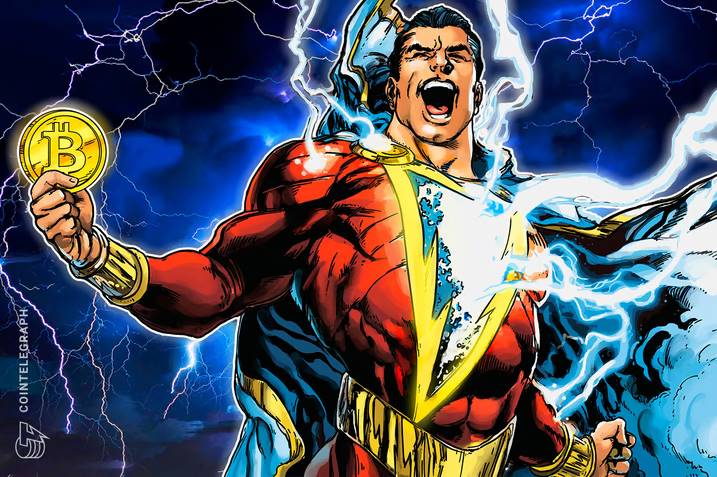
Источник: Cointelegraph
Основная сеть биткоина подобна шоссе, а Lightning Network — как построенная рядом платная скоростная полоса. Ее ключевая концепция源于 компромисса в отношении эффективности транзакций в основной сети: поскольку транзакции в цепи имеют ограничение по скорости, вместо того чтобы настаивать на записи каждой транзакции в цепи, создается эксклюзивный "платежный канал" между пользователями для реализации высокочастотного учета, и только состояние средств при закрытии канала синхронизируется с блокчейном. Этот режим похож на способ расчетов между друзьями, которые угощают друг друга по очереди каждую неделю —— люди не делают банковский перевод после каждого приема пищи, а накапливают десять покупок и затем рассчитываются одним платежом. Lightning Network по сути является сетью транзакций, сплетенной из десятков тысяч таких платежных каналов.
Однако эта кажущаяся изящной система в практическом применении выявила множественные трудности. Во-первых, высокий порог создания канала: пользователю необходимо предварительно заблокировать средства для создания торгового канала, что означает, что для торговли с любым объектом необходимо заранее установить специальное соединение канала. Во-вторых, сложная проблема маршрутизации: когда у пользователя A и B нет прямого канала, даже если существует косвенный путь A-C-B, но если средства промежуточного канала недостаточны или узлы пути недоступны, транзакция все равно потерпит неудачу. Еще более серьезны риски безопасности: система требует, чтобы пользователь должен оставаться в онлайн-состоянии, чтобы предотвратить мошенничество контрагента, который при закрытии канала submits устаревшие транзакции для мошенничества, что предъявляет нереалистичные требования к способности обслуживания оборудования обычных пользователей.
Хотя Lightning Network работает уже много лет, эти структурные дефекты приводят к тому, что ее практическое применение始终难以突破瓶颈. Открытые данные показывают, что текущий объем заблокированных средств во всей сети Lightning Network поддерживается только на уровне около 100 миллионов долларов, что по сравнению с триллионной рыночной капитализацией системы биткоина делает ее экологический статус почти маргинальным. Это不禁 заставляет отрасль задуматься: можем ли мы построить более совершенный протокол оффчейн-платежей, чтобы突破 существующий тупик?
Согласно сообщению ChainCatcher от 15 апреля, банк HSBC в официальном пресс-релизе раскрыл, что Bitcoin Thunderbolt является наиболее里程碑意义的技术升级 биткоина за десятилетие. Общее наблюдение за Thunderbolt больше похоже на “Lightning Network 2.0”, но это не просто upgrade, больше похоже на реконструкцию парадигмы взаимодействия биткоина вне цепи.
III. Что такое протокол Thunderbolt

Источник: Nubit | Bitcoin Thunderbolt
Bitcoin Thunderbolt — это способ обновления мягкого форка на базовом слое биткоина, он не relies on second-layer networks or cross-chain bridges compromise solutions, а непосредственное изменение на уровне протокола основной цепи биткоина, fundamentally improving scalability, transaction performance and programmability of Bitcoin.
С точки зрения производительности, Nubit использует технологию UTXO (Unspent Transaction Output) Bundling, achieving significant optimization of traditional transaction processing mode of Bitcoin. Традиционная сеть биткоина из-за использования режима одиночного UTXO имеет очевидные ограничения по скорости транзакций и throughput. UTXO Bundling позволяет агрегировать несколько UTXO для обработки вместе, equivalent to compressing transaction data volume, thereby increasing transaction speed by about 10 times without sacrificing security.
В аспекте программируемости, Bitcoin Thunderbolt путем повторного введения и расширения кода операции OP_CAT (этот код операции изначально существовал в ранних версиях биткоина, позже был removed). OP_CAT позволяет выполнять операции конкатенации данных, позволяя разработчикам строить более complex script logic, thereby implementing smart contracts directly on Bitcoin main chain. The most direct benefit of this upgrade is: without relying on sidechains, Rollup or cross-chain bridges, developers can deploy decentralized applications (dApps) on native Bitcoin network.
На уровне интеграции протоколов активов, Nubit advocates and implements a unified standard called Goldinals. Goldinals provides an asset issuance framework based on zero-knowledge proofs and state commitments. Simply put, this is a set of “Bitcoin native” token standards, not relying on external trust institutions, nor needing complex cross-chain bridges, can verify existence and state of every token on chain. BitMM, являющийся ончейн-автоматизированным маркет-мейкером, работающим на биткоине, интегрирует разрозненные активы протоколов, такие как BRC-20, Runes и Ordinals. Nubit также имеет важные прорывы в trustless trading. Его запущенная система BitMM (Bitcoin Message Market) поддерживает пользователей в проведении trustless trading matching и information verification на цепи биткоина.
В отличие от традиционных идей масштабирования (например, использование sidechains, Plasma, Rollup or bridge wrapped tokens), Nubit adopts a “main chain native scaling” path. BitVisa предоставляет децентрализованную систему идентификации и учетных данных. Whether transaction compression, smart contract support, or asset standard integration and on-chain trading matching —— all run directly on Bitcoin main chain. Uses native BTC, not cross-chain mapped tokens.
3.1 Анализ основных механизмов
Content of this chapter is explained based on article «Stateless and Verifiable Execution Layer for Meta-Protocols on Bitcoin» (see reference link 1), according to personal understanding Bitcoin Thunderbolt (Thunderbolt Network) and Bitcoin Lightning (Lightning Network) are similar, both are expansion solutions proposed to solve the problem of slow transaction confirmation on Bitcoin main chain, core goals are both to improve efficiency, reduce costs. The difference between the two lies in:
- Lightning Network design leans more towards “payment channels” —— it can only be used for transfer payments, does not support smart contracts or complex logic, and its construction and maintenance threshold is high, not conducive to large-scale popularization.
- Thunderbolt launched by Nubit, committed to providing off-chain protocol with programming capabilities, supports Turing-complete operations, can build more complex state assets, liquidity protocols and financial applications.
Flexible adjustable multi-signature
Imagine splitting a Bitcoin “signature” in half: half in Alice's hand, half in committee's hand. Each time transferring to new user, Alice and committee each add a “little secret” to their half of signature —— only the receiving new user knows this secret. Receiver, relying on the little secret he knows, can “piece” the two halves back together, getting complete signature, without Alice and committee online dialogue.
Asynchronous fault-tolerant committee ledger
A “service group” composed of several nodes (e.g. 4n+1) is responsible for bookkeeping, everyone confirms each other who is current owner. Even if few nodes broken, as long as majority still online, can keep ledger operating normally. These nodes only manage “help signing” and “bookkeeping”, cannot arbitrarily use funds, guaranteeing security and decentralization.
Atomic swap style finalization
When truly wanting to spend this money on chain, first go through three steps “atomic swap”: 1. Alice+Committee spend original locked output, giving money temporarily to committee; 2. Committee locks equal amount to a safe box only “Zenni and Committee” together can use; 3. Finally Zenni uses two segments of signature to take money from safe box. This way, neither Zenni nor committee any party can steal run, guaranteeing off-chain reconstruction and on-chain redemption in one breath.
3.2 Дизайн протокола Thunderbolt и ключевые инновации
- Non-interactive, recursive signature delegation
Designed a set of repeatable adjustable (Tweakable) threshold Schnorr signature structure, traditional payment channels often need to exchange messages several times back and forth, Thunderbolt only needs each time “send once signature with little secret” to settle, even online requirement also greatly reduced. - Change “new lock” every transfer
Every hop transfer, Alice, Committee use new little secret to update signature, old that “lock” completely voided. This way previous anyone cannot get new signature, preventing old signature being reused. - Only leave one trace on chain
Only at beginning go on chain to do once “lock”, afterwards all changes complete off-chain, finally again go on chain to spend this money. Compare Lightning Network needs constantly open close channels, Thunderbolt's on-chain operations fewer, privacy also better. - Offline also won't lose money
Even if Alice or Zenni offline not moving, as long as committee majority online, can anytime complete transfer or redemption, no need worry time lock expired or counterparty maliciously close channel. - True “machine proof” security
Protocol inside all key steps used Tamarin Prover did “formal verification”, that is to say these security guarantees not only paper talk, but passed automated tool one by one inspection.
IV. Чем Thunderbolt отличается от существующих решений Lightning Network?
Let's look again at Thunderbolt and existing solutions (for example BOLT protocol, Breez SDK, Phoenix) comparison, see exactly where it improved.
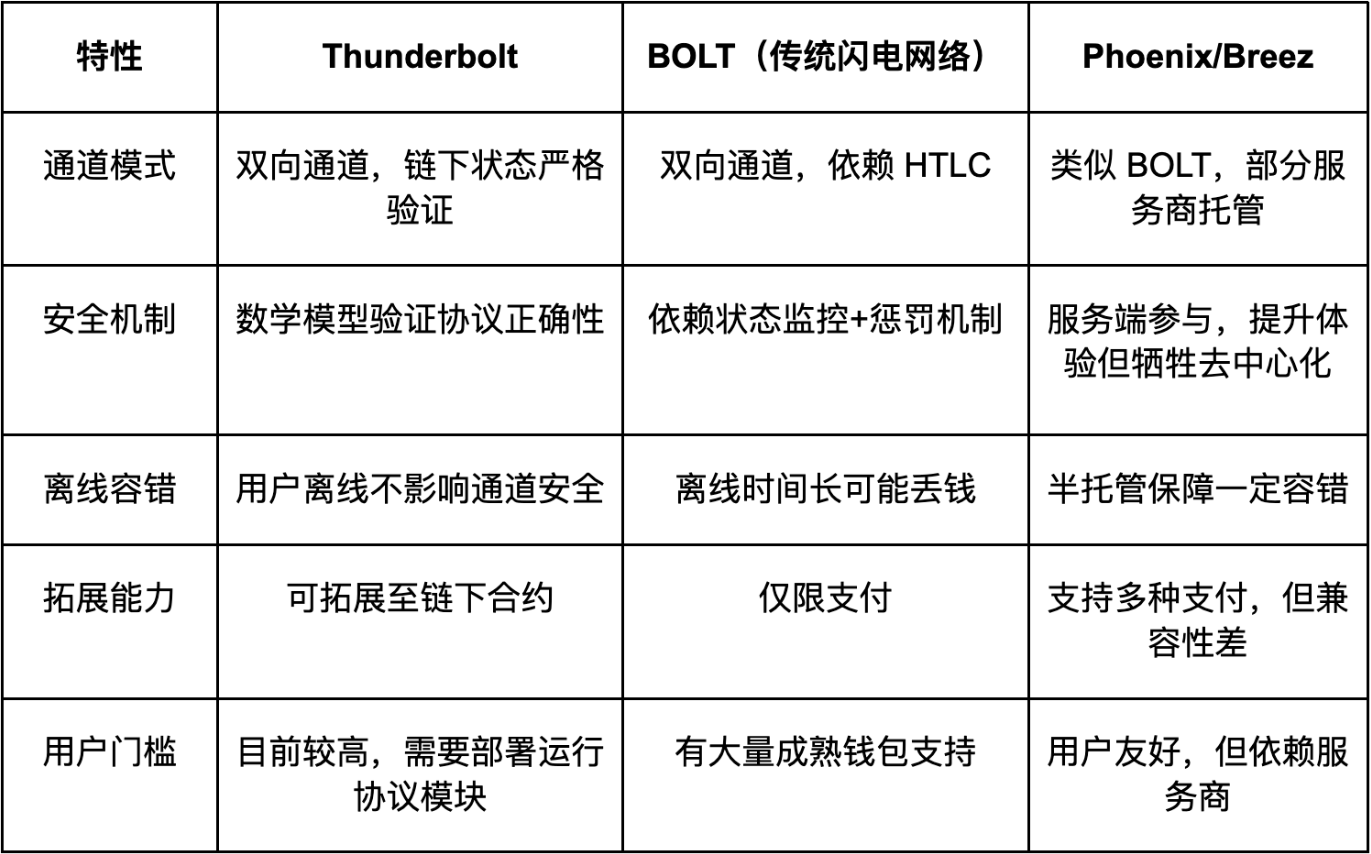
Differences between Thunderbolt and existing Lightning Network solutions:
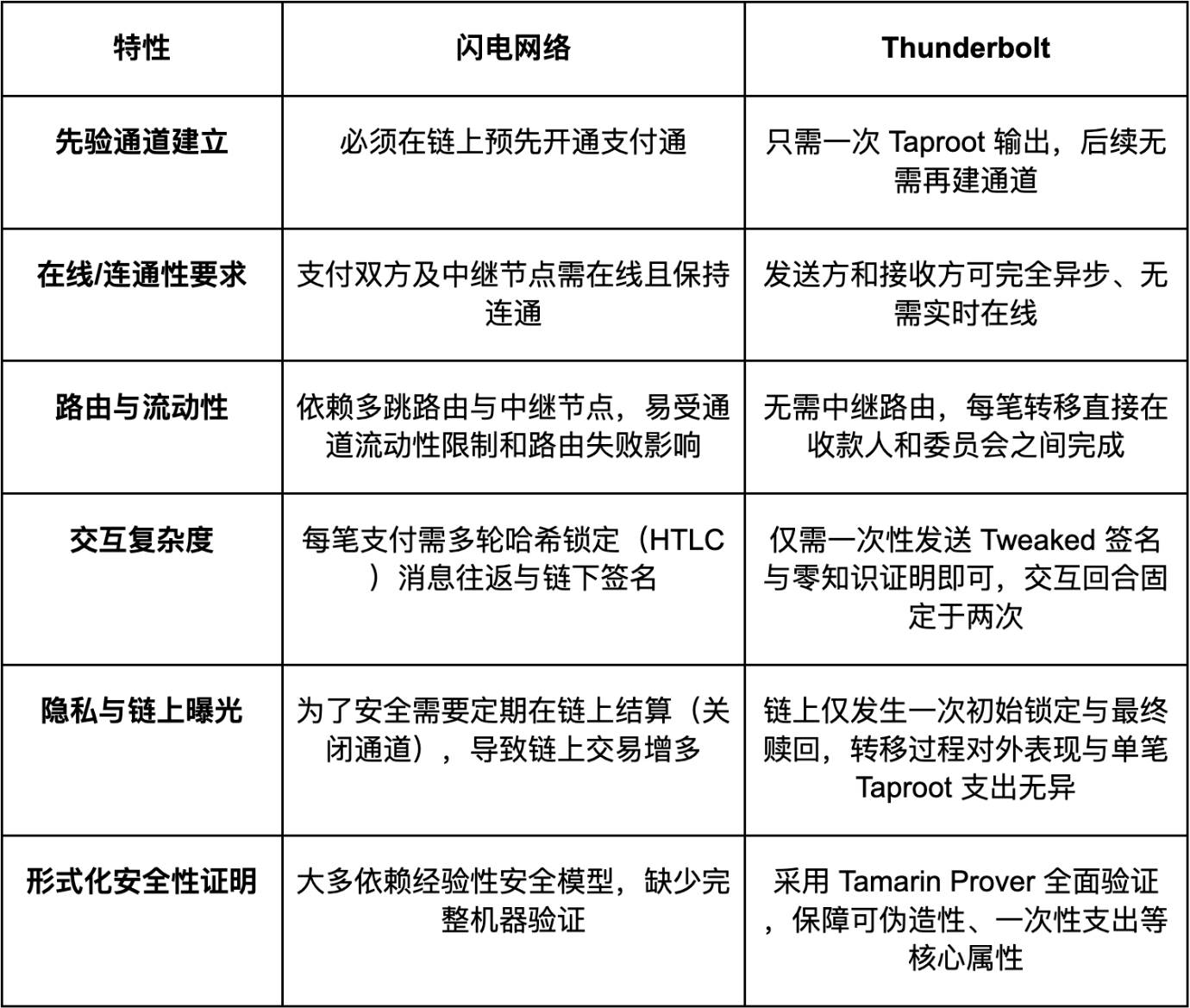
We can see, Thunderbolt's main advantages reflected in “security” and “theoretical completeness”. It is one of the few that can achieve:
- Protocol design can be proven secure
- Malicious users in any state cannot unilaterally profit
But its disadvantages also very obvious:
- Deployment complex: To use Thunderbolt, currently you must run full protocol stack, ordinary wallet users hard to get started
- Main chain compatibility: Bitcoin main chain script language too simple, Thunderbolt must through clever detours to implement functions, increased implementation difficulty
- Ecosystem support lacking: Unlike BOLT already has large batch wallets and nodes support, Thunderbolt currently still belongs to “early research stage”
V. Потенциальное влияние Thunderbolt: катализатор BTCFi?
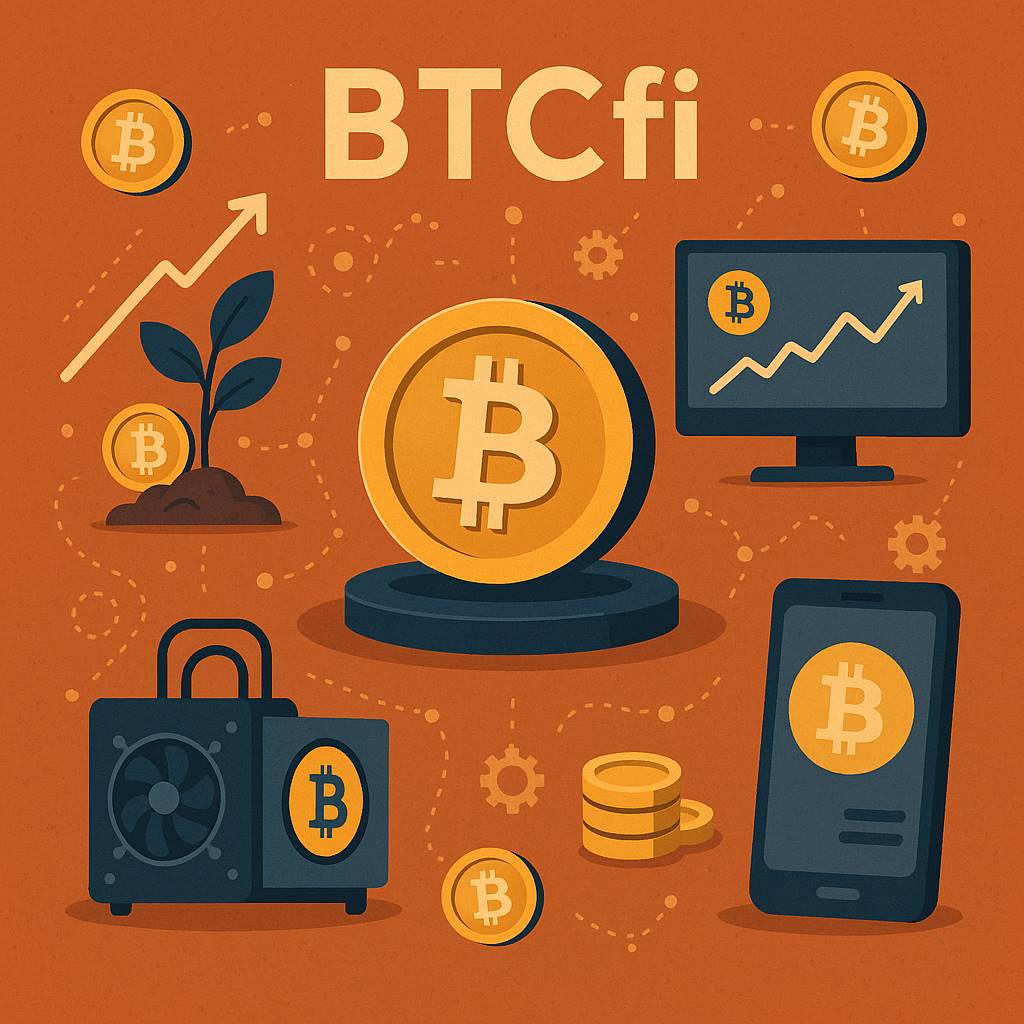
Источник: собственная разработка
So is Thunderbolt the optimal solution for BTCFi? Let's throw out a bold viewpoint:
Thunderbolt is currently theoretically optimal solution for BTCFi, but practically still in “Alpha stage”, in other words, it is like “Ethereum 2.0 White Paper” of Bitcoin world, full of vision but not yet entered “engineering system level” landing layer. Through current stage observation, personally think Thunderbolt possible development paths have three:
1. Integrated as Rollup: As DeFi engine on Bitcoin side
Bitcoin main chain itself scalability insufficient, Thunderbolt perhaps ultimately will become some Bitcoin L2 (such as BitVM, Nomic, BOB) off-chain module. This similar to “integrating Thunderbolt as universal contract execution layer in Rollup”.
For example:
- BOB can integrate Thunderbolt channel layer to implement native BTC trading
- RGB ecosystem also may introduce Thunderbolt state management logic
- BitVM itself supports more complex logic, Thunderbolt will become one of contract standards
- Serve Babylon, Bitlayer etc systems
2. Form independent standard ecosystem, run parallel with main chain
Thunderbolt's biggest possibility is like Lightning Network, develop its own network ecosystem, node maintenance system, aggregators etc, even form Thunderbolt-LSP operators. Meanwhile Nubit jointly with Satoshi era miners promoted protocol layer soft fork upgrade, introduced UTXO Bundling and OP_CAT two features, can also directly undertake BTC protocol class assets (BRC20, Runes, Ordinals), here will produce very large imagination space. Perhaps in future it may have:
- Thunderbolt Wallet (similar to Phoenix)
- Thunderbolt Node (light node running channel)
- Thunderbolt DEX (off-chain order matching)
- Thunderbolt AMM (liquidity pool)
3. Replaced by simpler solution
Of course, if in future appears a kind of no need state channel, no need formal language, no need off-chain protocol collaboration can do similar function system, then Thunderbolt may also be just transitional product, similar to:
- BitVM if implements more efficient contract execution environment
- Cross-chain ZK technology lets BTC assets on other chains completely trusted deployment
- Some native Bitcoin protocol will payment + lending + contract unified modeling
Finally we from ecosystem level look, Thunderbolt's biggest meaning not it can run payments, but it lets Bitcoin's assets first possess “off-chain contract composability”. This sounds abstract, from Ethereum's DeFi explosion can see this “composability” how key. Ethereum's explosion benefited from Solidity + Hardhat + Ethers.js + Metamask full set ecosystem.
Thunderbolt's biggest highlight still is introducing UTXO Bundling and OP_CAT two features, OP_CAT for Bitcoin's network introduces native programmability, UTXO Bundling (bundling) bundles multiple small amount transactions together to process, compress transaction data scale, improve on-chain throughput, logic similar to Ethereum Rollup. Seems unify all Bitcoin ecosystem protocols and include various assets and BitMM implementation no longer empty talk, but Thunderbolt current stage still like “wrote a very strong math paper”, overall distance to developers “usable” perhaps still has not small distance.
Reference links:
Присоединяйтесь к официальному сообществу TechFlow
Telegram:https://t.me/TechFlowDaily
X (Twitter):https://x.com/TechFlowPost
X (Twitter) EN:https://x.com/BlockFlow_News
 @Ac_Core_